


SACRED SPACES:
ISLAMIC ART and ARCHITECTURE
(Mecca and the Dome of the Rock)


Study with the several resources on Docsity

Earn points by helping other students or get them with a premium plan

Prepare for your exams
Study with the several resources on Docsity
Earn points to download
Earn points by helping other students or get them with a premium plan
1 / 32

This page cannot be seen from the preview
Don't miss anything!
Mosque - Wikipedia, the free encyclopedia
Dome of the Rock - Wikipedia, the free encyclopedia
Mecca - Wikipedia, the free encyclopedia
Kaaba - Wikipedia, the free encyclopedia
Minaret - Wikipedia, the free encyclopedia
Mihrab - Wikipedia, the free encyclopedia
Minbar - Wikipedia, the free encyclopedia
Adhan - Wikipedia, the free encyclopedia
Muezzin - Wikipedia, the free encyclopedia
Isra and Mi'raj - Wikipedia, the free encyclopedia
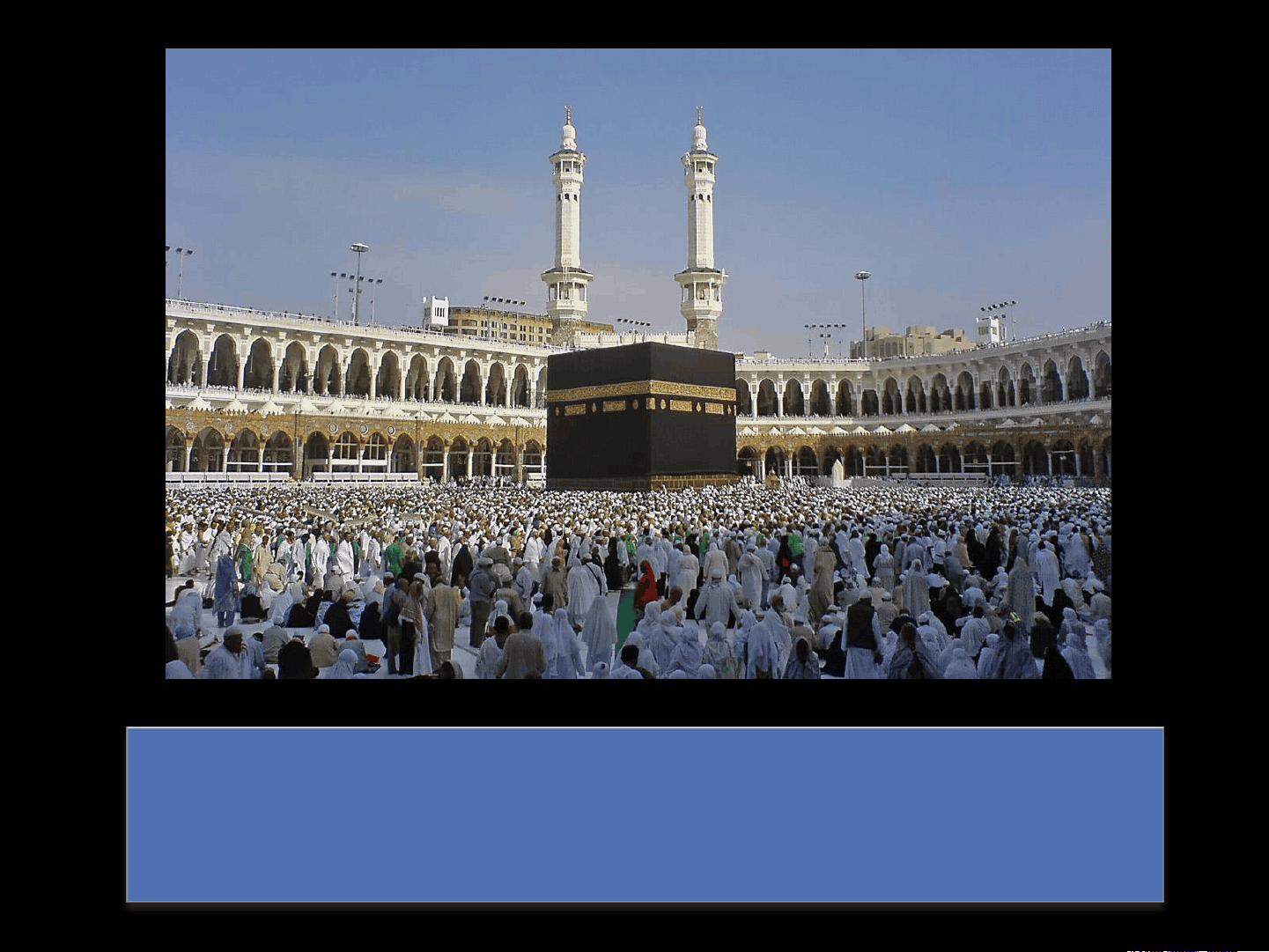
According to tradition, this cube-shaped building, draped in black cloth embroidered with a band of sacred verses in gold and silver thread, was originally built as a replica of a heavenly prototype. It was sacred to the Meccans before the time of the Prophet. And since the birth of Islam in the seventh century, it has been the focal point of the hajj, now the world’s largest annual pilgrimage. One of the “five pillars” of Islam, the hajj lasts several days, during which pilgrims must carry out certain rituals in Mecca and at sacred sites nearby.
Muslims consider the city and an area several miles around it to be haram (“restricted,” “sacred”) and off-limits to non-Muslims. Thus the number of westerners who have risked their lives to make the hajj has been few.
Two notable adventurers who did were the Swiss Johann Burckhardt, in 1814, and the Briton Sir Richard Burton, in
Circumambulating the Kaaba represents the idea of oneness. Its meaning regarding the social life is not to leave unity and to try to maintain this unity. Its meaning regarding individual life contains deep truths. The sky has seven layers; man has seven souls. Each turning around the Kaaba represents a phase, a stage; man covers a phase and is elevated up to the seventh sky, above the material realm.
Besides, it means to rise from the lowest step of the soul, which has seven steps, to the highest one. That is, from nafs al-ammarah (soul commanding the evil) to nafs al-mutmainnah (tranquil self); from the animal life to the spiritual life. Circumambulating the Kaaba is a kind of worshipping taken from the order of the universe. The planets rotate around the sun, the electrons around the nucleus, the moth around the candle; rotating around such a center means allegiance with love.
The origins of the Ka’aba are variously explained. According to Muslim tradition, it was built by Abraham and his son Ishmael as a physical reminder of the links between Islam and Judaism. It is stated in the Koran that this was the first house built for humanity to worship Allah. In her book, Islam: A Short History , Karen Armstrong asserts that the Kaaba was at some point dedicated to Hubal, a Nabatean deity, and contained 360 idols that probably represented the days of the year.
By the time of Muhammad, the Ka'aba had been taken over by pagan Arabs to house their numerous tribal gods. In 630 C.E., Muhammad and his followers took over leadership of Mecca after years of persecution. Muhammad destroyed the idols inside the Ka'aba and re-dedicated it as a house of monotheistic worship.
This Sunday, Dec. 31, 2006 file photo, shows an aerial view of one of three huge stone pillars as Muslim pilgrims are seen casting stones at it in the symbolic stoning of the devil for the second day in Mina, near Mecca, Saudi Arabia. As Muslims from around the world stream into Mecca for the annual hajj pilgrimage this week, they come to a city undergoing the biggest transformation in its history.
In this Wednesday, Oct. 16, 2013 file photo, shows the tallest clock tower in the world with the world's largest clock face at the Abraj Al-Bait Towers overlooks the Grand Mosque and its expansion in Mecca, Saudi Arabia. As Muslims from around the world stream into Mecca for the annual hajj pilgrimage this week, they come to a city undergoing the biggest transformation in its history.
In this photo taken May 11, 2014, Essam Kalthoum, left, managing director of the Bawabat Makkah Company, which oversees several projects around the city, shows at his office in Jiddah, Saudi Arabia, a prototype of what the heart of Mecca will look like after construction around the Grand Mosque is complete. As Muslims from around the world stream into Mecca for the annual hajj pilgrimage this week, they come to a city undergoing the biggest transformation in its history.
Although mosques around the world reflect local architectural traditions, most share certain basic features. These are a sahn, or enclosed courtyard (less common in later centuries), and a qibla, or prayer wall, oriented toward Mecca.
The qibla frequently has a mihrab (small niche) set into it. Jami mosques also contain a minbar , a pulpit from which an imam (religious teacher) leads the faithful.
