Download Sample Project: River Crossing | MATH 360 and more Study Guides, Projects, Research Mathematics in PDF only on Docsity!
Math 360 Sample Project:
River Crossing
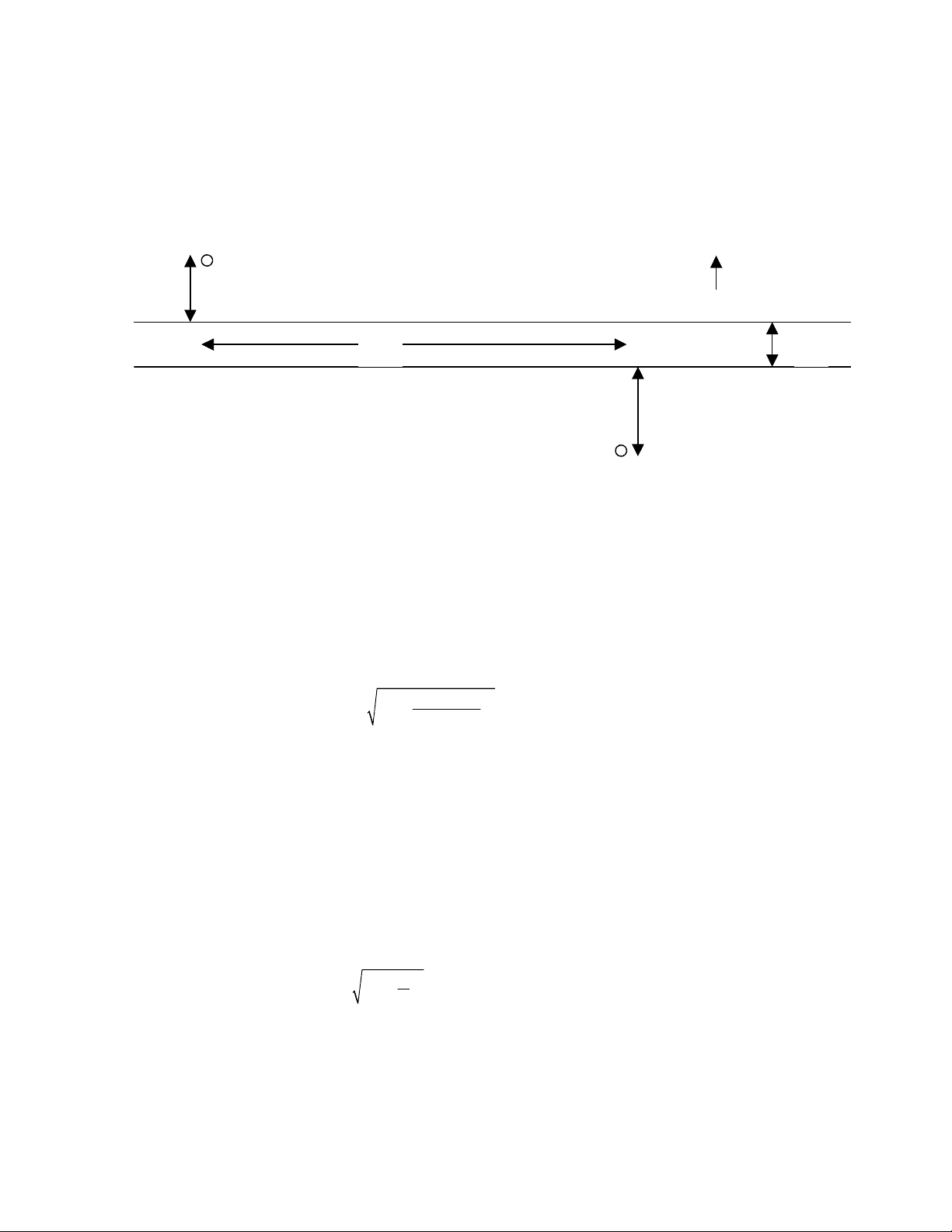
Project: Consider a straight portion of a river of width w as depicted in the map. The project is to determine the most cost-effective configuration of a buried cable connecting a location north of the river to a location south of the river. Suppose the cost of laying cable per unit length is given by a positive constant cL on land, and by a positive constant cR crossing the river. Problem 1: Show that the cost C 1 of connecting the two locations using a single straight line-segment is given by
2 1 L R^1 C c a b c w c = + + + (^) a + w + b.
Problem 2: Argue why it is reasonable to assume that cR > cL and suspect that it is more cost-effective to cross the river more directly than as given by the single straight line-segment. To analyze this possibility introduce a number g corresponding to the east-west difference between the entry and the exit points at the river. Assume the crossing is from north to south, so g is positive if the exit point is east of the entry point. With this convention it is clear that g > c yields a more expensive path than g = c, because both the land and the river portions are longer. Similarly it is also clear that g < 0 yields a more expensive path than g = 0. Show that the cost C 2 of connecting the two locations when g = c is given by
2 2 L R^1 C c a b c w c = + + + (^) w.
Problem 3: The case g = 0 is not unique since the crossing can take place at an infinite number of places. Let x represent the location of the crossing. It must be that 0 ≤ x ≤ cwhere x = 0 corresponds to the crossing farthest to the west and x = c to the crossing farthest to the east. The cost
a
w
b
c
N
C 3 (^ x ) of connecting the two locations, when g = 0 and the crossing takes place at x , is given by
C 3 (^ x )^ = cL ( a 2 + x 2 + b^2 + (^ c − x )^2 )+ c wR.
Since C 3 (^ x ) is a continuous function and x ∈ [^ 0,c], there is a minimum. Check the endpoints and show that ( ) (^ ) ( ) (^ ) ( ) (^ )
3 3 3 3 3 3
a b C C c a b C C c a b C C c
Compute the derivative C 3 ′ (^ x)and show that it is zero only at the unique
x ac = (^) a + b.
Evaluate the derivative at the two endpoints and deduce that x in fact gives the minimum of C 3 (^ x ). Show that the least cost C 3 , when g = 0 , is given by
( ) ( ) (^) ( )
2 3 3 L 1 R C C x c a b c c w = = + + (^) a + b +.
Problem 4: Show that in some cases C 3 < C 2 , and in others C 3 > C 2. Problem 5: For a fixed g let 0 ≤ x ≤ c − g be the distance moved to the east before reaching the river. Let C 5 (^ x )be the cost so that
C 5 (^ x )^ = cL (^) ( x 2 + a 2 + b^2 + (^ c − g − x )^2 )+ cR w^2 + g^2.
Show that the minimum of C 5 (^ x )restricted to [ 0,c − g]is attained at
x = (^) a a + b ( c −g).
Hence, for a fixed g the minimal cost is given by
Cmin ( g ) = C 5 ( (^) a a+ b( c − g )) = cL ( a + b ) 2 + ( c − g )^2 + cR w^2 +g^2.
Problem 6: Assume g ∈ [^ 0,c]is a given fixed number. Compare the costs of the two dashed paths in the picture.
The cost of the broken path is given by C 6 ( )x = cR x 2 + w 2 + cL ( g − x).
g
x
Problem 8: Show that for the most cost effective solution α = β , and sin sin
R L
c c
α ω =^. In the context of light refraction in physics this relationship is known as Snell’s law. Describe, in the form of a short rule useful to the cable crew, how to quickly find the optimal configuration.
α
β
ω
x
g