
Dijkstra's Algorithm for Shortest Path Problems, Study notes of Data Structures and Algorithms

The concept of shortest path problems in the context of directed weighted graphs. It covers different types of shortest path problems such as single source single destination and single source all destinations. The document also introduces a greedy algorithm, known as dijkstra's algorithm, for finding the shortest path from a single source to all destinations in a graph.

Typology: Study notes

Pre 2010

Uploaded on 09/17/2009

koofers-user-uki
koofers-user-uki 🇺🇸

10 documents

1 / 4

Toggle sidebar

This page cannot be seen from the preview

Don't miss anything!

bg1
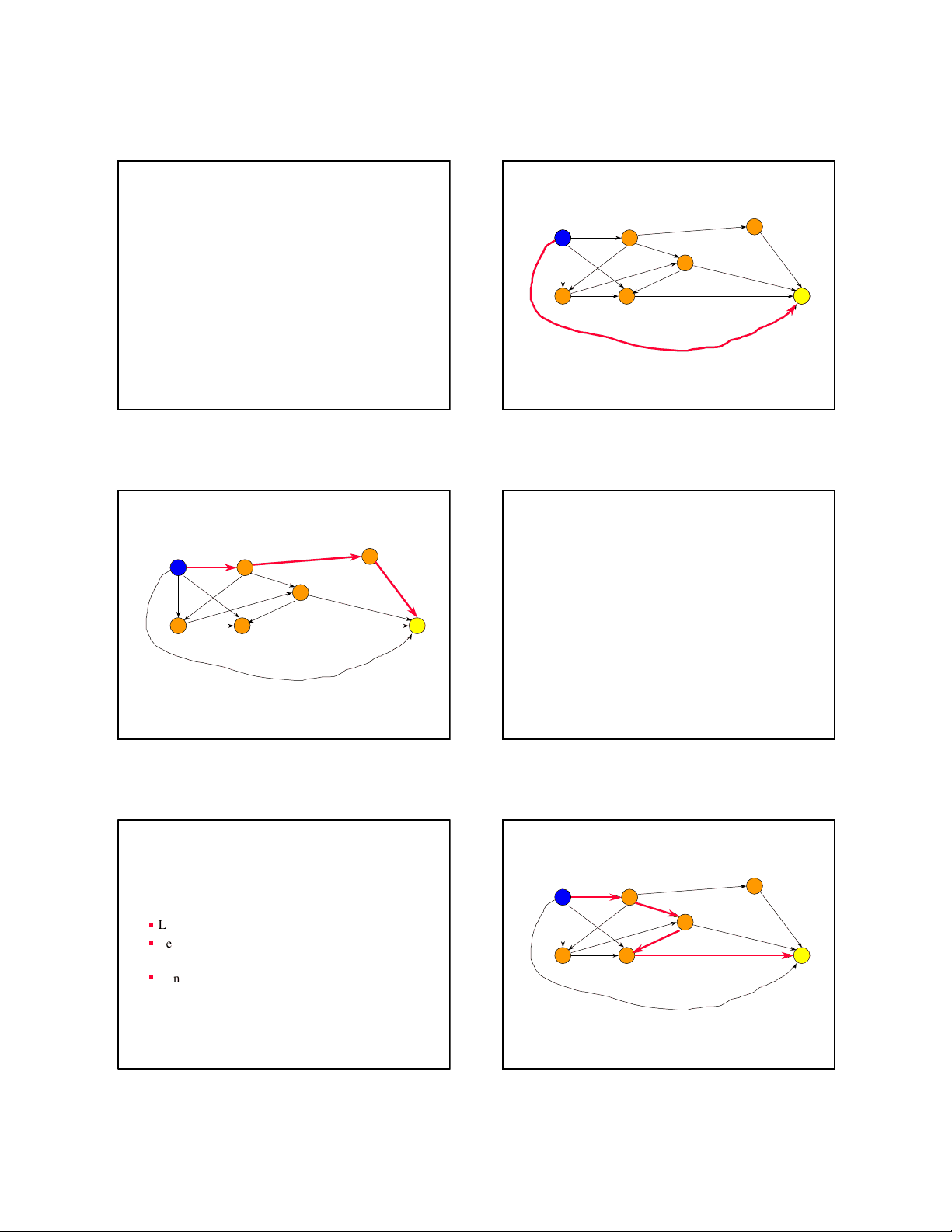
Shortest Path Problems
Directed weighted graph.
Path length is sum of weights of edges on path.
The vertex at which the path begins is the
source vertex.
The vertex at which the path ends is the
destination vertex.
Example
A path from 1to 7.
1
2
3
4
5
6
7
2
616 7
8
10
3
14
44
5 3
1
1
7
Path length is 14.
Example
Another path from 1to 7.
1
2
3
4
5
6
7
2
616 7
8
10
3
14
44
5 3
1
Path length is 11.
Shortest Path Problems
Single source single destination.
Single source all destinations.
All pairs (every vertex is a source
and destination).
Single Source Single Destination
Possible greedy algorithm:
Leave source vertex using cheapest/shortest edge.
Leave new vertex using cheapest edge subject to the
constraint that a new vertex is reached.
Continue until destination is reached.
Greedy Shortest 1 To 7 Path
1
2
3
4
5
6
7
2
616 7
8
10
3
14
44
5 3
1
Path length is 12.
Not shortest path. Algorithm doesn’t work!
pf3
pf4

Partial preview of the text

Download Dijkstra's Algorithm for Shortest Path Problems and more Study notes Data Structures and Algorithms in PDF only on Docsity!

Shortest Path Problems

  • Directed weighted graph.
  • Path length is sum of weights of edges on path.
  • The vertex at which the path begins is the

source vertex.

  • The vertex at which the path ends is the

destination vertex.

Example

A path from 1 to 7.

1

2

3

4

5

6

7

1

7

Path length is 14.

Example

Another path from 1 to 7.

1

2

3

4

5

6

7

Path length is 11.

Shortest Path Problems

  • Single source single destination.
  • Single source all destinations.
  • All pairs (every vertex is a source

and destination).

Single Source Single Destination

Possible greedy algorithm:

ƒ Leave source vertex using cheapest/shortest edge. ƒ Leave new vertex using cheapest edge subject to the constraint that a new vertex is reached. ƒ Continue until destination is reached.

Greedy Shortest 1 To 7 Path

1

2

3

4

5

6

7

Path length is 12.

Not shortest path. Algorithm doesn’t work!

Single Source All Destinations

Need to generate up to n (n is number of vertices)

paths (including path from source to itself).

Greedy method:

ƒ Construct these up to n paths in order of increasing length. ƒ Assume edge costs (lengths) are >= 0. ƒ So, no path has length < 0. ƒ First shortest path is from the source vertex to itself. The length of this path is 0.

Greedy Single Source All Destinations

1

2

3

4

5

6

7

Path (^) Length (^1 ) 1 3 2 1 3 5 5

Greedy Single Source All Destinations

Path Length (^1 )

1 3 2 (^1 3 )

1 2 6

1 3 5 4 9

1 3 6 10

1 3 6 7 11

  • •^ Each path (other than first) is a one edge extension of a previous path.
  • Next shortest path is the shortest one edge extension of an already generated shortest path.

Greedy Single Source All Destinations

  • Let d(i) (distanceFromSource(i)) be the length of

a shortest one edge extension of an already

generated shortest path, the one edge extension

ends at vertex i.

  • The next shortest path is to an as yet unreached

vertex for which the d() value is least.

  • Let p(i) (predecessor(i)) be the vertex just before

vertex i on the shortest one edge extension to i.

Greedy Single Source All Destinations

1

2

3

4

5

6

7

[1] [2] [3] [4] [5] [6] [7]

d p

1

2

3

4 7

Greedy Single Source All Destinations

1

2

3

4

5

6

7

[1] [2] [3] [4] [5] [6] [7]

d p

1

1 3

2

5

6

Data Structures For Dijkstra’s Algorithm

  • The greedy single source all destinations

algorithm is known as Dijkstra’s algorithm.

  • Implement d() and p() as 1D arrays.
  • Keep a linear list L of reachable vertices to

which shortest path is yet to be generated.

  • Select and remove vertex v in L that has smallest

d() value.

  • Update d() and p() values of vertices adjacent to

v.

Complexity

  • O(n) to select next destination vertex.
  • O(out-degree) to update d() and p() values

when adjacency lists are used.

  • O(n) to update d() and p() values when

adjacency matrix is used.

  • Selection and update done once for each

vertex to which a shortest path is found.

  • Total time is O(n^2 + e) = O(n^2 ).

Complexity

  • When a min heap of d() values is used in

place of the linear list L of reachable

vertices, total time is O((n+e) log n),

because O(n) remove min operations and

O(e) change key (d() value) operations are

done.

  • When e is O(n^2 ), using a min heap is worse

than using a linear list.

  • When a Fibonacci heap is used, the total

time is O(n log n + e).