
Integration of Electric Potential for a Spherical Shell, Study notes of Physics

The integration formula for finding the electric potential at a distance 's' from a spherical shell with surface charge density 'λ'. How to calculate the area of a circular strip on the spherical shell and the integration of the potential using the variable 'x' and the substitution 'u'. The document also mentions the potential outside and inside the shell.

Typology: Study notes

Pre 2010

Uploaded on 08/16/2009

koofers-user-y7f
koofers-user-y7f 🇺🇸

10 documents

1 / 2

Toggle sidebar

This page cannot be seen from the preview

Don't miss anything!

bg1
Spherical Integrals MJM PH 316 September 14, 2006
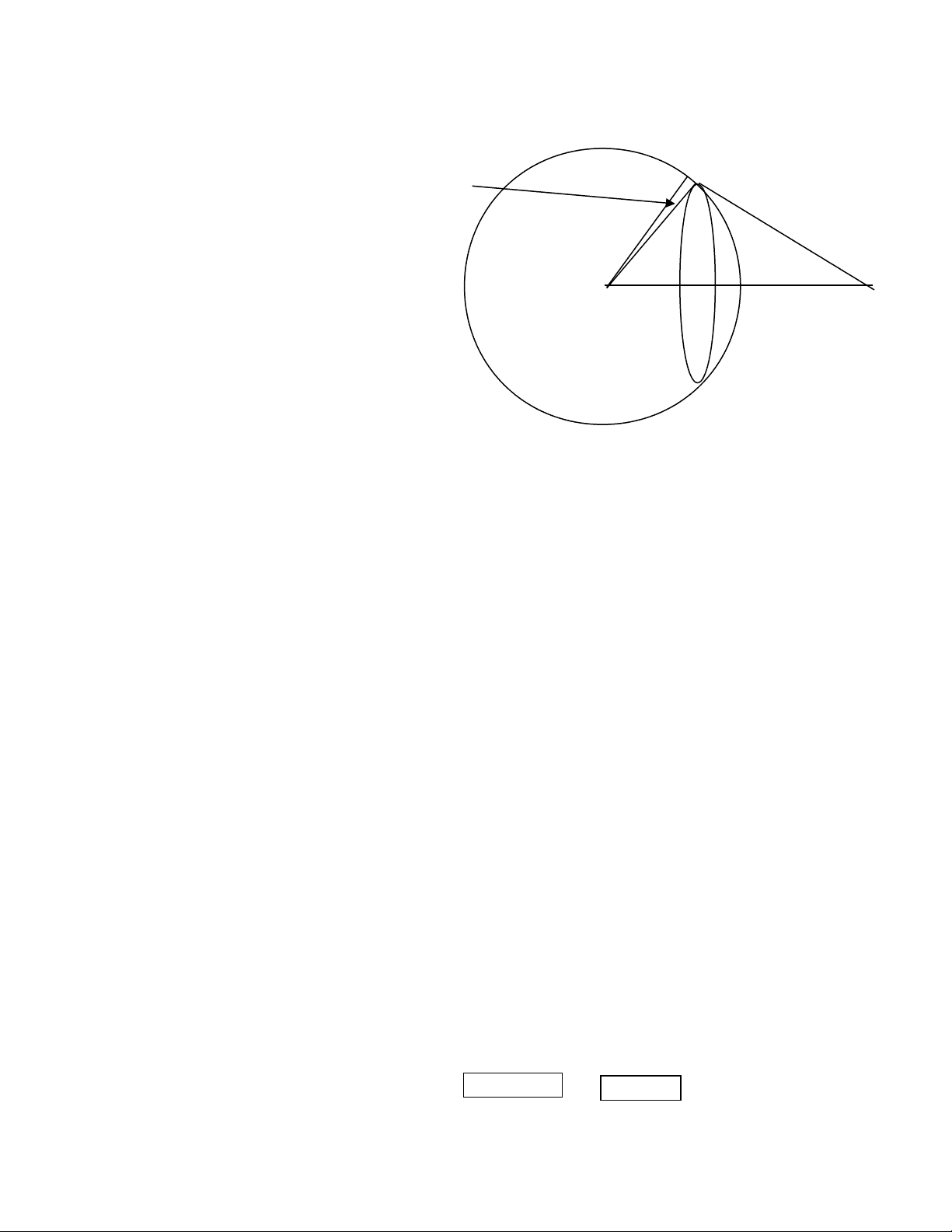
Griffiths pp. 85,6 does an integral for electric
potential for a spherical shell. There d
is a shell of radius R, having surface
charge density . We must integrate
over the shell to find the potential at
a distance s from the origin.
s p
Since
dVp = k dq/r,
we will add up all the dq's on the spherical shell.
(I'll use the symbol instead of Griffiths' curly r.)
The radius of the shell is R, and we want
to find the area of a circular strip whose
radius is R sin and whose width is R d.
The area of this strip is the width Rd times its length (circumference) 2R sin , or 2 R2 sin d.
The tiny element of charge on the strip is
dq = dA = 2 R2 sin d.
The distance curly r, or is given by
= ( R2 + s2 - 2Rs cos ) .
Then the integral for V at p is
Vp = dVp = kdq/ = k 2 R2 sin d / ( R2 + s2 - 2Rs cos )
The limits on are 0 to :
Vp = 2k R2 0 sin d/ ( R2 + s2 - 2Rs cos ).
Now we change variables to x = cos , and we note that dx = -sin d. Then the integral becomes
Vp = 2k R2 1-1 -dx/ ( R2 + s2 - 2 R s x).
Interchanging the limits gives us
Vp = 2k R2 -1+1 dx/ ( R2 + s2 - 2 R s x).
The integral is of the form dx/(a-bx), where a = R2 + s2 and b = 2Rs. If we let
1
pf2

Partial preview of the text

Download Integration of Electric Potential for a Spherical Shell and more Study notes Physics in PDF only on Docsity!

Spherical Integrals MJM PH 316 September 14, 2006 Griffiths pp. 85,6 does an integral for electric potential for a spherical shell. There d is a shell of radius R, having surface charge density . We must integrate  over the shell to find the potential at a distance s from the origin.  s p Since dVp = k dq/r, we will add up all the dq's on the spherical shell. (I'll use the symbol  instead of Griffiths' curly r.) The radius of the shell is R, and we want to find the area of a circular strip whose radius is R sin  and whose width is R d. The area of this strip is the width Rd times its length (circumference) 2R sin , or 2 R^2 sin  d. The tiny element of charge on the strip is dq =  dA =  2  R^2 sin  d. The distance curly r, or  is given by  =  ( R^2 + s^2 - 2Rs cos ). Then the integral for V at p is Vp =  dVp =  kdq/ = k   2  R^2 sin  d / ( R^2 + s^2 - 2Rs cos ) The limits on  are 0 to : Vp = 2k R^2 0 ^ sin  d/ ( R^2 + s^2 - 2Rs cos ). Now we change variables to x = cos , and we note that dx = -sin  d. Then the integral becomes Vp = 2k R^2 1 -1^ -dx/ ( R^2 + s^2 - 2 R s x). Interchanging the limits gives us Vp = 2k R^2 -1+1^ dx/ ( R^2 + s^2 - 2 R s x). The integral is of the form dx/(a-bx), where a = R^2 + s^2 and b = 2Rs. If we let

u = a-bx, then du = -bdx. Rearranging the integral gives Vp = 2k R^2 (-1/(2Rs)) (^) -1+1^ dx/ ( R^2 + s^2 - 2 R s x). With the substitution u = a- bx in mind, we get Vp = k R/s (^) a+ba-b^ du/u = k R/s 2 { -( R^2 + s^2 - 2Rs) + ( R^2 + s^2 + 2Rs) }. Rembember that s can be greater or smaller than R, since we want to know the potential inside or outside the spherical shell. Both square roots have to be positive. The first one is ( R^2 + s^2 - 2Rs) = | R-s |, and the second is R+s. When R<s, we are outside the shell, and V (^) p, outside = 2k R/s ( -(s-R) + R+s ) = 4k R^2 /s = kQshell / s. (Acts like a point charge Q) When R > s, we are inside the shell and we get V (^) p, intside = 2k R/s ( -(R-s) + R+s ) = 4k R^2 /R = kQshell / R. (Constant within the shell) On prob 2.28 you will have to integrate over an entire sphere to find the potential V at some point a distance s from the origin, inside the sphere. The integral will still look like dVp = kdq/, but now dq will be dq =  d, where d is the volume of a ring of radius r sin , width rd and thickness dr: dq =  (2R sin )(rd)dr. You will find an angle integral like the one we just did, and in addition you must do an integral over r. This note is intended to serve as a reminder of how thing fit together when one does integrals of this type.