


TONI MORRISON


Study with the several resources on Docsity

Earn points by helping other students or get them with a premium plan

Prepare for your exams
Study with the several resources on Docsity
Earn points to download
Earn points by helping other students or get them with a premium plan
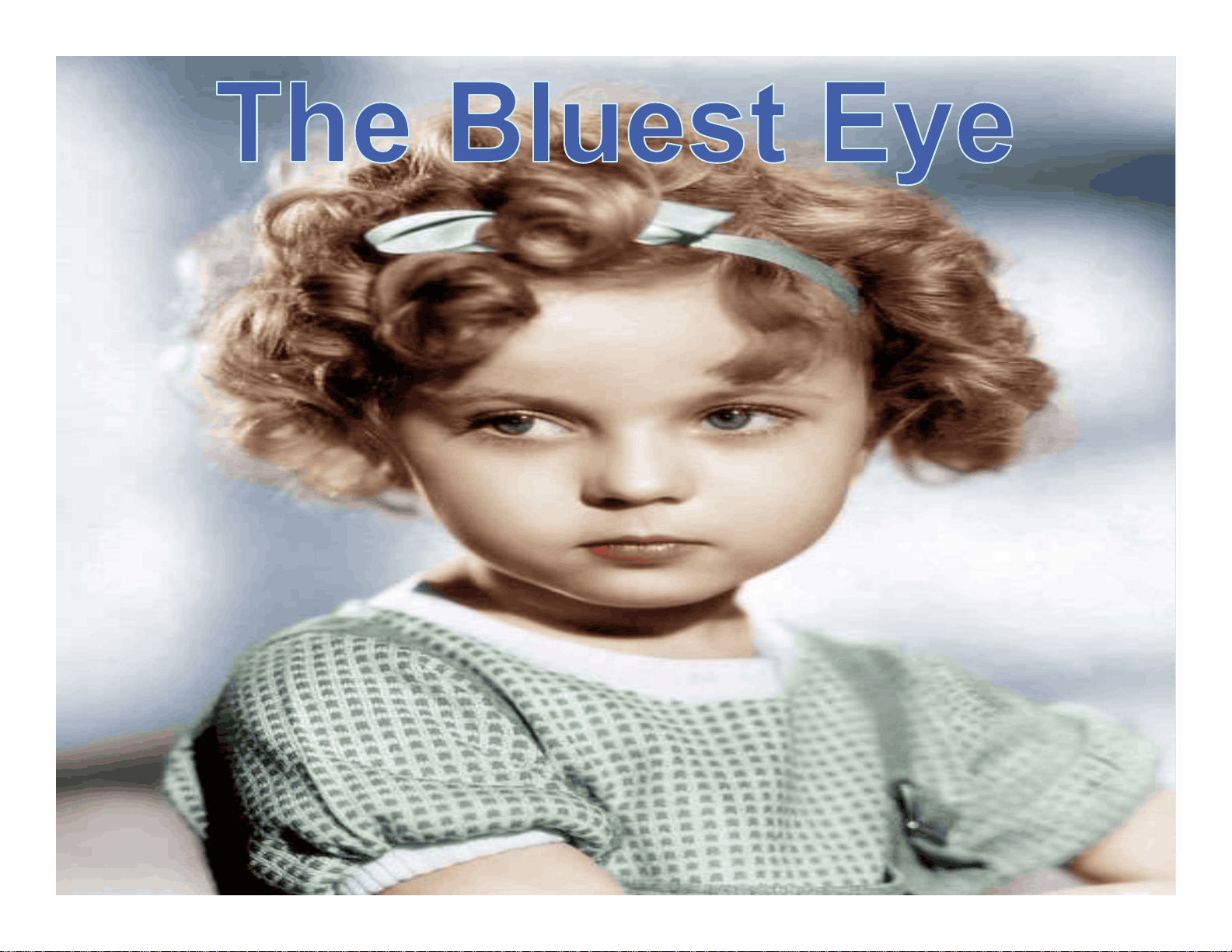
The Bluest Eye, debut novel by Nobel Prize- winning author Toni Morrison, published in 1970. Set in Morrison's hometown of Lorain, Ohio, in.
Typology: Study notes
1 / 60

This page cannot be seen from the preview
Don't miss anything!
TONI MORRISON
¾
Born – Chloe Ardelia Wofford. February 18, 1931Lorain;Ohio,London. ¾
Occupation – Novelist and Writer. ¾
Genre –
American Literature
.
¾
Notable Works :
The Bluest Eye
Beloved
Song of Solomon ¾
Notable Awards : ^
Presidential Medal of Freedom(2012) ^
Nobel Prize in Literature (1993) ^
Pulitzer Prize for Fiction (1988)
The
Bluest
Eye
The Bluest Eye
, debut novel by Nobel Prize
‐
winning author Toni Morrison, published in 1970.Set in Morrison’s hometown of Lorain, Ohio, in1940–41, the novel tells the tragic story of PecolaBreedlove, an African American girl from anabusive home. Eleven
‐year
‐old Pecola equates
beauty and social acceptance with whiteness;she therefore longs to have “the bluest eye.”Although largely ignored upon publication,
The
Bluest Eye
is now considered an American classic
and an essential account of the African Americanexperience after the Great Depression.
Summary
^
Pecola’s story is told through the eyes of multiple narrators. The main narrator is ClaudiaMacTeer, a childhood friend with whom Pecola once lived. Claudia narrates from two differentperspectives: the adult Claudia, who reflects on the events of 1940–41, and the nine
‐year
‐old
Claudia, who observes the events as they happen. ^
In the first section of the novel (“Autumn”), nine
‐year
‐old Claudia introduces Pecola and explains
why she is living with the MacTeers. Claudia tells the reader what her mother, Mrs. MacTeer, toldher: Pecola is a “case…a girl who had no place to go.” The Breedloves are currently “outdoors,” orhomeless, because Pecola’s father, Cholly, burned the family house down. The county placedPecola with the MacTeer family until “they could decide what to do, or, more precisely, until the[Breedlove] family was reunited.” ^
Despite the tragic circumstances of their friendship, Claudia and her 11
‐year
‐old sister, Frieda,
enjoy playing with Pecola. Frieda and Pecola bond over their shared love of Shirley Temple, afamous American child star known for her blonde curls, babyish singing, and tap
‐dancing with Bill
(“Bojangles”) Robinson. Claudia, however, “couldn’t join them in their adoration because [she]hated Shirley.” In fact, she hated “all the Shirley Temples of the world.” The adult Claudia recallsbeing given a blue
‐eyed baby doll for Christmas:
^
From the clucking sounds of adults I knew that the doll represented what they thought was myfondest wish...all the world had agreed that a blue
‐eyed, yellow
‐haired, pink
‐skinned doll was what
every girl child treasured. “Here,” they said, “this is beautiful, and if you are on this day ‘worthy’ youmay have it.” ^
Claudia remembers dismembering the doll “to see of what it was made, to discover the dearness,to find the beauty, the desirability that had escaped me, but apparently only me.” Findingnothing special at its core, Claudia discarded the doll and continued on her path of destruction,her hatred of little white girls unabated.
.
^
The second section (“Winter”) consists of two short vignettes. The first of these isnarrated by Claudia, and in it she documents Pecola’s fascination with a light
‐skinned
black girl by the name of Maureen Peal. Friendly at first, Maureen ultimatelyhumiliates Pecola and her friends by declaring herself “cute” and Pecola “ugly.” Thesecond vignette, narrated by a third
‐person omniscient narrator, focuses on Geraldine
and Louis Junior, a young mother and son in Lorain, Ohio. Geraldine and Junior’sconnection to Pecola is not immediately obvious; she does not appear until the end ofthe vignette. On a particularly boring afternoon, Junior entices Pecola into his house.After she comes inside, he throws his mother’s beloved cat at her face. Scratched andverging on tears, Pecola attempts to leave. Junior stops her, claiming she is his“prisoner.” Junior then picks up his mother’s cat and begins swinging it around hishead. In an effort to save it, Pecola grabs his arm, causing them both to fall to theground. The cat, released in mid
‐motion, is thrown full
‐force at the window. At this
point Geraldine appears, and Junior promptly tells her that Pecola has killed the cat.Geraldine calls Pecola a “nasty little black bitch” and orders her to leave. ^
The third section of the novel (“Spring”) is by far the longest, comprising fourvignettes. In the first vignette, Claudia and Frieda talk about how Mr. Henry—a gueststaying with the MacTeers—“picked at” Frieda, inappropriately touching her while herparents were outside. After Frieda told her mother, her father “threw our old tricycleat [Mr. Henry’s] head and knocked him off the porch.” Frieda tells Claudia she fearsshe might be “ruined,” and they set off to find Pecola. In the second and thirdvignettes, the reader learns about Pecola’s parents, Pauline (Polly) and ChollyBreedlove. According to the omniscient narrator, Polly and Cholly once loved eachother. They were married at a relatively young age and migrated together fromKentucky to Lorain. Over the years, their relationship steadily deteriorated. Onedisappointment followed another, and sustained poverty, ignorance, and fear tooksteep tolls on their well
‐being. At the end of the third vignette—just before the events
of the first section begin—Cholly drunkenly stumbles into his kitchen, where he findsPecola washing dishes. Overwhelmed by conflicting feelings of tenderness and rage,Cholly rapes Pecola and leaves her unconscious body on the floor for Polly to find.
Origin
And
Analysis
^
Questions of race and gender are at the centre of
The Bluest Eye
. In a 2004 interview
Morrison described her motivations to write the novel. She explained that in the mid
1960s “most of what was being published by black men [was] very powerful,aggressive, revolutionary fiction or non
‐fiction.” These publications “had a very
positive, racially uplifting rhetoric.” Black male authors expressed sentiments like“black is beautiful” and used phrases like “black queen.” At the time, Morrisonworried that people would forget that “[black] wasn’t always beautiful.” In
The Bluest
Eye
, she set out to remind her readers “how hurtful a certain kind of internecine racism is.” ^
Morrison conceived of the idea for the novel some 20 years before its publication.During an undergraduate creative writing workshop at Howard University, sheworked on a short story about a young black girl who prayed for blue eyes. The storywas in part true; it was based on a conversation with a childhood friend who wantedblue eyes. “Implicit in her desire,” Morrison observed, “was racial self
‐loathing.” The
soon
‐to
‐be author wondered how her friend had internalized society’s racist beauty
standards at such a young age. ^
By 1965 Morrison’s short story had become a novel, and between 1965 and 1969 shedeveloped it into an extensive study of socially constructed ideals of beauty (andugliness). In
The Bluest Eye
, Morrison foregrounded the demonization of blackness in
American culture, focusing on the effects of internalized racism. Through Geraldine,Polly, Pecola, and other characters, she demonstrated how even the most subtleforms of racism—especially racism from within the black community—can negativelyimpact self
‐worth and self
‐esteem
.
Form
And
Style
^
The Bluest Eye
is a work of tremendous emotional, cultural, and historical depth. Its
passages are rich with allusions to Western history, media, literature, and religion.Morrison’s prose was experimental; it is lyrical and evocative and unmistakably typicalof the writing style that became the hallmark of her later work. Some 20 years afterits initial publication, Morrison, reflecting on the writing of her first novel in a 1993afterword to
The Bluest Eye
, described her prose as “race
‐specific yet race
‐free,” the
product of a desire to be “free of racial hierarchy and triumphalism.” In her words: ^
The novel tried to hit the raw nerve of racial self
‐contempt, expose it, then soothe it not
with narcotics but with language that replicated the agency I discovered in my firstexperience of beauty. Because that moment was so racially infused…the struggle wasfor writing that was indisputably black. ^
The form of this novel was also experimental and was highly innovative: Morrisonbuilt a “shattered world” to complement Pecola’s experiences. She changed narratorsand focal points within and between the four sections. The narration itself alternatesbetween first person and third
‐person omniscient. Although the events of the novel
are, as Morrison wrote, “held together by seasons in childtime,” they are narratedmostly nonchronologically. The novel itself is fairly short; it concludes after only 164pages. ^
The temporal structure and frequent shifts in perspective are a key part of Morrison’sattempt to imagine a fluid model of subjectivity—a model she hoped could offersome kind of resistance to a dominant white culture. By shifting the point of view,Morrison effectively avoids dehumanizing the black characters “who trashed Pecolaand contributed to her collapse.” Instead, she emphasizes the systemic nature of theproblem. She shows the reader how the racial issues of the distant and not
‐so
‐distant
past continue to affect her characters in the present, thereby explaining, if notjustifying, many of their actions.
Legacy
Since
its
publication
in
1970,
there
have
been
numerous
attempts
to
ban
The
Bluest
Eye
from
schools
and
libraries
because
of
its
depictions
of
sex,
violence,
racism,
incest,
and
child
molestation;
it
frequents
the
American
Library
Association’s list
of
banned
and
challenged
books.
Psychoanalysis of Pecola
Hegemonies
Displacement
Maniac
Allenation
DENIAL
Racial Conflictmade by whitepeople
Displacement
Displacement
The Bluest Eye
