
Using Freezing-Point Depression to Find Molecular Weight - Experiment 4 | CHEM 1212, Lab Reports of Chemistry

Material Type: Lab; Class: Principles of Chem II-Majors; Subject: Chemistry; University: Georgia College & State University; Term: Unknown 1989;

Typology: Lab Reports

Pre 2010

Uploaded on 02/25/2010

koofers-user-kqa
koofers-user-kqa 🇺🇸

5

(1)

9 documents

1 / 4

Toggle sidebar

This page cannot be seen from the preview

Don't miss anything!

bg1
GCSU – Chem 1212L Experiment
#4
Chemistry with Calculators 4 - 1
Using Freezing-Point Depression
to Find Molecular Weight
When a solute is dissolved in a solvent, the freezing temperature is lowered in proportion to the
number of moles of solute added. This property, known as freezing-point depression, is a
colligative property; that is, it depends on the ratio of solute and solvent particles, not on the
nature of the substance itself. The equation that shows this relationship is:
Δt = Kf m
where Δt is the freezing point depression, Kf is the freezing point depression constant for a
particular solvent (3.9°C-kg/mol for lauric acid in this experiment1), and m is the molality of the
solution (in mol solute/kg solvent).
In this experiment, you will first find the freezing temperature of the pure solvent, lauric acid,
CH3(CH2)10COOH. You will then add a known mass of benzoic acid solute, C6H5COOH, to a
known mass of lauric acid, and determine the lowering of the freezing temperature of the
solution. In an earlier experiment, you observed the effect on the cooling behavior at the freezing
point when a solute was added to a pure substance. By measuring the freezing point depression,
Δt, and the mass of benzoic acid, you can use the formula above to find the molecular weight of
the benzoic acid solute, in g/mole.
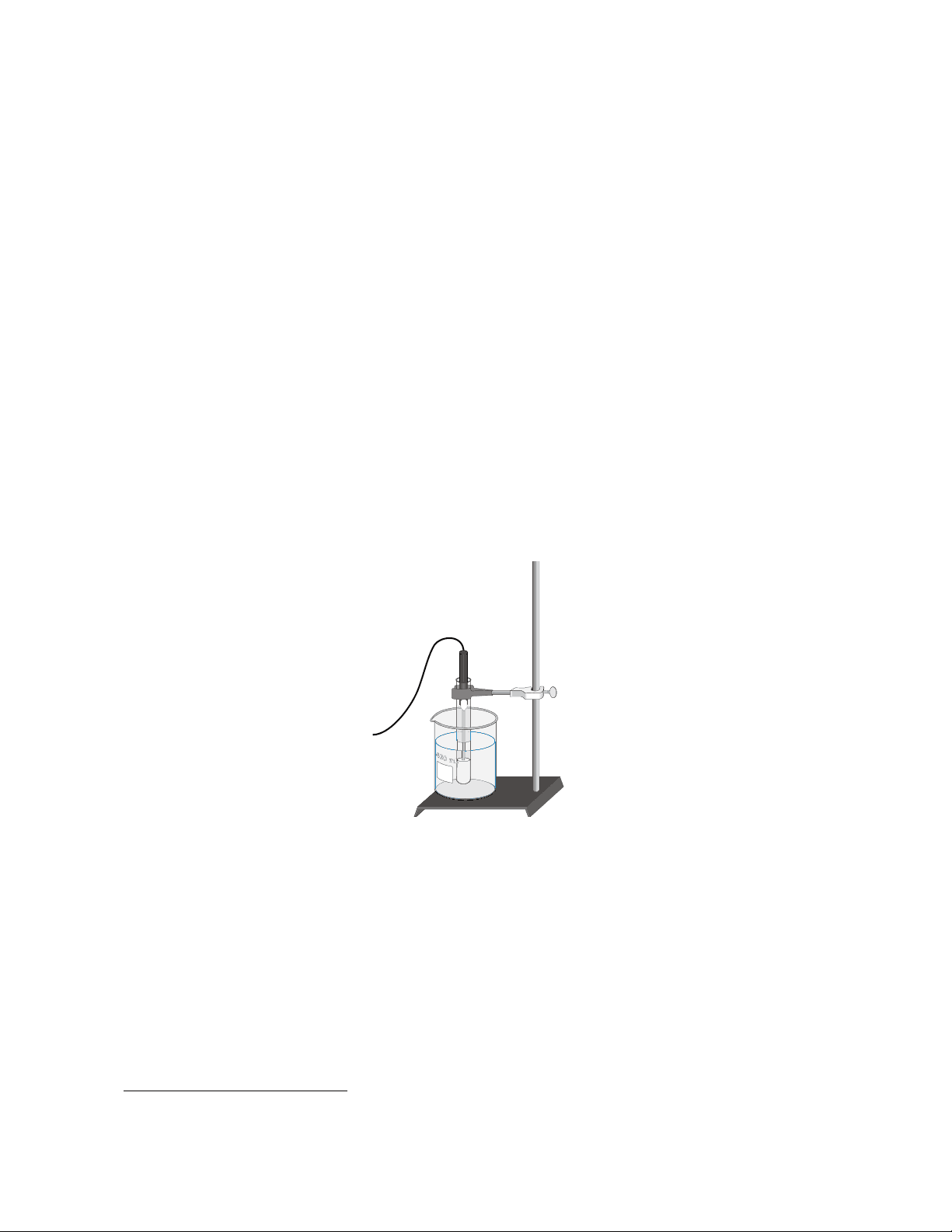
Figure 1
MATERIALS
TI-83 Plus or TI-84 Plus graphing calculator
400 mL beaker
EasyData application
18 X 150 mL test tube
Temperature Probe and data-collection interface
lauric acid
or EasyTemp
benzoic acid
ring stand
thermometer
utility clamp
water
1 “The Computer-Based Laboratory,” Journal of Chemical Education: Software, 1988, Vol. 1A, No. 2, p. 73.
pf3
pf4

Partial preview of the text

Download Using Freezing-Point Depression to Find Molecular Weight - Experiment 4 | CHEM 1212 and more Lab Reports Chemistry in PDF only on Docsity!

GCSU – Chem 1212L Experiment

Chemistry with Calculators 4 - 1

Using Freezing-Point Depression

to Find Molecular Weight

When a solute is dissolved in a solvent, the freezing temperature is lowered in proportion to the number of moles of solute added. This property, known as freezing-point depression, is a colligative property ; that is, it depends on the ratio of solute and solvent particles, not on the nature of the substance itself. The equation that shows this relationship is: Δ t = Kfm where Δ t is the freezing point depression, Kf is the freezing point depression constant for a particular solvent (3.9°C-kg/mol for lauric acid in this experiment 1 ), and m is the molality of the solution (in mol solute/kg solvent). In this experiment, you will first find the freezing temperature of the pure solvent, lauric acid, CH 3 (CH 2 ) 10 COOH. You will then add a known mass of benzoic acid solute, C 6 H 5 COOH, to a known mass of lauric acid, and determine the lowering of the freezing temperature of the solution. In an earlier experiment, you observed the effect on the cooling behavior at the freezing point when a solute was added to a pure substance. By measuring the freezing point depression, Δ t , and the mass of benzoic acid, you can use the formula above to find the molecular weight of the benzoic acid solute, in g/mole. Figure 1

MATERIALS

TI-83 Plus or TI-84 Plus graphing calculator 400 mL beaker EasyData application 18 X 150 mL test tube Temperature Probe and data-collection interface lauric acid or EasyTemp benzoic acid ring stand thermometer utility clamp water (^1) “The Computer-Based Laboratory,” Journal of Chemical Education: Software , 1988, Vol. 1A, No. 2, p. 73.

Experiment 4 4 - 2 Chemistry with Calculators

PROCEDURE

  1. Obtain and wear goggles.
  2. Turn on the calculator. Connect the Temperature Probe, data-collection interface, and calculator. (If you are using an EasyTemp, you do not need a data-collection interface.)
  3. Set up EasyData for data collection. a. Start EasyData if it is not already running. b. Select from the Main screen, and then select New to reset the application. c. Select from the Main screen, then select Time Graph… d. Select on the Time Graph Settings screen. e. Enter 6 as the time between samples in seconds. f. Select. g. Enter 100 as the number of samples and select (data will be collected for 10 minutes). h. Select to return to the Main screen. Part I Freezing Temperature of Pure Lauric Acid
  4. Add about 300 mL of tap water with a temperature between 20 and 25°C to a 400 mL beaker. Place the beaker on the base of the ring stand.
  5. Use a utility clamp to obtain a test tube containing hot melted lauric acid from your teacher. Fasten the utility clamp at the top of the test tube. Caution : Be careful not to spill the hot lauric acid on yourself and do not touch the bottom of the test tube.
  6. Insert the Temperature Probe into the hot lauric acid. About 30 seconds are required for the probe to warm up to the temperature of its surroundings and give correct temperature readings. During this time, fasten the utility clamp to the ring stand so the test tube is above the water bath.
  7. After the 30 seconds have elapsed, select to begin data collection.
  8. Lower the test tube into the water bath. Make sure the water level outside the test tube is higher than the lauric acid level inside the test tube. If the lauric acid is not above 50°C, obtain another lauric acid sample and begin again.
  9. With a very slight up and down motion of the Temperature Probe, continuously stir the lauric acid during the cooling. Hold the top of the probe and not its wire.
  10. Data collection will stop after 10 minutes. Use the hot water bath provided by your teacher to melt the probe out of the solid lauric acid. Do not attempt to pull the probe out—this might damage it. Carefully wipe any excess lauric acid liquid from the probe with a paper towel or tissue. Return the test tube containing lauric acid to the place directed by your teacher.
  11. To determine the freezing temperature of pure lauric acid, you need to determine the temperature in the portion of the graph with nearly constant temperature. Examine the data points along this portion of the graph. As you move the cursor right or left, the time (X) and temperature (Y) values of each data point are displayed above the graph. Determine this temperature, either by visually approximating the value or by taking the mathematical average of the temperatures in this plateau. Record the freezing temperature of pure lauric acid in your data table (round to the nearest 0.1°C).

Experiment 4 4 - 4 Chemistry with Calculators

  1. Calculate molality (m), in mol/kg, using the formula, Δ t = Kfm ( Kf = 3.9°C-kg/mol for lauric acid).
  2. Calculate moles of benzoic acid solute, using the answer in Step 2 (in mol/kg) and the mass (in kg) of lauric acid solvent.
  3. Calculate the experimental molecular weight of benzoic acid, in g/mol. Use the original mass of benzoic acid from the Data and Calculations table, and the moles of benzoic acid you found in the previous step.
  4. Determine the accepted molecular weight for benzoic acid from its formula, C 6 H 5 COOH.
  5. Calculate the percent error.

DATA AND CALCULATIONS

Mass of lauric acid g Mass of benzoic acid g Freezing temperature of pure lauric acid °C Freezing point of the benzoic acid–lauric acid mixture °C Freezing temperature depression, Δ t °C Molality, m mol/kg Moles of benzoic acid mol Molecular weight of benzoic acid (experimental) g/mol Molecular weight of benzoic acid (accepted) g/mol Percent error %