Download William Shakespeare: Early Life, Family, and Religion and more Summaries English in PDF only on Docsity!
William Shakespeare
William Shakespeare
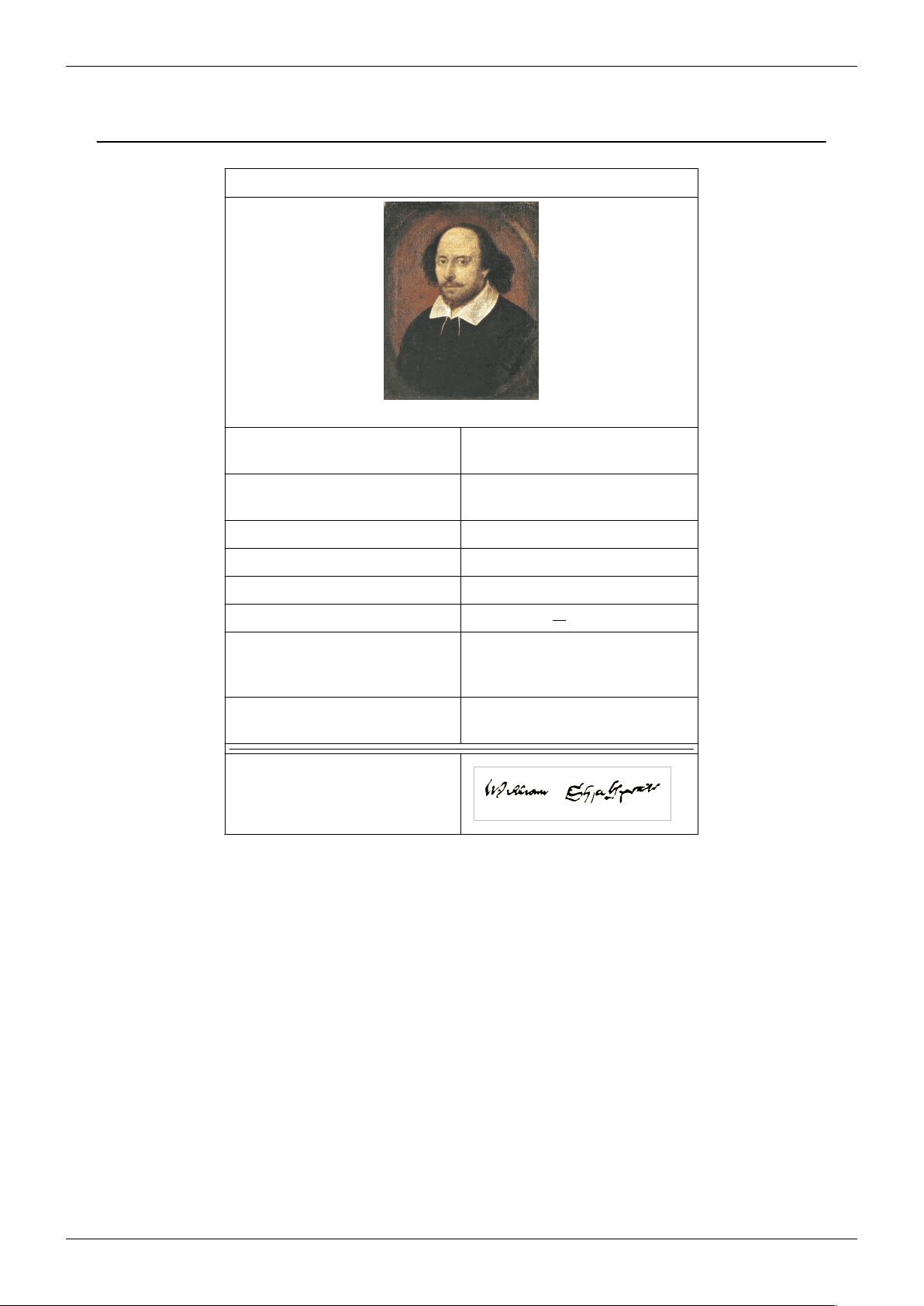
The Chandos portrait, artist and authenticity unconfirmed. National Portrait Gallery, London. Born Baptised 26 April 1564 (birth date unknown) Stratford-upon-Avon, Warwickshire, England Died 23 April 1616 (aged 52) Stratford-upon-Avon, Warwickshire, England Occupation Playwright, poet, actor Nationality English Period English Renaissance Spouse(s) Anne Hathaway (m. 1582–1616) Children • • Susanna Hall
- • Hamnet Shakespeare
- • Judith Quiney Relative(s) • John Shakespeare (father)
- Mary Shakespeare (mother)
Signature
William Shakespeare (26 April 1564 (baptised) – 23 April 1616)[1]^ was an English poet and playwright, widely regarded as the greatest writer in the English language and the world's pre-eminent dramatist.[2]^ He is often called England's national poet and the "Bard of Avon".[3][4]^ His extant works, including some collaborations, consist of about 38 plays,[5]^ 154 sonnets, two long narrative poems, and a few other verses, the authorship of some of which is uncertain. His plays have been translated into every major living language and are performed more often than those of any other playwright.[6]
Shakespeare was born and brought up in Stratford-upon-Avon. At the age of 18, he married Anne Hathaway, with whom he had three children: Susanna, and twins Hamnet and Judith. Between 1585 and 1592, he began a successful career in London as an actor, writer, and part-owner of a playing company called the Lord Chamberlain's Men, later known as the King's Men. He appears to have retired to Stratford around 1613 at age 49, where he died three years later. Few records of Shakespeare's private life survive, and there has been considerable speculation about such matters as his physical appearance, sexuality, religious beliefs, and whether the works attributed to him were written by others.[7]
Shakespeare produced most of his known work between 1589 and 1613.[8][9]^ His early plays were mainly comedies and histories, genres he raised to the peak of sophistication and artistry by the end of the 16th century. He then wrote mainly tragedies until about 1608, including Hamlet , King Lear , Othello , and Macbeth , considered some of the finest works in the English language. In his last phase, he wrote tragicomedies, also known as romances, and collaborated with other playwrights.
Many of his plays were published in editions of varying quality and accuracy during his lifetime. In 1623, John Heminges and Henry Condell, two friends and fellow actors of Shakespeare, published the First Folio, a collected edition of his dramatic works that included all but two of the plays now recognised as Shakespeare's. It was prefaced with a poem by Ben Jonson, in which Shakespeare is hailed, presciently, as "not of an age, but for all time."[10]
Shakespeare was a respected poet and playwright in his own day, but his reputation did not rise to its present heights until the 19th century. The Romantics, in particular, acclaimed Shakespeare's genius, and the Victorians worshipped Shakespeare with a reverence that George Bernard Shaw called "bardolatry".[11]^ In the 20th century, his work was repeatedly adopted and rediscovered by new movements in scholarship and performance. His plays remain highly popular today and are constantly studied, performed, and reinterpreted in diverse cultural and political contexts throughout the world.
Life
Early life
William Shakespeare was the son of John Shakespeare, an alderman and a successful glover originally from Snitterfield, and Mary Arden, the daughter of an affluent landowning farmer.[12]^ He was born in Stratford-upon-Avon and baptised there on 26 April 1564. His actual date of birth remains unknown, but is traditionally observed on 23 April, Saint George's Day.[13]^ This date, which can be traced back to an 18th-century scholar's mistake, has proved appealing to biographers, since Shakespeare died 23 April 1616.[14]^ He was the third child of eight and the eldest surviving son.[15]
Although no attendance records for the period survive, most biographers agree that Shakespeare was probably educated at the King's New School in Stratford,[16]^ a free school chartered in 1553,[17]^ about a quarter-mile from his home. Grammar schools varied in quality during the Elizabethan era, but grammar school curricula were largely similar, the basic Latin text was standardised by royal decree,[18]^ and the school would have provided an intensive education in grammar based upon Latin classical authors.[19]
John Shakespeare's house, believed to be Shakespeare's birthplace, in Stratford-upon-Avon.
At the age of 18, Shakespeare married the 26-year-old Anne Hathaway. The consistory court of the Diocese of Worcester issued a marriage licence on 27 November 1582. The next day two of Hathaway's neighbours posted bonds guaranteeing that no lawful claims impeded the marriage.[20]^ The ceremony may have been arranged in some haste, since the Worcester chancellor allowed the marriage banns to be read once instead of the usual three times,[21]^ and six months after the marriage Anne gave birth to a daughter, Susanna, baptised 26 May 1583.[22]^ Twins, son Hamnet and daughter Judith, followed almost two years later and were baptised 2 February 1585.[23]^ Hamnet died of unknown causes at the age of 11 and was buried 11 August 1596.[24]
After the birth of the twins, Shakespeare left few historical traces until he is mentioned as part of the London theatre scene in 1592. The exception is the appearance of his name in the 'complaints bill' of a law case before the Queen's Bench court at Westminster dated Michaelmas Term 1588 and 9 October 1589.[25]^ Scholars refer to the years
Volpone , although we cannot know for certain which roles he played.[46]^ In 1610, John Davies of Hereford wrote that "good Will" played "kingly" roles.[47]^ In 1709, Rowe passed down a tradition that Shakespeare played the ghost of Hamlet's father.[48]^ Later traditions maintain that he also played Adam in As You Like It and the Chorus in Henry V ,[49]^ though scholars doubt the sources of the information.[50]
Shakespeare divided his time between London and Stratford during his career. In 1596, the year before he bought New Place as his family home in Stratford, Shakespeare was living in the parish of St. Helen's, Bishopsgate, north of the River Thames.[51]^ He moved across the river to Southwark by 1599, the year his company constructed the Globe Theatre there.[52]^ By 1604, he had moved north of the river again, to an area north of St Paul's Cathedral with many fine houses. There he rented rooms from a French Huguenot named Christopher Mountjoy, a maker of ladies' wigs and other headgear.[53]
Later years and death
Rowe was the first biographer to pass down the tradition that Shakespeare retired to Stratford some years before his death.[54]^ It is perhaps relevant that the London public playhouses were repeatedly closed for months at a time during the extended outbreaks of the Plague (a total of over 60 months closure between May 1603 and February 1610),[55] which meant there was often no acting work. Retirement from all work was uncommon at that time,[56]^ and Shakespeare continued to visit London.[54]^ In 1612, Shakespeare was called as a witness in Bellott v. Mountjoy , a court case concerning the marriage settlement of Mountjoy's daughter, Mary.[57]^ In March 1613 he bought a gatehouse in the former Blackfriars priory;[58]^ and from November 1614 he was in London for several weeks with his son-in-law, John Hall.[59]
Shakespeare's funerary monument in Stratford-upon-Avon.
After 1610, Shakespeare wrote fewer plays, and none are attributed to him after 1613.[60]^ His last three plays were collaborations, probably with John Fletcher,[61]^ who succeeded him as the house playwright for the King’s Men.[62] Shakespeare died on 23 April 1616[63]^ and was survived by his wife and two daughters. Susanna had married a physician, John Hall, in 1607,[64]^ and Judith had married Thomas Quiney, a vintner, two months before Shakespeare’s death.[65] In his will, Shakespeare left the bulk of his large estate to his elder daughter Susanna.[66]^ The terms instructed that she pass it down intact to "the first son of her body".[67]^ The Quineys had three children, all of whom died without marrying.[68]^ The Halls had one child, Elizabeth, who married twice but died without children in 1670, ending Shakespeare’s direct line.[69]^ Shakespeare's will scarcely mentions his wife, Anne, who was probably entitled to one third of his estate automatically.[70]^ He did make a point, however, of leaving her "my second best bed", a bequest that has led to much speculation.[71]^ Some scholars see the bequest as an insult to Anne, whereas others believe that the second-best bed would have been the matrimonial bed and therefore rich in significance.[72] Shakespeare was buried in the chancel of the Holy Trinity Church two days after his death.[73]^ The epitaph carved into the stone slab covering his grave includes a curse against moving his bones, which was carefully avoided during restoration of the church in 2008:[74]
Shakespeare's grave
Good frend for Iesvs sake forbeare, To digg the dvst encloased heare. Bleste be ye man yt spares thes stones, And cvrst be he yt moves my bones. UNIQ-ref-0-d126b768cb9ddcb4-QINU
(Modern spelling: Good friend, for Jesus' sake forbear, | To dig the dust enclosed here. | Blessed be the man that spares these stones, | And cursed be he that moves my bones. )
Sometime before 1623, a funerary monument was erected in his memory on the north wall, with a half-effigy of him in the act of writing. Its plaque compares him to Nestor, Socrates, and Virgil.[75]^ In 1623, in conjunction with the publication of the First Folio, the Droeshout engraving was published.[76]
Shakespeare has been commemorated in many statues and memorials around the world, including funeral monuments in Southwark Cathedral and Poets' Corner in Westminster Abbey.
Plays
Most playwrights of the period typically collaborated with others at some point, and critics agree that Shakespeare did the same, mostly early and late in his career.[77]^ Some attributions, such as Titus Andronicus and the early history plays, remain controversial, while The Two Noble Kinsmen and the lost Cardenio have well-attested contemporary documentation. Textual evidence also supports the view that several of the plays were revised by other writers after their original composition.
The first recorded works of Shakespeare are Richard III and the three parts of Henry VI , written in the early 1590s during a vogue for historical drama. Shakespeare's plays are difficult to date, however,[78]^ and studies of the texts suggest that Titus Andronicus , The Comedy of Errors , The Taming of the Shrew and The Two Gentlemen of Verona may also belong to Shakespeare’s earliest period.[79]^ His first histories, which draw heavily on the 1587 edition of Raphael Holinshed's Chronicles of England, Scotland, and Ireland ,[80]^ dramatise the destructive results of weak or corrupt rule and have been interpreted as a justification for the origins of the Tudor dynasty.[81]^ The early plays were influenced by the works of other Elizabethan dramatists, especially Thomas Kyd and Christopher Marlowe, by the traditions of medieval drama, and by the plays of Seneca.[82]^ The Comedy of Errors was also based on classical models, but no source for The Taming of the Shrew has been found, though it is related to a separate play of the same name and may have derived from a folk story.[83]^ Like The Two Gentlemen of Verona , in which two friends appear to approve of rape,[84]^ the Shrew's story of the taming of a woman's independent spirit by a man sometimes troubles modern critics and directors.[85]
Oberon, Titania and Puck with Fairies Dancing. By William Blake, c. 1786. Tate Britain.
Shakespeare's early classical and Italianate comedies, containing tight double plots and precise comic sequences, give way in the mid-1590s to the romantic atmosphere of his greatest comedies.[86]^ A Midsummer Night's Dream is a witty mixture of romance, fairy magic, and comic lowlife scenes.[87]^ Shakespeare's next comedy, the equally romantic Merchant of Venice , contains a portrayal of the vengeful Jewish moneylender Shylock, which reflects Elizabethan views but may appear derogatory to modern audiences.[88]^ The wit and wordplay of Much Ado About Nothing ,[89]^ the charming rural setting of As You Like It , and the lively merrymaking of Twelfth Night complete
playhouse built by actors for actors, on the south bank of the Thames at Southwark.[110]^ The Globe opened in autumn 1599, with Julius Caesar one of the first plays staged. Most of Shakespeare's greatest post-1599 plays were written for the Globe, including Hamlet , Othello and King Lear .[111]
The reconstructed Globe Theatre, London.
After the Lord Chamberlain's Men were renamed the King's Men in 1603, they entered a special relationship with the new King James. Although the performance records are patchy, the King's Men performed seven of Shakespeare's plays at court between 1 November 1604 and 31 October 1605, including two performances of The Merchant of Venice .[112]^ After 1608, they performed at the indoor Blackfriars Theatre during the winter and the Globe during the summer.[113]^ The indoor setting, combined with the Jacobean fashion for lavishly staged masques, allowed Shakespeare to introduce more elaborate stage devices. In Cymbeline , for example, Jupiter descends "in thunder and lightning, sitting upon an eagle: he throws a thunderbolt. The ghosts fall on their knees."[114]
The actors in Shakespeare's company included the famous Richard Burbage, William Kempe, Henry Condell and John Heminges. Burbage played the leading role in the first performances of many of Shakespeare's plays, including Richard III , Hamlet , Othello , and King Lear .[115]^ The popular comic actor Will Kempe played the servant Peter in Romeo and Juliet and Dogberry in Much Ado About Nothing , among other characters.[116]^ He was replaced around the turn of the 16th century by Robert Armin, who played roles such as Touchstone in As You Like It and the fool in King Lear .[117]^ In 1613, Sir Henry Wotton recorded that Henry VIII "was set forth with many extraordinary circumstances of pomp and ceremony".[]^ On 29 June, however, a cannon set fire to the thatch of the Globe and burned the theatre to the ground, an event which pinpoints the date of a Shakespeare play with rare precision.[]
Textual sources
Title page of the First Folio, 1623. Copper engraving of Shakespeare by Martin Droeshout.
In 1623, John Heminges and Henry Condell, two of Shakespeare's friends from the King's Men, published the First Folio, a collected edition of Shakespeare's plays. It contained 36 texts, including 18 printed for the first time.[118]^ Many of the plays had already appeared in quarto versions—flimsy books made from sheets of paper folded twice to make four leaves.[]^ No evidence suggests that Shakespeare approved these editions, which the First Folio describes as "stol'n and surreptitious copies".[119]^ Alfred Pollard termed some of them "bad quartos" because of their adapted, paraphrased or garbled texts, which may in places have been reconstructed from memory.[120]^ Where several versions of a play survive, each differs from the other. The differences may stem from copying or printing errors, from notes by actors or audience members, or from Shakespeare's own papers.[121]^ In some cases, for example Hamlet , Troilus and Cressida and Othello , Shakespeare could have revised the texts between the quarto and folio editions. In the case of King Lear, however, while most modern additions do conflate them, the 1623 folio version is so different from the 1608 quarto, that the Oxford Shakespeare prints them both, arguing that they cannot be conflated without confusion.[122]
Poems
In 1593 and 1594, when the theatres were closed because of plague, Shakespeare published two narrative poems on erotic themes, Venus and Adonis and The Rape of Lucrece. He dedicated them to Henry Wriothesley, Earl of Southampton. In Venus and Adonis , an innocent Adonis rejects the sexual advances of Venus; while in The Rape of Lucrece , the virtuous wife Lucrece is raped by the lustful Tarquin.[123]^ Influenced by Ovid's Metamorphoses ,[124]^ the poems show the guilt and moral confusion that result from uncontrolled lust.[125]^ Both proved popular and were often reprinted during Shakespeare's lifetime. A third narrative poem, A Lover's Complaint , in which a young woman laments her seduction by a persuasive suitor, was printed in the first edition of the Sonnets in 1609. Most scholars now accept that Shakespeare wrote A Lover's Complaint. Critics consider that its fine qualities are marred by leaden effects.[126]^ The Phoenix and the Turtle , printed in Robert Chester's 1601 Love's Martyr , mourns the deaths of the legendary phoenix and his lover, the faithful turtle dove. In 1599, two early drafts of sonnets 138 and 144 appeared in The Passionate Pilgrim , published under Shakespeare's name but without his permission.[127]
Sonnets
Title page from 1609 edition of Shake-Speares Sonnets.
Published in 1609, the Sonnets were the last of Shakespeare's non-dramatic works to be printed. Scholars are not certain when each of the 154 sonnets was composed, but evidence suggests that Shakespeare wrote sonnets throughout his career for a private readership.[128]^ Even before the two unauthorised sonnets appeared in The Passionate Pilgrim in 1599, Francis Meres had referred in 1598 to Shakespeare's "sugred Sonnets among his private friends".[129]^ Few analysts believe that the published collection follows Shakespeare's intended sequence.[130]^ He seems to have planned two contrasting series: one about uncontrollable lust for a married woman of dark complexion (the "dark lady"), and one about conflicted love for a fair young man (the "fair youth"). It remains unclear if these figures represent real individuals, or if the authorial "I" who addresses them represents Shakespeare himself, though Wordsworth believed that with the sonnets "Shakespeare unlocked his heart".[131] "Shall I compare thee to a summer's day?
Thou art more lovely and more temperate..."
—Lines from Shakespeare's Sonnet 18 .[132]
The 1609 edition was dedicated to a "Mr. W.H.", credited as "the only begetter" of the poems. It is not known whether this was written by Shakespeare himself or by the publisher, Thomas Thorpe, whose initials appear at the foot of the dedication page; nor is it known who Mr. W.H. was, despite numerous theories, or whether Shakespeare even authorised the publication.[133]^ Critics praise the Sonnets as a profound meditation on the nature of love, sexual passion, procreation, death, and time.[134]
Style
Shakespeare's first plays were written in the conventional style of the day. He wrote them in a stylised language that does not always spring naturally from the needs of the characters or the drama.[135]^ The poetry depends on extended, sometimes elaborate metaphors and conceits, and the language is often rhetorical—written for actors to declaim rather than speak. The grand speeches in Titus Andronicus , in the view of some critics, often hold up the action, for example; and the verse in The Two Gentlemen of Verona has been described as stilted.[136]
Soon, however, Shakespeare began to adapt the traditional styles to his own purposes. The opening soliloquy of Richard III has its roots in the self-declaration of Vice in medieval drama. At the same time, Richard’s vivid
Influence
Macbeth Consulting the Vision of the Armed Head. By Henry Fuseli, 1793–94. Folger Shakespeare Library, Washington.
Shakespeare's work has made a lasting impression on later theatre and literature. In particular, he expanded the dramatic potential of characterisation, plot, language, and genre.[148]^ Until Romeo and Juliet , for example, romance had not been viewed as a worthy topic for tragedy.[149]^ Soliloquies had been used mainly to convey information about characters or events; but Shakespeare used them to explore characters' minds.[150]^ His work heavily influenced later poetry. The Romantic poets attempted to revive Shakespearean verse drama, though with little success. Critic George Steiner described all English verse dramas from Coleridge to Tennyson as "feeble variations on Shakespearean themes."[151] Shakespeare influenced novelists such as Thomas Hardy, William Faulkner, and Charles Dickens. The American novelist Herman Melville's soliloquies owe much to Shakespeare; his Captain Ahab in Moby-Dick is a classic tragic hero, inspired by King Lear .[152]^ Scholars have identified 20,000 pieces of music linked to Shakespeare's works. These include two operas by Giuseppe Verdi, Otello and Falstaff , whose critical standing compares with that of the source plays.[153]^ Shakespeare has also inspired many painters, including the Romantics and the Pre-Raphaelites. The Swiss Romantic artist Henry Fuseli, a friend of William Blake, even translated Macbeth into German.[154]^ The psychoanalyst Sigmund Freud drew on Shakespearean psychology, in particular that of Hamlet, for his theories of human nature.[155]
In Shakespeare's day, English grammar, spelling and pronunciation were less standardised than they are now,[156] and his use of language helped shape modern English.[157]^ Samuel Johnson quoted him more often than any other author in his A Dictionary of the English Language , the first serious work of its type.[158]^ Expressions such as "with bated breath" ( Merchant of Venice ) and "a foregone conclusion" ( Othello ) have found their way into everyday English speech.[159]
Critical reputation
"He was not of an age, but for all time."
—Ben Jonson[160]
Shakespeare was not revered in his lifetime, but he received a large amount of praise.[161]^ In 1598, the cleric and author Francis Meres singled him out from a group of English writers as "the most excellent" in both comedy and tragedy.[162]^ And the authors of the Parnassus plays at St John's College, Cambridge, numbered him with Chaucer, Gower and Spenser.[163]^ In the First Folio, Ben Jonson called Shakespeare the "Soul of the age, the applause, delight, the wonder of our stage", though he had remarked elsewhere that "Shakespeare wanted art".
A recently garlanded statue of William Shakespeare in Lincoln Park, Chicago, typical of many created in the 19th and early 20th century.
Between the Restoration of the monarchy in 1660 and the end of the 17th century, classical ideas were in vogue. As a result, critics of the time mostly rated Shakespeare below John Fletcher and Ben Jonson.[164]^ Thomas Rymer, for example, condemned Shakespeare for mixing the comic with the tragic. Nevertheless, poet and critic John Dryden rated Shakespeare highly, saying of Jonson, "I admire him, but I love Shakespeare".[165]^ For several decades, Rymer's view held sway; but during the 18th century, critics began to respond to Shakespeare on his own terms and acclaim what they termed his natural genius. A series of scholarly editions of his work, notably those of Samuel Johnson in 1765 and Edmond Malone in 1790, added to his growing reputation.[166]^ By 1800, he was firmly enshrined as the national poet.[167]^ In the 18th and 19th centuries, his reputation also spread abroad. Among those who championed him were the writers Voltaire, Goethe, Stendhal and Victor Hugo.[168]
During the Romantic era, Shakespeare was praised by the poet and literary philosopher Samuel Taylor Coleridge; and the critic August Wilhelm Schlegel translated his plays in the spirit of German Romanticism.[169]^ In the 19th century, critical admiration for Shakespeare's genius often bordered on adulation.[170]^ "That King Shakespeare," the essayist Thomas Carlyle wrote in 1840, "does not he shine, in crowned sovereignty, over us all, as the noblest, gentlest, yet strongest of rallying signs; indestructible".[171]^ The Victorians produced his plays as lavish spectacles on a grand scale.[172]^ The playwright and critic George Bernard Shaw mocked the cult of Shakespeare worship as "bardolatry". He claimed that the new naturalism of Ibsen's plays had made Shakespeare obsolete.[173]
The modernist revolution in the arts during the early 20th century, far from discarding Shakespeare, eagerly enlisted his work in the service of the avant-garde. The Expressionists in Germany and the Futurists in Moscow mounted productions of his plays. Marxist playwright and director Bertolt Brecht devised an epic theatre under the influence of Shakespeare. The poet and critic T. S. Eliot argued against Shaw that Shakespeare's "primitiveness" in fact made him truly modern.[174]^ Eliot, along with G. Wilson Knight and the school of New Criticism, led a movement towards a closer reading of Shakespeare's imagery. In the 1950s, a wave of new critical approaches replaced modernism and paved the way for "post-modern" studies of Shakespeare.[175]^ By the 1980s, Shakespeare studies were open to movements such as structuralism, feminism, New Historicism, African American studies, and queer studies.[176][177]
Speculation about Shakespeare
Authorship
Around 230 years after Shakespeare's death, doubts began to be expressed about the authorship of the works attributed to him.[178]^ Proposed alternative candidates include Francis Bacon, Christopher Marlowe, and Edward de Vere, 17th Earl of Oxford.[179]^ Several "group theories" have also been proposed.[180]^ Only a small minority of academics believe there is reason to question the traditional attribution,[181]^ but interest in the subject, particularly the Oxfordian theory of Shakespeare authorship, continues into the 21st century.[182]
tragedy.[197]^ The other problem plays are marked below with a double dagger (‡).
Plays thought to be only partly written by Shakespeare are marked with a dagger (†) below. Other works occasionally attributed to him are listed as apocrypha.
Works
Comedies
- All's Well That Ends Well ‡
- • As You Like It
- • The Comedy of Errors
- • Love's Labour's Lost
- Measure for Measure ‡
- • The Merchant of Venice
- • The Merry Wives of Windsor
- • A Midsummer Night's Dream
- • Much Ado About Nothing
- Pericles, Prince of Tyre *†
- • The Taming of the Shrew
- The Tempest *
- • Twelfth Night
- • The Two Gentlemen of Verona
- The Two Noble Kinsmen *†
- The Winter's Tale *
Histories
- • King John
- • Richard II
- • Henry IV, Part 1
- • Henry IV, Part 2
- • Henry V
- Henry VI, Part 1 †
- • Henry VI, Part 2
- • Henry VI, Part 3
- • Richard III
- Henry VIII †
Tragedies
- • Romeo and Juliet
- • Coriolanus
- Titus Andronicus †
- Timon of Athens †
- • Julius Caesar
- Macbeth †
- • Hamlet
- Troilus and Cressida ‡
- • King Lear
- • Othello
- • Antony and Cleopatra
- Cymbeline *
Poems
- • Shakespeare's sonnets
- • Venus and Adonis
- • The Rape of Lucrece
- The Passionate Pilgrim [198]
- • The Phoenix and the Turtle
- • A Lover's Complaint
Lost plays
- • Love's Labour's Won
- The History of Cardenio †
Apocrypha
- • Arden of Faversham
- • The Birth of Merlin
- • Edward III
- • Edmund Ironside
- • Locrine
- • The London Prodigal
- • The Puritan
- • The Second Maiden's Tragedy
- • Sir John Oldcastle
- • Thomas Lord Cromwell
- • A Yorkshire Tragedy
- • Sir Thomas More
Notes
Footnotes
[1] Dates follow the Julian calendar, used in England throughout Shakespeare's lifespan, but with the start of year adjusted to 1 January (see Old Style and New Style dates). Under the Gregorian calendar, adopted in Catholic countries in 1582, Shakespeare died on 3 May. [2][2] ; ;. [4] The "national cult" of Shakespeare, and the "bard" identification, dates from September 1769, when the actor David Garrick organised a week-long carnival at Stratford to mark the town council awarding him the freedom of the town. In addition to presenting the town with a statue of Shakespeare, Garrick composed a doggerel verse, lampooned in the London newspapers, naming the banks of the Avon as the birthplace of the "matchless Bard". [5] The exact figures are unknown. See Shakespeare's collaborations and Shakespeare Apocrypha for further details. [6][6]. [7][7] ; ; [8][8] ;. [9] Individual play dates and precise writing span are unknown. See Chronology of Shakespeare's plays for further details. [10][10] The Norton Anthology of English Literature: Sixteenth/Early Seventeenth Century, Volume B, 2012, pg. 1168
[11][11]. [12][12]. [13][13]. [14][14] ;. [15][15]. [16][16] ; ; [17][17]. [18][18] ;. [19][19]. [20][20]. [21][21] ;. [22][22]. [23][23]. [24][24]. [25][25]. [26][26]. [27][27] ;. [28][28]. [29][29]. [30][30] ; [31][31] ;. [34][34]. [35][35] ;. [36][36]. [38][38] ; ;. [39][39]. [40][40]. [41][41]. [42][42]. [43][43] ; ; [45][45]. [46][46]. [47][47]. [48][48]. [49][49] ; [50][50]. [51][51]. [52][52]. [53][53] ;. [54][54]. [55][55]. [56][56]. [57][57] ;. [58][58]. [59][59]. [60][60]. [61][61]. [62][62]. [63][63]. [64][64]. [65][65]. [66][66]. [67][67]. [68][68] ;. [69][69] ;. [70] Charles Knight, 1842, in his notes on Twelfth Night , quoted in. [71][71] ; ;. [72][72]. [73][73] ;
[139][139]. [140][140]. [141][141]. [142][142]. [143][143]. [144][144]. [145][145]. [146][146]. [147][147] ;. [148][148]. [149][149]. [150][150]. [151][151]. [152][152]. [153][153] Gross, John, "Shakespeare's Influence" in. [154][154]. [155] Bloom, Harold. The Western Canon. New York, Riverhead Books, p. [156][156] Cercignani 1981. [157][157]. [158][158]. [159][159] ;. [160][160]. [161][161] ;. [162][162] ;. [163][163]. [164][164]. [165][165]. [166][166] ;. [167][167] Cited by. [168]. Grady cites Voltaire's Philosophical Letters (1733); Goethe's Wilhelm Meister's Apprenticeship (1795); Stendhal's two-part pamphlet Racine et Shakespeare (1823–5); and Victor Hugo's prefaces to Cromwell (1827) and William Shakespeare (1864). [169][169]. [170][170]. [171][171]. [172][172]. [173][173]. [174][174]. [175][175]. [176][176]. [178][178]. [179][179]. [180][180]. [181] Did He or Didn’t He? That Is the Question (http:/ / www. nytimes. com/ 2007/ 04/ 22/ education/ edlife/ 22shakespeare-survey. html?_r=1), The New York Times , 22 April 2007 [182][182] ; ;. [183][183]. [184][184] ;. [185][185] ; ;. [186][186] ;. [188][188] ; ;. [189][189]. [190][190]. [191][191]. [192][192]. [193][193] ;. [194][194] ;. [195][195]. [196][196]. [197][197] ; ;.
[198] The Passionate Pilgrim , published under Shakespeare's name in 1599 without his permission, includes early versions of two of his sonnets, three extracts from Love's Labour's Lost , several poems known to be by other poets, and eleven poems of unknown authorship for which the attribution to Shakespeare has not been disproved
Citations
References
- Ackroyd, Peter (2006), Shakespeare: The Biography , London: Vintage, ISBN 978-0-7493-8655-9.
- Adams, Joseph Quincy (1923), A Life of William Shakespeare , Boston: Houghton Mifflin, OCLC 1935264 (http:/ /www.worldcat.org/oclc/1935264).
- Baer, Daniel (2007), The Unquenchable Fire , Xulon Press, ISBN 978-1-60477-327-9.
- Baldwin, T. W. (1944), William Shakspere's Small Latine & Lesse Greek (http://durer.press.illinois.edu/ baldwin/vol.1/html/index.html) 1 , Urbana, Ill: University of Illinois Press, OCLC 359037 (http://www. worldcat.org/oclc/359037).
- Barber, C. L. (1964), Shakespearian Comedy in the Comedy of Errors , England: College English 25.7.
- Bate, Jonathan (2008), The Soul of the Age , London: Penguin, ISBN 978-0-670-91482-1.
- BBC News (28 May 2008). "Bard's 'cursed' tomb is revamped" (http://news.bbc.co.uk/2/hi/uk_news/ england/coventry_warwickshire/7422986.stm). British Broadcasting Corporation. Retrieved 23 April 2010.
- Bentley, G. E. (1961), Shakespeare: A Biographical Handbook , New Haven: Yale University Press, ISBN 0-313-25042-1, OCLC 356416 (http://www.worldcat.org/oclc/356416).
- Berry, Ralph (2005), Changing Styles in Shakespeare , London: Routledge, ISBN 0-415-35316-5.
- Bertolini, John Anthony (1993), Shaw and Other Playwrights , Pennsylvania: Pennsylvania State University Press, ISBN 0-271-00908-X.
- Bevington, David (2002), Shakespeare , Oxford: Blackwell, ISBN 0-631-22719-9.
- Bloom, Harold (1999), Shakespeare: The Invention of the Human , New York: Riverhead Books, ISBN 1-57322-751-X.
- Boas, F. S. (1896), Shakspere and His Predecessors , New York: Charles Scribner's Sons.
- Bowers, Fredson (1955), On Editing Shakespeare and the Elizabethan Dramatists , Philadelphia: University of Pennsylvania Press, OCLC 2993883 (http://www.worldcat.org/oclc/2993883).
- Boyce, Charles (1996), Dictionary of Shakespeare , Ware, Herts, UK: Wordsworth, ISBN 1-85326-372-9.
- Bradbrook, M. C. (2004), "Shakespeare's Recollection of Marlowe", in Edwards, Philip; Ewbank, Inga-Stina; Hunter, G. K., Shakespeare's Styles: Essays in Honour of Kenneth Muir , Cambridge University Press, pp. 191–204, ISBN 0-521-61694-
- Bradford, Gamaliel Jr. (February 1910), "The History of Cardenio by Mr. Fletcher and Shakespeare", Modern Language Notes 25 (2).
- Bradley, A. C. (1991), Shakespearean Tragedy: Lectures on Hamlet, Othello, King Lear and Macbeth , London: Penguin, ISBN 0-14-053019-3.
- Brooke, Nicholas (1998), "Introduction", in Shakespeare, William; Brooke, Nicholas (ed.), The Tragedy of Macbeth , Oxford: Oxford University Press, ISBN 0-19-283417-7.
- Brooke, Nicholas (2004), "Language and Speaker in Macbeth", in Edwards, Philip; Ewbank, Inga-Stina; Hunter, G. K., Shakespeare's Styles: Essays in Honour of Kenneth Muir , Cambridge University Press, pp. 67–78, ISBN 0-521-61694-
- Bryant, John (1998), " Moby Dick as Revolution", in Levine, Robert Steven, The Cambridge Companion to Herman Melville , Cambridge: Cambridge University Press, ISBN 0-521-55571-X.
- Bryson, Bill (2007), Shakespeare: The World as a Stage , Harper Collins, ISBN 0-06-074022-1.
- Burns, Edward (2000), "Introduction", in Shakespeare, William; Burns, Edward (ed.), King Henry VI, Part 1 , London: Arden Shakespeare, Thomson, ISBN 1-903436-43-5.
- Edwards, Philip; Ewbank, Inga-Stina; Hunter, G. K., eds. (2004), Shakespeare's Styles: Essays in Honour of Kenneth Muir , Cambridge: Cambridge University Press, ISBN 0-521-61694-8.
- Eliot, T. S. (1934), Elizabethan Essays , London: Faber & Faber, ISBN 0-15-629051-0, OCLC 9738219 (http:// www.worldcat.org/oclc/9738219).
- Evans, G. Blakemore (1996), "Commentary", in Shakespeare, William; Evans, G. Blakemore (ed.), The Sonnets , Cambridge: Cambridge University Press, ISBN 0-521-22225-7.
- Farley-Hills, David (1990), Shakespeare and the Rival Playwrights, 1600– 06 , London: Routledge, ISBN 0-415-04050-7.
- Foakes, R. A. (1990), "Playhouses and Players", in Braunmuller, A.; Hattaway, Michael, The Cambridge Companion to English Renaissance Drama , Cambridge: Cambridge University Press, ISBN 0-521-38662-4.
- Fort, J. A. (October 1927), "The Story Contained in the Second Series of Shakespeare's Sonnets", The Review of English Studies 3 (12).
- Freehafer, John (May 1969), "'Cardenio', by Shakespeare and Fletcher", PMLA 84 (3).
- Friedman, Michael D. (2006), "'I'm not a feminist director but...': Recent Feminist Productions of The Taming of the Shrew", in Nelsen, Paul; Schlueter, June, Acts of Criticism: Performance Matters in Shakespeare and his Contemporaries: Essays in Honor of James P. Lusardi , New Jersey: Fairleigh Dickinson University Press, ISBN 0-8386-4059-1.
- Frye, Roland Mushat (2005), The Art of the Dramatist , London; New York: Routledge, ISBN 0-415-35289-4.
- Gager, Valerie L. (1996), Shakespeare and Dickens: The Dynamics of Influence , Cambridge: Cambridge University Press, ISBN 0-521-45526-X.
- Gibbons, Brian (1980), Romeo and Juliet. The Arden Shakespeare Second Series , London: Thomson Learning, ISBN 978-1-903436-41-7.
- Gibbons, Brian (1993), Shakespeare and Multiplicity , Cambridge: Cambridge University Press, ISBN 0-521-44406-3.
- Gibson, H. N. (2005), The Shakespeare Claimants: A Critical Survey of the Four Principal Theories Concerning the Authorship of the Shakespearean Plays , London: Routledge, ISBN 0-415-35290-8.
- Grady, Hugh (2001a), "Modernity, Modernism and Postmodernism in the Twentieth Century's Shakespeare", in Bristol, Michael; McLuskie, Kathleen, Shakespeare and Modern Theatre: The Performance of Modernity , New York: Routledge, ISBN 0-415-21984-1.
- Grady, Hugh (2001b), "Shakespeare Criticism 1600–1900", in deGrazia, Margreta; Wells, Stanley, The Cambridge Companion to Shakespeare , Cambridge: Cambridge University Press, ISBN 0-521-65094-1.
- Gray, Arthur (1926), A Chapter in the Early Life of Shakespeare , Cambridge: Cambridge University Press. Reissued by Cambridge University Press, 2009;, ISBN 978-1-108-00557-9.
- Greenblatt, Stephen (2005), Will in the World: How Shakespeare Became Shakespeare , London: Pimlico, ISBN 0-7126-0098-1.
- Greer, Germaine (1986), William Shakespeare , Oxford: Oxford University Press, ISBN 0-19-287538-8.
- Halio, Jay (1998), Romeo and Juliet: A Guide to the Play , Westport: Greenwood Press, ISBN 0-313-30089-
- Hansen, William (1983), Saxo Grammaticus & the Life of Hamlet , Lincoln: University of Nebraska Press, ISBN 0-8032-2318-8.
- Hattaway, Michael (1990), "Introduction", in Shakespeare, William; Hattaway, Michael (ed.), The First Part of King Henry VI , Cambridge: Cambridge University Press, ISBN 0-521-29634-X.
- Hoeniger, F. D. (1963), "Introduction", in Shakespeare, William; Hoeniger, F. D. (ed.), Pericles , London: Arden Shakespeare, ISBN 0-17-443588-6l.
- Holland, Peter (2000), "Introduction", in Shakespeare, William; Holland, Peter (ed.), Cymbeline , London: Penguin, ISBN 0-14-071472-3.
- Honan, Park (1998), Shakespeare: A Life , Oxford: Oxford University Press, ISBN 0-19-811792-2.
- Honigmann, E. A. J. (1999), Shakespeare: The Lost Years (Revised ed.), Manchester: Manchester University Press, ISBN 0-7190-5425-7.
- Hunter, Robert E. (1864), Shakespeare and Stratford-upon-Avon: A ‘Chronicle of the Time’ , Whittaker. Reissued by Cambridge University Press, 2009;, ISBN 978-1-108-00162-5.
- Jackson, MacDonald P. (2004), "A Lover's Complaint Revisited", in Zimmerman, Susan, Shakespeare Studies , Cranbury, NJ: Associated University Press, ISBN 0-8386-4120-2.
- Jackson, MacDonald P. (2003), Defining Shakespeare: Pericles as Test Case , Oxford: Oxford University Press, ISBN 0-19-926050-8.
- Johnson, Samuel (2002), Lynch, Jack, ed., Samuel Johnson's Dictionary: Selections from the 1755 Work that Defined the English Language , Delray Beach, FL: Levenger Press, ISBN 1-84354-296-X.
- Jonson, Ben (1996), "To the memory of my beloued, The AVTHOR MR. WILLIAM SHAKESPEARE: AND what he hath left vs", in Shakespeare, William; Hinman, Charlton (ed.); Blayney, The First Folio of Shakespeare (2nd ed.), New York: W. W. Norton & Company, ISBN 0-393-03985-4.
- Kastan, David Scott (1999), Shakespeare After Theory , London: Routledge, ISBN 0-415-90112-X.
- Kathman, David (2003), "The Question of Authorship", in Wells, Stanley; Orlin, Lena Cowen, Shakespeare: an Oxford Guide , Oxford Guides, Oxford University Press, pp. 620–32, ISBN 978-0-19-924522-
- Keeble, N.H. (1980), Romeo and Juliet: Study Notes , Longman: York Notes, ISBN 0-582-78101-9.
- Kermode, Frank (2004), The Age of Shakespeare , London: Weidenfeld & Nicholson, ISBN 0-297-84881-X.
- Kolin, Philip C. (1985), Shakespeare and Southern Writers: A Study in Influence , Jackson: University Press of Mississippi, ISBN 0-87805-255-0.
- Knutson, Roslyn (2001), Playing Companies and Commerce in Shakespeare's Time , Cambridge: Cambridge University Press, ISBN 0-521-77242-7.
- Lambourne, Lionel (1999), Victorian Painting , London: Phaidon, ISBN 0-7148-3776-8.
- Lee, Sidney (1900), Shakespeare's Life and Work , London: Smith Elder & Co..
- Levenson, Jill L. (2000), "Introduction", in Shakespeare, William; Levenson, Jill L. (ed.), Romeo and Juliet , Oxford: Oxford University Press, ISBN 0-19-281496-6.
- Levin, Harry (1986), "Critical Approaches to Shakespeare from 1660 to 1904", in Wells, Stanley, The Cambridge Companion to Shakespeare Studies , Cambridge: Cambridge University Press, ISBN 0-521-31841-6.
- Love, Harold (2002), Attributing Authorship: An Introduction , Cambridge: Cambridge University Press, ISBN 0-521-78948-6.
- Maguire, Laurie E. (1996), Shakespearean Suspect Texts: The "Bad" Quartos and Their Contexts , Cambridge: Cambridge University Press, ISBN 0-521-47364-0.
- McAfee, Cleland Boyd (1912), The Greatest English Classic: A Study of the King James Version of the Bible and Its Influence on Life and Literature , New York.
- McDonald, Russ (2006), Shakespeare's Late Style , Cambridge: Cambridge University Press, ISBN 0-521-82068-5.
- McIntyre, Ian (1999), Garrick , Harmondsworth, England: Allen Lane, ISBN 0-7139-9328-6.
- McMichael, George; Glenn, Edgar M. (1962), Shakespeare and his Rivals: A Casebook on the Authorship Controversy , New York: Odyssey Press, OCLC 2113359 (http://www.worldcat.org/oclc/2113359).
- McMullan, Gordon (2000), "Introduction", in Shakespeare, William; McMullan, Gordon (ed.), King Henry VIII , London: Arden Shakespeare, Thomson, ISBN 1-903436-25-7.
- Meagher, John C. (2003), Pursuing Shakespeare's Dramaturgy: Some Contexts, Resources, and Strategies in his Playmaking , New Jersey: Fairleigh Dickinson University Press, ISBN 0-8386-3993-3.
- Milward, Peter (1973), Shakespeare's Religious Background , Chicago: Loyola University Press, ISBN 0-8294-0508-9.
- Morris, Brian Robert (1968), Christopher Marlowe , New York: Hill and Wang, ISBN 0-8090-6780-3.
- Muir, Kenneth (2005), Shakespeare's Tragic Sequence , London: Routledge, ISBN 0-415-35325-4.