Download Windowing in Spectral Estimation and more Summaries Engineering in PDF only on Docsity!
Name: Afsheen Bibi
Roll No: EE-
Submitted to: Dr. Ali Baig
Course Code: ADSP EE-
WINDOWING IN SPECTRAL ESTIMATION
SPECTRAL ESTIMATION:
While applying FFT in real world signal, End points of signal are not known hence N that defines the number of frequency components in the signal is not known hence pre assumed value of N may result in presence of frequency components that are not the part of actual signal but near to the actual frequency component that is to be identified. Hence for real time signal spectrum of signal is not the true but estimated one hence the former technique is termed as SPECTRAL ESTIMATION technique in this context.
SPECTRAL LEAKAGE:
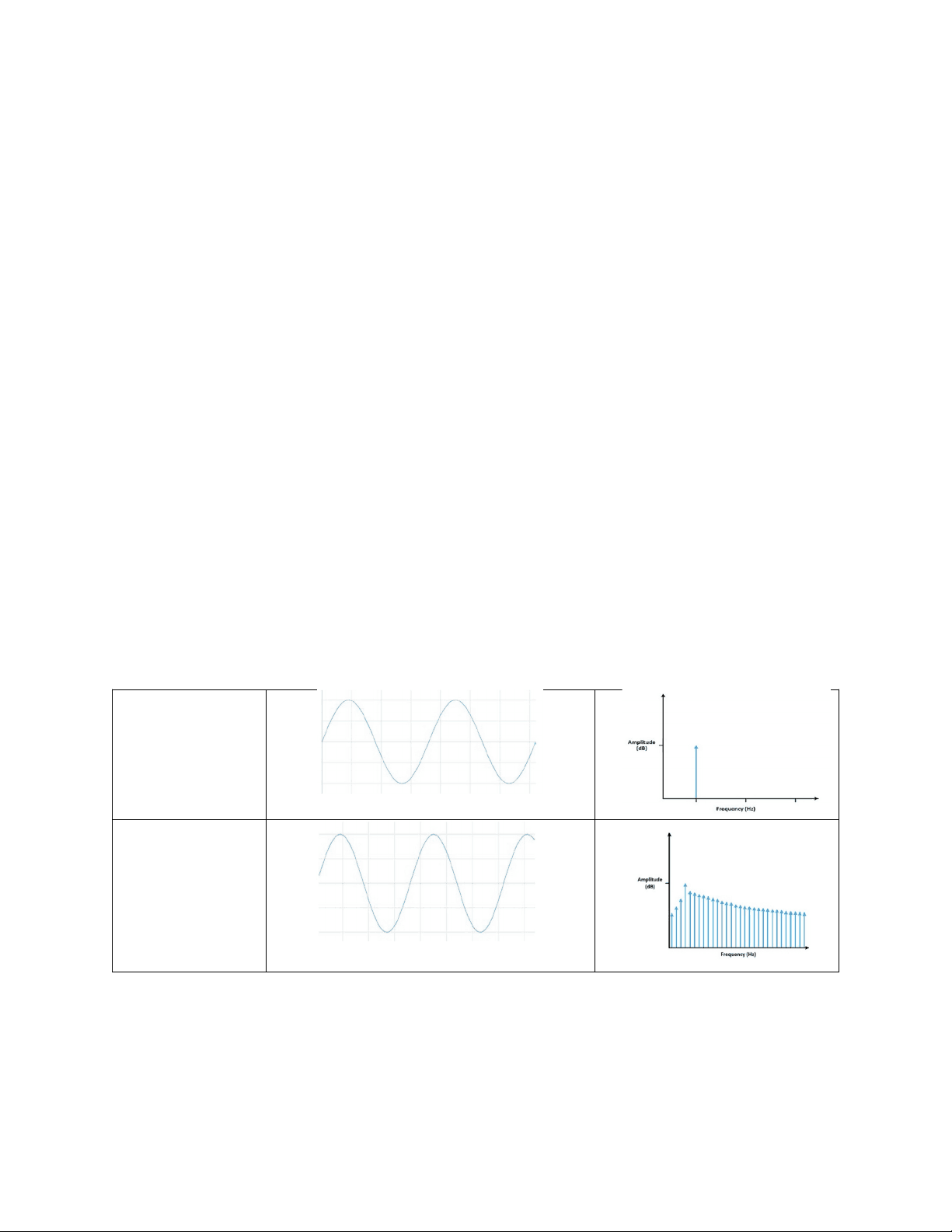
In spectral estimation lack of information about N results in other frequency components around asked frequency components this is called spectral leakage. The phenomenon of frequency leakage can be viewed in the table below. Finite signal Real world signal
WINDOWING:
In order to reduce the effect of spectral leakage, Windowing is performed over real world signal to break the signal in the chunks by multiplying the windowing function with the original signal. The complete
spectral estimation of the signal is performed by windowing the small chunks individually and then combine the results to see the whole picture of the signal. There are several different types of window functions that you can apply depending on the signal. An actual plot of a window shows that the frequency characteristic of a window is a continuous spectrum with a main lobe and several side lobes.
Main Lob & Side Lobs:
The main lobe is centered at each frequency component of the time-domain signal, and the side lobes approach zero. The height of the side lobes indicates the affect the windowing function has on frequencies around main lobes. The side lobe response of a strong sinusoidal signal can overpower the main lobe response of a nearby weak sinusoidal signal. Typically, lower side lobes reduce leakage in the measured FFT but increase the bandwidth of the major lobe. The side lobe roll-off rate is the asymptotic decay rate of the side lobe peaks. By increasing the side lobe roll-off rate, we can reduce spectral leakage.
CRITERIA OF SELECTING WINDOWING FUNCTION:
Each window function has its own characteristics and suitability for different applications. To choose a window function, we must estimate the frequency content of the signal.
To demonstrate the impact of window functions on a real signal, let’s measure the spectrum of a sine signal at 100 kHz