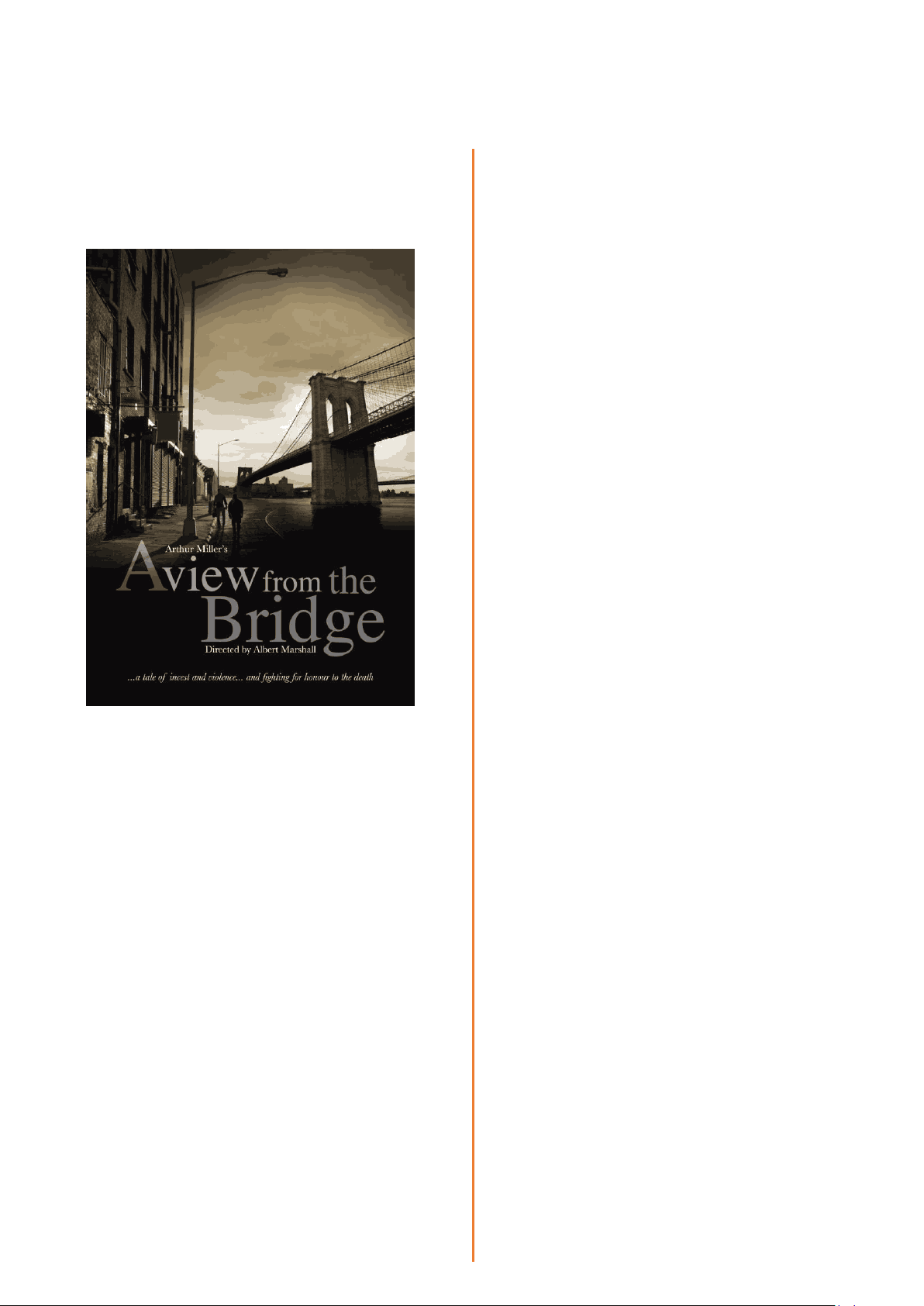
Download “A View from the Bridge” by Arthur Miller Study pack and more Study notes Italian in PDF only on Docsity!
“A VIEW FROM
THE BRIDGE” BY
ARTHUR MILLER
STUDY PACK
This study pack is designed to help you prepare for the critical essay element of the Critical Reading paper.
ABSTRACT
This study pack contains summaries of the text, key quotations and the essay plans that we created in class.
Ms Kirkwood
National 5 English: Critical Reading Paper
Contents Page
- Character Summary……………………………………………………………………………………………. 2 -
- Plot Summary…………………………………………………………………………………………………… 6 -
- Dramatic Effect Summary………………………………………………………………………………….... 9 -
- Key Quotations………………………………………………………………………………………………….
- Turning Point Essay Plan……………………………………………………………………………………… 12 -
- Dramatic Scene Essay Plan…………………………………………………………………………………...14-
- Conflict Essay Plan………………………………………………………………………………………………16-
- Loyalty Essay Plan………………………………………………………………………………………………18-
o Physical conflict with Rodolfo. o Conflict within himself as he grapples with his love of Catherine
Beatrice Carbone
She is Eddie's wife. She has never had children of her own and cares for Catherine as if she were her own daughter.
She is a loving, caring person. She is excited by the imminent arrival of her cousins and worried that
everything is not just so for them, yet also "nervous".
She defers to Eddie and lets him control things in the home. Before the arrival of her cousins, she is anxious
not to upset him: "I'm just worried about you." There are hints right from the start that she is aware of Eddie's feelings for Catherine, such as when she
avoids Eddie's gaze when Catherine fetches his cigar. This becomes more obvious when she confronts Eddie about the state of their marriage: "When am I gonna be a wife again, Eddie?"
Partly because of this, she supports Catherine and encourages her to be independent. She helps Catherine
persuade Eddie to let Catherine go out to work and, later, tells Catherine she must stand up for herself. "It means you gotta be your own self more."
She has a no-nonsense, practical approach, makes clear observations and is assertive. At the end, she is
brave enough to tell Eddie the truth: "You want somethin' else, Eddie, and you can never have her!"
She is upset by the conflict within the family that the relationship between Rodolfo and Catherine causes.
She continually tries to be the calming influence. At the end, however, she remains loyal to Eddie, choosing to stay with him rather than attend Catherine's wedding. She is rewarded for this with Eddie's dying words
Catherine
She is 17 years old, the orphaned daughter of Beatrice's sister Nancy.
She is attractive, energetic and cheerful. Yet she is also naive - she has never known anything of life
outside the Carbone household.
She loves Eddie like a father.
She wants his approval for everything that she does: right at the start, she is desperate for him to admire her new skirt.
Later we hear that perhaps she is too familiar with Eddie now she has grown up: Beatrice tells her not to
wander round the apartment in her slip, which shocks and saddens Catherine - the stage directions say, "She is at the edge of tears, as though a familiar world had shattered." She had never before imagined there was anything wrong with her relationship with Eddie. She is excited at Marco and Rodolfo's arrival - they represent the world outside her own sheltered life. She
is attracted to Rodolfo straight away - so she is reluctant to take off her high heels when Eddie tells her to!
She is initially torn because her love of Rodolfo is at odds with her love for Eddie.
She tries to encourage Eddie to talk to Rodolfo: "Why don't you talk to him, Eddie? He blesses you, and you
don't talk to him hardly." She is loyal to Eddie and tells Beatrice that her marriage to Rodolfo would be wrong if Eddie is against it.
However, she is prepared to take sides : when Eddie spars with Rodolfo at the end of Act 1, she rushes to
help her lover. (This prepares us for her choosing to marry Rodolfo in spite of Eddie's wishes in Act 2.)
By the start of Act II, she has become quieter and more withdrawn, concerned about the rift between the two men she loves. She mourns to Rodolfo, "I mean I know him and now I'm supposed to turn around and make a stranger out of him?"
However, she is strong enough to leave Eddie to get married, and is furious with him both for betraying the
brothers and for forbidding Beatrice to attend her wedding ceremony, calling him "This rat!"
During the play, she turns from a child into a woman, capable of making her own decisions. Despite her new independence and maturity , she blames herself on Eddie's death: "Eddie, I never meant to do nothing bad to you." Do you think she is partly responsible for the tragedy?
Marco
Marco is the older brother of Rodolfo. He comes from a poor village in Sicily. He is Beatrice's cousin.
He has left a wife and three children at home, the oldest of whom has tuberculosis. He has come to America
so he can earn more money for them than he could at home. It is clear he loves his family very much: he is near tears when he first talks about them to the Carbones.
He is anxious not to outstay his welcome with the Carbones: almost his first words are "I want to tell you now, Eddie - when you say we go, we go." He is extremely polite.
He always speaks simply and clearly ; which indicates his straightforward, uncomplicated character.
He is very strong. Eddie's friend Mike describes him as a regular bull.
He feels a sense of responsibility for Rodolfo: when Eddie is upset that Catherine and Rodolfo were out
late, he warns his brother "You come home early now." However, he is also protective of Rodolfo. After Eddie has punched Rodolfo while 'teaching' him to box, he
shows how he can lift a chair above his head with one hand. The stage directions tell us the chair is raised like a weapon over Eddie's head. He is warning Eddie that he will defend Rodolfo if necessary.
He has a clear sense of justice. He sees things as right or wrong. When he is arrested, he spits in Eddie's face
and accuses Eddie in front of the neighbours - "That one! He killed my children!" His sense of honour is such that if the law can't right a wrong, he will take the law into his own hands. He
comes to see Eddie at the end to do what he sees as his duty - even when Alfieri had warned him that only God makes justice. (It is interesting that he breaks his word to Alfieri - he kills Eddie despite having promised he would not.)
Do you think that Marco would have killed Eddie if Eddie has not got out a knife? What do you think is Marco's reaction to Eddie's death?
Rodolfo
He is the younger brother of Marco. He has got platinum hair and so makes an immediate impression. He has striking good looks - Beatrice and
Catherine are obviously attracted to him. His unusual looks may be a signal to us that he is 'different' from the average Italian immigrant. (We later find that he has a different, more sensitive way of trying to solve disputes from Eddie and Marco.)
He has a good sense of humour , so he is popular. He is unvaryingly polite, even when Eddie is rude. Unlike Marco, he wants to stay in America and own a motorbike. He loves America and wants to find out
as much about New York as possible - he is keen to see Broadway. Eddie is concerned because he buys 'American' items like a new jacket and records, rather than send money to Marco's family.
He can sing, cook and sew: he is very talented. It upsets him that Eddie seems to dislike him so much - he
cannot understand why his 'feminine' skills are a problem for the 'manly' Eddie.
PLOT SUMMARY BY ACT
Act 1 Scene 1 The play opens with the lawyer Alfieri, who sets the scene. He talks about justice and how, sometimes, justice is dealt with outside the law. He says he has a timeless story to tell - one that ran a "bloody course" he was powerless to prevent - and introduces its hero, Eddie Carbone. One day Eddie arrives home from the dockyard where he works with some news. He announces that Beatrice's two cousins from Italy have reached New York and they will arrive at the family's home at 10 o'clock that night. It is obvious that the family has often discussed the visit before - Beatrice is anxious that she hasn't completed all the preparations in the house she had intended to welcome them, and Eddie reminds Beatrice not to be so kind to the cousins that he will be turned out of his own bed for them. Yet he then claims it is an honour for him to be able to help them.
Act 1 Scene 2
Catherine also has some news: she tells Eddie that she has been picked out of all the girls in her typing class to be offered a well-paid job at a big plumbing company. She is excited at the prospect, but Eddie is worried: he doesn't want her mixing with strangers, wants her to finish her education and is concerned for her safety. Beatrice takes Catherine's side, however, so in the end Eddie relents and allows Catherine to take the job. Because the cousins are illegal immigrants, Eddie reminds Beatrice and Catherine not to mention them outside the house. To reinforce the danger, Eddie tells the story of Vinny Bolzano, who let on to the Immigration authorities that his family were hiding an uncle - and the bloody consequences.
Act 1 Scene 3
The cousins, Marco and Rodolfo, arrive and are warmly welcomed. The quiet, polite Marco reassures Eddie that they will not outstay their welcome and talks about his family left behind in Sicily, desperate for the cash that he will be able to send them once he starts work. He hopes to go home in about six years. The cheerful Rodolfo describes what it is like living in a poor peasant village: unlike his brother, he wants to stay in America. Rodolfo shows off his voice by singing 'Paper Doll', to Catherine's delight. Eddie puts a stop to the music because he doesn't want suspicions raised in the neighbourhood, but we also sense Eddie's dislike of Rodolfo - his face is "puffed with trouble."
Act 1 Scene 4
A few weeks later, Eddie and Beatrice sit waiting for Catherine and Rodolfo to come home from the cinema. It is clear that Rodolfo and Catherine have fallen in love. Eddie's hostility towards Rodolfo is now more open and he is anxious - Beatrice jokes that he must to jealous of Rodolfo. She admires Rodolfo and hope that he and Catherine will marry, but Eddie is appalled by this idea. This conversation leads Beatrice to ask Eddie about the state of their own marriage: they have not made love for months. Eddie refuses to discuss it. When Catherine and Rodolfo finally return, Eddie asks to speak to Catherine alone. He repeats, wistfully, that she has grown up without his realising it. When she admits to liking Rodolfo, Eddie tells her that Rodolfo is only using her and that he just wants to marry an American to gain US
citizenship. Catherine is very upset. She admits privately to Beatrice that she loves Rodolfo and wants to marry him, but that she doesn't want to hurt Eddie. Beatrice advises her to be more independent and grown up, and less intimate with Eddie in the house.
Act 1 Scene 5
Eddie goes to see Alfieri, wanting the law to step in to stop Catherine marrying Rodolfo. He claims that Rodolfo is only doing it to gain a US passport, and that Rodolfo is homosexual. Eddie is amazed when Alfieri explains that no law can prevent the marriage. Alfieri hints that perhaps Eddie loves Catherine too much (over and beyond the caring, uncle-niece love which could be expected), to which Eddie reacts angrily. There is tension in the air when we next see Eddie, Beatrice, Catherine, Marco and Rodolfo at home together. Eddie makes barbed comments, implying that Rodolfo is too friendly with Catherine and too casual with his money. He pretends to admire the fact that Rodolfo can cook, sew and sing, before adding that it is wrong for someone with those skills to work at the docks. He offers to treat Rodolfo and Marco to a night watching a prize-fight and teaches Rodolfo to box. This is clearly just an excuse to punch Rodolfo, but Rodolfo takes it good-humouredly. Catherine shows that she is more interested in Rodolfo's safety than Eddie's. Marco shows off his own strength to Eddie by lifting a chair by its leg with one hand - a feat that Eddie cannot match.
Act 2 Scene 1 It is nearly Christmas. Catherine and Rodolfo are alone in the apartment for the first time. Catherine is sombre. She asks Rodolfo if they could live in Italy when they are married, but he claims it would be ridiculous to go back to such poverty. He does reassure her that he is not going to marry her just to gain US citizenship, however. She says that she doesn't want to hurt Eddie. When he has comforted her, they go into the bedroom. Eddie returns, drunk, and is aghast to see Rodolfo follow Catherine out of the bedroom. He tells Rodolfo to leave immediately; Catherine says that she will go too, but Eddie grabs her and kisses her. When Rodolfo protests, saying Catherine is going to be his wife, Eddie kisses him too. The men fight, "like animals". Four days later, Eddie returns to Alfieri and tells him what happened. Marco has not been told of the fight. Alfieri reiterates that there is nothing Eddie or the law can do to prevent the wedding. He advises Eddie to let the couple marry, warning him that there could be awful consequences if he didn't. Yet Eddie ignores Alfieri's words and telephones the Immigration Bureau, anonymously, to betray the cousins. When Eddie returns home, he finds that Marco and Rodolfo have moved upstairs to a neighbour's apartment. There is a tense conversation with Beatrice - she is very angry with him. Beatrice tells Eddie that Catherine and Rodolfo are going to get married next week, ironically because Catherine is afraid that the authorities will catch up with the brothers. She tries to get Eddie
- who has tears in his eyes - to agree to come to the wedding and, when Catherine comes in, Beatrice encourages Catherine to ask Eddie herself. Catherine refuses to listen to Eddie's suggestion that it is not too late for her to meet other boys - his last-ditch attempt to prevent the wedding.
Act 2 Scene 2
DRAMATIC EFFECT SUMMARY
Each of the following aspects of the play contribute importantly to the build-up of dramatic tension as we wait to see how the tragedy will play out.
The Character of Eddie
The drama revolves around Eddie. He is the focal point. Everything rests on Eddie's reaction to events. At first this is comparatively minor: will he or won't he allow Catherine to take the job at the plumbing company? Yet soon it becomes crucial: will he or won't he understand that he cannot keep Catherine to himself - that he must allow her to live her own life?
Eddie is the centre round which all the conflict in the play revolves.
Verbal conflict with all the other characters at some point or another. He often deliberately starts
arguments - for instance, he questions the virtue of the wives of Italian immigrants: "I betcha there's plenty of surprises sometimes when those guys get back there, heh? Even his jokes are barbed and bitter.
Conflict within himself as he grapples with his love of Catherine.
Physical conflict with Rodolfo and, ultimately, Marco. This creates a lot of tension, with each scene of conflict becoming more intense than the one that preceded it. The tense atmosphere during the boxing at the end of Act 1 leads on to the shock near the start of Act 2 when an enraged Eddie kisses both Catherine and Rodolfo and starts a fight - which in turn prepares us for the final scene.
Tone and Timing
There are numerous changes in tone. Again, this is often dependent on Eddie. If he is in a good mood, such as immediately the cousins arrive and the stage directions tell us he is "laughing" , the tone is light-hearted; if he is in a bad mood, such as later on that night when "his face puffed with trouble" , there is tension. Can you think of any other changes in the tone in the play?
Timing is crucial to the action of the play. For example, Eddie calls the Immigration Bureau after his meeting with Alfieri on the very day that Catherine says that she is going to marry Rodolfo soon because she is scared of him getting caught by Immigration; simultaneously Marco and Rodolfo move out of the apartment, and thereby cause other immigrants - relatives of the Liparis who have nothing to do with Eddie - to be picked up too. From then on, the pace increases quickly to the end.
These examples of unlucky timing give rise to dramatic irony (where the audience have a better idea of what is going to happen than the characters do themselves). Another example is when the Immigration Officers appear outside the Carbones' apartment just as Catherine is arguing with Eddie over where Marco and Rodolfo if Eddie throws them out of the building. We know their argument is pointless because the officers are about to pounce. The effect of dramatic irony is to involve us in the action, to make us feel implicated, almost as if we are ourselves characters in the play.
The Ending
The ending is poignant. A private tragedy ends up being acted out in public. All the main characters and other people are on the street outside the apartment to see Eddie killed by Marco. Alfieri rounds off the drama by reminding us that Eddie's death was useless and that he loved him, but that he mourns him with "a certain... alarm." What does Alfieri mean by this?
He is thinking that even though he could predict what was going to happen, even he - a lawyer - could do nothing to prevent it.
Probably he is thinking that Eddie's faults are common ones, and that his story should be a warning to us all
to be more self-aware.
Perhaps another, equally disturbing thought has occurred to him: that when it finally comes, Eddie's
destruction feels not only tragic, but in some way right and appropriate: like the old generation making way for the new.
Class Essay Plans: These essay plans are typed up versions of you group-work plans. You should also have these in your jotters.
A View from the Bridge: National 5 Essay Plan
Choose a scene from a play which acts as a turning point in the fate of a character. By referring to appropriate techniques, show how this scene acts as a turning point and explain what effect it has on the play as a whole.
Introduction
- Title
- Author
- Genre (tragedy)
- Summary (no more than 2 sentences) -Link to the question
EXAMPLE: "A View from the Bridge" by Arthur Miller is a tragedy set in a Brooklyn slum in 1950's America. The play centres around an Italian immigrant community for whom loyalty is incredibly important. The arrival of two illegal immigrants, Rodolfo and Marco, marks the beginning of the tragic events for the tragic hero, Eddie Carbone, as he cannot control his feelings of jealousy. The beginning of Act 2 marks the turning point of the play as Eddie's irrational behaviour leads him to make an important and fatal decision - calling immigration and betraying his community.
Paragraph One Statement: Eddie's arrival onto the scene at the beginning of Act 2, marks the turning point of the play. Miller makes clear that Eddie has been drinking and no longer has control over his jealousy. Context: On seeing Catherine and Rodolfo emerge from the bedroom, Eddie's anger and violent impulses are obvious: Quotation: "Eddie: (his arm jerks slightly in shock)...Pack it up. Go ahead. Get your stuff and get outa here." Analysis: Eddie is clearly not in control of this impulse and it betrays his feelings of anger and aggression. Continue the analysis of this paragraph including the following information:
- On seeing Eddie's physical reaction, the audience feels tense (explain why)
- The short, blunt sentences leave no room for discussion – what does this show about Eddie’s state of mind?
- Reality of Eddie's feelings - drops all pretence of 'protecting Catherine' and it's clear he-s acting in jealousy.
- Remember to link back to the question at the end of the paragraph.
Paragraph Two: Statement: Eddie’s aggressive and violent impulses continue to grow in this scene and his behaviour becomes more irrational and out of control. Context : Introduce your quotation Quotation : Either quote the stage directions or simply describe how Eddie kisses both Catherine and Rodolfo – you don’t have to quote stage directions. Analysis : He is trying to show his dominance and masculinity to Catherine and he is trying to prove that Rodolfo is “a weird” say what this shows about his state of mind.
Say that Catherine’s reaction demonstrates that he is completely lost and that his actions are irrational – she says that she will “kill him”. Think back to the boxing scene – just like in that scene, Eddie’s actions have the opposite effect to that which he intended. say what this is and how the audience feels on seeing that he doesn’t get his way. Break down of his family relationships – he loses everything he wants and the audience feel tense as they can sense his desperation. say what this shows about the theme of loyalty Link back to the question
Paragraph Three:
Statement: This should be one or more sentences which link this paragraph to paragraph two. It should mention the question and clearly show what this paragraph is going to be about. Context: Introduce your quotation Quotations: "Eddie: Don't make me do nuttin', Catherine. Watch your step, submarine. By rights they oughta throw you back in the water. But I got pity on you." Analysis: Eddie is trying to blame Catherine for his irrational behaviour – this is a threat and shows that Eddie is trying to regain control say how the audience feels about this. Reminds Rodolfo of his illegal status say why this is surprising coming from Eddie and what Miller is trying to show that Eddie might do. Eddie is demonstrating his power over the couple say what the audience thinks about this. “By rights” – say why this is ironic (think American Law vs Italian Code and what Eddie used to be like) Link back to the question – how is this a difference in Eddie’s character?
Paragraph Four
Statement: This should be one or more sentences which link this paragraph to paragraph three. It should mention the question and clearly show what this paragraph is going to be about. Context: Introduce your quotation Quotations: "(A phone booth begins to glow on the opposite side of the stage; a faint lonely blue)" "Alfieri: ...You won't have a friend in the world, Eddie! Even those who understand will turn against you..." Analysis: Starts glowing = represents the start of the idea to call immigration in Eddie’s mind Light gets stronger = Eddie has definitely made up his mind to call immigration. Alfieri tries to stop him by reminding him of the consequences but light keeps getting stronger Audience learns he is determined – driven by his feelings for Catherine (theme of unnatural love) Forgets about loyalty and honour say why this is significant Tension between American law and Italian Code say what this tension helps the audience understand about this theme. Link back to the question – how has this scene determined the fate of Eddie Carbone?
“Eddie: ( crying out in agony ) That’s what you think of me? That I would have such a thoughts?” Think - why is this important? What are the implications? Think about Eddie's reaction to this accusation – how does it show us that he was in denial about his true motivations? o How does it engage the audience? o What do we feel for Eddie? Why do we feel this? o How does it make the scene tenser? o Say what theme it reveals and how it helps the audience to understand that theme.
Paragraph Four: The scene reaches a dramatic climax when Marco arrives to confront Eddie in front of the whole neighbourhood. Evidence: “Marco: Animal! You go on your knees to me!” Say why Marco is so angry and what he is seeking Say why Eddie cannot back down – think about his state of mind Say how Eddie eventually dies with the knife in his own hands Say what this symbolises and why this is such a dramatic climax to the scene Say how the audience is left feeling for Eddie Say what themes (justice and loyalty) this scene helps you to understand and how it helps you to understand them.
Conclusion
Summarise the reasons why this scene was so tense and how it left the audience feeling.
Summarise why the climax is so dramatic and how the audience is left feeling for Eddie
Say what themes this scene helped you to understand.
Critical Essay Plans – A View from the Bridge
Question:
Choose a play which deals with conflict within a family or a group of people.
Describe the conflict and explain what effects the conflict has on the characters and the events of the play.
Introduction:
- Author and title
- Summary
- Eddie’s inner conflict over his growing incestuous feelings for his niece Catherine cause a wider conflict within his family.
Paragraph 1
Statement
- From the beginning of the play Eddie is dealing with an inner turmoil caused by the ambiguity of his feelings for Catherine. Set the scene of seeming domestic harmony Family scene between Catherine, Beatrice and Eddie Eddie returning from work Quote and Analysis
- Miller uses Eddie’s character to show that the apparent domestic harmony might not be all that it seems. Eddie’s reaction and behaviour towards Catherine act as subtle clues to his growing feelings for her. ‘Listen, you been givin’ me the willies the way you walk down the street, I mean it.’
- Eddie’s reaction is stronger than the reaction of a protective father figure
- Because of the way he feels about her he presumes everyone else can see it too
- Miller is building tension by creating uncertainty around the relationship between Catherine and Eddie and hints at the action to follow
- At the beginning of the play Eddie has some control over his inner conflict. As the play progresses he loses control and this causes a more visible conflict within the family.
Paragraph 2
Statement
- Eddie’s internal conflict starts to surface when the cousins arrive. This acts as a catalyst, creating further conflict in the wider family. Catherine and Rodolfo’s developing relationship Eddie’s reaction to it – 1 st^ visit to Alfieri to try and stop the relationship before it starts Eddie’s outward displays of jealously towards Rodolfo Eddie’s attempts to emasculate Rodolfo
Quote and Analysis
‘I take the blankets off my bed for him, and he takes and puts his dirty, filthy hands on her like a goddam thief.’’
- Eddie thinks he owns Catherine. He treats her like a possession
- Eddie is causing conflict between himself, Beatrice, Catherine, Marco and Rodolfo by his actions and reactions
- Examples of this:
National 5 Critical Essay Plans – A View from the Bridge
Question:
How is the theme of loyalty established and developed in Arthur Miller’s “A View from the Bridge”.
Introduction
- Author and title
- Brief summary
- The theme of loyalty is established in the opening scenes of the play and is developed over the course of the drama through the action and characterisation.
Paragraph 1
Statement
- Early on in Act 1 the theme of loyalty to family and community is established. Eddie appears to value these qualities very highly and tells Catherine the story of Vinny Bolzano in order to warn her of the consequences of not being loyal. Briefly outline the story Say how the characters react to the story. Quote and Analysis
Eddie tries to really emphasise how important it is to be loyal to family and community and not to “snitch”.
“Just remember, kid, you can quicker get back a million dollars that was stole than a word you gave away”
- He emphasises just how difficult it would be to be forgiven.
- His warning shows that he would never consider betraying family – he has to warn others but Eddie is very aware of what the consequences would be.
- This makes it clear just how highly Eddie and the community value loyalty. At this point Eddie shows that he is full of integrity.
Paragraph 2
Statement
At the beginning of Act 2 the theme of loyalty reaches crisis point as it becomes clear that Eddie’s loyalty to his own feelings for Catherine is greater than any loyalty he may have for his community.
- Eddie’s desperation to end Catherine and Rodolfo’s relationship
- Eddie arrives home drunk, sees Catherine and Rodolfo leaving the bedroom and is filled with rage.
- His actions show he is forgetting about his loyalty to family and community.
Quotation and Analysis
“Don’t make me do nuttin’, Catherine. Watch your step, submarine. By rights I oughta throw you back in the water. But I got pity on you.” (59)
- It is clear Eddie is trying to make Catherine feel responsible by saying ‘Don’t make me’ – he is warning her.
- Makes the audience wonder what Eddie is planning to do. Indicates he is no longer loyal to family.
- Clear that he is contemplating drastic action – if he breaks loyalty audience knows there will be serious consequences.
- Say what Miller has shown about the theme of loyalty.
Paragraph 3+
Statement
At the end of Act 2 the theme of loyalty reaches climax as Eddie’s obsession with his niece has finally led him to break the code of the community (which he had a strong belief in) and inform the immigration bureau that Beatrice’s cousins are in America illegally.
Quotation and Analysis
“My God, what did you do?’ (74)
- Beatrice’s exclamation ‘My God’ conveys…
- Shows how important Beatrice and Catherine still consider loyalty to be. They can’t believe what has happened.
- How important loyalty is considered – how significant it is that Eddie betrayed family. “ Marco : That one! I accuse that one!... That one! He killed my children”
- Has ruined the lives of his cousins. Has betrayed his family – the consequences will be felt by more than a few.
- Betrayal considered as bad as killing – by breaking his loyalty to family, Marco will no longer be able to provide for his family.
- All of the community feel the same horror – even Beatrice, Eddie’s wife can’t believe what he has done.
The consequences of his betrayal – “ (Eddie tries in vain to convince his ‘friends’ that he is not in the wrong) “Eddie: Lipari!’ [ He follows LIPARI up left. ) ‘For Christ’s sake, I kept them, I give them the blankets off my bed! LOUIS barely turns, then walks off and exits down right with MIKE”
- denied by friends and family. He will not be forgiven for his lack of commitment to the community and to family.
Conclusion
- Sum up points made
- At the end of Act 2 the theme of loyalty to a code/community is brought to resolution as Eddie’s breaking of the code and betraying Marco and Rodolfo leads to his death.
- Discuss how well the theme was developed and what Miller has helped the audience to understand.