Download Angular Impulse & Momentum for a Particle: Angular Momentum, Rate of Change & Principle and more Exercises Classical Mechanics in PDF only on Docsity!
Lecture L10 - Angular Impulse and Momentum for a Particle
In addition to the equations of linear impulse and momentum considered in the previous lecture, there is a
parallel set of equations that relate the angular impulse and momentum.
Angular Momentum
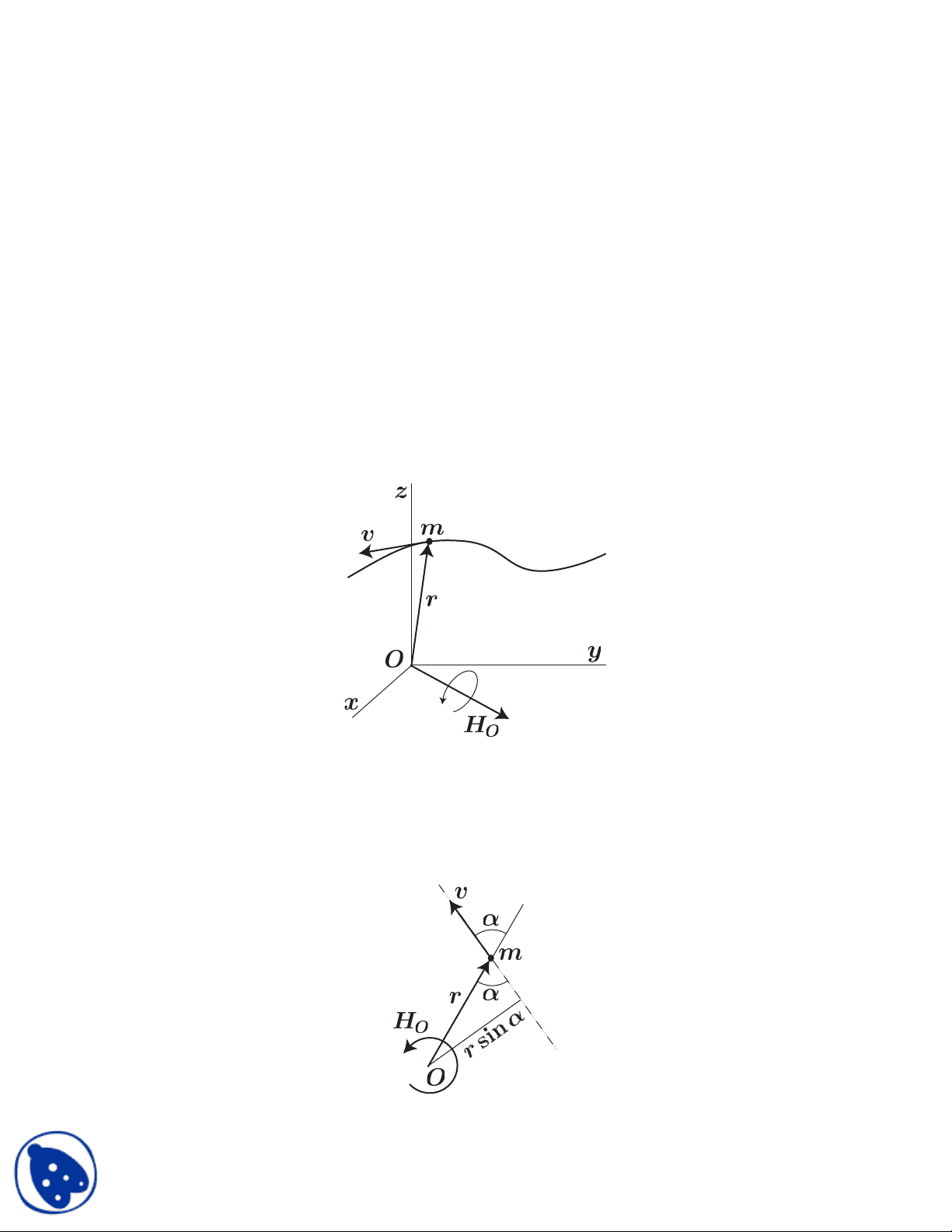
We consider a particle of mass m, with velocity v, moving under the influence of a force F. The angular
momentum about point O is defined as the “moment” of the particle’s linear momentum, L, about O.
Thus, the particle’s angular momentum is given by,
HO = r × mv = r × L. (1)
The units for the angular momentum are kg m 2 /s in the SI system, and slug ft 2 · · /s in the English system.
It is clear from its definition that the angular momentum is a vector which is perpendicular to the plane
defined by r and v. Thus, on some occasions it may be more convenient to determine the direction of HO
from the right hand rule, and its modulus directly from the definition of the vector product,
HO = mvr sin α ,
where α is the angle between r and v.
In other situations, it may be convenient to directly calculate the angular momentum in component form.
For instance, using a right handed cartesian coordinate system, the components of the angular momentum
are calculated as
HO = Hxi + Hy j + Hz k =
i j k
x y z
mvx mvy mvz
= m(vz y − vy z)i + m(vxz − vz x)j + m(vy x − vxy)k.
Similarly, in cylindrical coordinates we have
HO = Hr er + Hθ eθ + Hz k =
er eθ k
r 0 z
mvr mvθ mvz
= −mvθ zer + m(vr z − vz r)eθ + mvθ rk.
Rate of Change of Angular Momentum
We now want to examine how the angular momentum changes with time. We examine this in two different
coordinate systems: system a) is about a fixed point O; system b) is about the center of mass of the particle.
Of course system b) is rather trivial for a point mass, but its later extensions to finite bodies will be extremely
important. Even at this trivial level, we will obtain an important result.
About a Fixed Point O
The angular momentum about the fixed point O is
HO = r × mv (2)
point mass, the x
� , y
� system. The result that the angular momentum in this coordinate system is zero, gives
us an immediate result that no external torques can act on the particle. Gravity acts at the particle and
therefore produces no moment. Therefore we conclude that the force in the rod must point directly to the
mass, along the rod itself. In other words the rod acts as a string supporting a tension T. We will later see
that if the pendulum has a finite moment of inertia about the center of mass, this result no longer applies.
We now examine the pendulum in a coordinate system fixed at the point O and re-derive the pendulum
equation using equation (3).
There are two forces acting on the suspended mass: the string tension and the weight. By our earlier
argument, the tension, T , is parallel to the position vector r and therefore its moment about O is zero. On
the other hand, the weight creates a moment about O which is M (^) O = −lmg sin θk.
The angular momentum is given by
HO = r × mv = ler × mlθ
eθ = ml
2 θ
er × eθ = ml
2 θ
k.
Therefore, the z component of equation (3) gives
ml
2 θ¨^ = −lmg sin θ ,
or,
θ¨^ +
g sin θ = 0 , l
which is precisely the same equation as the one derived in lecture L5 using Newton’s law. The derivation
using angular momentum is more compact.
Principle of Angular Impulse and Momentum
Equation (3) gives us the instantaneous relation between the moment and the time rate of change of angular
momentum. Imagine now that the force considered acts on a particle between time t 1 and time t 2. Equation
(3) can then be integrated in time to obtain
t 2 t 2
M (^) O dt = H
O dt^ = (HO ) 2 −^ (HO ) 1 = ΔHO.^ (4) t 1 t 1
Here, (HO ) 1 = HO (t 1 ) and (HO ) 2 = HO (t 2 ). The term
t 2
M (^) O dt ,
t 1
is called the angular impulse. Thus, the angular impulse on a particle is equal to the angular momentum
change.
Equation (4) is particularly useful when we are dealing with impulsive forces. In such cases, it is often
possible to calculate the integrated effect of a force on a particle without knowing in detail the actual value
of the force as a function of time.
Conservation of Angular Momentum
We see from equation (1) that if the moment of the resultant force on a particle is zero during an interval of
time, then its angular momentum HO must remain constant.
Consider now two particles m 1 and m 2 which interact during an interval of time. Assume that interaction
forces between them are the only unbalanced forces on the particles that have a non-zero moment about a
fixed point O. Let F be the interaction force that particle m 2 exerts on particle m 1. Then, according to
Newton’s third law, the interaction force that particle m 1 exerts on particle m 2 will be −F. Using expression
(4), we will have that Δ(HO ) 1 = −Δ(HO ) 2 , or ΔHO = Δ(HO ) 1 + Δ(HO ) 2 = 0. That is, the changes
in angular momentum of particles m 1 and m 2 are equal in magnitude and of opposite sign, and the total
angular momentum change equals zero. Recall that this is true only if the unbalanced forces, those with
non-zero moment about O, are the interaction forces between the particles. The more general situation in
which external forces can be present will be considered in future lectures.
We note that the above argument is also valid in a componentwise sense. That is, when two particles interact
and there are no external unbalanced moments along a given direction, then the total angular momentum
change along that direction must be zero.
Example Ball on a cylinder
A particle of mass m is released on the smooth inside wall of an open cylindrical surface with a velocity v 0
that makes an angle α with the horizontal tangent. The gravity acceleration is pointing downwards. We
want to obtain : i) an expression for the largest magnitude of v 0 that will prevent the particle from leaving
For part ii), we also consider conservation of energy
mv
2 = mvb
2 − mgb 2
0 2
and conservation of angular momentum,
rmv 0 cos α = rmvb cos β.
Eliminating, vb from these two expressions we obtain,
β = cos
− 1 �
cos α . 1 + 2gb/v 0
2
Example Spinning Mass
A small particle of mass m and its restraining cord are spinning with an angular velocity ω on the horizontal
surface of a smooth disk, shown in section. As the force F (^) s is slowly increased, r decreases and ω changes.
Initially, the mass is spinning with ω 0 and r 0. Determine : i) an expression for ω as a function of r, and ii)
the work done on the particle by F (^) s between r 0 and an arbitrary r. Verify the principle of work and energy.
The component of the moment of the forces acting on the particle is zero along the spinning axis. Therefore,
the vertical component of the angular momentum will be constant. For i), we have
r 0
2 ω 0 mr 0 v 0 = mrv, v 0 = ω 0 r 0 , v = ωr → ω =. r 2
For ii), we first calculate the force on the string
v
2 r
2 ω
2 r 0
4 ω 0
2
Fs = −m = −m = −m. r r r 3
The work done by Fs, will be
r r dr 1 1 1 W = Fsdr = −mr 0
4 ω
2
r 3
= mr 0
4 ω
2
2 r 2
r
2 r 0 r 0 0
The energy balance implies that
T 0 + W = T.
This expression can be directly verified since,
m(ω 0 r 0 )
2
m(ω 0 r 0 )
2 r
r
0
2
2
m(ωr)
2 . 2 2 2 � �� � (^) � �� � � �� � T 0 W T
Example Ballistic Pendulum
We consider a pendulum consisting of a mass, M , suspended by a rigid rod of length L. The pendulum is
initially at rest and the mass of the rod can be neglected. A bullet of mass m and velocity v 0 impacts M
and stays embedded in it. We want to find out the angle θmax reached by the pendulum. The angle that
the velocity vector v 0 forms with the horizontal is α.
Because the rod is assumed to be rigid, we can expect that when the bullet impacts the mass, there will
be an impulsive reaction that the rod will exert on the bullet. If we use the principle of linear impulse and
momentum, it will be necessary to solve for this impulsive force. An alternative approach that simplifies the
problem considerably is to use the principle of angular impulse and momentum. We consider the angular
momentum about point O of the particles m and M just before and after the impact. The only external
forces acting on the two particles are gravity and the reaction from the rod. It turns out that gravity is not
an impulsive force and therefore its effect on the total angular impulse, over a very short time interval, can
be safely neglected (it turns out that in this case, the moment about O of the gravity forces at the time of
impact is also zero). On the other hand, we can expect the reaction from the rod to be large. However, the
moment about O of this reaction is zero, since it is directed in the direction of the rod. Therefore, we have
that during impact, the z component of the angular momentum is conserved.