


Holodomor — The name of the man-made famine of
1932 and 1933that killed millions of Soviet citizens,
most of them Ukrainians. Collectivization policies and
the Soviet government’s seizure of grain have been
blamed for the mass starvation. “Holod” means
“hunger” in the Ukrainian language.
Collectivization — The policy of transferring the own-
ership of private farmland to the state. The Soviet state
in the 1930s seized land and set up collective farms
where workers would produce grain for the state to
distribute. The policy proved disastrous for grain pro-
duction levels.
Kulak — “Fist” in Russian. It was the term used to
demonize farm owners during collectivization. Ku-
laks resisted collectivization. Millions were exiled to
forced labor camps or killed as a result.
Collectivization and the H olodomor
The 1930s saw many horrors in the Soviet Union. Joseph
Stalin’s purges resulted in the execution of thousands, while
millions more were sent to forced labor camps. The decade
began with the forced collectivization of farms throughout the
Soviet Union, a process that resulted in the deaths of millions
by starvation. Ukraine, which suffered the most from collectivi-
zation, lost an estimated 3-5 million people to a famine that
was entirely avoidable and likely at least in part deliberate.
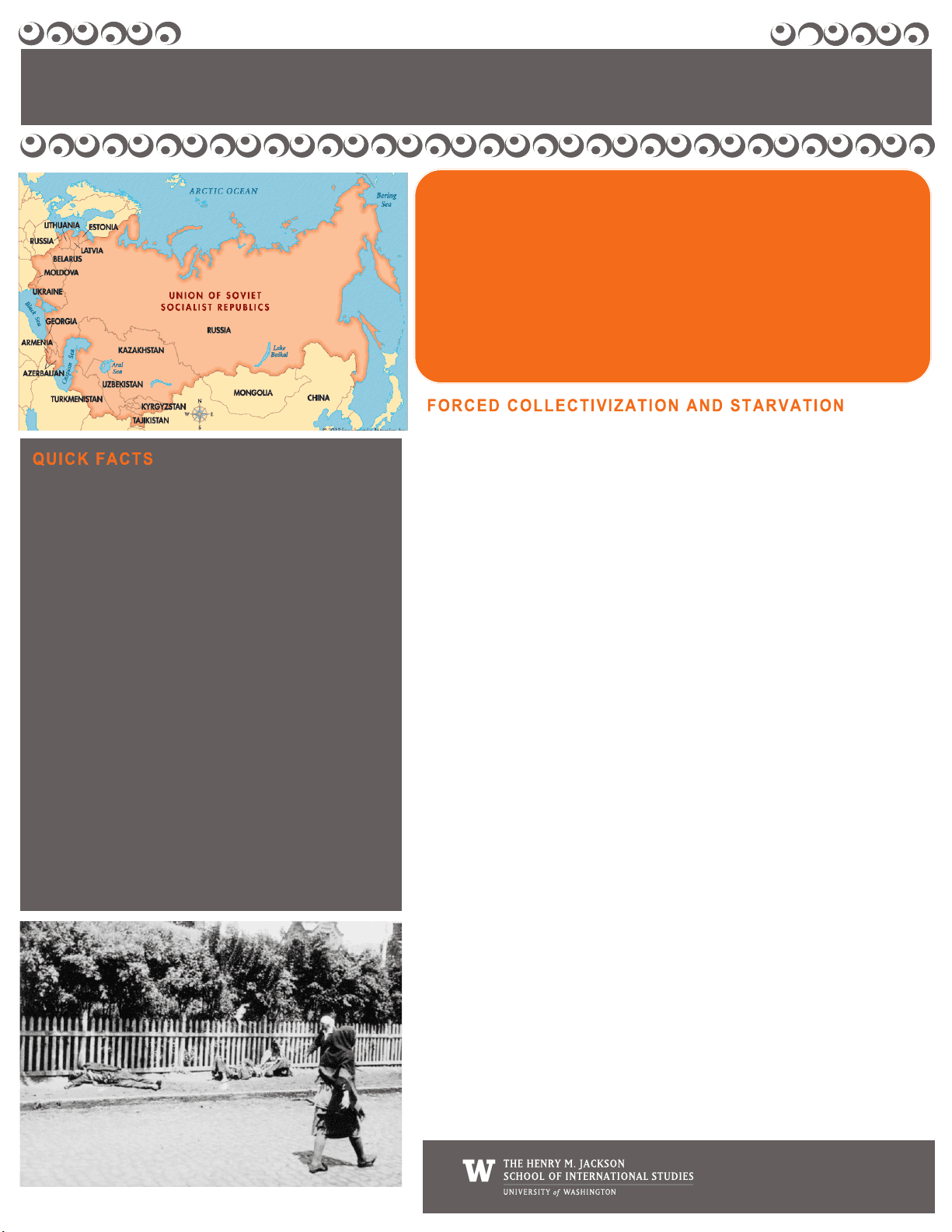
Famine victims lie on the streets of Kharkiv
By the end of the 1920s, Joseph Stalin had consolidated power as the
unchallenged leader of the Soviet Union. In 1928 he introduced a pro-
gram to collectivize farms and end private ownership of land. Farmers in
Ukraine, known as the “bread basket” of the Soviet Union for its fertile
soil, resisted giving up their land to the state and joining collective farms.
The Soviet state under Stalin responded with a program called “de-
kulakization,” which evicted farmers and their families. The word “kulak”
means “fist” in Russian and was used to demonize private farmers who
refused to open their “clenched fists” and participate in building socialism.
More than a million Ukrainian farmers were exiled to the far reaches of
the Soviet Union or left without homes or work in the process.
In 1932, the Soviet state increased Ukrainian grain harvest quotas, even
as collectivization policies led to much lower production levels. The im-
possibly high quotas meant grain that would be normally be eaten by
farmers was confiscated and sent to other parts of the Soviet Union or
sold abroad. As a result, millions, mostly rural Ukrainians, went hungry.
The state gave orders to the internal police, the NKVD, to arrest or exe-
cute farmers who tried to steal grain from fields or storage facilities. The
so-called kulaks were also denied residency permits to gain access to
housing in cities. Signs of agony became widespread as starving families
moved to the streets of cities such as Kharkiv, desperate to find food.
In 1930, an estimated 30,000 people were dying of starvation per day,
many of them children. Some resorted to cannibalism.
Because the USSR did not record deaths from the famine and attempted
to cover it up, an exact number of victims is difficult to verify. However,
scholars generally agree that millions lost their lives. Discussion of the
Holodomor was banned until the final years of the USSR under Mikhail
Gorbachev’s policies of glasnost and perestroika.
Updated: June 2017
C L A S S R O O M C O U N T R Y P R O F I L E S

