
Stormwater Pollution Prevention Plan Quiz, Exams of Environmental Science

A quiz focused on developing a stormwater pollution prevention plan (swppp). It covers key aspects such as identifying pollution sources, implementing control measures, understanding npdes permit requirements, and best management practices (bmps). The quiz questions address structural and non-structural bmps, regulatory compliance, and the importance of site evaluations in preventing stormwater pollution. This resource is valuable for students and professionals in environmental science, civil engineering, and construction management, providing a practical assessment of knowledge in stormwater management.

Typology: Exams

2024/2025

Available from 08/31/2025

Upstudy
Upstudy 🇺🇸

2.8

(9)

13K documents

1 / 6

Toggle sidebar

This page cannot be seen from the preview

Don't miss anything!

bg1
DEVELOPING YOUR STORMWATER
POLLUTION PREVENTION PLAN TEST
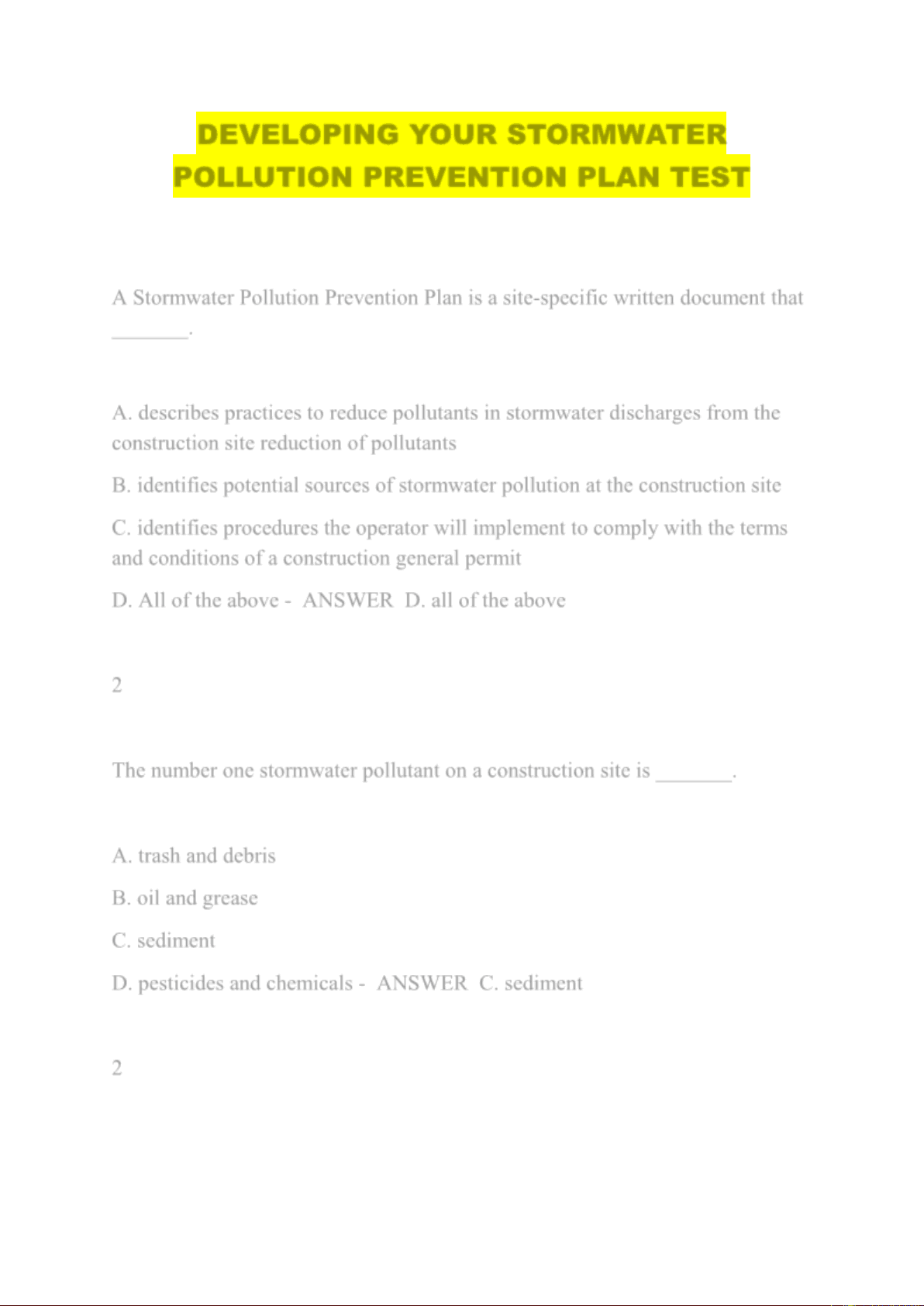
A Stormwater Pollution Prevention Plan is a site-specific written document that
_______.
A. describes practices to reduce pollutants in stormwater discharges from the
construction site reduction of pollutants
B. identifies potential sources of stormwater pollution at the construction site
C. identifies procedures the operator will implement to comply with the terms
and conditions of a construction general permit
D. All of the above - ANSWER D. all of the above
2
The number one stormwater pollutant on a construction site is _______.
A. trash and debris
B. oil and grease
C. sediment
D. pesticides and chemicals - ANSWER C. sediment
2
pf3
pf4
pf5

Partial preview of the text

Download Stormwater Pollution Prevention Plan Quiz and more Exams Environmental Science in PDF only on Docsity!

DEVELOPING YOUR STORMWATER

POLLUTION PREVENTION PLAN TEST

A Stormwater Pollution Prevention Plan is a site-specific written document that _______. A. describes practices to reduce pollutants in stormwater discharges from the construction site reduction of pollutants B. identifies potential sources of stormwater pollution at the construction site C. identifies procedures the operator will implement to comply with the terms and conditions of a construction general permit D. All of the above - ANSWER D. all of the above 2 The number one stormwater pollutant on a construction site is _______. A. trash and debris B. oil and grease C. sediment D. pesticides and chemicals - ANSWER C. sediment 2

Which of the following is not a structural BMP used to prevent stormwater pollution? A. silt fences B. picking up trash and debris C. temporary seeding D. erosion control blankets - ANSWER B. picking up trash and debris 3 The Clean Water Act requires nearly all construction site operators engaged in clearing, grading, and excavating activities that disturb _______ acre(s) or more to obtain coverage under a National Pollutant Discharge Elimination System (NPDES) permit for their stormwater discharges. A. 1 B. 1. C. 2 D. 3 - ANSWER A. 1 4 Which of the following would NOT be required to obtain NPDES permit coverage for their stormwater discharges?

C. Develop an outline for your SWPPP D. Evaluate your proposed construction site and identify measures to protect natural features - ANSWER D. Evaluate your proposed construction site and identify measures to protect natural features 10 Vehicle/equipment use and storage can cause which of the follow poluntants? A. Oil and grease B. Sediment C. Heavy metals D. All of the above - ANSWER A. Oil and grease 12 Sec table Which of the following is NOT a primary means of preventing stormwater pollution? A. Protect slopes B. Retain sediment on-site and control dewatering practices C. Control stormwater flowing onto and through the project D. Phase construction activity - ANSWER B. Retain sediment on-site and control dewatering practices 17

Designated washout areas for concrete, paint and stucco operations should be located at least ________ yards away from storm drains whenever possilbe. A. 150 B. 100 C. 75 D. 50 25 - 26 Your construction general permit describes the minimum frequency of inspections which is typically weekly or bi-weekly and after each rainfall event exceeding _______ inch A. 1/ B. 1/ C. 1 D. 1.5 - ANSWER B. 1/ 28 You must keep copies of the SWPPP, inspection records, copies of all reports required by the permit, and records of all data used to complete the NOI to be covered by the permit for at least ________ year(s) from the date that permit coverage expires or is terminated.