




B.Sc. Engg. CSE 7th Semester /
B.Sc. Engg. SWE 5th Semester
Date: 16 September 2021
ISLAMIC UNIVERSITY OF TECHNOLOGY (IUT)
ORGANISATION OF ISLAMIC COOPERATION (OIC)
Department of Computer Science and Engineering (CSE)
SEMESTER FINAL EXAMINATION
WINTER SEMESTER, 2020-2021
DURATION: 1 Hour 30 Minutes
FULL MARKS: 75
CSE 4733 / CSE 4561: Digital Image Processing
Programmable calculators are not allowed. Do not write anything on the question paper.
There are 3 (three) questions. Answer all 3 (three) of them.
Figures in the right margin indicate marks and corresponding CO & PO are written in brackets.
Special Instructions:
i. Limited Open Book Exam: Use the Hardcopy book “Digital Image Processing” by
Gonzalez & Woods, Printed Lectures slides, & Handwritten Class-notes only.
ii. No Internet Browsing, No Keyboard use.
iii. No softcopy of any kind of Class Material or e-Book.
iv. Your full Monitor should be within your camera view.
1.
a)
Show that 2D Fourier Transform can be computed by first computing 1D Fourier transform
along the individual rows (columns) of an input image, followed by performing another 1D
Fourier transform along the columns (rows) of the results from the first transform output.
8
[CO1,
PO1]
b)
Mathematically prove that multiplying an image f(x,y) with
( 1)xy
and then applying
Fourier Transform shifts the frequency domain by
,
22
N
M
, i.e.,
𝔍
( , )( 1) F u , v
22
xy N
M
f x y
Note: Use the term
()
( 1)
x y j x y
e
.
7
[CO3,
PO3]
c)
Suppose, you have a
33
spatial mask which can enhance the edge structures of an image
through convolution operation. How can you produce an equivalent filter that can give you
the same output when applied with element-wise multiplication in the Frequency domain?
10
[CO3,
PO3]
2.
a)
Design the required transformation function(s) for producing the complement
transformation of color images using HSI color space.
5
[CO3,
PO3]
b)
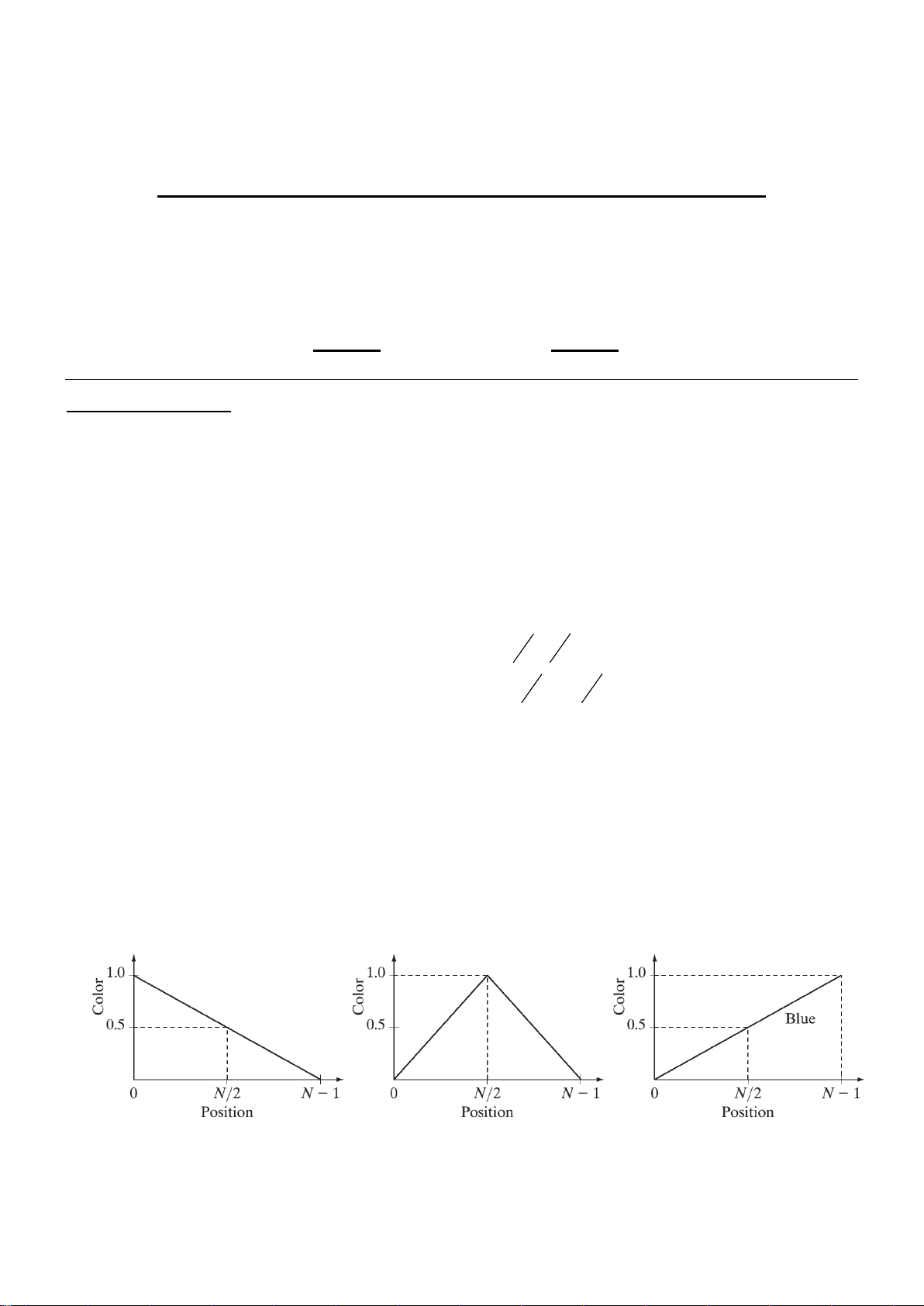
In a 24-bit RGB image, the R, G, and B channels have the horizontal intensity profiles
shown in Figure 1.What color would a person see in the middle column (y=N/2) of this
image? Here, the column size of the image is N.
5
[CO2,
PO2]
Figure 1.
c)
In an automated assembly application, two classes of parts are to be color coded in order to
simplify detection. However, only a monochrome TV camera is available to acquire digital
images. Propose a technique for using this camera to detect the two different colors, such as
Red and Cyan.
10
[CO3,
PO3]
Green
Red
