


2
docsity.com


Study with the several resources on Docsity

Earn points by helping other students or get them with a premium plan

Prepare for your exams
Study with the several resources on Docsity
Earn points to download
Earn points by helping other students or get them with a premium plan
Dr. Chittaranjan Verma delivered this lecture for Digital Image Processing course at B R Ambedkar National Institute of Technology. It includes: Objective, Image, Enhancement, Digital, Image, Processing, Frequency, Domain
Typology: Slides
1 / 29

This page cannot be seen from the preview
Don't miss anything!
5
Point/Pixel operationsOutput
value
at
specific
coordinates
(x,y) is dependent only on the inputvalue at (x,y)
Local operationsThe output value at (x,y) is dependenton
the
input
values
in
the
neighborhood of (x,y)
Global operationsThe output value at (x,y) is dependenton all the values in the input image
6
domain
enhancement
methods
can
be
generalized
as
8
g(x,y) = T [f(x,y)]
Pixel/point operation:
Neighborhood of size 1x1: g depends only on f at (x,y)
T: a gray-level/intensity transformation/mapping function
Let r = f(x,y) & s = g(x,y), (r and s represent gray levelsof f and g at (x,y)), then
s = T(r)
Local operations:
g depends on the predefined number of neighbors of f at(x,y)
Implemented by using mask processing or filtering
Masks (filters, windows, kernels, templates): a small (e.g.3×3) 2-D array, in which the values of the coefficientsdetermine the nature of the process
9
Image negatives
Log transformations
Power-lawtransformations
11
12
14
Fourier spectrum: image values
ranging from 0 to 1.5x
6
Scaled linearly for display purpose
The result of log transformation
with c = 1
15
17
Gamma correction
To make the CRT response linear, a pre-distortioncircuit is needed
s = cr
1/
18
20
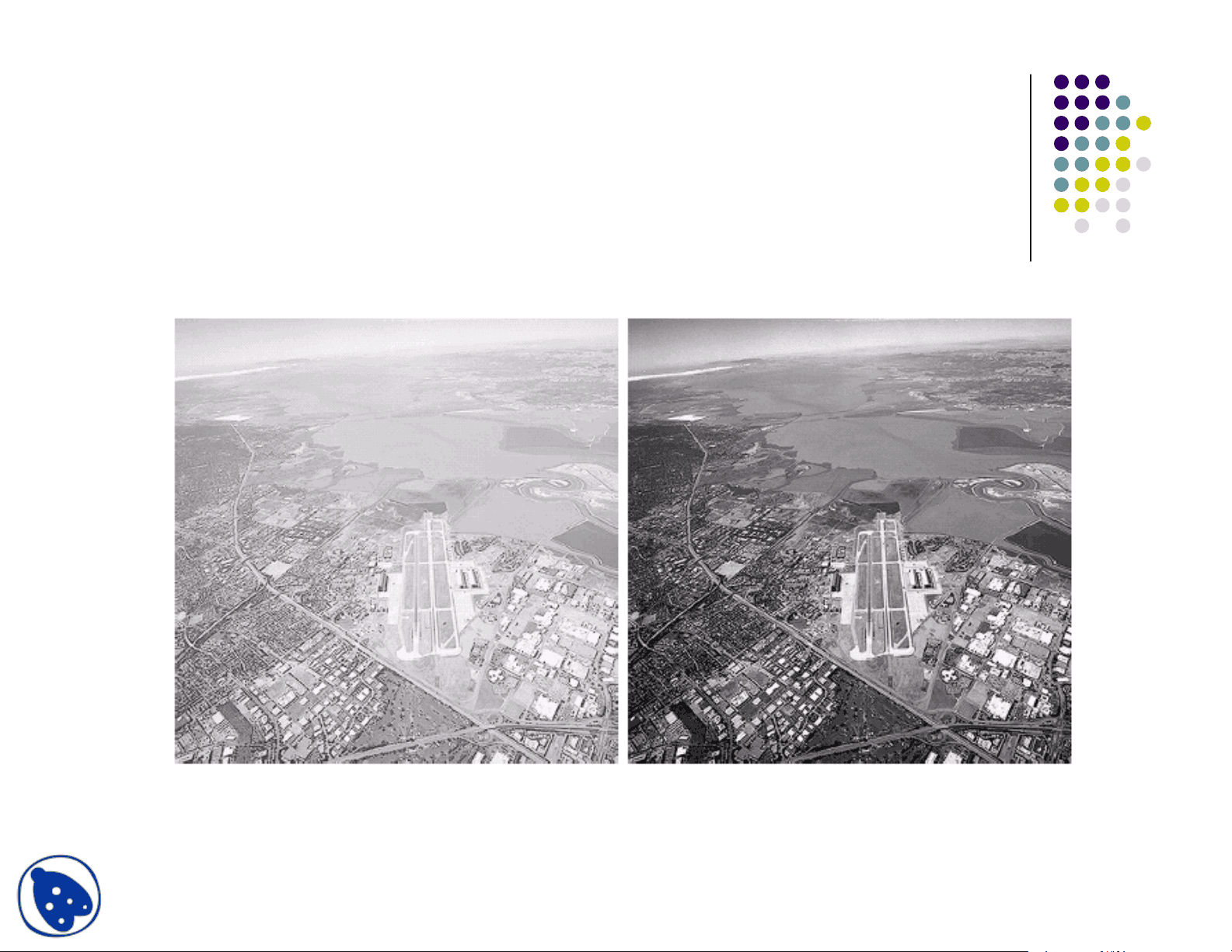
Aerial Image
Result ofPower lawtransformationc = 1,
= 3.
(suitable)
Result of
Power law
transformation
c = 1,
= 4.
(suitable)
Result ofPower lawtransformationc = 1,
= 5.
(high contrast,some regions aretoo dark, somedetails are lost)
21
Examples: Contrast stretch, Gray level slicing, etc.Contrast stretch
Objective:
Increase the dynamic range of the gray
levels for low contrast images
Low contrast images can result from:
poor illumination
lack of dynamic range in the imaging sensor
wrong setting of a lens aperture during image acquisition