


EARLY CIVILIZATIONS
IN THE EASTERN HEMISPHERE
Reading study guide


Study with the several resources on Docsity

Earn points by helping other students or get them with a premium plan

Prepare for your exams
Study with the several resources on Docsity
Earn points to download
Earn points by helping other students or get them with a premium plan
A study guide on the early civilizations in the Eastern Hemisphere, focusing on Mesopotamia, Egypt, India, and China. It covers topics such as geography, agriculture, economy, government, technology, religion, and writing. The document also includes an assessment section with multiple-choice questions. The study guide is useful for students who want to learn about the origins of civilization in the Eastern Hemisphere.
Typology: Schemes and Mind Maps
1 / 40

This page cannot be seen from the preview
Don't miss anything!
Learning Targets
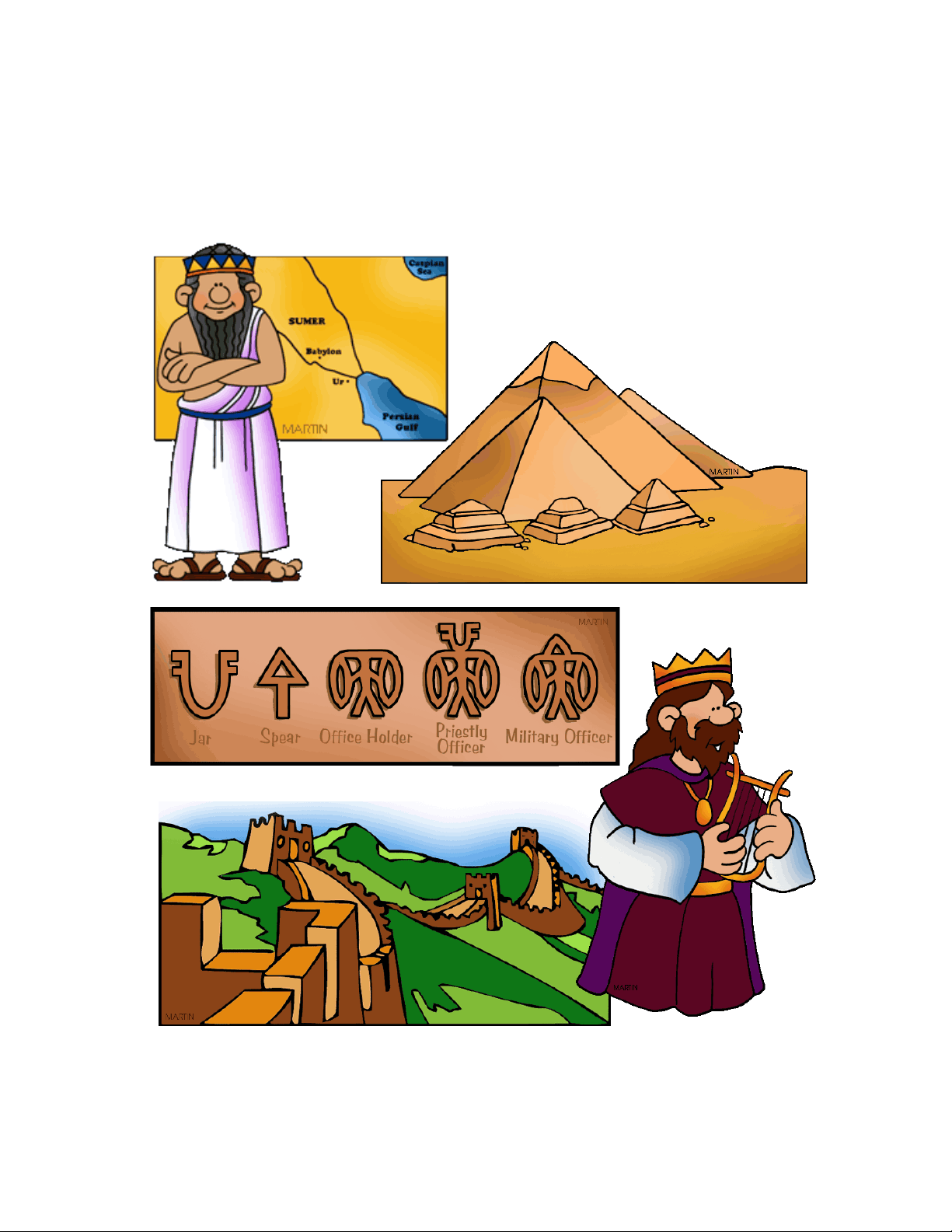
Historians often refer to the ancient Near East as the “The cradle of civilization.” Many great civilizations rose and fell here. The religions of Judaism, Christianity, and Islam began in this area. The Fertile Crescent is the region in which humans first began farming and herding around 8,000 B.C.E. This change from hunting and gathering allowed early humans to settle into permanent villages and to produce a surplus of food. The area of Mesopotamia (modern- day Iraq) within the Fertile Crescent gave rise to the region’s most powerful empires and greatest cities. Mesopotamia was the land between the Tigris and Euphrates Rivers. With a surplus of food, people could focus on developing the skills needed for civilization. Some people became priests, scribes, merchants, artists, teachers, and government officials. They began to build cities and establish empires. Sumerian City-States (4,000 B.C.E. – 2,000 B.C.E) Geography and Agriculture – The Sumerians settled in Mesopotamia around 4000 B.C.E. They lived in independent, walled city-states. The climate was very dry. There was very little natural vegetation, and palm trees were the only trees that grew there. The rivers flooded in the spring, and deposited a rich layer of silt on the surrounding floodplain. This silt provided fertilizer for growing crops. Sumerians farmers build large irrigation systems of canals and dams. Before long, the desert was blooming with a surplus of barley, dates, and other crops. They were also the first people to use the plow to lift the silt-rich soil of their crop fields.
Writing – As the government and economy grew, officials and merchants needed a writing system to record information. Developed between 3500 B.C.E. and 3000 B.C.E., the writing system, called cuneiform, consisted of wedged-shaped characters. Sumerians wrote on clay tablets, using a reed pen called a stylus. The world's oldest book is The Epic of Gilgamesh , a collection of stories about a Sumerian hero. Babylonian Empire (1792 B.C.E. – 1595 B.C.E.) As many Sumerian city-states grew weak from outside invasions and military conflict, the city-state of Babylon took over and established an empire in Mesopotamia. Babylonian rulers constructed temples, roads, and an extensive canal system. They also organized laws. Technology – Nebuchadnezzar built the Hanging Gardens of Babylon, one of the Seven Wonders of the World. Babylon received little rain, and there were few stone slabs needed to hold terraces in place in the region. Engineers devised a chain pump that brought water from the Euphrates River to irrigate the gardens. The gardens were a lush mountain of vegetation in the middle of a flat, dry desert. Government and Law – Hammurabi came to power in 1792 B.C.E., and is the best known of all Mesopotamian kings. As he conquered city-states and his empire grew, he wanted one set of laws for all of the diverse peoples he conquered. He sent legal experts throughout his kingdom to gather existing laws. Some were changed or removed before compiling the final list of 282 laws, known as the Code of Hammurabi. The phrase "an eye for an eye" represents what many people view as a harsh sense of justice based on revenge. The entire code, however, is much more complex than that one phrase. The code outlines rules for witnesses and those making accusations of crimes. It details how theft or destruction of property should be handled and gives guidelines for dealing with trade and business problems.
The code also gives rules for family matters, such as marriage, divorce, and adoption. Payment amounts for the work of doctors and other professionals are outlined. The Code covers all types of issues related to farming and herding animals, and it also lays out rules on the ownership and sale of slaves. Babylonians did not believe all people were equal. The code treated slaves, commoners, and nobles differently. Women had some rights, including the ability to buy and sell property and to obtain a divorce. Assyrian Empire ( 1365 B.C.E. – 609 B.C.E.) Assyria was located in the middle and northern part of Mesopotamia. While Babylonia is best remembered for its contributions in literature, architecture, and the law, Assyria is remembered for its military strength, advances in weapons, and conquests. In its time, the Assyrian Empire was the greatest the world had ever seen. Their armies were highly trained and professional. And their troops had a great deal of experience in battle. Assyrian armies used movable towers and iron-headed battering rams for sieges on walled towns. Soldiers used iron weapons, which were much stronger than the bronze weapons of some of their foes. The Assyrians also built roads for quick and easy movement of troops, so that conquered rebelling kingdoms could easily be brought back under control. With the wealth they obtained, the Assyrian kings built well-fortified and beautiful cities. In these cities they placed their grand palaces, some of which spanned several acres. The first glassmaking, the invention of backgammon, the early version of the lock and key, even the massage, are believed to be Assyrian inventions.
Exercise 1.2 Mesopotamia Timeline Use the information from the chapter to place the following events on the timeline below.
Chapter 1. Ancient Mesopotamia Assessment
Learning Targets
The sands of the Nile River Valley hold many clues about one of the most mysterious, and artistic ancient civilizations. A great deal of evidence survives about how the ancient Egyptians lived, but questions remain. Geography In 3,000 B.C.E., Egypt’s geography looked similar to the way it looks today. The country was mostly covered by desert. But along the Nile River was a fertile land that was (and remains today) a life source for many people. None of the achievements of ancient Egypt would have been possible without the Nile River. There is always a connection between land and how a civilization develops. The Nile is the longest river in the world. It flows north for nearly 4, miles. In ancient times, crops could be grown only along a narrow, 12- mile stretch of land that borders the river. Along the river were fruit trees, and fish swam in the Nile in great numbers. Agriculture At the same time each year, the Nile flooded for about six months. This flooding left a rich layer of silt that was fit for growing wheat, beans, barley, or even cotton. Farmers learned to dig short canals leading to fields near the Nile. This provided fresh water for irrigation all year. By planting right after a flood, the Egyptians could have harvests before the next year's flood. Egyptians needed to track days so they would know when to plant. They developed an accurate calendar based on the flooding of the Nile. It
Egyptian rulers, pharaohs, were believed to be gods in human form. They had total power over people. The pharaoh was responsible for protection and directed the army in case of a foreign threat or conflict. All laws were passed at the will of the pharaoh. Nobles and Priests were right below the pharaoh in status. Only nobles could hold government posts. They grew wealthy from tributes paid to the pharaoh. Priests were responsible for pleasing the gods. Soldiers fought in wars or put down uprisings within Egypt. During long periods of peace, soldiers also supervised peasants, farmers, and slaves who built as pyramids and palaces. Skilled workers such as physicians and craftspersons made up the middle class. Merchants and storekeepers sold goods to the public. Slaves and farmers were at the bottom of the social structure pyramid. Slaves were captured as prisoners of war. They were forced to work on building projects. Farmers paid taxes in the form of grain that could be as much as 60 percent of their yearly harvest. A small number of peasants and farmers moved up the social pyramid. Families saved money to send their sons to village schools to learn trades. Government There were more than 30 dynasties in Egyptian history. Dynasties were powerful groups or families that ruled Egypt for a number of years. Dynasties helped keep Egypt united. This was a difficult task. Leaders Complete the Egyptian Social Structure Pyramid by listing the groups from the most powerful at the top to the least powerful at the bottom.
faced periods of turmoil, rivals within Egypt, and foreign groups who wanted to conquer the region. Most of the pharaohs who ruled Egypt for about 3,000 years were considered strong military leaders, successful traders, and overseers of great building projects. Pharaohs could not manage all these duties without assistance. The pharaoh appointed a chief minister called a vizier as a supervisor. The vizier ensured that taxes were collected. Working with the vizier were scribes who kept government records. Scribes had mastered a rare skill in ancient Egypt — they could read and write. After pharaohs died, huge stone pyramids were built as their tombs. Pharaohs were buried in chambers within the pyramids. For centuries, they were the tallest structures in the world. Pyramids are one of the Seven Wonders of the World. Pyramids were built for religious purposes. Egyptians believed that when the physical body expired, the ka (soul) enjoyed eternal life. Those who passed the test of Osiris wanted to be comfortable in their lives beyond earth. The Great Pyramids were simply grand tombs of powerful pharaohs. Ancient Egyptian civilization lasted for several thousand years. Many of its discoveries and practices have survived an even greater test of time.
Chapter 2. Ancient Egypt Assessment
