




Minerals are present everywhere and some examples can be found at home.
Example of these are: Hematite (hinges, handles, make-up color), Chromite (chrome
plating, dyes), Copper (electric wiring), Quartz (clocks, mirrors), Gold (jewelries),
Feldspar (porcelain, ceramics) and Fluoride (toothpaste). Because of its importance,
we need to determine its physical and chemical properties.
This part of the module will give you details on the different physical and
chemical properties of minerals.
PHYSICAL AND CHEMICAL PROPERTIES OF MINERALS
Minerals can be distinguished using their physical and chemical properties.
https://www.saddleback.edu/faculty/jrepka/notes/GEOmineralLAB_1.pdf
Physical properties include habit, luster, cleavage and fracture, hardness,
color, and streak.
1. Crystal Habit – refers to the overall shape or growth pattern of the mineral. It can
be described as equant, elongate and platy.
Equant – three dimensions of the mineral have about the same length, like that of
a cube or sphere. (ei. garnet)
Elongate – forms prismatic or prism-like crystals that are thicker than the needle
as in a pencil. (ei. Indicolite)
Platy – looks like a flattened and thin crystal (like plate). (ei. Wulfenite)
2. Luster - describes the appearance of a mineral when light is reflected from its
surface. It can be described as opaque, transparent, dull, or shiny.
Metallic luster is opaque and very reflective like gold and silver.
Nonmetallic luster is dull, silky, greasy, and pearly like silicates.
3. Cleavage and Fracture – Cleavage refers to the tendency of minerals to break
along very smooth, flat and shiny surfaces. It can be described as one, two, three,
four or all direction. A mineral fracture may break along random, irregular
surfaces. It can be classified as conchoidal, uneven, hackly, splintery, and earthy.
Some minerals break only by fracturing, while others both cleave and fracture.
Biotite and mica have one direction, orthoclase has two directions, galena has
three directions and fluorite has four directions.
Quartz has a conchoidal fracture while asbestos has a splintery fracture.
4. Hardness – is a measure of the mineral’s resistance to scratching. Harder
minerals will scratch softer minerals. Friedrich Mohs in 1812 ranked minerals
according to hardness as shown in Table 1. He selected ten minerals of distinctly
different hardness that ranged from a very soft mineral (talc) to a very hard
mineral (diamond).
5. Color - is one of the most obvious properties of a mineral but not reliable alone.
Some minerals come in just one color, while others come in many colors and
varieties. Quartz varies widely in color, due to minor (parts per billion) impurities
and even defects in its crystalline structure.
6. Streak - refers to the color of the mineral in its powdered form, which may or may
not be the same color as the mineral. According to Bayo-ang (2016) streak is obtained
by scratching the mineral on an unpolished piece of white porcelain called a streak
plate. When the excess powder is blown away, what remains is the color of the streak.
Streak is a more reliable property than color as streak shows the true color of
minerals. It does not vary even if color does.
Additional Properties
There are other properties of minerals.
(https://fac.ksu.edu.sa/sites/default/files/geo_221-unit-2_0.pdf )
Magnetism - Some minerals are attracted to a hand magnet. To test a mineral
for magnetism, just put the magnet and mineral together and see if they are
attracted. Magnetite is the only common mineral that is always strongly magnetic.
Striations -presence of very thin, parallel grooves. The grooves are present in only
one of the two sets of cleavages and are best seen with a hand lens. They may not
be visible on all parts of a cleavage surface. Before you decide if there are no
striations, look at all parts of all visible cleavage surfaces, moving the sample around
as you look wherein light is reflected from these surfaces at different angles.
Specific Gravity - is the weight of that mineral divided by the weight of an
equal volume of water. The specific gravity of water equals 1.0. Most
silicate, or rock-forming, minerals have specific gravities of 2.6 to 3.4; the ore
minerals are usually heavier, with specific gravities of 5 to 8. For most minerals,
specific gravity is not a particularly noteworthy feature, but for some, high specific
gravity is distinctive (examples are barite and galena).
Taste, Odor, Feel – Some minerals have distinctive taste (halite is salt, and
tastes like it). Some give off a distinctive odor (the powder of some sulfide minerals,
such as sphalerite, a zinc sulfide, smells like rotten eggs), and some have a distinctive
feel (talc feels slippery).
A. Chemical Properties
Chemical properties of minerals show the presence and arrangement of atoms
in minerals. Using their chemical properties, minerals are identified by how they
react to certain substances. Some minerals, especially carbonate minerals, react
visibly with acid. (Usually, a dilute hydrochloric acid [HCl] is used.) When a drop of
dilute hydrochloric acid is placed on calcite, it readily bubbles or effervesces,
releasing carbon dioxide. Some are toxic like cinnabar and soluble in water like
halite.
Metallic sulfide minerals form into sulfuric acid when exposed to air and
water. Uranium and thorium containing minerals like Autunite (hydrated calcium
uranium phosphate) and Thorianite (thorium dioxide) are radioactive. Metals like
magnesium are flammable.
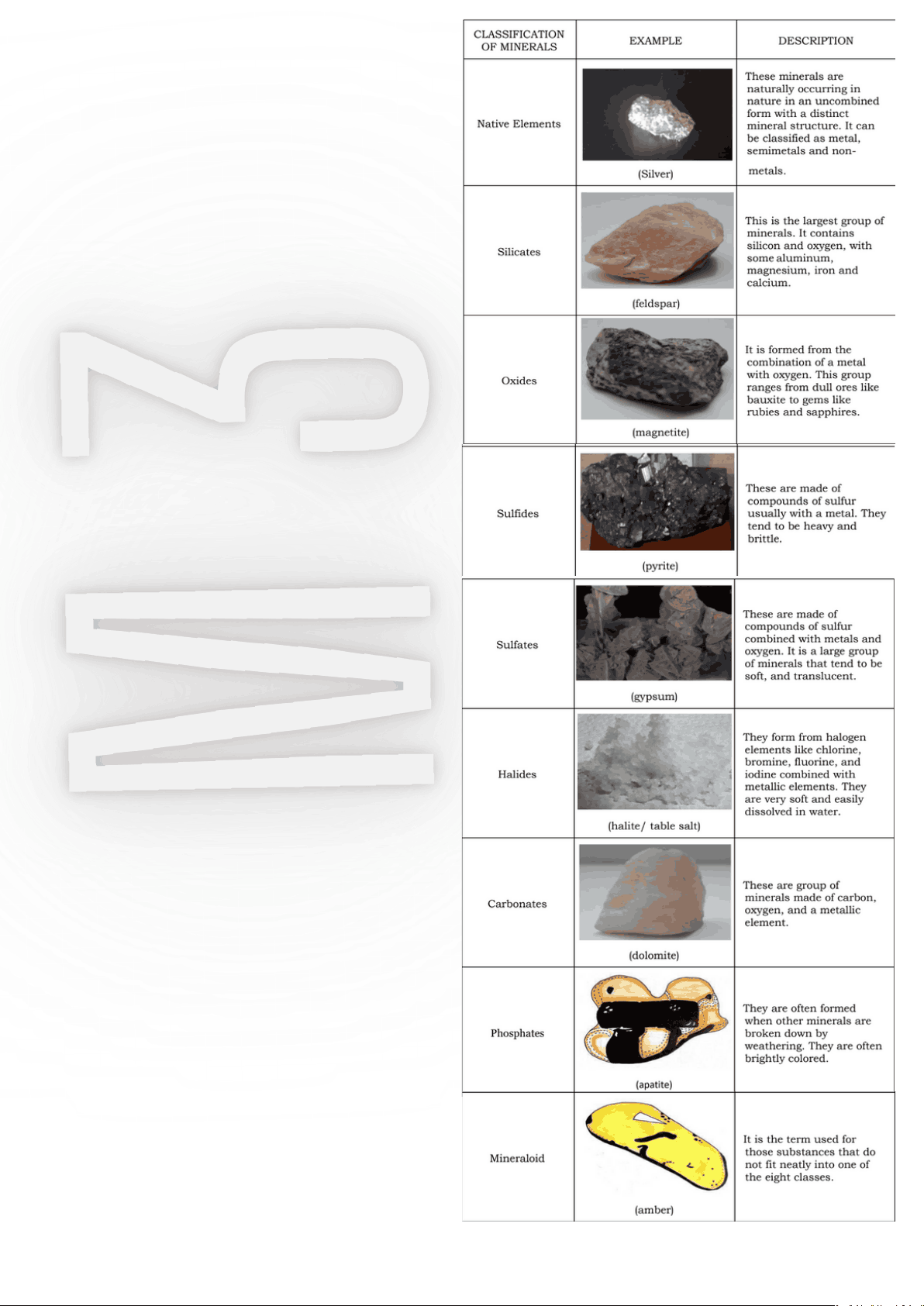
Furthermore, Cuarto (2016) classified minerals according to their chemical
composition using Dana System which divides minerals into eight basic classes. The
classes are native elements, silicates, oxides, sulfides, sulfates, halides, carbonates,
phosphates, and mineraloids. This classification shows the chemical composition of
minerals.
