Download Lesson 1 Lecture on Earth Science and more Lecture notes Earth science in PDF only on Docsity!
Fact Sheet in Earth Science
Lesson 1: The Universe and the Solar System
MOTIVATION: The Universe is said to be at least 13. billion of years old and the Earth/ Solar System at least 4.5-4.6 billion of years old. But how large exactly is a billion? How long will it take you to spend 1 billion pesos if you spend 1 peso per second?
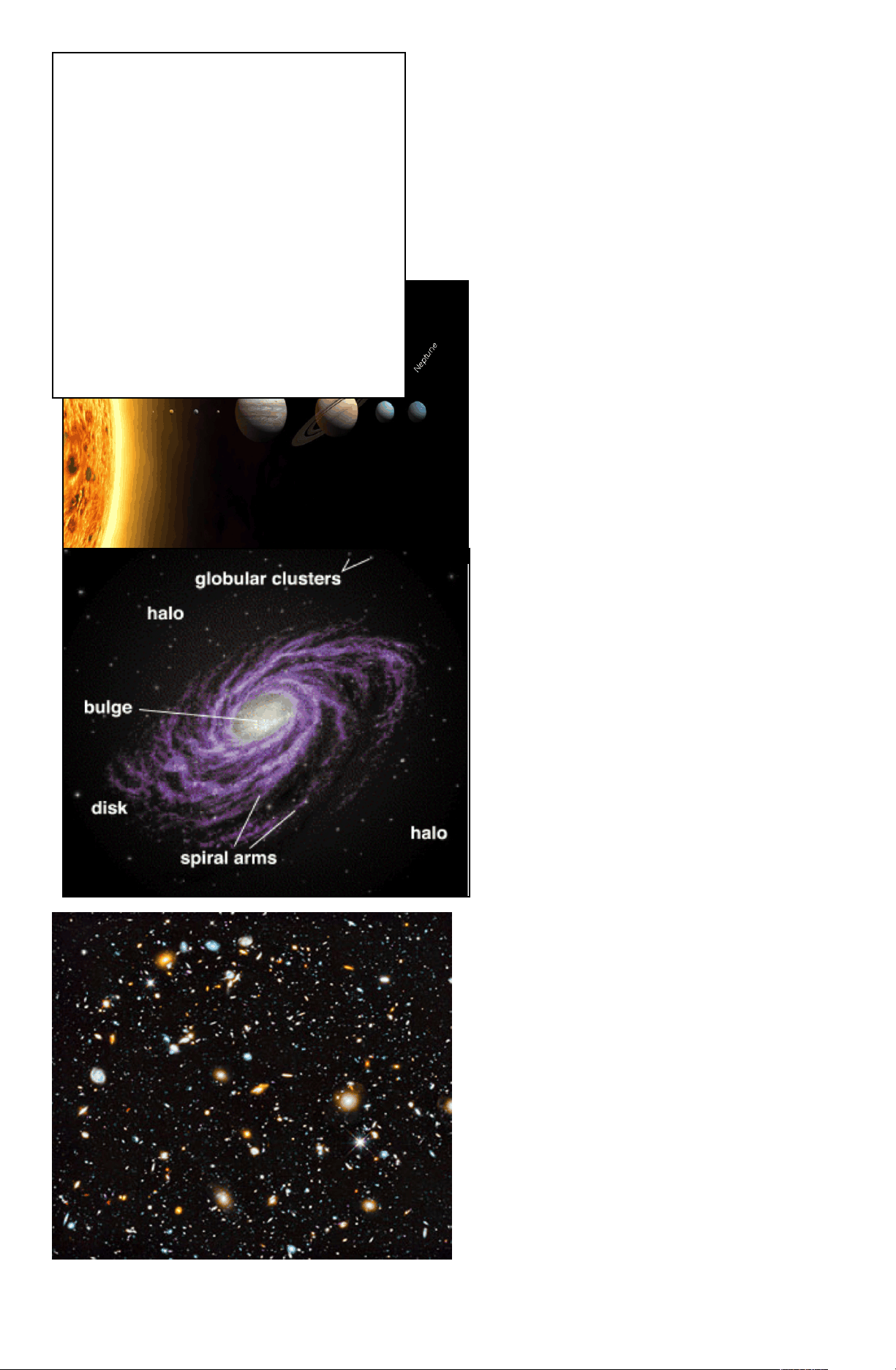
Beyond our planet earth, we find it is but a small part of a larger entity, the solar system. It consists of the sun, nine planets and minor components such as satellites of planets, asteroids, comets, meteor and meteorites. The sun takes up more than 99% of the mass of the whole system.
The sun is but one of the billion stars forming the assembly called the Milky Way Galaxy. Outside the Milky Way at great distance are other galaxies, each containing 10 9 to 10 11 stars.
This galaxy is a cluster of billions of stars from superclusters. Because the galaxies are so far away, they look like tiny faint clouds in the night sky. Scattered throughout the system of stars are great clouds of gas and dust known as nebulae.
A galaxy is a cluster of billions of stars and clusters of galaxies form superclusters. In between the clusters is practically an empty space. This organization of matter in the universe. suggests that it is indeed clumpy at a certain
The sun is but one of the billion stars forming the assembly called the Milky Way Galaxy. Outside the Milky Way at great distance are other galaxies, each containing 10^9 to 10 11 stars.
This galaxy is a cluster of billions of stars from superclusters. Because the galaxies are so far away, they look like tiny faint clouds in the night sky. Scattered throughout the system of stars are great clouds of gas and dust known as nebulae.
All these celestial bodies and the vast space between them constitute the physical Universe. Because of its seemingly orderly arrangement, it is sometimes called the cosmos.
Cosmology is the study of the nature of the universe as a whole. It is the scientific inquiry into the origin, evolution, and the fate of the universe. By making assumptions that are not at odds with the observable universe, cosmologists create models, or theories that attempt to describe the universe, its origin, and its future.
Structure, Composition, and Age The universe is made of:
- 4.6% Baryonic Matter - "ordinary" matter consisting of protons, electrons, and neutrons that
comprises atoms, planets, stars, galaxies, and other bodies. Example:
- Clouds of cold gas
- (^) Planets
- Comets and asteroids
- Stars
- Neutron Stars
- (^) Black Holes
- 24% Dark Matter - The matter that has gravity but does not emit light.
- 71.4% Dark Energy - a source of anti-gravity; a force that counteracts gravity and causes the universe to expand.
“While dark energy repels, dark matter attracts…”
- Dark matter can explain what may be holding galaxies together for the reason that the low total mass is insufficient for gravity alone to do so while dark energy can explain the observed accelerating expansion of the universe.
Hydrogen Helium are the three most abundant elements. lithium
*Inside every new born star are hydrogen atoms fused together to make Helium. This process is called Fusion or “nuclear burning” (nucleosynthesis) and it creates the energy that powers every star (i.e. a natural hydrogen bomb).
Stars - the building block of galaxies born out of clouds of gas and dust in galaxies. Instabilities within the clouds eventually results into gravitational collapse, rotation, heating up, and transformation to a protostar.
Protostar - is a baby star, an area of material that hasn't yet formed into a full-fledged star.
- the core of a future star as thermonuclear reactions set in. Thermonuclear Reactions - a nuclear fusion reaction responsible for the energy produced by stars.
Stellar interiors - are like furnaces where elements are synthesized or combined/fused together. main sequence star - stars that fuse hydrogen atoms to form helium atoms in their cores;
- The Kuba people of Central Africa tell the story of a creator god Mbombo (or Bumba) who, alone ina dark and water-covered Earth, felt an intense stomach pain and then vomited the stars, sun, and moon.
- In India, there is the narrative that gods sacrificed Purusha, the primal man whose head, feet, eyes, and mind became the sky, earth, sun, and moon respectively.
- The monotheistic religions of Judaism, Christianity, and Islam claim that a supreme being created the universe, including man and other living organisms.
Steady State Model
Big Bang Theory
Steady State Model
- The now discredited steady state model of the universe was first proposed by Sir James Jeans in 1920’s and was revised in 1948 by Bondi and Gould and by Hoyle .It maintains that new matter is created as the universe expands thereby maintaining its density.
- Its predictions led to tests and its eventual rejection with the discovery of the cosmic microwave background.
Big Bang Theory
- As the currently accepted theory of the origin and evolution of the universe, the Big Bang Theory postulates that 13.8 billion years ago, the universe expanded from a tiny, dense and hot mass to its present size and much cooler state. Georges Lemaitre - a Belgian priest, was the first to suggest the Big Bang Theory in the 1920’s.
The Steady State Model and the Big Bang Theory are both models of how the universe began.
- The theory rests on two ideas: General Relativity and the Cosmological Principle. In Einstein’s General Theory of Relativity , gravity is thought of as a distortion of space-time and no longer described by a gravitational field in contrast to the Law of Gravity of Isaac Newton. General Relativity explains the peculiarities of the orbit of Mercury and the bending of light by the Sun and has passed rigorous tests. The Cosmological Principle assumes that the universe is homogeneous and isotropic when averaged over large scales. This is consistent with our current large-scale image of the universe. But keep in mind that it is clumpy at smaller scales. E=MC^2 - a theory developed by Albert Einstein
- The Big Bang Theory has withstood the tests for expansion:
- the redshift
- abundance of hydrogen, helium, and lithium, and
- the uniformly pervasive cosmic microwave background radiation-the remnant heat from the bang.
Expanding Universe
Edwin Hubble - in 1992, he announced his significant discovery of the “redshift” and its interpretation that galaxies are moving away from each other, hence as evidence for an expanding universe, just as predicted by Einstein’s Theory of General Relativity.
- He observed that spectral lines of starlight made to pass through a prism are shifted toward the red part of the electromagnetic spectrum, i.e., toward the band of lower frequency; thus, the inference that the star or galaxy must be moving away from us.
Red Shift – a change in frequency of the position of the lines.
***** You may have noticed that when an ambulance or police car goes past, its siren is high-pitched as it comes towards you, then becomes low-pitched as it goes away. This effect, where there is change in frequency and wavelength, is called the Doppler Effect. It happens with any wave source that moves relative to an observer.
This happens with light too. Our sun contains helium. We know this because there are black lines in the spectrum of the light from the sun, where helium has absorbed light. These lines form the absorption spectrum for helium.
When we look at the spectrum of a distant star, the absorption spectrum is there, but the pattern of lines has moved towards the red end of the spectrum, as you can see below.
- Astronomers have found that the further from us a star is the more its light red shifted. This tells us that
The main differences between the two theories: