Download Finite State Automata and Flip-Flops: Implementing FSAs using Flip-Flops and more Slides Computer Science in PDF only on Docsity!
FiniteFinite State
State
FiniteFinite State
State
MachineMachine Design
Design
Intro to Computer Architecture
Flip-Flops and Finite State Automata• Finite State Automata (FSA) have states.• The system has to remember the current
state.
- Flip-Flops are one bit memories.• Flip-Flops can be used to remember the
current state of an FSAcurrent state of an FSA.
- A sequential logic circuit using Flip-Flops
can implement an FSA.
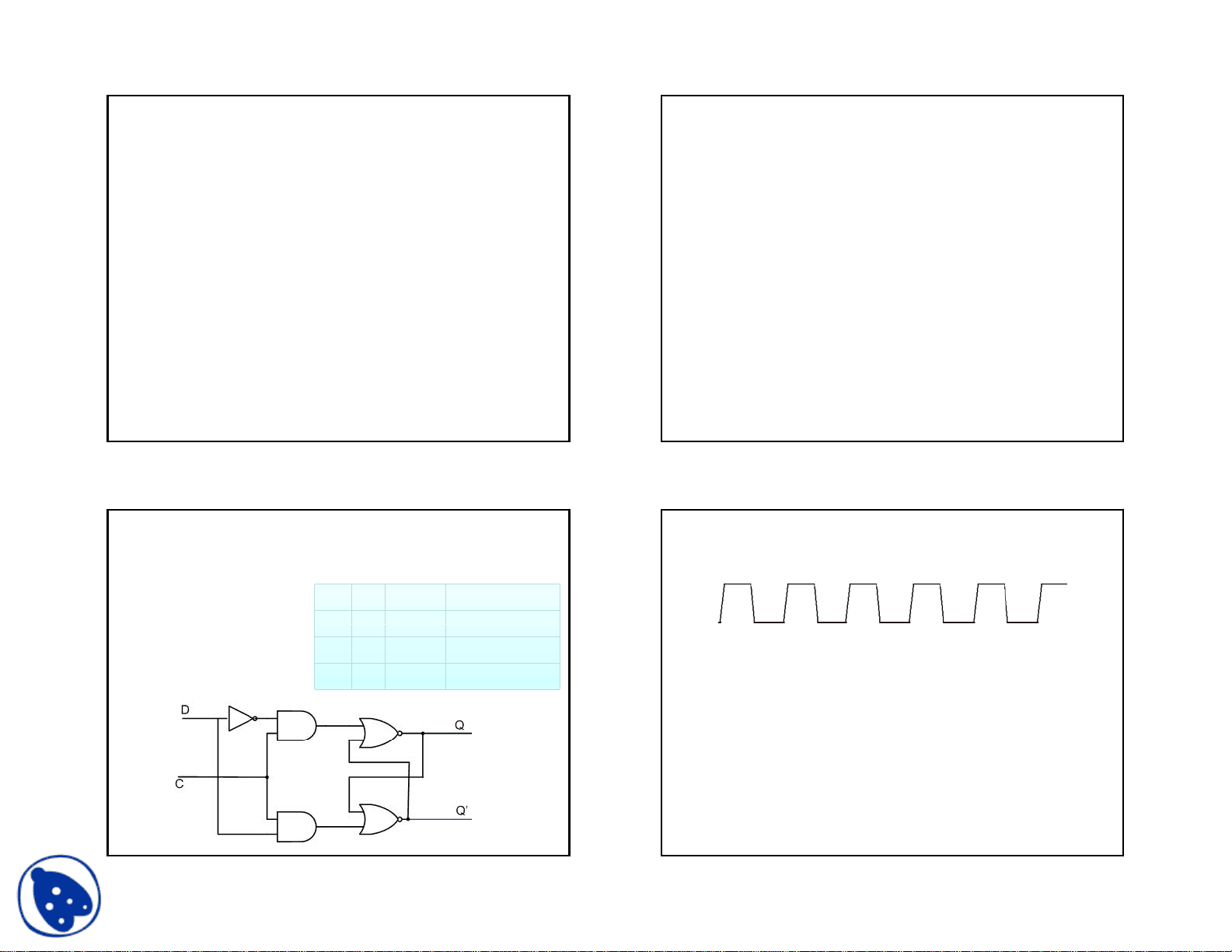
D Flip-Flop
l^
d t
C
D
Q
next
Comment
0
X
Q
No change
only one datainput, D, plusenable, C
0
X
Q
prev
No change
1
0
0
Reset
1
1
1
Set
Clock
- Many sequential logic circuits use a clock
input.
- A flip-flop can change state on a clock
rising edge.
- The new state will be available on the
falling edge.
Docsity.com
Overview of Design Process
- Specifications start with a word description 2
C
t^
Fi it
St t
A t
t^
t^
d l
- Create a Finite State Automata to model
the system
- Create a state table to indicate next states4. Convert next states and outputs to output
d fli
fl
i^
t^
ti
and flip flop input equations
- Simplify logic expressions6. Draw resulting circuits
Example
- Create a sequential circuit that detects
h
th
ti
1 i
t
when three or more consecutive 1 inputshave been received.
- Inputs are checked each clock pulse.• The output will be true only when three or
more 1 inputs have been detectedmore 1 inputs have been detected.
- The output will be false when zeroes and
less than three inputs of 1 have beenreceived.
FSA for 3 Consecutive 1 inputs
-^
State S
0
: zero 1s detected
-^
State S
1
: one 1 detected
-^
State S
2
: two 1s detected
-^
State S
3
: three 1s detected
° Note that each state has 2 output arrows
Moore Machine
- With a Moore Finite State Automata, the
t^
t i
i t d
ith th
t t
f th
output is associated with the state of theFSA.
- Often the new state will be available
during the second half of a clock pulse.
- The output is related to the state and not• The output is related to the state and not
how the FSA got to the state.
- In our example, state 3 (three consecutive
1’s) has an output of 1. All other are zero.
Docsity.com
Simplify Each Result
OldQ
1
OldQ
0
input
NewD
A
Q’
in’ 0
Q’
in 0
Q^0
in
Q
in’ 0
Q’
1
0
0
1
0
Q^1
0
1
1
0
p
0
0
0
0
0
0
1
0
0
1
0
0
0
1
1
1
1
0
0
0
1
0
0
0
1
0
1
1
1
1
0
0
1
1
1
1
new D
A^
= in * Q
1
0
Simplify new D
B
OldQ
1
OldQ
0
input
NewD
B
Q’
in’ 0
Q’
in 0
Q
in 0
Q
in’ 0
Q’
1
0
1
0
0
Q
1
0
1
1
0
p
0
0
0
0
0
0
1
1
0
1
0
0
0
1
1
0
1
0
0
0
1
0
0
0
1
0
1
1
1
1
0
0
1
1
1
1
new D
B
= in * Q
1
0
Simplify Output
OldQ
1
OldQ
0
input
output
Q’
in’ 0
Q’
in 0
Q^0
in
Q
in’ 0
Q’
1
0
0
0
0
Q^1
0
0
1
1
p^
p
0
0
0
0
0
0
1
0
0
1
0
0
0
1
1
0
1
0
0
0
1
0
0
0
1
0
1
0
1
1
0
1
1
1
1
1
output = Q
1
0
FSA implementation
Docsity.com
Flip-Flops Required
n
states in the FSA, it will
i^
l^
(^
) fli
fl
require log
n
)^
flip-flops.
n
is not an even power of two, you have
to round up.
- When n is not an even power of two, the
truth table may have
“don’t care”
entries
truth
table may have
don t
care
entries
Example: Parity Checker
- Even parity is when the count of the “1”
bit
i^
b
bits is an even number.
- We want the output to be true when the
parity is even.
Parity FSA
h
1 i
i^
t
when a 1 is input
same on 0 input.
How many flip-flops will be required
to implement the parity?
- none
Docsity.com
Regular Languages
- A regular language can be recognized by
Fi it
St t
A t
t
a Finite State Automata.
- Compilers use FSA to remove comments,
separate strings and numbers and dividethe input into a series of “tokens”.
Context Free Languages
- Most computer languages, like Java, C++,
P
l^
d PHP
t^
t f
Pearl and PHP, are context freelanguages.
- Context Free languages can be
recognized by a FSA with a stack memory.
Context Sensitive and R.E.
- Context Sensitive languages and
R
i^
l^
E
bl
l
Recursively Enumerable languages canbe recognized by a Turing Machine.
- A Turing Machine can compute anything
that a modern “real” computer can.
- The Turing-Church thesis states:• The Turing-Church thesis states:
“Every function which would naturally beregarded as computable, can becomputed by a Turing machine”
Turing Machine
- A Turing Machine has a FSA and a tape
for memory.
- Based on the state of the FSA and the
current symbol on the tape, the TuringMachine can write a new symbol, movethe tape left or right and change the stateof the FSAof the FSA.
Docsity.com
Non-Computable
- There are problems that cannot be
t d
computed.
- There are several well defined problems
for which there cannot be a computersolution.
Halting Problem
- You cannot write a program that will read
i^
th
d
f^
d t ll
in the source code of any program and tellif that program will get caught in an infiniteloop.
- You can write a program that can detect
infinite loops in many programs, but not allinfinite loops in many programs, but not allprograms.
Post Correspondence Problem
- Image you have a piles of dominos that
each have a binary number on the top andeach have a binary number on the top andbottom.
- Can you put the dominos in a series so the
numbers on the top and bottom are thesame? You can use each domino as often
lik
as you like.
Solution to Simple Problem
Dominos
Solution
1001100100100
Docsity.com