Download Lecture 4: Torques and Angular Momentum in Physics 100 and more Study notes Classical Physics in PDF only on Docsity!
Lecture 4, Torques, Ang Momentum Phys 100, How Things Work
Levers, Torque, Rotation, Angular momentum,
Lever and mechanical advantage Torque Rotating stuff Angular momentum Lecture 4, Torques, Ang Momentum Phys 100, How Things Work
Remember Conservation of Energy
Controlled stored energy = Potential Energy Can be converted to Motion energy = Kinetic Energy Uncontrolled stored energy = heat, etc Easy to make (friction, etc) difficult to recover (ie to control) but stay tuned…. Lecture 4, Torques, Ang Momentum^ Phys 100, How Things Work
Remember Conservation of Momentum
Don’t try this at home Car “wanted” to go straight Even significant force from tire traction could not enforce Δp So slow down BEFORE the curve Lecture 4, Torques, Ang Momentum^ Phys 100, How Things Work
Rotation and center of mass
Push on an extended object and in general it will turn. Throw an object and it will rotate and translate Center of mass translates according to old rules Object rotates around the CM Center of mass is balance point (aka center of gravity) Use symmetry to locate or: x =x 0 + v 0 t Lecture 4, Torques, Ang Momentum^ Phys 100, How Things Work
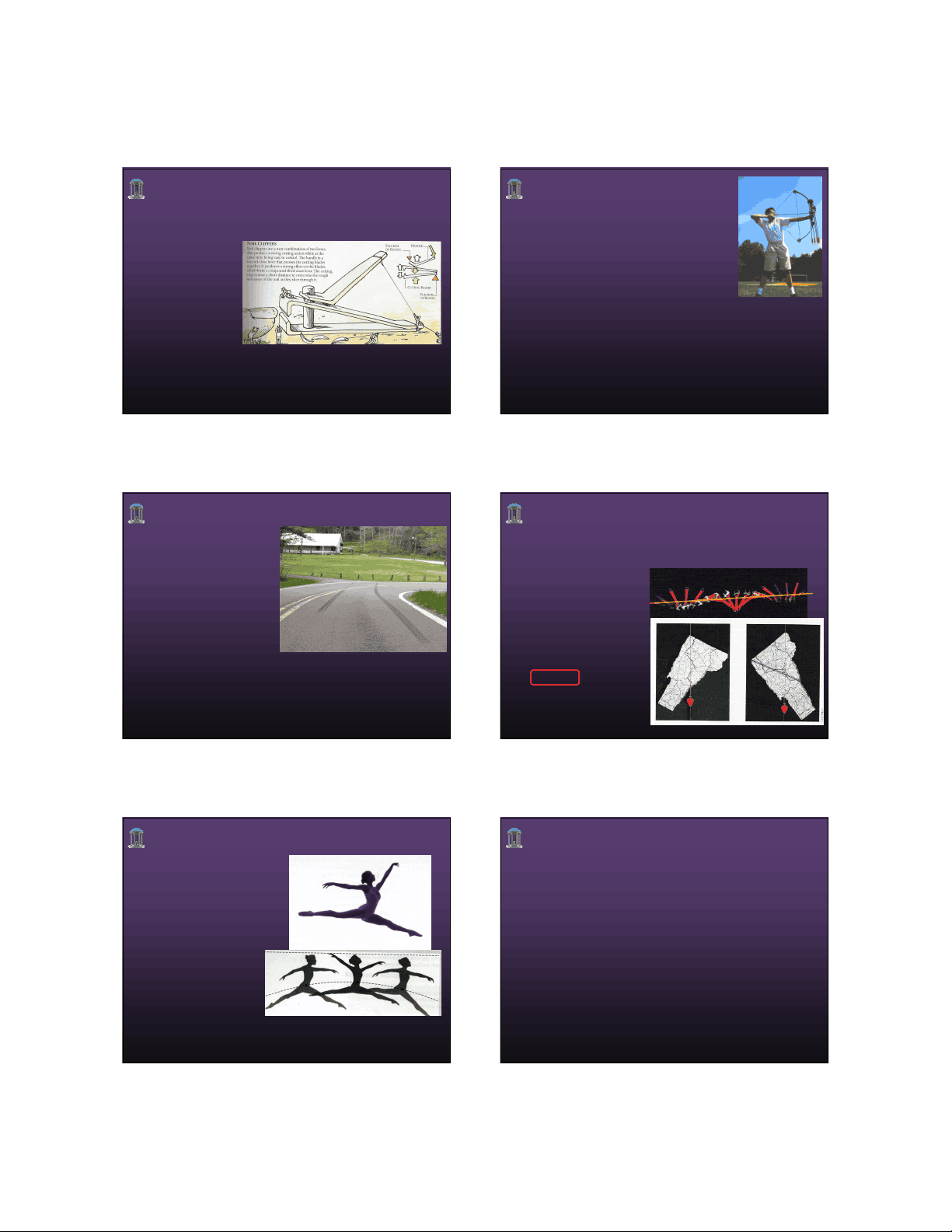
How do Baryshnikov and MJ do that?!?
Also skaters, high jumpers, leaping predators, etc Wave limbs to “fly” or to “defy gravity” Watch carefully for mid-flight flexures Lecture 4, Torques, Ang Momentum^ Phys 100, How Things Work
Where is the center of mass
Where is the CM for a book? Where is the CM of a football? Where is the CM of a DVD? Where is the CM of a burrito? Where is the CM of a bar-bell? Where is the CM of a can of clam chowder?
Lecture 4, Torques, Ang Momentum Phys 100, How Things Work
Balancing a see-saw
Older siblings sit closer to the fulcrum (or younger siblings wail) Torque = (lever arm) × (force) τ = r × F⊥ So the toddler can lift the babysitter with a long enough lever arm Lecture 4, Torques, Ang Momentum Phys 100, How Things Work
Lever: Torque around a fulcrum
Mechanical advantage “amplifies” the force
r 1 F 1 = r 2 F 2
F 1
r 2 r 1 F 2 = (r 1 /r 2 ) × F 1 F^2 F 2 can be as big as you like, if you can find a longer stick levers (like ramps) are old and ubiquitous Did you notice that this is just like Newton III?? Lecture 4, Torques, Ang Momentum^ Phys 100, How Things Work
Levers, levers and levers
Different “efficiencies” (or amounts of leverage) depending on relations of fulcrum and forces They are everywhere! Lecture 4, Torques, Ang Momentum^ Phys 100, How Things Work
Levers closer to home
But wait a minute! This gives a mechanical DISadvantage?
d
d
F
F
Fd=Fd
Why would nature/evolution choose this method?? Lecture 4, Torques, Ang Momentum^ Phys 100, How Things Work
Gear ratios
“Change gears” means change ratios of cog diameters
r 1 T = r 2 T (oops?!? What’s missing here?)
And hence the rotation rate of the wheel compared to the pedal
r 1
r 2 Lecture 4, Torques, Ang Momentum^ Phys 100, How Things Work
Torques in balance
Only the force component perpendicular to r (F⊥ ) contributes to the torque F r F⊥ mg mg⊥ r 1 In equilibrium, torques balance (like forces) rF⊥ = r 1 mg⊥ Net torque = 0
Lecture 4, Torques, Ang Momentum Phys 100, How Things Work
Before he pukes
Change ω by changing I Lecture 4, Torques, Ang Momentum Phys 100, How Things Work
Used by humans and cleverer animals
Navigational gyro axis stays fixed so how does the cat “break the rules”??
- The cat pushes it's hind legs out and stretches them as far behind itself as possible, causing the rear section of the body to have a larger I than the front section.
- At the same time it bring in its front legs making them have lower I. The front half can rotate in one direction, while the rear part rotates much less in the opposite direction.
- Once the front section of the cat has rotated the 180 ˚, the cat brings back in the rear legs and stretches out the front legs so that I is larger in the front, allowing the cat to rotate the rear half of its body around 180 ˚.
- During the whole maneuver L = 0. Lecture 4, Torques, Ang Momentum^ Phys 100, How Things Work
New Newton, New Principles
ω = ω 0 + αt ϕ = ϕ 0 + ω 0 t + (1/2) αt^2 v = v 0 + at x = x 0 + v 0 t + (1/2)at^2 Equations of motion for constant force Physics translation rotation Conservation Laws (F, τ = 0) Kinetic energy Newton II momentum Mass, moment KE+PE = constant L = constant KE+PE = constant p = constant KE = (1/2)mv^2 KE^ =^ (1/2)I^ ω^2 F = ma τ =Iα p = mv L =Iω m I Lecture 4, Torques, Ang Momentum^ Phys 100, How Things Work
Take home messages
Center of mass = center of gravity = balance point for an object (Symmetry!) Torque is τ = r × F⊥. (Only perpendicular component matters) Torque equation: τ = Iα Rotational mass: I = (mass)(lever arm)^2 Conservation of angular momentum: If τ = 0, then L = constant Right hand rule for rotation vectors