





Study with the several resources on Docsity

Earn points by helping other students or get them with a premium plan

Prepare for your exams
Study with the several resources on Docsity
Earn points to download
Earn points by helping other students or get them with a premium plan
A comprehensive set of exam preparation questions and verified answers related to obstetrics, specifically focusing on labor and delivery. It covers various aspects of the birthing process, including the stages of labor, pain management techniques, fetal monitoring, and nursing interventions. The questions are designed to test understanding of key concepts and best practices in obstetric care, making it a valuable resource for nursing students and professionals preparing for certification or seeking to enhance their knowledge in this field. The content is structured to facilitate learning and review, with clear questions and concise answers that highlight important clinical considerations. This resource is particularly useful for those studying for exams or seeking to reinforce their understanding of obstetric principles and practices. It includes topics such as breathing techniques, pain relief measures, fetal heart rate monitoring, and stages of labor.
Typology: Exams
1 / 62

This page cannot be seen from the preview
Don't miss anything!
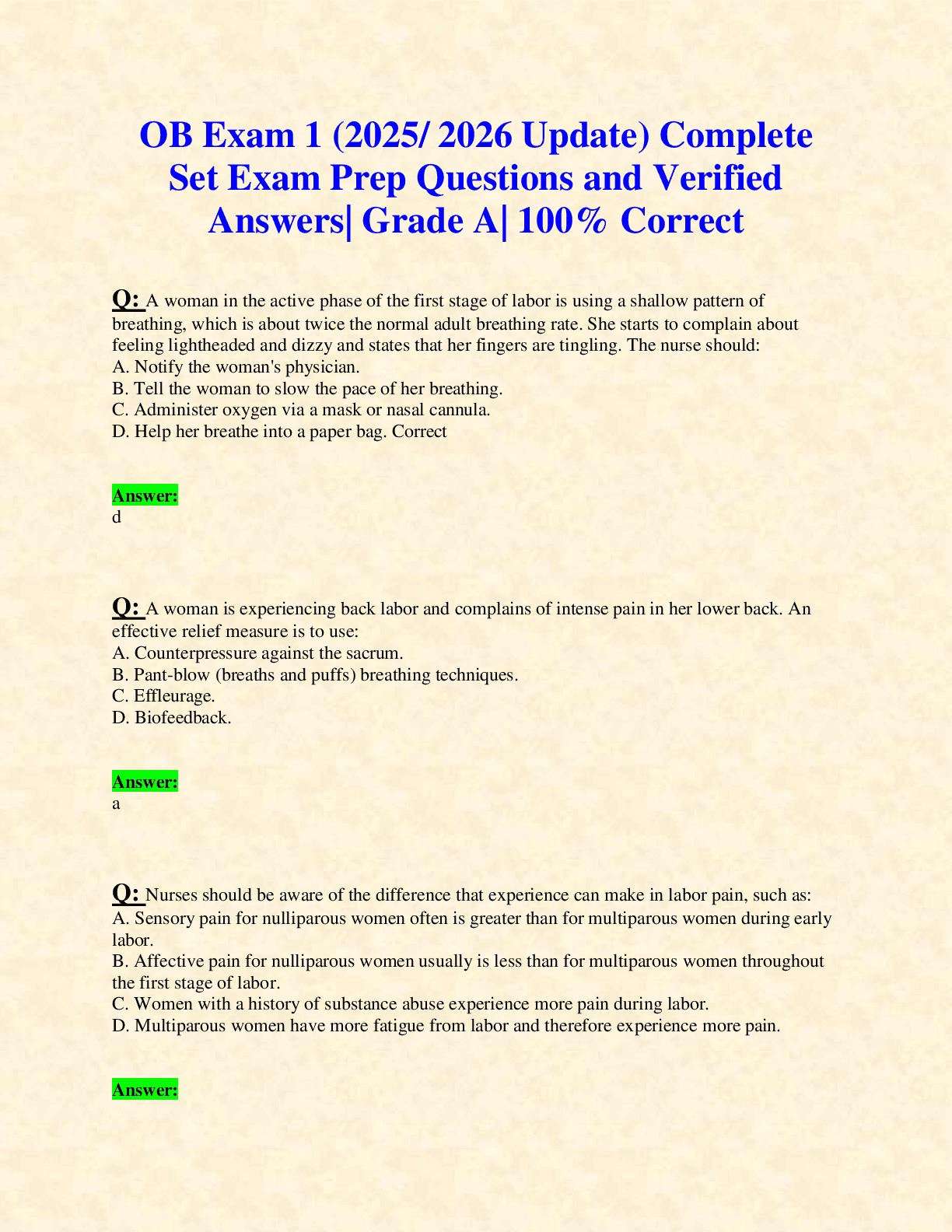
breathing, which is about twice the normal adult breathing rate. She starts to complain about feeling lightheaded and dizzy and states that her fingers are tingling. The nurse should: A. Notify the woman's physician. B. Tell the woman to slow the pace of her breathing. C. Administer oxygen via a mask or nasal cannula. D. Help her breathe into a paper bag. Correct Answer: d
effective relief measure is to use: A. Counterpressure against the sacrum. B. Pant-blow (breaths and puffs) breathing techniques. C. Effleurage. D. Biofeedback. Answer: a
A. Sensory pain for nulliparous women often is greater than for multiparous women during early labor. B. Affective pain for nulliparous women usually is less than for multiparous women throughout the first stage of labor. C. Women with a history of substance abuse experience more pain during labor. D. Multiparous women have more fatigue from labor and therefore experience more pain. Answer:
a
A. The Dick-Read (natural) childbirth method. B. The Lamaze (psychoprophylactic) method. C. The Bradley (husband-coached) method. D. Encouraging expectant parents to attend childbirth preparation in any or no specific method. Answer: d
A. Breathing techniques in the first stage of labor are designed to increase the size of the abdominal cavity to reduce friction. B. By the time labor has begun, it is too late for instruction in breathing and relaxation. C. Controlled breathing techniques are most difficult near the end of the second stage of labor. D. The patterned-paced breathing technique can help prevent hyperventilation. Answer: a
should be aware that: A. Either hot or cold applications may provide relief, but they should never be used together in the same treatment. B. Acupuncture can be performed by a skilled nurse with just a little training. C. Hand and foot massage may be especially relaxing in advanced labor, when a woman's tolerance for touch is limited. D. Therapeutic touch (TT) uses handheld electronic stimulators that produce sympathetic vibrations. Answer: c
D. Tocolytic treatment using ritodrine. Answer: c
movement: A. Are reassuring. B. Are caused by umbilical cord compression. C. Warrant close observation. D. Are caused by uteroplacental insufficiency Answer: a
A. Altered cerebral blood flow. B. Fetal hypoxemia. C. Umbilical cord compression. D. Fetal sleep cycles. Answer: d
you see the fetal heart rate (FHR) drop from its baseline of 125 down to 80. You reposition the mother, provide oxygen, increase IV fluid, and perform a vaginal exam. The cervix has not changed. Five minutes have passed, and the FHR remains in the 80s. What additional nursing measures should you take? A. Call for help. B. Insert a Foley catheter. C. Start oxytocin (Pitocin). D. Notify the primary health care provider immediately. Answer:
d
that: A. The examiner's hand should be placed over the fundus before, during, and after contractions. B. The frequency and duration of contractions are measured in seconds for consistency. C. Contraction intensity is given a judgment number of 1 to 7 by the nurse and client together. D. The resting tone between contractions is described as either placid or turbulent. Answer: a
rate might be caused by: A. Narcotics. B. Barbiturates. C. Methamphetamines. D. Tranquilizers Answer: c
contraction? A. Frequency (how often contractions occur) B. Intensity (the strength of the contraction at its peak) C. Resting tone (the tension in the uterine muscle) D. Appearance (shape and height) Answer: d
increased by:
Answer: c
labor? A. An admission to the hospital at the start of labor B. When accelerations of the fetal heart rate (FHR) are noted C. On maternal perception of perineal pressure or the urge to bear down D. When membranes rupture Answer: b
measures to enhance the progress of fetal descent. These measures include: A. Encouraging the woman to try various upright positions, including squatting and standing. B. Telling the woman to start pushing as soon as her cervix is fully dilated. C. Continuing an epidural anesthetic so that pain is reduced and the woman can relax. D. Coaching the woman to use sustained, 10 - to 15 - second, closed-glottis bearing-down efforts with each contraction. Answer: a
practice during the immediate newborn period? A. The healthy newborn should be taken to the nursery for a complete assessment. B. After drying, the infant should be given to the mother wrapped in a receiving blanket. C. Skin-to-skin contact of mother and baby should be encouraged. D. The father or support person should be encouraged to hold the infant while awaiting delivery of the placenta. Answer: c
A. Latent phase: feels sleepy, fetal station is 2+ to 4+, duration is 30 to 45 minutes B. Active phase: overwhelmingly strong contractions, Ferguson reflux activated, duration is 5 to 15 minutes C. Descent phase: significant increase in contractions, Ferguson reflux activated, average duration varies D. Transitional phase: woman "laboring down," fetal station is 0, duration is 15 minutes Answer: c
what principle? A. Cleanse the vulva and perineum before and after the examination as needed. B. Wear a clean glove lubricated with tap water to reduce discomfort. C. Perform the examination every hour during the active phase of the first stage of labor. D. Perform an examination immediately if active bleeding is present. Answer: a
A. Urine analysis B. Fern test C. Leopold maneuvers D. AROM Answer: b
notes that the woman's fundus is firm and has become globular. A gush of dark red blood comes from her vagina. The nurse concludes that: A. The placenta has separated. B. A cervical tear occurred during the birth.
mother shares the care of the infant with: A. The father of the infant. B. Her mother (the infant's grandmother). C. Her eldest daughter (the infant's sister). D. The nurse. Answer: d
instruct her to: A. Wear a snug, supportive bra. B. Allow warm water to soothe the breasts during a shower. C. Express milk from breasts occasionally to relieve discomfort. D. Place absorbent pads with plastic liners into her bra to absorb leakage Answer: a
bladder is distended because her fundus is now 3 cm above the umbilicus and to the right of the midline. In the immediate postpartum period, the most serious likely consequence of bladder distention is: A. Urinary tract infection. B. Excessive uterine bleeding. C. A ruptured bladder. D. Bladder wall atony. Answer: b
her menstrual activity after childbirth?
A. "My first menstrual cycle will be lighter than normal and then will get heavier every month thereafter." B. "My first menstrual cycle will be heavier than normal and will return to my prepregnant volume within three or four cycles." C. "I will not have a menstrual cycle for 6 months after childbirth." D. "My first menstrual cycle will be heavier than normal and then will be light for several months after." Answer: b
A. Caused by mild, continual contractions for the duration of the postpartum period. B. More common in first-time mothers. C. More noticeable in births in which the uterus was overdistended. D. Alleviated somewhat when the mother breastfeeds Answer: c
A. Is similar to a light menstrual period for the first 6 to 12 hours. B. Is usually greater after cesarean births. C. Will usually decrease with ambulation and breastfeeding. D. Should smell like normal menstrual flow unless an infection is present. Answer: d
A. The cervix shortens, becomes firm, and returns to form within a month postpartum. B. Rugae reappear within 3 to 4 weeks. C. Most episiotomies heal within a week. D. Hemorrhoids usually decrease in size within 2 weeks of childbirth.
postpartum period? (Select all that apply.) A. Moderate hyperglycemia B. Increased BMR in the immediate postpartum period C. Secretion of insulinase D. Mildly increased T3 and T4 levels for the first several weeks postpartum E. Decrease in estrogen and cortisol levels Answer: b,c,e
woman's perineal care technique, the nurse would recognize the need for further instruction if the woman: A. Uses soap and warm water to wash the vulva and perineum. B. Washes from symphysis pubis back to the episiotomy. C. Changes her perineal pad every 2 to 3 hours. D. Uses the peribottle to rinse upward into her vagina. Answer: d
completely saturated a perineal pad within 15 minutes. The nurse's first action is to: A. Begin an IV infusion of Ringer's lactate solution. B. Assess the woman's vital signs. C. Call the woman's primary health care provider. D. Massage the woman's fundus. Answer: d
A. Vaginal or vulvar hematomas. B. Unrepaired lacerations of the vagina or cervix.
C. Failure of the uterine muscle to contract firmly. D. Retained placental fragments. Answer: c
birth. A. 1 hour B. 30 minutes C. 2 hours D. 4 hours Answer: 1
12 hours postpartum? A. Postural hypotension B. Temperature of 38° C C. Bradycardia—pulse rate of 55 beats/min D. Pain in left calf with dorsiflexion of left foot Answer: d
1 cm below the umbilicus. Her lochial flow is profuse, with two plum-sized clots. The nurse's initial action is to: A. Place her on a bedpan to empty her bladder B. Massage her fundus C. Call the physician D. Administer methylergonovine (Methergine), 0.2 mg IM, which has been ordered prn Answer:
first hour, saturating multiple pads. Which interventions would the nurse anticipate that the physician would order? (Select all that apply.) A. Document findings in the health care record B. Decrease flow rate for intravenous fluid administration C. Administer oxygen via nonrebreather mask @ 10 L/minute D. Insert a secondary intravenous line access E. Type & screen for 2 units of blood Answer: c,d
What behavior, if exhibited by this woman, does the nurse identify as a possible maladaptive behavior regarding parent-infant attachment? A. Talks and coos to her son B. Seldom makes eye contact with her son C. Cuddles her son close to her D. Tells visitors how well her son is feeding Answer: b
of maternal behaviors and characteristics is called: A. Mutuality. B. Bonding. C. Claiming. D. Acquaintance. Answer: a
nurse can identify parental behaviors that can either facilitate or inhibit attachment. Which of the following is a facilitating behavior? A. The parents have difficulty naming the infant. B. The parents hover around the infant, directing attention to and pointing at the infant. C. The parents make no effort to interpret the actions or needs of the infant. D. The parents do not move from fingertip touch to palmar contact and holding Answer: b
sensory impairment? A. One of the major difficulties visually impaired parents experience is the skepticism of health care professionals. B. Visually impaired mothers cannot overcome the infant's need for eye-to-eye contact. C. The best approach for the nurse is to assess the parents' capabilities rather than focusing on their disabilities. D. Technologic advances, including the Internet, can provide deaf parents with a full range of parenting activities and information. Answer: b
to acknowledge the "other mother's" role in pregnancy, birth, and parenting. Integration of the nonchildbearing partner into care includes offering the same opportunities afforded male partners of heterosexual women. Which opportunity could not be provided to male partners? A. Labor support B. Cutting the cord C. Rooming-in during hospitalization D. Breastfeeding the infant Answer: d
A. No restrictions are placed on the mother during this ritual period. B. This ritual occurs over a period of 40 days. C. Spicy foods are encouraged as part of the maternal diet. D. The ritual is limited to preparing the woman to become a good mother Answer: b
adaptation? (Select all that apply.) A. Emergence of family unit B. Dependent behaviors C. Sexual intimacy relationship continuing D. Defining one's individual roles E. Being talkative and excited about becoming a mother Answer: a,c,d
engorgement. What suggestion should the nurse provide to alleviate breast discomfort? a. Apply warm compresses. b. Wear a well-fitting bra. c. Express milk frequently. d. Apply hydrogel dressing. Answer: b
Secretion of which substance would the nurse identify as the cause of afterpains? a. prolactin b. progesterone
c. oxytocin d. estrogen Answer: c
she is voiding a large volume of urine frequently. Which factor should the nurse identify as a potential cause for urinary frequency? a. urinary overflow b. postpartum diuresis c. urinary tract infection d. trauma to pelvic muscles Answer: b
weepiness, lasting for short periods each day. Which condition does the nurse believe is causing this experience? a. postpartum baby blues b. postpartum anxiety c. postpartum reaction d. postpartum depression Answer: a
become engorged with breast milk. How should the nurse respond to this concern? a. "It takes about 3 days after birth for milk to begin forming." b. "I'm sorry to hear that. There are some excellent formulas on the market now, so you will still be able to provide for your infant's nutritional needs." c. "You may have developed mastitis. I'll ask the primary care provider to examine you." d. "You are experiencing lactational amenorrhea. It may be several weeks before your milk comes in."
