
Previous years Question paper, Exams of History

Previous years board questions paper

Typology: Exams

2022/2023

Uploaded on 05/15/2024

suman-parihar
suman-parihar 🇮🇳

1 / 33

Toggle sidebar

This page cannot be seen from the preview

Don't miss anything!

bg1
/1/1 1 P.T.O.
- -
-
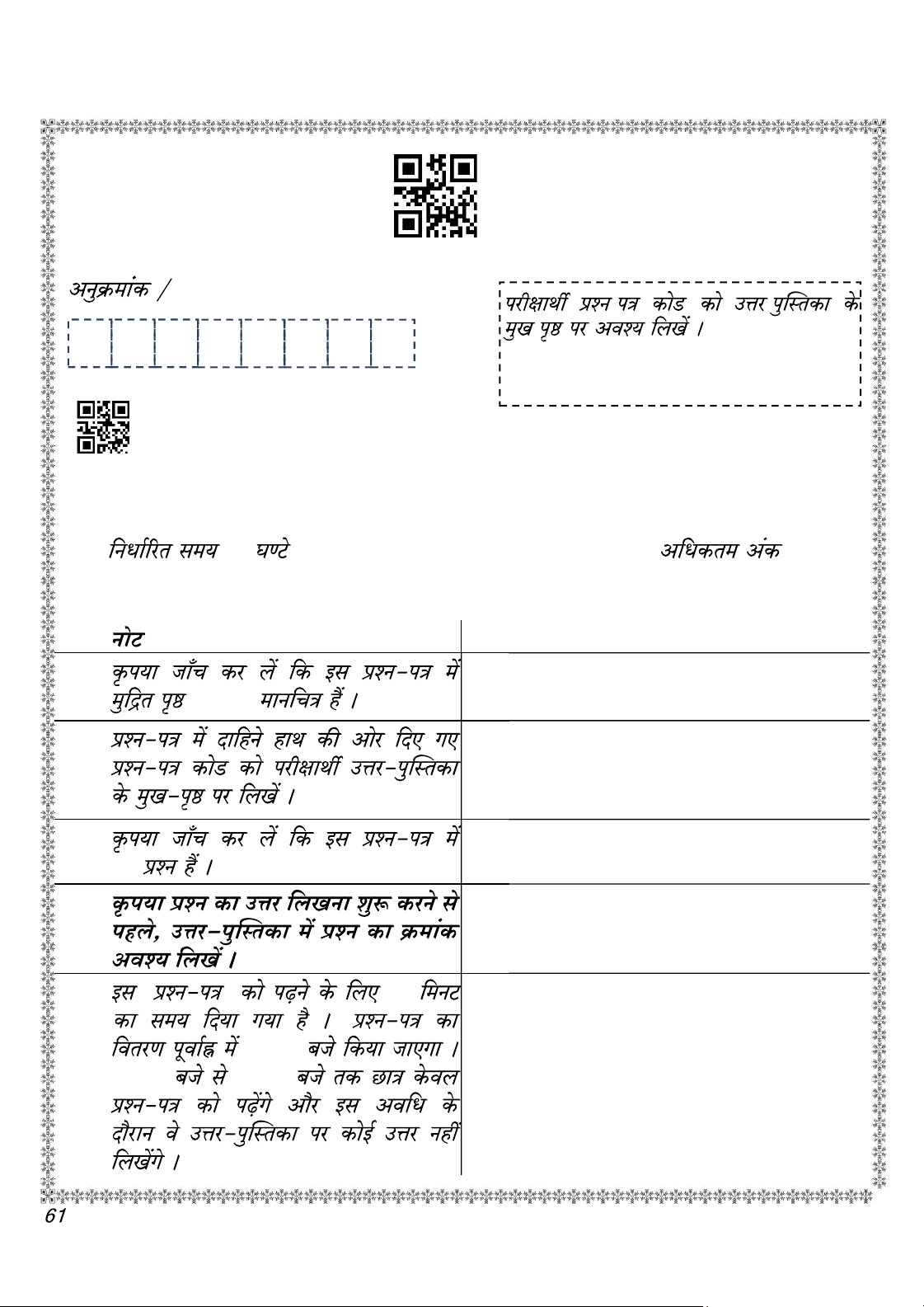
Candidates must write the Q.P. Code on
the title page of the answer-book.
Series E1GFH/1 Set No. 1
àíZ-nÌ H$moS>
Q.P. Code
Roll No.
B{Vhmg
HISTORY
: 3 : 80
Time allowed : 3 hours Maximum Marks : 80
NOTE
(I)
21 + 1
(I)
Please check that this question paper
contains 21 printed pages + 1 Map.
(II) (II)
Q.P. Code given on the right hand side
of
the question paper should be written
on the title page of the answer-
book by
the candidate.
(III)
34
(III)
Please check that this question paper
contains 34 questions.
(IV)
(IV)
Please write down the serial
number of the question in the
answer-book before attempting it.
(V) 15
10.15
10.15 10.30
(V)
15 minute time has been allotted to
read this question paper. The question
paper will be distributed
at 10.15
a.m. From 10.15 a.m. to 10.30 a.m., the
students will read the question paper
only and will not write any answer on
the answer-book during this period.
61/1/1
*
pf3
pf4
pf5
pf8
pf9
pfa
pfd
pfe
pff
pf12
pf13
pf14
pf15
pf16
pf17
pf18
pf19
pf1a
pf1b
pf1c
pf1d
pf1e
pf1f
pf20
pf21

Partial preview of the text

Download Previous years Question paper and more Exams History in PDF only on Docsity!

/1/1 1 P.T.O.

Candidates must write the Q.P. Code on the title page of the answer-book.

Series E1GFH/1 Set No. 1

àíZ-nÌ H$moS>

Q.P. Code Roll No.

B{Vhmg

HISTORY

Time allowed : 3 hours Maximum Marks : 80 NOTE (I) 21 + 1 (I) Please check that this question paper contains 21 printed pages + 1 Map. (II) (II)^ Q.P. Code given on the right hand side of the question paper should be written on the title page of the answer-book by the candidate. (III) 34 (III) Please check that this question paper contains 34 questions. (IV) (IV)^ Please^ write^ down^ the^ serial number of the question in the answer-book before attempting it. (V) (^15)

10.15 10. (V) 15 minute time has been allotted to read this question paper. The question paper will be distributed at 10. a.m. From 10.15 a.m. to 10.30 a.m., the students will read the question paper only and will not write any answer on the answer-book during this period.

(i) 34 (ii) (iii) 1 21 (MCQ) (iv) 22 27 (SA) 60 80 (v) 28 30 (LA) 300 350 (vi) 31 33 (vii) 34 (viii) (ix) IÊS> H (~hþ{dH$ënr` àH$ma Ho$ àíZ) 21 1=

  1. H$m àmMrZ nwamñWb amIrJ , AmYw{ZH$ ^maV Ho$ {H$g amÁ_| pñWV h¡? (a) {h_mMb àXoe (b) CÎma àXoe (c) h[amUm (d) amOñWmZ
  2. {ZåZ{b{IV _| go nwñVH$ Ho$ boIH$ H$m¡Z h¢? (a) Ama.S>r. ~¡ZOu (b) S>r.Ama. gmhZr (c) Eg.EZ. am°` (d) ~r.~r. bmb
  1. {ZåZ{b{IV _| go H$m¡Z-gr ñVyn H$s g§aMZmËH$ {deofVm h¡? (a) h{©H$m (b) N>Var (c) J^©J¥h (d) VmoaUÛma
  2. {ZåZ{b{IV OmZH$mar H$s ghmVm go _hm^maV Ho$ Bg M[aÌ H$s nhMmZ H$s{OE : CgH$m g§~§Y amjg g_wXm go Wm & CgH$m {ddmh ^r_ go hþAm Wm & dh KQ>moËH$M H$s _mVm Wr & (a) ^rbZr (b) gw^Ðm (c) Ðm¡nXr (d) {h{S>å~m
  3. {ZåZ{b{IV | go {H$g emgH$ Zo gwXe©Z Prb H$mo nwZ{Z©{©V {H$m? (a) {g[a gVH${Z© (b) emH$mgoZ (c) {g[a {dO gVH${Z© (d) éÐX_Z
  4. nm±Mdt eVmãXr H$m ^maV Ho$ {H$g amÁ` | pñWV h¡? (a) {~hma (b) npíM ~§Jmb (c) (d) CÎma àXoe
  5. {ZåZ{b{IV _| go {H$g emgH$ Zo AnZr àOm Am¡a A{YH$m[am| Ho$ {bE g§Xoem| H$mo nhbr ~ma A{^bo{IV {H$m Wm? (a) MÝÐJwá (b) g_wÐJwá (c) AemoH$ (d) q~Xþgma
  6. BãZ ~VyVm Ho$ g§X^© | {ZåZ{b{IV | go H$m¡Z-gm H$WZ ghr h¡? (a) H$m mÌr Wm & (b) CgHo$mÌm d¥Îmm§V H$s {H$Vm~ H$mo H$hVo h¢ & (c) dh e[amm Bñbm Y© Ho$ H$mZyZ H$m {deofk Wm & (d) CgZo H$s VrW©`mÌm H$s Wr &

/1/1 5 P.T.O.

  1. Which one of the following is not a structural feature of Stupa? (a) Harmika (b) Chhatri (c) Garbhagriha (d) Gateways
  2. Identify the character of Mahabharata with the help of following information : She belonged to Rakshasa clan. She was married to Bheema. She was the mother of Ghatotkatcha. (a) Bhilni (b) Subhadra (c) Draupadi (d) Hidimba
  3. (a) Siri Satakarni (b) Sakasena (c) Siri Vijaya Satakarni (d) Rudradaman
  4. In which state of India is the fifth century temple, Devgarh situated? (a) Bihar (b) West Bengal (c) Orissa (d) Uttar Pradesh
  5. Who among the following was the first ruler to inscribe messages to his subjects and officials? (a) Chandragupta (b) Samudragupta (c) Ashoka (d) Bindusara
  6. Which of the following statement is not true regarding Ibn Battuta? (a) He was a Moroccan traveller to India. (b) Badshahnama (c) He had expertise in the Islamic religious law Sharia. (d) He had made a pilgrimage to Mecca.

/1/1 7 P.T.O.

  1. Two statements as Assertion (A) and Reason (R) are given below. Read them carefully and answer the questions that follow : Assertion (A) : Francois Bernier has called the Mughal king as the king of barbarians. Reason (R) : Crown ownership of land was its reason. (a) Both Assertion (A) and Reason (R) are correct and Reason (R) is the correct explanation of the Assertion (A). (b) Both Assertion (A) and Reason (R) are correct, but Reason (R) is not the correct explanation of the Assertion (A). (c) Both Assertion (A) and Reason (R) are not correct. (d) Assertion (A) is correct, but Reason (R) is incorrect.
  2. Which of the following pairs is correctly matched? (a) Ibn Battuta Portuguese (b) Francois Bernier Frenchman (c) Duarte Barbosa Moroccan (d) Manucci Spanish
  3. Two statements as Assertion (A) and Reason (R) are given below. Read them carefully and answer the questions that follow : Assertion (A) : Mirabai was the woman poet of Nirguna Bhakti tradition. Reason (R) : She has been recognized as a source of inspiration for centuries. (a) Both Assertion (A) and Reason (R) are correct and Reason (R) is the correct explanation of the Assertion (A). (b) Both Assertion (A) and Reason (R) are correct, but Reason (R) is not the correct explanation of the Assertion (A). (c) Assertion (A) is correct, but Reason (R) is incorrect. (d) Assertion (A) is incorrect, but Reason (R) is correct.
  1. {ZåZ{b{IV H$mo H$mb AZwgma H«$_~Õ H$s{OE Am¡a ZrMo {XE JE {dH$ënm| _| go ghr {dH$ën H$m M`Z H$s{OE : (i) Jwé Jmo{~ÝX qgh (ii) Jwé AO©Z Xod (iii) Jwé ha{H$eZ Xod (iv) Jwé ZmZH$ Xod {dH$ën : (a) (i), (iv), (iii), (ii) (b) (ii), (iii), (iv), (i) (c) (iii), (i), (ii), (iv) (d) (iv), (ii), (iii), (i)
  2. {ZåZ{b{IV OmZH$mar H$s ghmVm go {dOZJa Ho$ d§e H$s nhMmZ H$s{OE : h[a & BÝhm|Zo hr[am Zha H$m {Z_m©U H$admm & h {dOZJa gm_«mÁ` H$m g~go nhbm d§e Wm & (a) g§J_ (b) gbwd (c) Vwbwd (d) Aam{dSy>
  3. AH$~a Ho$ emgZH$mb _| O_rZ H$mo Mma ^mJm| _| dJuH¥$V {H$`m OmVm Wm & {ZåZ{b{IV Mma dJm] _| go H$m¡Z-gm g~go AÀN>m _mZm OmVm Wm? (a) nmobO (b) nam¡Vr> (c) MMa (d) ~§Oa
  4. {ZåZ{b{IV _| go {H$gZo ~§Jmb | BñV_amar ~§Xmo~ñV bmJy {H$m? (a) Wm°_g _wZamo (b) Mmëg© H$m°Z©dm{bg (c) {d{b ~opÝQ>§H$ (d) hoZar hm{S>ªJ
  5. {ZåZ{b{IV | go H$m¡Z-go H$WZ ghr h¢? (i) A§J«oμOm| Zo ^maV | nmíMmË{ejm H$s ewéAmV H$s & (ii) CÝhm|Zo A§J«oμOr _mÜ Ho$ {dÚmb` Am¡a H$m°boO Imobo & (iii) CÝhm|Zo gVr àWm H$mo IË H$aZo Ho$ {bE H$mZyZ ~ZmE & (iv) CÝhm|Zo {dYdm {ddmh H$s AZw_{V Zht Xr & {dH$ën : (a) (i), (ii) Am¡a (iii) (b) (ii), (iii) Am¡a (iv) (c) (i), (iii) Am¡a (iv) (d) (i), (ii) Am¡a (iv)
  1. {ZåZ{b{IV _| go {H$gH$mo \«§${Q>`a Jm±Yr H$hm OmVm Wm? (a) _m¡bmZm AmμOmX (b) ImZ AãXþb Jμâμ$ma ImZ (c) Jmonmb H¥$îU JmoIbo (d) XmXm^mB© Zm¡amoOr
  2. {ZåZ{b{IV _| go {H$gZo g§{dYmZ g^m _| _{hbmAm| Ho$ {bE Ým H$s m±J H$s? (a) EM.Oo. Im§S>oH$a (b) Q>r.E. am_mqbJ Mo{Å>ma (c) h§gm _ohVm (d) Onmb qgh
  3. {ZåZ{b{IV {dH$ënm| _| go (a) _hmË_m Jm±Yr g§{dYmZ g^m Ho$ AÜj (b) Odmhabmb Zohê$ g§{dYmZ g^m Ho$ dH$sb (c) S>m°. amOoÝÐ àgmX CÔoí àñVmd nm[aV {H$m (d) S>m°. ~r.Ama. Aå~oS>H$a àmê$n g{_{V Ho$ AÜj
  4. {ZåZ{b{IV _| go H$m¡Z-gm {dH$ën ghr gw_o{bV h¡? (a) Pm±gr ~hmXþa emh (b) Amam Hw±$da qgh (c) {Xëbr dm{OX Abr emh (d) AdY bú_r ~mB©
  5. {ZåZ{b{IV OmZH$mar H$s ghmVm go A§J«oμO B©ñQ> B§{S>m H$ånZr Ho$ A$ga H$s nhMmZ H$s{OE : dh bm°S>© doëgbr H$m {M{H$ËgH$ Wm CgZo ~§Jmb H$m {dñV¥V gd}jU {H$`m CgZo H$bH$Î H$s ñWmnZm H$s (a) H$m°{bZ _¡Ho$ÝμOr (b) Om°Z _me©b (c) _mH$m©o nmobmo (d) \«$m§{gg ~wH$mZZ

/1/1 11 P.T.O.

(a) Maulana Azad (b) Khan Abdul Ghaffar Khan (c) Gopal Krishna Gokhale (d) Dadabhai Naoroji

  1. Who among the following demanded justice for women in the Constituent Assembly? (a) H.J. Khandekar (b) T.A. Ramalingam Chettiar (c) Hansa Mehta (d) Jaipal Singh
  2. Select the correct pair from the following options : (a) Mahatma Gandhi President of Constituent Assembly (b) Jawaharlal Nehru Lawyer of Constituent Assembly (c) Dr. Rajendra Prasad Passed Objectives Resolution (d) Dr. B. R. Ambedkar Chairman of Drafting Committee
  3. Which of the following option is correctly matched? (a) Jhansi Bahadur Shah (b) Arrah Kunwar Singh (c) Delhi Wajid Ali Shah (d) Awadh Lakshmi Bai
  4. information : Was a physician of Lord Wellesley He surveyed Bengal He established zoo in Bengal (a) Colin Mackenzie (b) John Marshall (c) Marco Polo (d) Francis Buchanan

/1/1 13 P.T.O.

SECTION B

(Short-Answer Type Questions) 6 3=

  1. (a) Explain how the drainage system of Harappan cities indicate town planning. 3 OR (b) Explain why the seals and sealings were used by the Harappans. 3
  2. How is Mahabharata a dynamic text? Explain with examples. 3
  3. Explain the role of women devotees in the traditions of Alvars and Nayanars. 3
  4. (a) How did the Chishtis adopt the local languages of India during the Medieval period? Explain. 3 OR (b) Explain the distinctive features of Al- Kitab-Ul-Hind. 3
  5. How did the American Civil War of 1861 affect the lives of Ryots of India? Explain. 3
  6. the statement with suitable examples. 3 SECTION C (Long-Answer Type Questions) 3 8=
  7. (a) 8 OR (b) Explain the growth of Puranic Hinduism. 8
  8. (a) Explain the reasons of apogee and fall of the Vijayanagara Empire. 8 OR (b) Explain the distinctive features of the Royal Centre of Vijayanagara Empire. 8
  9. (a) Examine the reasons and outcomes of the Salt Satyagraha. 4+4= OR (b) Examine the causes and events of Quit India Movement. 4+4=

IÊS> K (òmoV-AmYm[aV àíZ) 3 4=

  1. {XE JE òmoV JE àíZm| Ho$ CÎma {b{IE : 1+1+2= r H$mo nH$ ¶h {bIm h¡ : hmWr dZm| Ho$ g§ajH$ hm{W¶m| H$mo nmbZo dmbo bmoJm|, hmWr Ho$ n¡am| _| O§μOra ~m±YZo dmbo bmoJm|, , , O§Jbr hm{W¶m| Ûmam ¶yZmZr òmoVm| Ho$ AZwgma, : bmI n¡Xb g¡{ZH , Vrg hμOma Kw (31.1) Ho$ boIH$ H$m¡Z^ h¢^? 1 (31.2) O§Jbm| | hm{W¶m| H$m nVm H¡$go bJm¶m OmVm Wm? 1 (31.3) Ûmam hm{W`m| H$mo ³¶m|? 2
  1. {XE JE òmoV H$mo JE àíZm| Ho$ CÎma {b{IE : 1+1+2= ZμH$X ¶m OrÝg? go ¶h EH$ Am¡a AZwÀN>oX h¡ : ^r boZo Ho$ {bE nhbm, : qh , AZmO, Am¡a A§XmμOm ...... AJa H$moB© eH$ hmo, Vmo μ$gb H$mo VrZ AbJ- Mm{hE AÀN>m, , Am¡a Bg Vah eH$ Xÿa H$aZm Mm{hE & AH$ga A§XmμO ZVrOm XoVm h¡ & Xÿgam, {Ogo μ$gb H$mQ> H$a , Am¡a { ; dZm© XþîQ-~w{Õ r H$s Zr¶V aIVo h¢ & Vrgao, O~ do ~rO ~moZo Ho$ ~mX IoV ~m±Q> boVo h¢ & Mm¡Wo, ; μ$gb H$mQ>Zo Ho$ ~mX, do CgH$m T>oa ~Zm boVo h¢ , Am¡a haoH$ (nj) AnZm h¡ & (32.1) ZμH$ 1 (32.2) - H$s ^y 1 (32.3) Ho$ VarHo$ H$s ì¶m»¶m H$s{OE & 2

/1/1 17 P.T.O.

  1. Read the given source and answer the questions that follow : 1+1+2= Cash or Kind? The Ain on land revenue collection : Let him (the amil-guzar) not make it a practice of taking only in cash but also in kind. The latter is effected in several ways. First, kankut: in the Hindi language kan signifies grain, and kut se, the crops should be cut and estimated in three lots, the good, the middling, and the inferior, and the hesitation removed. Often, too, the land taken by appraisement, gives a sufficiently accurate return. Secondly, batai, also called bhaoli, the crops are reaped and stacked and divided by agreement in the presence of the parties. But in this case several intelligent inspectors are required; otherwise, the evil-minded and false are given to deception. Thirdly, khet-batai, when they divide the fields after they are sown. Fourthly, lang batai, after cutting the grain, they form it in heaps and divide it among themselves, and each takes his share home and turns it to profit. (32.1) Explain the meaning of cash. 1 (32.2) Explain the role of Amil-Guzar. 1 (32.3) Explain the system of lang batai. 2

/1/1 19 P.T.O.

  1. Read the given source and answer the questions that follow : 1+1+2= ft the mischief Sardar Vallabh Bhai Patel said : It is no use saying that we ask for separate electorates, because it is good for us. We have heard it long enough. We have heard it for years, and as a result of this agitation we are now a separate me one free country where there are separate electorates? If so, I shall be prepared to accept it. But in this unfortunate country if this separate electorate is going to be persisted in, even after the division of the country, woe betide the country; it is not worth living in. Therefore, I say, it is not for my good alone, it is for your own good that I say it, forget the have left the mischief behind. We do not want to perpetuate that mischief. (Hear, hear). When the British introduced this element they had not expected that they will have to go so soon. They wanted it for their easy administration. That is all right. But they have left the legacy behind. Are we to get out of it or not? (33.1) Mention the meaning of separate electorates. 1 (33.2) Why did Sardar Patel insist on unity? 1 (33.3) Why was separate electorate considered a mischief by the British? 2

IÊS> L> (_mZ{MÌ-AmYm[aV àíZ) 5

  1. (34.1) ^maV Ho$ {XE JE amOZr{VH$ aoIm- 23 A§{H$V : 3 1= (i) - AemoH$ A{^boI H$m EH$ joÌ & (ii) amOJra - (iii) (H$) MÝÐ{J[a - Aam{dSy> d§e H$m emgZ joÌ & AWdm (iii) (I) {Xëbr b gm_«mÁH$s amOYmZr (34.2) Bgr amOZr{VH$ aoIm- 1857 Ho$ {dÐmoh Ho$ Xmo Ho$ÝÐm| H$mo A Am¡a B go A§{H$V {H$¶m J¶m h¡ & CÝh| nhMm{ZE Am¡a CZHo$ {ZH$Q> ItMr JB© aoImAm| na ghr & 2 : 34 : (34.1) AemoH$ Ho$ A{^boI nmE OmZo dmbo 1 (34.2) m amOYmZr ZJa H$m¡Z-gm Wm? 1 (34.3) (H$) 1 AWdm (34.3) (I) gm_«mÁ 1 (34.4) 1857 Ho$ {dÐmoh Ho$ {H$Ýht Xmo Ho$ÝÐm| & 2