
proaches that are now available. Keywords: affinity reagents, biosensors, glucose sensor,, Summaries of Biotechnology

proaches that are now available. Keywords: affinity reagents, biosensors, glucose sensor, nanomaterials, pregnancy test Go to: Introduction A biosensor is a device that measures biological or chemical reactions by generating signals proportional to the concentration of an analyte in the reaction. Biosensors are employed in applications such as disease monitoring, drug discovery, and detection of pollutants, disease-causing micro-organisms and markers that are indicators of a disease in bodily fluids (blood, urine, saliva, sweat). A typical biosensor is represented in Figure 1; it consists of the following components. Analyte: A substance of interest that needs detection. For instance, glucose is an ‘analyte’ in a biosensor designed to detect glucose. Bioreceptor: A molecule that specifically recognises the analyte is known as a bioreceptor. Enzymes, cells, aptamers, deoxyribonucleic acid (DNA) and antibodies are some examples of bioreceptors. The process of signal generation (in the

Typology: Summaries

2022/2023

Uploaded on 06/27/2023

sreebal
sreebal 🇮🇳

1 document

1 / 6

Toggle sidebar

This page cannot be seen from the preview

Don't miss anything!

bg1
pf3
pf4
pf5

Partial preview of the text

Download proaches that are now available. Keywords: affinity reagents, biosensors, glucose sensor, and more Summaries Biotechnology in PDF only on Docsity!

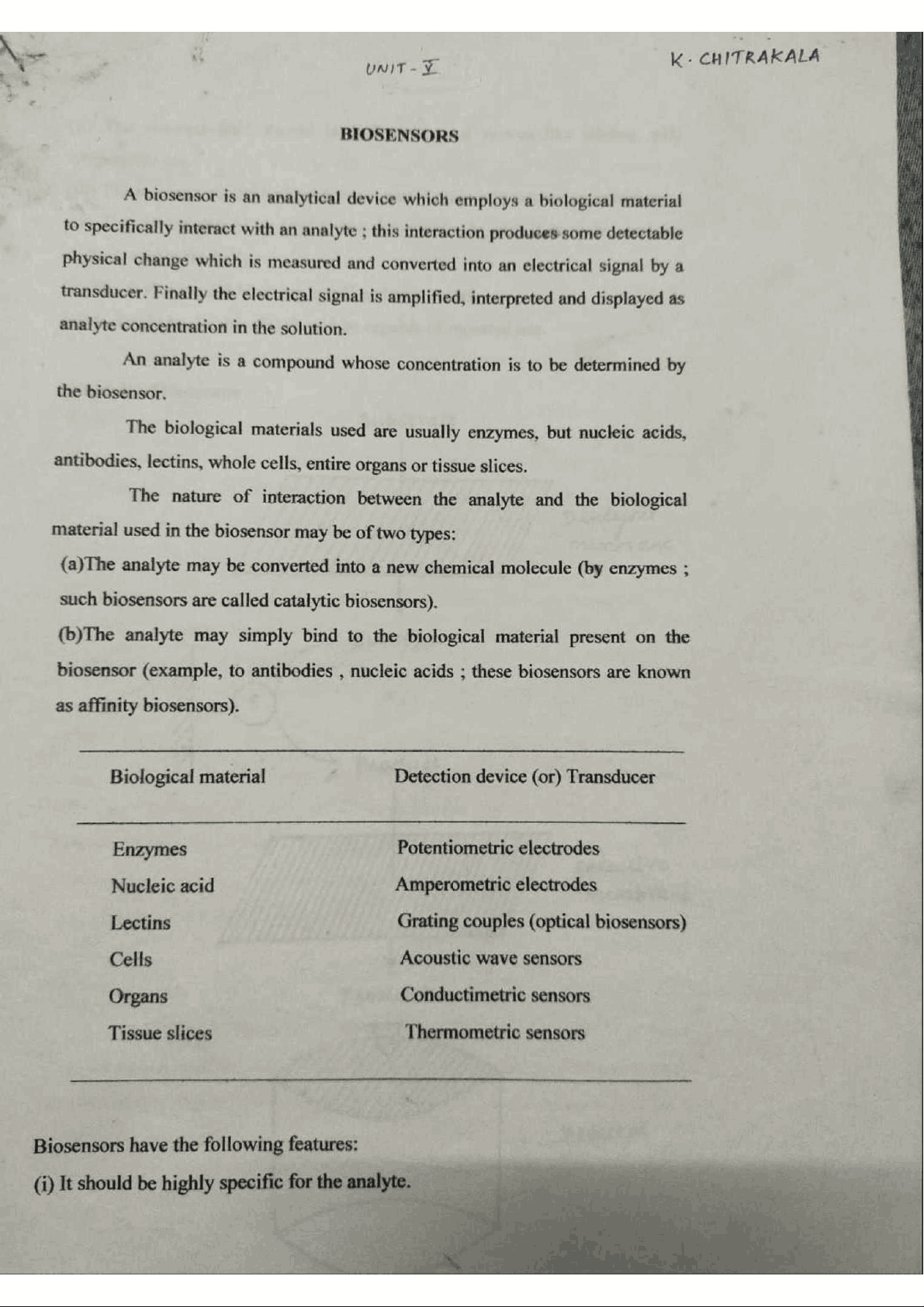
- CHITRAKALA iia K: CHITRAKA BIOSENSORS A biosensor is an analytical device which employs a biological material to specifically interact with an analyte ; this interaction produces-some detectable physical change which is measured and converted into an electrical signal by a transducer, Finally the electrical signal is amplified, interpreted and displayed as analyte concentration in the solution. An analyte is a compound whose concentration is to be determined by the biosensor. The biological materials used are usually enzymes, but nucleic acids, antibodies, lectins, whole cells, entire organs or tissue slices. The nature of interaction between the analyte and the biological material used in the biosensor may be of two types: (a)The analyte may be converted into a new chemical molecule (by enzymes ; such biosensors are called catalytic biosensors). (b)The analyte may simply bind to the biological material present on the biosensor (example, to antibodies , nucleic acids ; these biosensors are known as affinity biosensors). Biological material Detection device (or) Transducer P Enzymes Potentiometric electrodes Nucleic acid Amperometric electrodes Lectins Grating couples (optical biosensors) Cells Acoustic wave sensors Organs Conductimetric sensors Tissue slices Thermometric sensors