Download Renal Diagnostics and Laboratory Values and more Exams Nursing in PDF only on Docsity!
Renal Diagnostics and Laboratory Values
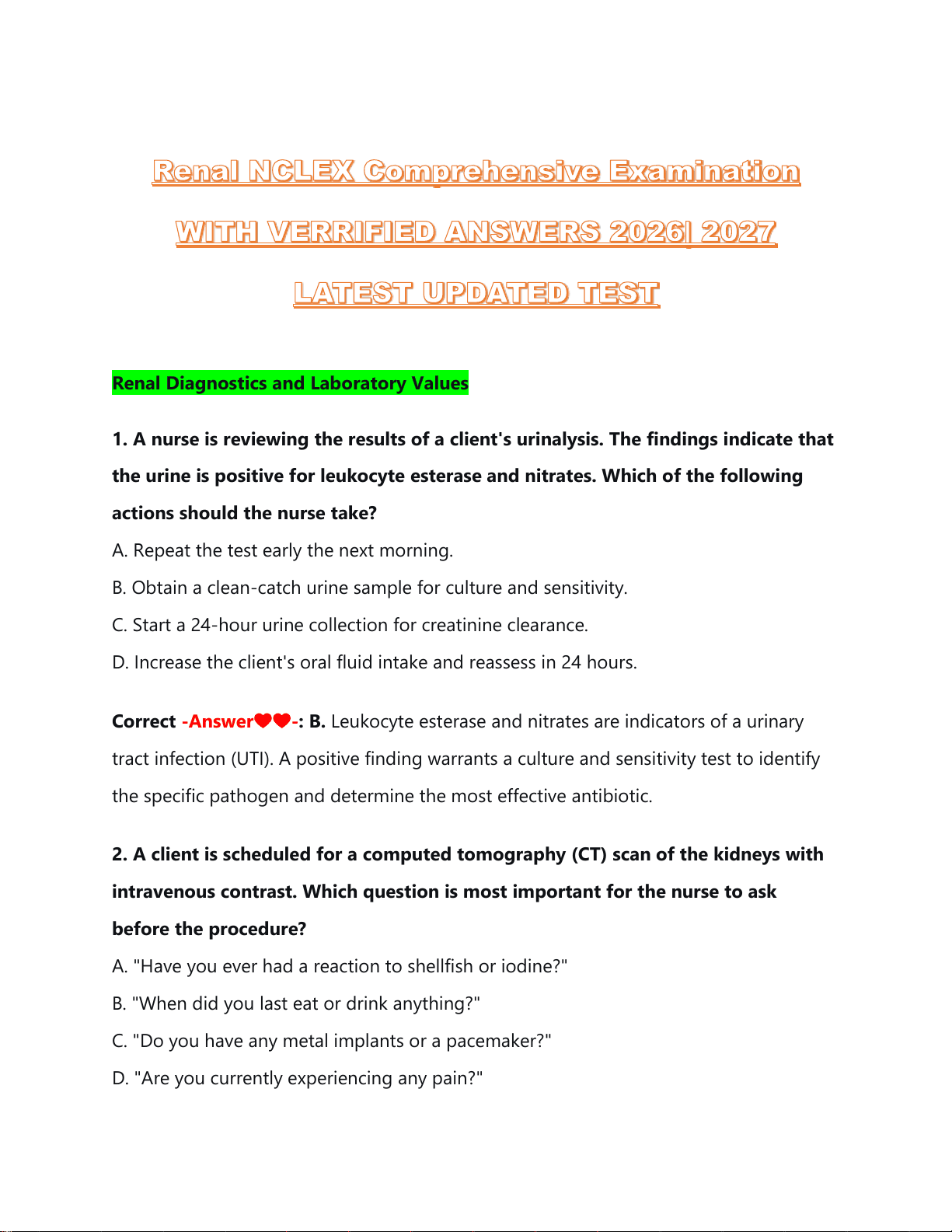
1. A nurse is reviewing the results of a client's urinalysis. The findings indicate that the urine is positive for leukocyte esterase and nitrates. Which of the following actions should the nurse take? A. Repeat the test early the next morning. B. Obtain a clean-catch urine sample for culture and sensitivity. C. Start a 24-hour urine collection for creatinine clearance. D. Increase the client's oral fluid intake and reassess in 24 hours. Correct -Answer 💜💜 - : B. Leukocyte esterase and nitrates are indicators of a urinary tract infection (UTI). A positive finding warrants a culture and sensitivity test to identify the specific pathogen and determine the most effective antibiotic. 2. A client is scheduled for a computed tomography (CT) scan of the kidneys with intravenous contrast. Which question is most important for the nurse to ask before the procedure? A. "Have you ever had a reaction to shellfish or iodine?" B. "When did you last eat or drink anything?" C. "Do you have any metal implants or a pacemaker?" D. "Are you currently experiencing any pain?"
Correct -Answer 💜💜 - : A. Intravenous contrast dye used in CT scans contains iodine. A client with an allergy to iodine or shellfish is at high risk for a severe allergic reaction. While checking for metal is crucial for MRIs, it is not the primary concern for a CT scan with contrast.
3. A client with type 2 diabetes mellitus is scheduled for an excretory urography. Which nursing action is most appropriate regarding the client's metformin (Glucophage)? A. Administer the metformin as usual with a sip of water. B. Hold the metformin for 24 hours before and 48 hours after the procedure. C. Increase the dose of metformin to account for contrast excretion. D. Hold the metformin only on the morning of the procedure. Correct -Answer 💜💜 - : B. Metformin can interact with the contrast dye, leading to a rare but serious condition called lactic acidosis, especially in clients with reduced kidney function. The medication should be withheld before and after the procedure as prescribed. 4. A nurse is teaching a client about a scheduled serum creatinine test. Which statement by the client indicates an understanding of the teaching? A. "This test will show if I have a urinary tract infection." B. "This test will check my blood for the level of waste products from muscle breakdown." C. "This test will measure the concentration of my urine." D. "This test will determine the amount of protein I am losing in my urine." Correct -Answer 💜💜 - : B. Serum creatinine is a breakdown product of creatine phosphate from muscle metabolism. It is filtered out of the blood by the kidneys and is
7. A nurse reviews the urinalysis results of a patient and notes a urine osmolality of 1200 mOsm/kg (1200 mmol/kg). Which action should the nurse take? A. Contact the provider and recommend a low-sodium diet. B. Prepare to administer an intravenous diuretic. C. Obtain a suction device and implement seizure precautions. D. Encourage the patient to drink more fluids. Correct -Answer 💜💜 - : D. Normal urine osmolality ranges from 300 to 900 mOsm/kg. A value of 1200 indicates highly concentrated urine, suggesting dehydration. The nurse should encourage the patient to increase fluid intake to correct the fluid volume deficit. 8. A nurse contacts the healthcare provider after reviewing a patient's laboratory results and noting a blood urea nitrogen (BUN) of 35 mg/dL (12.5 mmol/L) and a creatinine of 1.0 mg/dL (88.4 mcmol/L). What collaborative care measure does the nurse consult the provider about? A. Intravenous fluids B. Hemodialysis C. Fluid restriction D. Urine culture and sensitivity Correct -Answer 💜💜 - : A. The BUN is elevated, but the creatinine is normal. Creatinine is more specific for kidney function, while BUN can be elevated by non-renal factors such as dehydration, high-protein diet, or catabolism. The most likely cause here is dehydration, so the nurse should anticipate an order for IV fluids. 9. A nurse is providing post-procedure care for a client who had a kidney biopsy. Which intervention should the nurse include in the plan of care? A. Ambulate the client in the room and hall for short distances. B. Encourage fluids to at least 3 L in the first 24 hours.
C. Test serial urine samples with a dipstick for occult blood. D. Position the client prone for the first 4-6 hours. Correct -Answer 💜💜 - : C. The greatest risk after a kidney biopsy is hemorrhage. The nurse should monitor for bleeding by assessing serial urine samples for visible or occult blood, monitoring vital signs frequently, and enforcing bed rest (usually for 6-8 hours) on the affected side to apply pressure to the biopsy site.
10. A client with a history of hypertension is being evaluated for renal artery stenosis. The nurse anticipates preparing the client for which diagnostic procedure? A. Cystoscopy B. Intravenous pyelogram (IVP) C. Renal arteriogram D. KUB (kidney, ureter, bladder) x-ray Correct -Answer 💜💜 - : C. A renal arteriogram (angiogram) is an invasive imaging procedure where contrast dye is injected directly into the renal arteries to visualize blood flow and identify any blockages or narrowing (stenosis). **Acute Kidney Injury (AKI)
- A postoperative patient has a urine output of 100 mL in the past 8 hours. The nurse recognizes this as which potential condition?** A. Prerenal acute kidney injury B. Intrarenal acute kidney injury C. Postrenal acute kidney injury D. Chronic kidney disease
prevent worsening pulmonary edema and then reassess the patient and notify the provider.
14. Which finding most strongly suggests prerenal AKI? A. Positive urine eosinophils B. History of aminoglycoside therapy C. Prolonged hypotension with MAP 55 mmHg D. Obstructing ureteral stone on imaging Correct -Answer 💜💜 - : C. Prerenal AKI is caused by hypoperfusion of the kidneys. Prolonged hypotension (MAP < 60-65 mmHg) is a classic prerenal cause, as it directly reduces renal blood flow. Aminoglycosides and positive urine eosinophils suggest intrinsic (ATN or allergic) causes, while an obstructing stone indicates a postrenal cause. 15. A client has a serum potassium level of 6.5 mEq/L (6.5 mmol/L), a serum creatinine level of 2 mg/dL (176 mcmol/L), and a urine output of 350 mL/day. What is the best action by the nurse? A. Place the patient on a cardiac monitor immediately. B. Teach the patient to limit high-potassium foods. C. Continue to monitor the patient's intake and output. D. Ask for a prescription for a loop diuretic. Correct -Answer 💜💜 - : A. A serum potassium of 6.5 mEq/L in a patient with oliguria is a critical value. Hyperkalemia is a life-threatening complication of AKI because it can lead to fatal cardiac dysrhythmias. The priority action is to place the client on a cardiac monitor to detect changes early. 16. A nurse is caring for a client with AKI who has a dangerously high potassium level. Which medication order does the nurse anticipate administering to
temporarily shift potassium from the bloodstream into the cells? A. Sodium polystyrene sulfonate (Kayexalate) B. Intravenous regular insulin and glucose C. Oral calcium acetate (PhosLo) D. Furosemide (Lasix) Correct -Answer 💜💜 - : B. Intravenous insulin (with glucose to prevent hypoglycemia) drives potassium into the cells, providing a temporary but rapid shift to lower serum levels. Kayexalate removes potassium from the body via the bowel, which takes longer.
17. A patient in the intensive care unit is in the oliguric phase of AKI. The nurse should be most concerned about which assessment finding? A. Daily weight gain of 1 kg (2.2 lb) B. Serum sodium of 138 mEq/L C. Decreased deep tendon reflexes D. Serum phosphorus of 4.2 mg/dL Correct -Answer 💜💜 - : A. In the oliguric phase, the patient cannot excrete fluids, putting them at high risk for fluid overload. A weight gain of 1 kg equals a fluid gain of 1 liter. This rapid weight gain is a critical indicator of worsening fluid volume excess, which can lead to pulmonary edema and heart failure. 18. Which statement about acute renal failure (ARF) and chronic renal failure (CRF) is accurate? A. ARF is always reversible, while CRF is always irreversible. B. Both ARF and CRF are characterized by a slow, insidious onset. C. ARF is often a sudden, potentially reversible loss of function, while CRF is a slow, progressive, irreversible deterioration.
Correct -Answer 💜💜 - : A. In a patient with kidney failure, intake and output measurements are helpful, but they do not account for insensible fluid losses. Daily weights, measured at the same time each day on the same scale, provide the most accurate assessment of fluid gain or loss (1 kg = 1 L of fluid). Chronic Kidney Disease (CKD) and End-Stage Renal Disease (ESRD)
21. A client with chronic kidney disease (CKD) is experiencing nausea, vomiting, visual changes, and anorexia. Which action by the nurse is best? A. Check the client's digoxin (Lanoxin) level. B. Administer an antinausea medication. C. Ask if the patient is able to eat crackers. D. Get a referral to a gastrointestinal provider. Correct -Answer 💜💜 - : A. Nausea, vomiting, anorexia, and visual changes (such as seeing yellow halos) are classic signs of digoxin toxicity. Clients with CKD are at high risk for digoxin toxicity because the drug is excreted renally and can accumulate to toxic levels. The nurse's best action is to check the digoxin level. 22. A client with chronic kidney disease is receiving epoetin alfa (Epogen). The nurse should assess the client for which potential adverse effect of this medication? A. Uncontrolled hypertension B. Chronic diarrhea C. Hypokalemia D. Bleeding tendencies
Correct -Answer 💜💜 - : A. Epoetin alfa stimulates the bone marrow to produce red blood cells. As the red blood cell count rises, blood viscosity increases, which can lead to or exacerbate hypertension. Blood pressure must be closely monitored.
23. A patient with CKD asks why they need to take calcium acetate (PhosLo) with meals. The nurse's best response is: A. "It will prevent the stomach upset caused by your other medications." B. "It helps to replace the calcium that your diseased kidneys can no longer activate." C. "It binds to the phosphorus in food and helps eliminate it in your stool." D. "It increases the absorption of vitamin D, which is important for bone health." Correct -Answer 💜💜 - : C. Phosphate binders like calcium acetate work by binding to dietary phosphorus in the gastrointestinal tract, preventing its absorption into the bloodstream. They must be taken with meals to be effective. This helps manage hyperphosphatemia, a common complication of CKD. 24. A client with stage 4 CKD is being taught about a low-potassium diet. The nurse knows the patient understands the teaching when they select which meal? A. Granola made with dried fruits, nuts, and seeds B. Apple slices, green beans, and a roast beef sandwich C. Watermelon and a banana D. Bran cereal with milk and a glass of orange juice Correct -Answer 💜💜 - : B. Apple slices, green beans, and a roast beef sandwich are all relatively low in potassium. Dried fruits, nuts, bananas, watermelon, bran cereal, oranges, and milk are all high-potassium foods and should be limited or avoided on a renal diet. 25. A nurse is caring for a client in end-stage renal disease. The client has an internal arteriovenous (AV) fistula in the left arm for dialysis. Which of the
Correct -Answer 💜💜 - : B. Hemodialysis removes waste products but can also remove amino acids and some protein. To compensate for these losses and maintain a positive nitrogen balance, patients on hemodialysis require a high-protein diet (typically 1.0-1. g/kg/day).
28. A client with CKD has a serum potassium level of 6.8 mEq/L, and the cardiac monitor shows peaked T waves. Which medication should the nurse prepare to administer first? A. Sodium polystyrene sulfonate (Kayexalate) B. Intravenous calcium gluconate C. Intravenous regular insulin and dextrose D. Oral furosemide (Lasix) Correct -Answer 💜💜 - : B. The priority in life-threatening hyperkalemia with ECG changes is to stabilize the cardiac membrane. Intravenous calcium gluconate does not lower the serum potassium, but it immediately antagonizes the effects of potassium on the heart, reducing the risk of dysrhythmias. 29. The nurse is providing discharge teaching for a client newly diagnosed with CKD who is not yet on dialysis. Which statement about protein intake is correct for this client? A. Protein intake should be unrestricted to prevent malnutrition. B. Protein intake should be severely restricted to 0.2 g/kg/day. C. Protein intake should be moderately restricted (0.6-0.8 g/kg/day) to delay disease progression. D. Protein intake should be the same as for a patient on hemodialysis. Correct -Answer 💜💜 - : C. For clients with CKD who are not on dialysis, a moderately protein-restricted diet (0.6-0.8 g/kg/day) is often recommended to reduce the buildup
of nitrogenous wastes and slow the progression of kidney disease without causing malnutrition.
30. The nurse is assessing a patient with advanced CKD. Which finding is most consistent with uremic syndrome? A. Hypotension and polyuria B. Fatigue, pruritus, and pericardial friction rub C. Eupnea and metabolic alkalosis D. Polycythemia and bone pain Correct -Answer 💜💜 - : B. Uremic syndrome is the collection of signs and symptoms caused by the accumulation of waste products. Fatigue (from anemia) and pruritus (from high phosphorus and toxin deposition) are common. A pericardial friction rub indicates uremic pericarditis, a serious complication of untreated uremia. **Hemodialysis and Nursing Management
- A nurse is preparing to initiate hemodialysis for a patient with acute kidney injury. Which of the following actions should the nurse take? (Select all that apply)** A. Review the medications that the client currently takes. B. Assess the AV fistula for a bruit and thrill. C. Calculate the client's hourly urine output. D. Measure the client's weight. E. Assess the access site for venipuncture. Correct -Answer 💜💜 - : A, B, D. Before dialysis, it's essential to review medications (some may be held), assess the access site for patency (bruit/thrill), and obtain a pre- dialysis weight to calculate fluid removal goals. The access site must never be used for venipuncture or IVs.
34. The most frequent complication during hemodialysis is: A. Muscle cramping. B. Disequilibrium syndrome. C. Hypotension. D. Nausea and vomiting. Correct -Answer 💜💜 - : C. Hypotension is the most common intradialytic complication. It is caused by rapid fluid removal (ultrafiltration) that exceeds the rate of plasma refilling from the interstitial space. 35. A patient who has just returned from hemodialysis has a heart rate of 124 bpm and is complaining of dizziness. What is the nurse's priority action? A. Notify the healthcare provider immediately. B. Assess the patient's blood pressure. C. Place the patient in Trendelenburg position. D. Administer a 250 mL bolus of normal saline. Correct -Answer 💜💜 - : B. The priority is to assess for the most likely cause: hypovolemia/hypotension from dialysis. The nurse should first assess the patient's blood pressure and then check the post-dialysis weight to determine how much fluid was removed. 36. A patient on hemodialysis is scheduled for surgery. The nurse knows that the patient should ideally receive hemodialysis: A. Immediately after surgery. B. The day before surgery. C. The morning of surgery. D. The day after surgery.
Correct -Answer 💜💜 - : B. The ideal timing is the day before surgery. This allows for optimization of fluid and electrolyte balance and reduces uremia, which can improve surgical outcomes and wound healing. It also avoids the fluid shifts and anticoagulation used during dialysis immediately before or after a procedure.
37. Which instruction is most important for the nurse to include in the teaching plan for a patient with a new AV fistula? A. "You should check the site daily for a thrill or vibration." B. "You can still have your blood pressure taken on that arm." C. "It is best to sleep on that arm to protect the fistula." D. "Keep the site covered with a tight, restrictive bandage." Correct -Answer 💜💜 - : A. The patient is the first line of defense in monitoring their access. They must be taught to palpate for a thrill and auscultate for a bruit daily to ensure the fistula remains patent. Any change should be reported immediately. 38. The nurse is caring for a patient during their first hemodialysis treatment. The nurse monitors the patient closely for disequilibrium syndrome, which is characterized by: A. Hypotension, tachycardia, and fever. B. Headache, confusion, nausea, and seizures. C. Chest pain, dyspnea, and hypoxemia. D. Muscle cramping and weakness. Correct -Answer 💜💜 - : B. Disequilibrium syndrome is caused by a rapid shift in fluids and electrolytes during dialysis, leading to cerebral edema. It is most common in new patients or after a missed treatment. Symptoms are neurological and include headache, nausea, restlessness, confusion, and potentially seizures.
C. Flush the tubing with normal saline to maintain patency of the catheter. D. Check the peritoneal catheter for kinking and curling. Correct -Answer 💜💜 - : B. Cloudy or opaque effluent is the classic sign of peritonitis, the most common and serious complication of peritoneal dialysis. The nurse should obtain a sample for culture and sensitivity to identify the organism and then notify the provider for antibiotic orders.
42. The nurse monitoring a client receiving peritoneal dialysis notes that the client's outflow is less than the inflow. Which actions should the nurse take? (Select all that apply) A. Check the level of the drainage bag. B. Reposition the client to his or her side. C. Contact the health care provider (HCP) immediately. D. Place the client in good body alignment. E. Check the peritoneal dialysis system for kinks. F. Increase the flow rate of the peritoneal dialysis solution. Correct -Answer 💜💜 - : A, B, D, E. Poor outflow is a common problem. Nursing interventions include checking for kinks, repositioning the patient (as gravity can help), ensuring the drainage bag is below the level of the abdomen, and checking for constipation. The provider is not contacted immediately; these nursing measures are tried first. 43. A patient on continuous ambulatory peritoneal dialysis (CAPD) calls the clinic and reports abdominal pain and diarrhea. What additional question is most important for the nurse to ask? A. "Have you been eating any new or different foods?" B. "What does your dialysis output look like?"
C. "Have you been able to ambulate normally today?" D. "What was your last blood glucose reading?" Correct -Answer 💜💜 - : B. Given the patient is on CAPD, abdominal pain and diarrhea raise a high suspicion for peritonitis. The nurse must ask about the appearance of the peritoneal effluent. Cloudy effluent is a hallmark sign of peritonitis and would require immediate intervention.
44. Which criterion is required before a patient can be considered for continuous peritoneal dialysis? A. The patient must be hemodynamically stable. B. The vascular access must have healed. C. The patient must be in a home setting. D. Hemodialysis must have failed. Correct -Answer 💜💜 - : A. Hemodynamic stability is necessary for peritoneal dialysis. While PD is often done at home, it can be done in other settings. It is a choice, not a last resort after HD failure. It does not require a vascular access; it requires a peritoneal catheter. 45. The nurse is teaching a patient about CAPD. Which patient statement indicates a need for further teaching? A. "I should leave the drainage bag above the level of my abdomen." B. "I could flush the tubing with normal saline if the flow stops." C. "I should take a stool softener every morning to avoid constipation." D. "My diet should have low fiber in it to prevent any irritation." Correct -Answer 💜💜 - s: A, B, D. The drainage bag must always be kept below the abdomen to facilitate outflow by gravity. Flushing the tubing is not a standard practice