Download Rotational Motion: Displacement, Speed, Acceleration, Center of Mass, Inertia and more Study notes Law in PDF only on Docsity!
Rotations
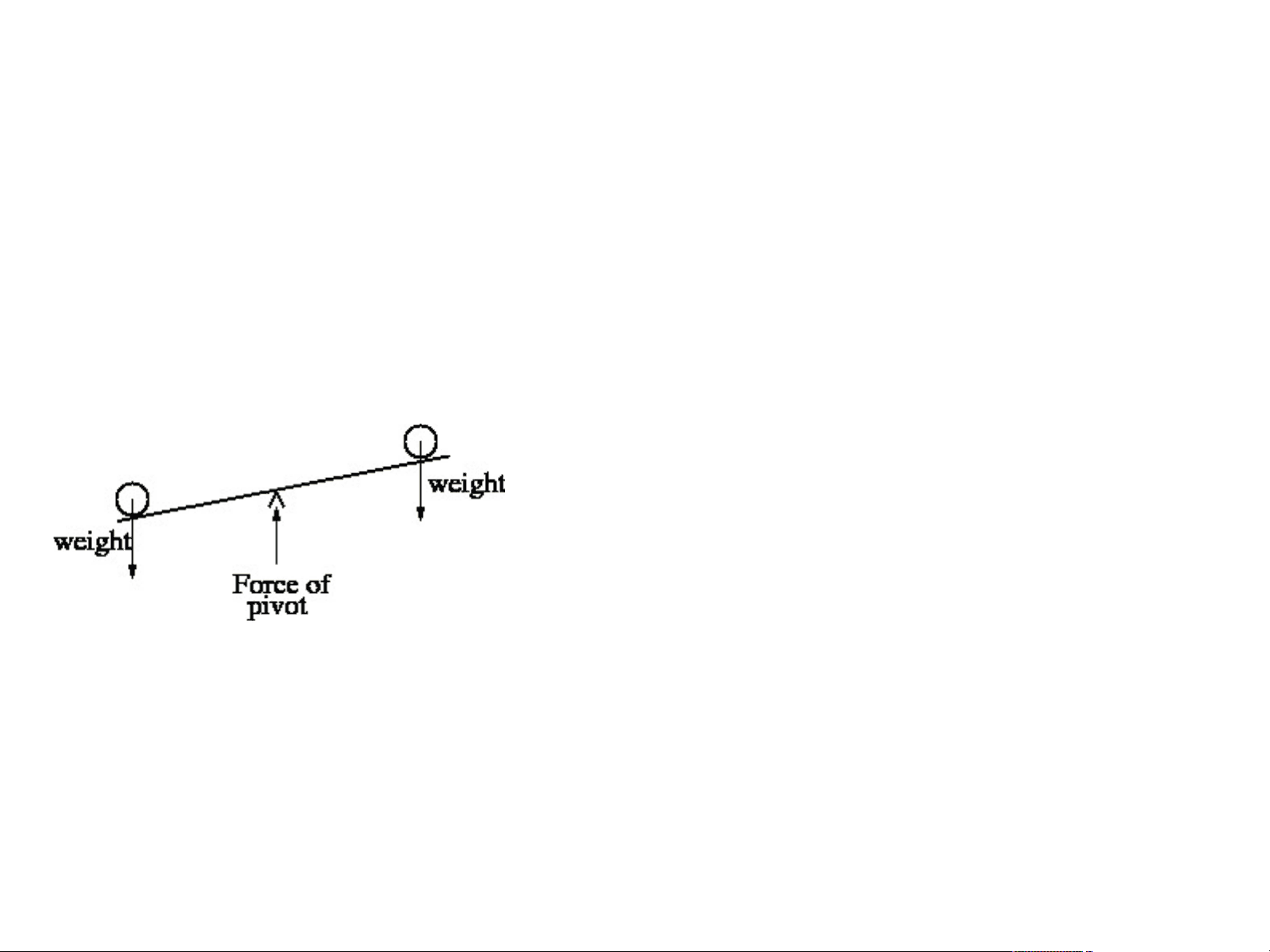
So far we have considered translational motion (along some path from point A to B). Things can also rotate. Rotational motion is common. A child's top, a seesaw or a merry-go-round are examples of 'pure' rotational motion. (The motion of a wheel on a car is a mixture of translation and rotational motion.) The seesaw is in^ translational equilibrium since the whole seesaw is not moving up, down, left or right. It is also in translational equilibrium since all the forces balance. However the seesaw can rotate about the pivot. If the 'rotational forces' are balanced, it will not rotate. If they are not balanced e.g. the two weights are not equal and at the same distance from the pivot, the seesaw will rotate. First we will look at doing 'rotational kinematics' in analogue with translational kinematics.
Angular Displacement, Speed and Acceleration
Degrees ( o ) are not good units for angles for what we want to do. A better unit is the radian. A radian is really dimensionless but I will often write 'rad' to show the number is really an angle measured in radians. So what is a radian? An angle in radians is the arc length you travel around a circle divided by the radius: Since the circumference of a circle is 2πr there are 2π radians in 360 o
. That works out to 1 radian = 57. o. A radian is dimensionless.
Angular Acceleration
In an analog to translational motion we can define angular acceleration as change in angular speed, α, for some time interval: α = Δt Δω The units for angular acceleration are s
- . The sign convention (basically the vector part) for angular displacement, speed and acceleration is that counterclockwise is positive and clockwise is negative.
Center of Mass and Rotational Inertia
If we have a uniform stick hanging from a string placed at the middle of the stick we can spin the stick around. If there is no friction it will spin forever. It takes some 'angular force' (called torque) to get it going. If it is at rest, it will stay at rest. This suggests an angular versions of Newton's 1 st laws. Every extended object (not a point mass) has a place where the object will balance and spin around. This point is called the 'center of mass'. An axis through the center of mass will allow the object to rotate without translational motion.
7
Rotational Inertia
The resistance of an object to start rotating or stop
rotating i.e., change its angular speed, is rotational
inertia. The measure of this rotational mass is called
the moment of inertia. This property of an extended
object depends on the mass of the object and the
shape (geometry) of the object. The units for this
rotational mass are kg m
2 .
The rotational mass also depends on which axis the
object is rotating about. For a uniform sphere it does
not matter which axis as long as it goes through the
center. For a long rod, the rotational mass is
different through the long axis through the center of
mass than perpendicular through the center.
Torque
Torque is rotational force. We can define torque more precisely using the analogue of Newton's 2 nd Law for rotations. Torque = rotational mass x angular acceleration or τ = I α (Newton's 2 nd law for rotation) We know from a seesaw that a larger child need to be positioned closer to the pivot than a smaller child for the seesaw to balance. A lever can be used to lift a heavy object with a smaller force.
Friction
So far we have ignored friction. Friction can be good or bad. We could not walk without friction but eliminating friction in machinery is very important i.e. using lubricants. If you push something across the floor, you may notice that it is harder (requires more force) to get it going than it is to keep it going. There are two types of friction: static and kinetic. Static friction is stronger than kinetic friction. Friction of object sliding over one another is causes by small microscopic bumps. Make the surfaces flatter and the friction is reduced. Add oil and the friction is even smaller.
11
Friction
A rolling wheel is actually a case of static friction. The wheel is moving and rotating. However as the wheel rotates around, the wheel comes down on the ground and then lifts off the ground. There is no motion between the ground and wheel at the point of contact at the bottom of the wheel. This assumes there is no slipping. ABS braking systems on cars are designed to keep the wheel from slipping by actually removing the brakes for a short time. Kinetic friction is very bad when you want to Stop quickly.
13
Kinetic Energy
A more obvious form of energy is energy of motion or kinetic energy. The energy of an object due to its motion is: Kinetic Energy = KE = ½ mass x speed 2 = ½mv 2 The unit is again a joule. Note that if you double the speed of an object, the kinetic energy is four times larger because of the squared speed. An object can also have kinetic energy because it is rotating. Then: Rotational KE = ½ I 2 Where I is the rotational 'mass' and ω is the angular speed. Note it is just like translational KE except it has rotational variable.
Work Energy Theorem
Work is something done to an object. Energy is something an object has. Said another way, when you do work on an object, you give it energy. The work energy theorem says the work you do on something is equal to the change in the Kinetic energy: W = ∆KE The caveat to this statement is the potential energy does not change like going up or down a hill. Friction (which is turned into heat) is another caveat so the work energy theorem also assumes there is no friction.
Conservation of Energy
The work energy theorem is just a special case of the more general law of energy conservation: Energy cannot be created or destroyed. Energy can be changed from one form to another but the total amount never changes. Energy conservation is probably the single most important idea in physics. When we say energy we are now including kinetic energy as well as all forms of potential energy (and eventually we will add heat energy).
Power
The rate work is done or the time rate of change of energy is called power. Power = The unit of power is the J/s or Watt. If you use a 20 W electrical clock radio you are using (and paying) for energy. A 1 kW (1000 W) hair dryer used 50 times the energy as the radio each second. If you get an electrical bill, you may have noticed you are charged by the kw . hr. A kw . hr is one kilowatt for 1 hour or 3.6 x 10 6 J (3.6 MJ). Work done Time interval
19
Impulse
It requires a force acting for some time to change the velocity and thus the momentum of an object. A force acting on something for some time interval is called 'impulse' and is related the the change in momentum. Impulse = force x time interval = F ∆t = ∆mv This is really just Newton's 2 nd law: a = = F ∆t = ∆mv A bullet hitting a brick wall has a large impulse because the time interval is small. A supertanker need a small force for hours to change its momentum.
F
m change in v change in time
Conservation of Momentum
We two objects collide the total momentum is conserved: total moment before = total momentum after This is known as the law of momentum conservation. The caveat on this is that there are no external forces (internal between the two object is fine.) Momentum is a vector so we have to have the same amount of momentum before and after in each dimension e.g. x and y.