Download Midterm Exam for PH111: Fall 2006 - Problems on Mechanics and more Exams Physics in PDF only on Docsity!
NAME (type clearly):
MIDTERM 2 - PH111, FALL 2006
November 2, 2006
Solve any 4 of the following 5 problems (25 points each). Problem 6 is for extra crediti ( points). In order to simplify the calculations, you may assume that the gravitational acceleration is g'10 [m/s^2 ], and you may round off other numbers, e.g., cos(45) = sin(45) ' 0. 7. SHOW ALL WORK ON TEST SHEET, OR ATTACH ADDITIONAL SHEETS.
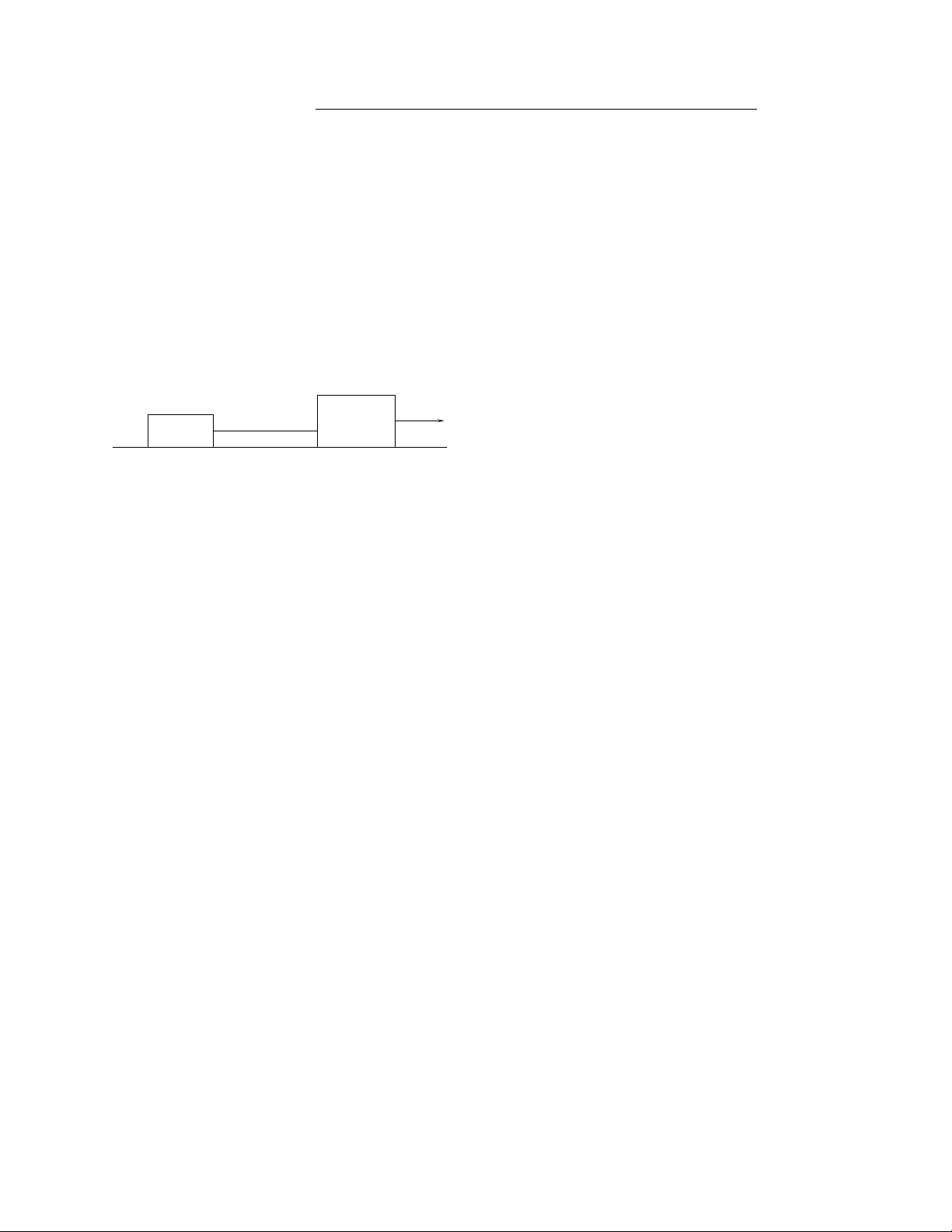
- Two boxes of mass mA=1 kg and mB =2 kg are connected by a rope, and pulled by a force F =3 [N] applied as in Figure.
A B
F
(a) Determine the acceleration of the two boxes, if no friction acts between the boxes and the plane.
(b) Determine the tension in the cord, if no friction acts between the boxes and the plane.
(c) It is observed that the two boxes move with an acceleration of a=0.5 m s−^2 along the horizontal plane. Find the coefficient of kinetic friction between the boxes and the plane.
- A box of mass m=1 [kg] is pushed along an incline of α=45 degrees by a force F , directed as in Figure. The coefficient of kinetic friction between the box and the incline is μK =0.1.
F α
d
(a) Find the magnitude of the force FN , the normal reaction of the incline.
(b) Find the work Wf done in order to overcome friction during a displacement of distance d=1 [m] along the incline.
(c) When the block reaches a distance of d=1 [m] along the incline, its velocity is v= 2 m s−^1 (the block started from rest). Find the magnitude of the force F.
- Two balls of mass m 1 =m 2 undergo a head-on collision along a frictionless surface. Ball 1 moves with an initial velocity of 2 m s−^1 , and ball 2 is initially at rest. It is observed that, after the collision, ball 2 moves with velocity v 2 =1 m s−^1.
(a) Determine if the collision is elastic or inelastic.
(b) Find the velocity of ball 1 after the collision.
- A practice baseball swings in a circular orbit of R = 2 m and angular velocity ω=10 rad s−^1 , in a horizontal plane (no gravity or friction). It is kept in a circular orbit by a spring which has a rest length of 1 [m].
����������
����������
�����
����������
����������
�����
Find the elastic constant k of the spring.