Download Understanding Satellite Motion: Gravity, Circular Motion, and Escaping Earth's Grasp and more Study notes Physics in PDF only on Docsity!
Satellites and Doors Question
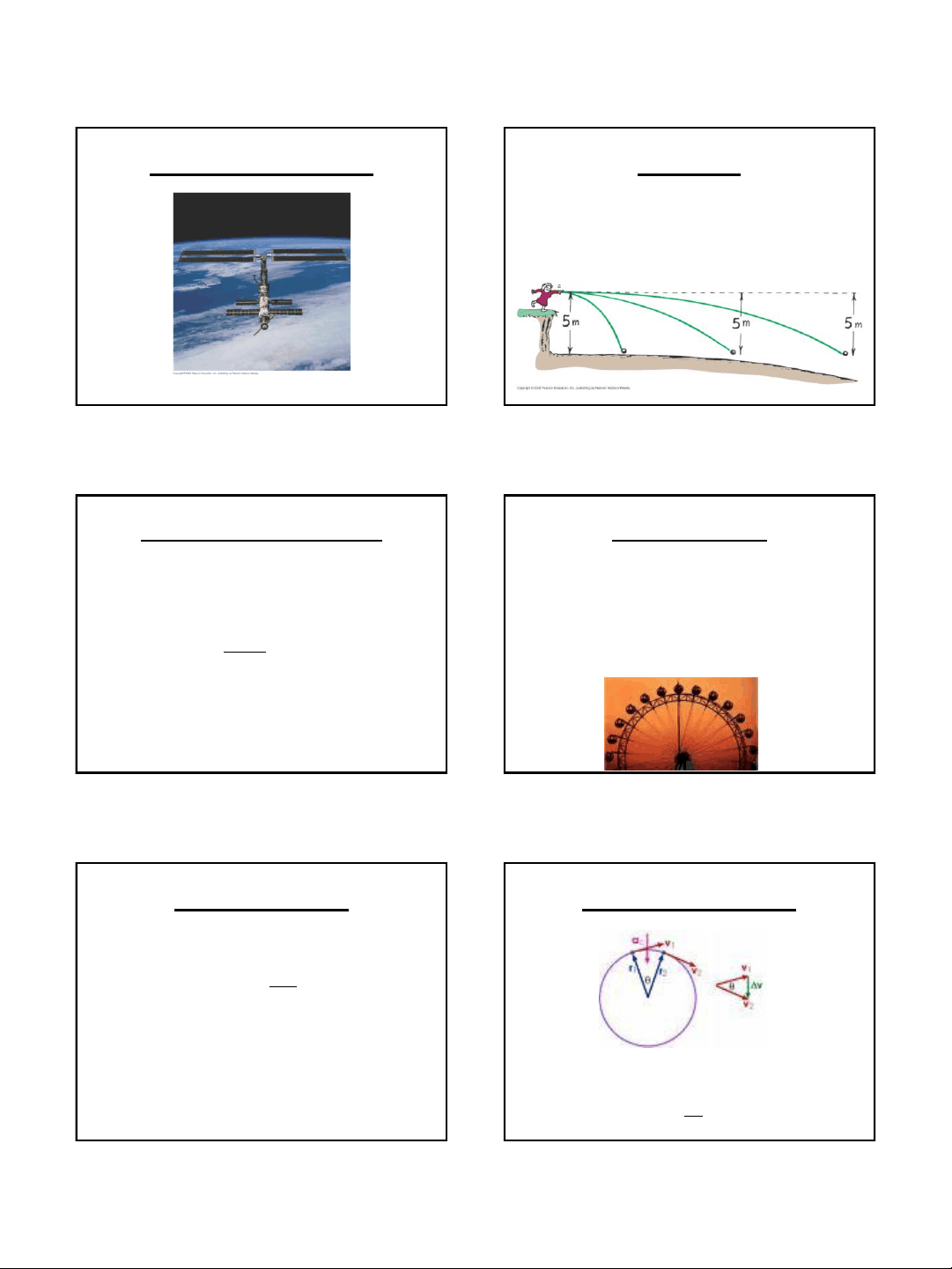
What happens to the trajectory of the
projectile when the horizontal
component of the velocity is large?
To answer that question
we need to know about
(1) Newton’s universal law of gravitation,
where the magnitude of the force of gravity
is
(2) circular motion
11 2 2
2
1 2
g
G 6.67x 10 Nm /kg
r
mm
F G
Circular motion
- Instead of linear displacement, consider
angular displacement:
- Angular displacement is a measure of rotation
f i
Circular motion
- The average angular velocity is
- How is the average angular velocity related to
the good old average linear velocity? Think
back to arc length
t
av
s r| |.
f i
v r| |.
av
Radial acceleration
The radial acceleration is directed inward towards
the center of the circle. It’s magnitude is given by
r
v
a
2
r
Satellite speed
- Now let’s go back to our original question of
what happens to a projectile launched with a
large horizontal velocity? Will it start to orbit
the Earth? How large is large?
- To answer the above question(s), consider a
satellite orbiting the Earth some distance
above the Earth’s surface? What is its speed?
What law do we need to invoke to determine
the satellite speed?
Satellite speed
Satellite speed
to obtain
F F ma
g i
.
r
Gm
v
E
E
Rotation curves of galaxies
Dark Matter?
Our galaxy: The
Milky Way
Are all orbits circular? Elliptical orbits
- To understand elliptical orbits, let’s talk
about energy. What is the more general
expression for gravitational potential
energy now that we have a more general
expression for the force of gravity?
GPE mgh.
r
mm
GPE G
1 2
Mechanical equilibrium
- For systems that can rotate, mechanical
equilibrium means that the sum of the
forces on the system is zero and the sum
of the torques on the system is also zero.