Download Gravitational Energy in Planetary Motion and more Assignments Physics in PDF only on Docsity!
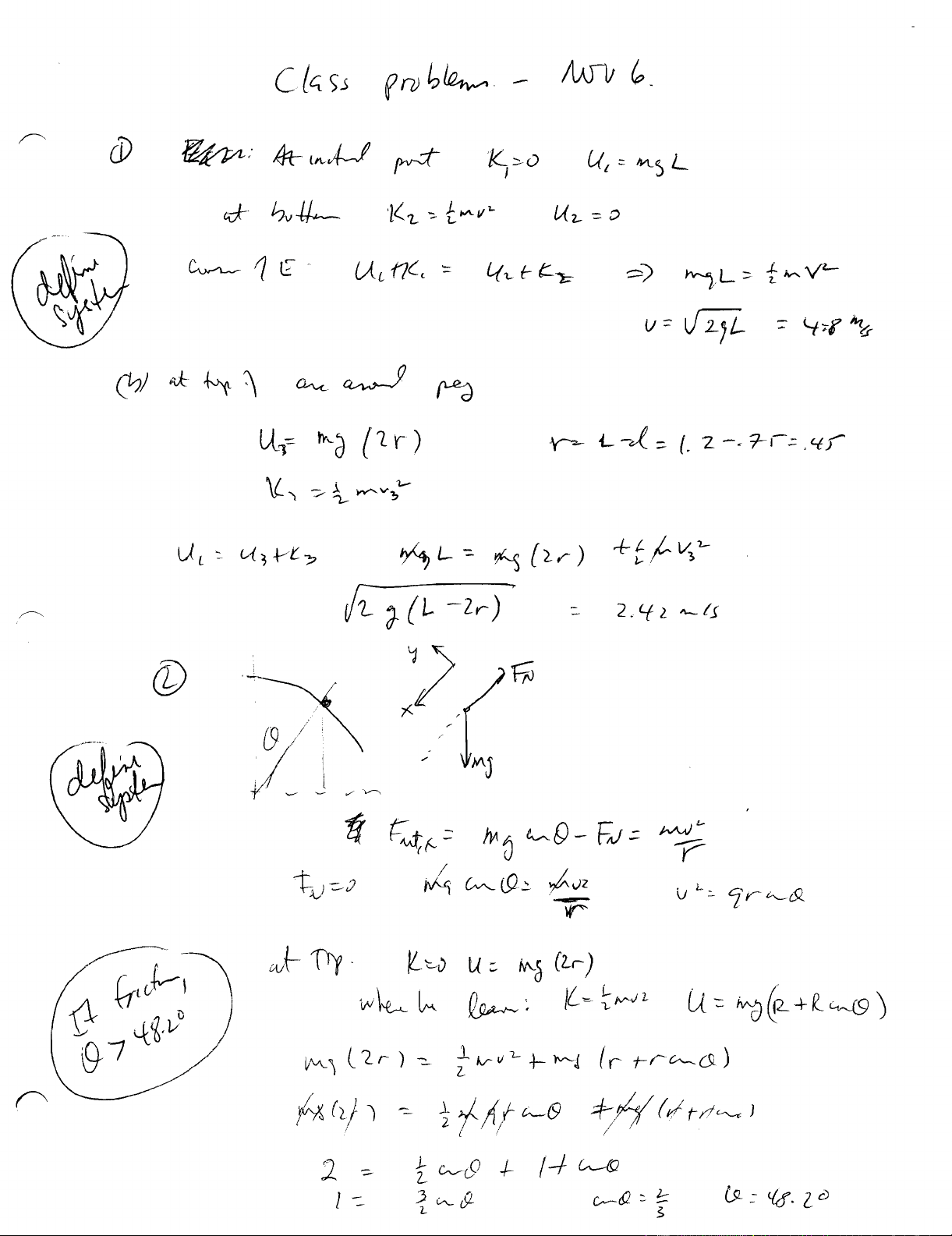
~) rv-;,L:; i Jv... VZ-
v::: V2,L ::: It,,r ~
(}1) .J:.~~ ~.~ ~
U1~ tr-- d (1 r )
(") ":/ .. ............ v~t-
wf-- IT'f. ~ 'c-u U ~ f.t--~ (Lr)
'0/~~ ~~ /L=tfV'il2- U::~~+t~)
v""-- ') C L r- ) ~ ~ kr IJ 7 +-- ~J (I t-rCA-..(y")
~ (?-! 'I ~ {f~/- ~(9 4-;7(y/ tr1~)
2 ~ i ~(9 -I- !-I- ~
1 -:. ~ <A... r9- G---t2 :: r (y.. ~ «0. l c)
/lAvl
- r-
M :::~2-
r
()~)r
vf- "': Ie ~u U: fIAj J--, ~
l
tet·~ ~ ~ lL:: f rv1/ U -- Y1A j (2,- )
-t/VL^ +- ~ (14') .~. rj h
1 CXr + 1- d^ r '-. ft!t.., A:: 2,)r
~/l 1 I
/ )^ J.",^ tty )^ ~ .¢ e..j^ 1.^ /Ij
uL..-~ tv j r
~ = "'1 +- ~l =:"'1 + ~ LDez/ ::::~)
u z: ~ (w ) ~ ::: { wvl
~ (Lr/ -+ 1 wV-l.--:;. ~ (~r)
if,,"1--": Y>(5r) v
L
,:::- 0Jr
PN~? ::- v:;; ~ ~. ~;-- ~ ~?- i?'Hr^ - ~ i -:: S
14-8 THE GRAVITATIONAL FIELD (OPTIONAL) 315
FIGURE 14-19. Sample Problem 14-10. The orbits of space
craft A and B are shown. Note that B catches A by moving to a
noncircular orbit at lower height above the Earth. The relative size of the Earth and the orbital heights is not to scale.
After the burn, the speed decreases by the given amount of 0.95%
to v' (l - O.OO95)v = 7.68 X 10³ mIs, and the new kinetic en
ergy of B is
K' ~(3250 kg)(7.68 X 10³ m/s)2 = 9.58 X 10¹⁰ 1.
The potential energy of B at point P immediately after the short
burn is unchanged, equal to the initial value E K or 2E, accord
ing to Eq. 14-25. The total energy E' of B after the burn must then
be E' K' + U' = 9.58 X 10¹⁰ J + 2(- 9.76 X 10¹⁰ J)
and the new semimajor axis is, from Eq. 14-25,
_ GmM E
a' 2Et
(6.67 X 10- 11 N· m^2 /kg 2 )(3250 kg)(5.98 X 1024 kg)
= ......... 2(-9.94 X lOiO J)
6.52 X 10⁶ m 6520 km, a reduction of 1.8% from the value in the original orbit. The corre sponding period is
41T2at3 )
T' (
GM E
417'2(6.52 X 10⁶ mi ) == ((6.67 X 10- 11 N' m^2 /kg^2 )(5.98 X 10 H^ kg)
'" 5240 s.
The difference in the periods is 140 s. That is, if A originally
passes through point P at t = 0 and B passes through (and fires its
rockets) at t = 105 s, then A returns to P at t 5380 s (deter
mined by the period T), and B returns to P at 5240 s after its ini
tial passage, or at t = 105 s + 5240 s 5345 s. Thus B is now
35 s ahead of A at point P. Now B can fire a second rocket burst
identical in strength and duration to the first but in the reverse di rection. This returns B to the original circular orbit, now 35 s
ahead of A. Figure 14-19 shows the relationship between A and B
during the first orbit after the bum. Note that after the burn, B
moves in an elliptical orbit and so can pass A without colliding be
cause A remains in the original circular orbit.
See Exercise 38 to help understand how B can reduce its speed
at P and still get ahead of A.
1 4-8 THE GRAVITATIONAL FIELD (Optional)
A basic fact of gravitation is that two particles exert forces on one another. We can think of this as a direct interaction between the two particles, if we wish. This point of view is called action-at-a-distance, the particles interacting even though they are not in contact. Another point of view is the field concept, which regards a particle as modifying the space around it in some way and setting up a gravitational field. This field, the strength of which depends on the mass of the particle, then acts on any other particle, exerting the force of gravitational attraction on it. The field therefore plays an intermediate role in our thinking about the force that one particle exerts on another. According to this view we have two separate parts to our problem. First, we must determine the gravitational ficld established by a given distribution of particles. Sec ond, we must calculate the gravitational force that this field exerts on another particle placed in it. We use this same approach later in the text when we study electromagnetism, in which case particles with elec tric charge set up an electric field, and the force on another charged particle is determined by the strength of the electric field at the location of the particle. Let us consider the Earth as an isolated particle and ig nore all rotational and other nongravitational effects (so that g and go are equivalent). We use a small test body of mass
mo as a probe of the gravitational field. If this body is
placed in the vicinity of the Earth, it will experience a force having a definite direction and magnitude at each point in space. The direction is radially in toward the center of the Earth, and the magnitude is mog. We can associate with each point near the Earth a vector g, which is the accelera tion that a body would experienee if it were released at this point. We define the gravitational field strength at a point as the gravitational force per unit mass at that point or, in terms of our test mass,
F g= (14-26)
By moving the test mass to various positions, we can make a map showing the gravitational field at any point in space. We can then find the force on a particle at any point in that field by multiplying the mass m of the particle by the value of the gravitational field g at that point: F mg. Figure 14-20 shows examples of gravitational fields. The gravitational field is an example of a vector field, each point in this field having a vector associated with it. There are also scalar fields, such as the temperature field in a heat-conducting solid. The gravitational field arising from
-