
Study with the several resources on Docsity
Earn points by helping other students or get them with a premium plan
Prepare for your exams
Study with the several resources on Docsity
Earn points to download
Earn points by helping other students or get them with a premium plan
The principles of planetary orbits, centripetal acceleration, and kepler's laws of planetary motion. It delves into the relationships between velocities, masses, and orbital radii, and demonstrates how to calculate the mass of the sun using kepler's third law and the earth's orbit. Additionally, it discusses the concept of the solar mass and the possibility of calculating the mass of the earth using the moon's orbit.
Typology: Exams
1 / 3
This page cannot be seen from the preview
Don't miss anything!


The planets in our Solar System all orbit the Sun in elliptical orbits. Most planetary orbits are, however, almost circular. Since the planets are moving in circles they must be experiencing a centripetal acceleration.
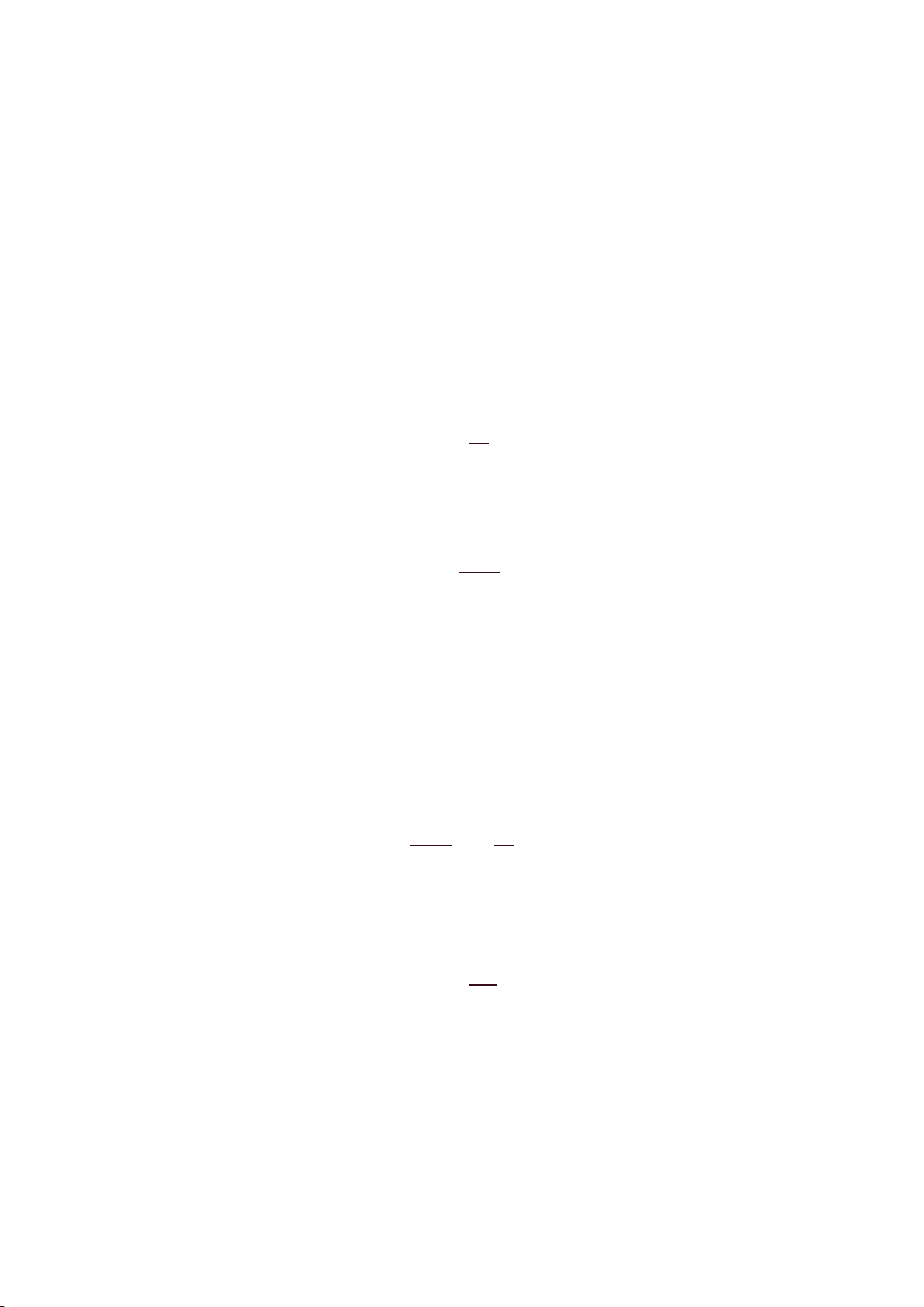
We know that the centripetal acceleration on an orbiting body (e.g. a planet) is given by:
where r is the distance from the central body (e.g. the Sun), and v is the velocity it is moving at.
The centripetal acceleration is caused by the gravitational attraction of the two bodies, which is given by:
= ܨ
where M is the mass of the central body, m is the mass of the orbiting body, and G is Newton’s Gravitational constant and is equal to 6.67 x 10 -11^ m 3 s -2^ kg-
Since the centripetal acceleration is caused by the gravitational force, we use Newton's 2nd^ law:
ܽ݉= ܨ
Putting the first two equations into the third one we therefore know that:
݉ܯܩ ݎ ଶ^
We can then work out a relationship between the velocity, the mass of the central object, and the orbital radius:
ݒ ଶ^ =
In 1605 Johannes Kepler wrote down three laws of planetary orbits:
The semi-major axis of an ellipse is the half the longest diameter of the ellipse. In a circle, which has the same diameter all the way round. the semi-major axis is equal to the radius.
Can you work out which of Kepler's laws the last equation on the previous page corresponds to? [ Hint: can you write the velocity around a circular orbit in terms of its period ]
Semi-major axis Radius