
Optics Problems: Refraction, Reflection, and Interference, Exams of Physics

A series of 15 optics problems involving refraction, reflection, and interference of light. The problems cover topics such as the behavior of light at interfaces, the relationship between wavelength and reflection, and the principles of young's double slit experiment. Students studying physics or optics will find these problems useful for understanding the fundamental concepts of optics.

Typology: Exams

2012/2013

Uploaded on 02/21/2013

rehmu
rehmu 🇮🇳

5

(1)

77 documents

1 / 6

Toggle sidebar

This page cannot be seen from the preview

Don't miss anything!

bg1
1. We can hear around corners, but we cannot see around corners. The reason is that
a) Sound waves carry more energy than do light waves
b) The frequency of sound is much greater than that of light
c) The wavelength of sound is much greater than that of light
d) Sound waves are longitudinal, while light waves are transverse
e) Sound waves are transverse, while light waves are longitudinal
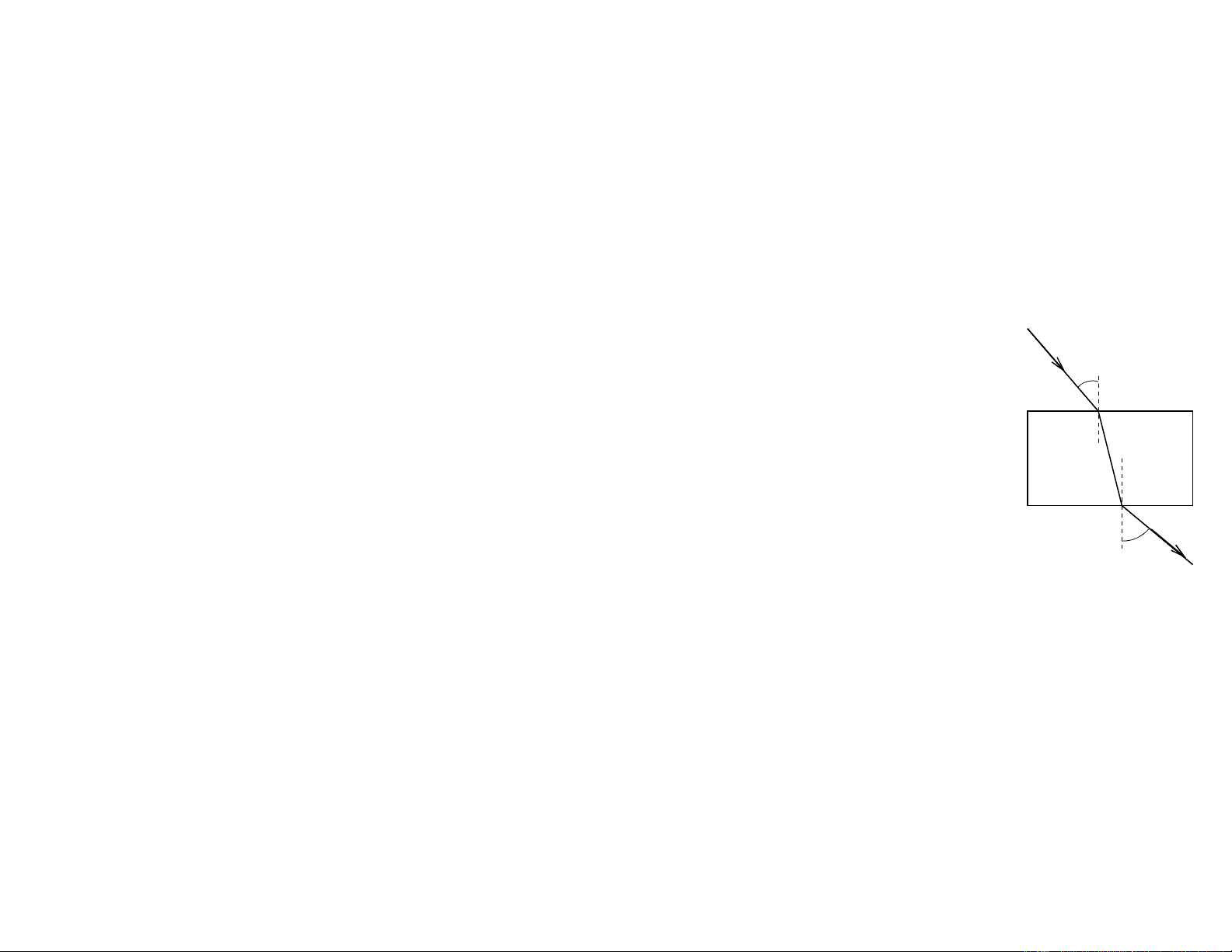
2. A ray of light goes from air into a flat block of glass (index of refraction = 1.5) at an angle of 36with the normal to
the interface. After passing through the glass, at what angle to the normal will the ray emerge into air?
a) 62
b) 23
c) 67
d) 36
e) The ray won’t emerge into air, because it will be totally internally reflected in the glass.
36o
θ
Air
Glass
n=1.5
3. A fish is swimming 30 cm below the water surface, and an insect is flying 12 cm above the surface. If the index of refraction of water is 4/3,
how far from the water surface will the fish see the insect’s image? (Assume the line of sight makes a small angle to the normal).
a) 9 cm
b) 16 cm
c) 31.5 cm
d) 56 cm
e) 12 cm
1
pf3
pf4
pf5

Partial preview of the text

Download Optics Problems: Refraction, Reflection, and Interference and more Exams Physics in PDF only on Docsity!

  1. We can hear around corners, but we cannot see around corners. The reason is that

a) Sound waves carry more energy than do light waves b) The frequency of sound is much greater than that of light c) The wavelength of sound is much greater than that of light d) Sound waves are longitudinal, while light waves are transverse e) Sound waves are transverse, while light waves are longitudinal

  1. A ray of light goes from air into a flat block of glass (index of refraction = 1.5) at an angle of 36◦^ with the normal to the interface. After passing through the glass, at what angle to the normal will the ray emerge into air? a) 62 ◦ b) 23 ◦ c) 67 ◦ d) 36 ◦ e) The ray won’t emerge into air, because it will be totally internally reflected in the glass.

36 o

Air

Glass

n=1.

  1. A fish is swimming 30 cm below the water surface, and an insect is flying 12 cm above the surface. If the index of refraction of water is 4/3, how far from the water surface will the fish see the insect’s image? (Assume the line of sight makes a small angle to the normal). a) 9 cm b) 16 cm c) 31.5 cm d) 56 cm e) 12 cm
  1. Total internal reflection takes place in the glass prism shown. The index of refraction of this glass is:

a) at least 1. b) at most 1. c) at least 1. d) at most 1. e) impossible, total reflection cannot occur as shown

Glass Air

45 o

90

o

  1. An object is placed 12 cm from a lens. The image is upright and one-third as big as the object. What is the focal length of the lens?

a) +6 cm b) +9 cm c) +18 cm d) −6 cm e) +3 cm

  1. Light from an incandescent bulb is passed through a filter which transmits yellow light, and then serves as the source for a Young’s double slit experiment. Which of the following changes would cause the interference fringes to be more closely spaced? a) use slits that are closer together b) use a light source of lower intensity c) use a light source of higher intensity d) use a filter which transmits blue instead of yellow e) move the light source farther away from the slits
  1. Light of wavelength 440 nm passes through a double slit, yielding the diffraction pattern of intensity I versus deflection angle θ shown. What is the width, a, of each slit? a) 10 μm b) 5. 0 μm c) 3. 3 μm d) 19 μm e) 42 μm
  2. Monochromatic light is normally incident on a grating which is 1 cm wide and has 10,000 slits. The first order maximum is deviated at a 30◦ angle. What is the wavelength of the incident light? a) 300 nm b) 400 nm c) 500 nm d) 600 nm e) 1,000 nm
  1. An unpolarized beam of light is incident on three parallel polarizing sheets that are lined up so that the tranmission axis of each is rotated by 30◦^ with respect to the preceding sheet. What fraction of the incident intensity is transmitted? a) 1 / 8 b) 1 / 3 c) 3 / 8 d) 9 / 32 e) 27 / 64
  2. Unpolarized light is incident at the Brewster angle from a medium of refractive index n 1 onto a medium of refractive index n 2 , with n 2 < n 1. The plane of incidence contains the normal to the interface, and the incident, transmitted, and reflected rays. Which of the following statements is true? a) The reflected light is polarized with its E vector in the plane of incidence. b) The reflected light is polarized with its E vector perpendicular to the plane of incidence. c) The transmitted light is polarized with its E vector in the plane of incidence d) The transmitted light is polarized with its E vector perpendicular to the plane of incidence. e) There is no transmitted light, since the Brewster angle in this case is is greater than the critical angle.
  3. An X-ray beam of wavelength 1.00 ˚A diffracts off a crystal in a first order Bragg reflection. The angle subtended between the incoming beam and the outgoing beam is 80◦^ as shown. What is the separation of the crystal layers d that will give rise to this Bragg reflection?

a) 0.51 ˚A b) 1.56 ˚A c) 0.65 ˚A d) 1.31 ˚A e) 0.78 ˚A Crystal

400 800

X−ray 400

Bragg−reflection