Download Optics Problems: Refraction and Lenses and more Exams Physics in PDF only on Docsity!
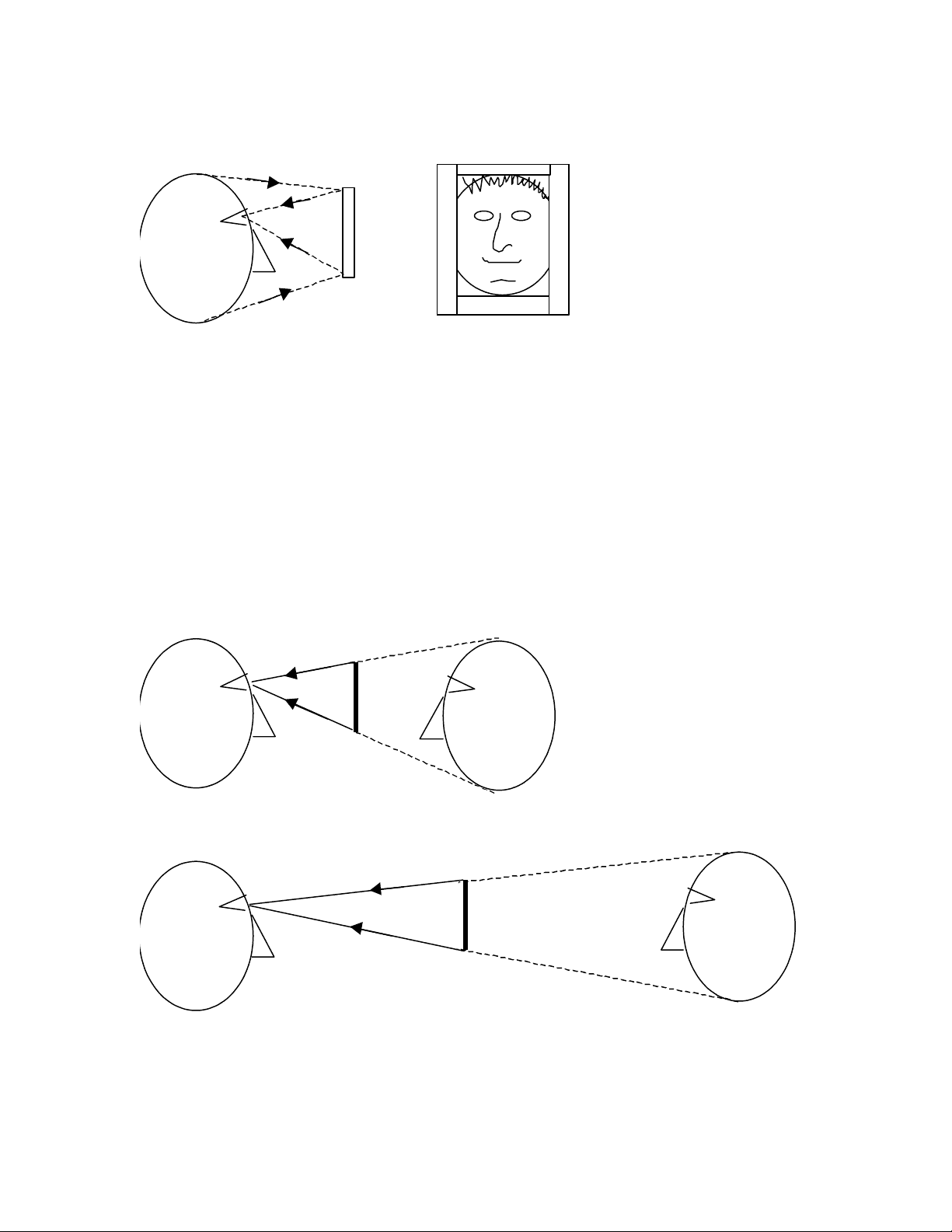
CTRay- 1 A man is looking in a mirror and he sees his faces just filling the mirror.
The man now moves back, away from the mirror, watching his reflection. As he moves
back, he sees the image of his face..
A: continues to just fill the mirror
B: becomes smaller than the frame of the mirror
C: become larger than the frame of the mirror.
Answer: From the man's point of view, his image always just fills the mirror. From his
point of view, both the mirror frame and the (virtual) image get smaller by the same
amount. If he doubles the distance L to the mirror, he is also doubling the distance 2L to
his image.
Man Virtual Image
CTRay- 2 A ray of light passes through 3 regions labeled I, II, and III, as shown. How do
the indices of refraction of regions I and III compare?
A: nI > nIII B: nI < nIII C: nI = nIII D: Impossible to tell.
Answer: nI < nIII. In refraction, the ray always gets bent toward the normal in the
medium with the larger n. The presence of medium II in between I and III has no effect
on the final ray's angle. If you shrink region II to a smaller slab, none of the angles
change. So you can shrink II down to zero thickness and ignore it.
CTRay- 3 A ray of light passes thru a sheet of glass which is thick at the bottom and thin
at the top. Which way is the ray traveling after it has passed through the glass?
A: bent toward the thin end B: undeviated C: bent toward the thick end
I II
III
o
o
o
o
air, n = 1
glass
n = 1.
A
B
C
A) Unchanged. B) greater, f > 20 cm. C) smaller, f < 20cm, but still
positive D) negative.
Answer: greater, f > 20cm. The rays of light are bent when they pass from the medium
(air or water) into the glass according to Snell's law. The amount of bending (the change
in the angle, ) depends on the change in the index of refraction, n. Bigger change in
n means bigger change in angle, , that is, more bending. If the lens is immersed in a
fluid with the same n as the glass, then there is no refraction: n = 0, = 0. When the
lens is in air the change in n is n = 1.6 - 1 = 0.6. When the lens is in water, the change
in n is n = 1.6 - 1.33 = 0.27. Smaller n in the water means less bending, a longer focal
length f.
CTRay- 6 A bundle of parallel rays approaches the eye and some of the rays enter the
eye's pupil, as shown below. No other rays enter the eye. What does the eye see?
A) A single point of light, surrounded by blackness.
B) A uniformly illuminated wall of light, like a white wall.
C) Many scattered points of light, like stars in the night sky.
D) None of these
Answer: A single point of light, surrounded by blackness. A point source at infinity
makes a parallel bundle of rays. The lens of the eye focuses these rays onto a point on
the retina, and the brain perceives a point of light.
Eye
rays in water (less bending of ray, longer f)
rays
in air
CTRay- 7 Two point sources of light are imaged onto a screen by a converging lens as
shown. The images are labeled 1 and 2. A mask is used to cover up the left half of the
lens, as shown. What happens to the images on the screen when the mask is inserted over
the left half the lens?
A) Image 1 on left vanishes
B) Image 2 on right vanishes
C) Something else happens.
Answer: Something else happens. Both images dim somewhat but neither disappears.
Rays from each source cover the entire lens. When half the lens is covered, half the rays
from each source are blocked, but the other half get through, producing a dimmed image.
mask
lens
screen
(^1 )
screen
lens
mask
1 2
CTRay- 9 An object is placed is placed near a diverging lens, but the object is further
from the lens than the absolute value of the focal length of the lens. The image formed
is.. A) real B) virtual C) there is no image.
The magnitude of the image distance, compared to the object distance, is ...
A) smaller. B) greater.
Answers: The image is virtual and the image distance is smaller than the object distance.
The only way to understand this is to draw a ray diagram:
You get the same answers whether or not the object distance is further from the lens than
the focal point.
CTRay- 10
Is the image on a movie screen real or virtual? A) real B) virtual
Is the image seen with a virtual reality headset real or virtual? A) real B) virtual
optic axis object
image
Answers: Movie screen image is real. When the rays actually converge at a point in
space (where you can put a screen to see the image) then the image is real.
Virtual reality image is virtual. The image must be further than 25cm from the viewer's
eye for the viewer to be able to focus on the image.
CTRay- 11 An object is placed closer to a magnifying glass than the focal length.
image
This person needs eyeglasses with lenses that are
A) converging B) diverging C) either converging or diverging, depending on
much correction is needed.
Answer: diverging lens is needed. To be diverging, a lens must be
thinner in the middle. Eyeglasses to correct myopia are shaped like
this.
The job of the eyeglasses is to take the real image at do = and
create a (virtual) image close enough so the myopic eye can focus
on it.
In my case, my myopia is so bad that I can focus on objects no
further than 11 cm from my eye. So for my glasses, when the object is at infinity ( do =
), the virtual image must be 11 cm from my eye, which means it must be about 9.5cm
from the glasses ( di = -9.5 cm = -0.095 m). The lens equation says:
o i
10.4 diopters
d d 0.095 m f
Diopters = 1/f, where f is in meters. (Optometrists always indicate lens power in
diopters.)
CTRay- 13 An object is near a mirror. The virtual image formed by the mirror is upright,
is smaller than the object, and is nearer the mirror than the object as shown. Is the mirror
A: complex B: concave or C: convex ? (Don't vote A)
f too short
Hint: For a plane mirror, the (virtual) image is the same distance from the mirror as the
object. Imagine bending the mirror. Do the reflected rays bend so the image gets further
or closer to the mirror.
Answer: Convex. A convex mirrors bends the reflected rays more outward, which has
the effect of moving the image closer to the mirror
object
image
mirror
(B)
concave
(C)
convex
object
image