Download Unit 02 - Planning & Risk Assessment and more Study notes Auditing in PDF only on Docsity!
in l
l
int
is
nil
i's
i
i
is
n 7
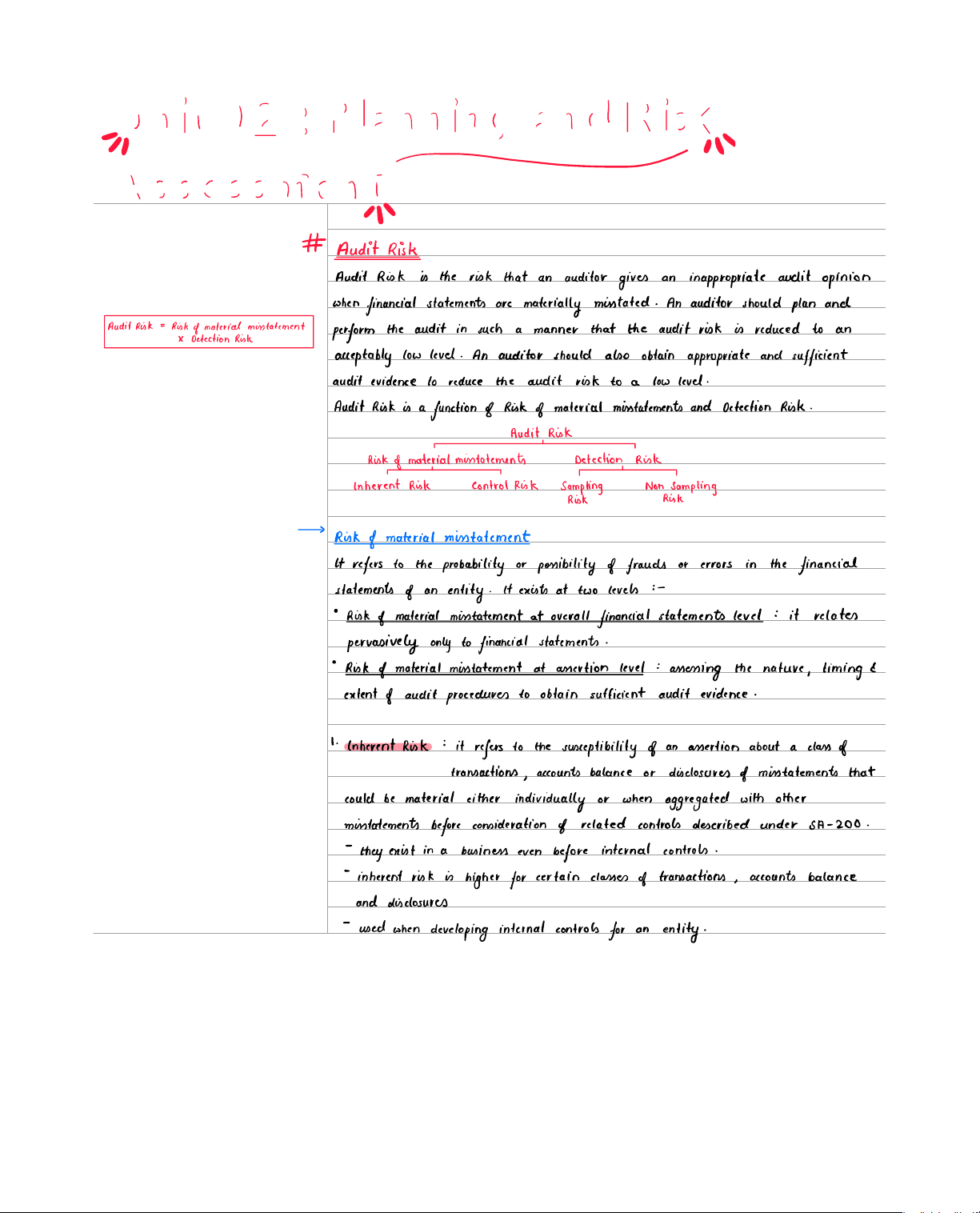
AuditRisk
AuditRisk is
the risk that an
auditor
gives
an
inappropriate audit
opinion
when
financial
statements
are materially
misstated
An
auditor
should
plan
and
perform
theaudit in
such a manner that the auditrisk is
reduced
to an
aditrisk R detection
his
tatement
acceptably low
level
An
auditor
should
also
obtain appropriate and sufficient
audit
evidence
to
reduce the audit risk to
a low
level
AuditRisk is a function
of
Risk
of
material
misstatements
and
Detection
Risk
Audit Risk
Risk
of
material
misstatements Detection
Risk
inherent Risk
control
Risk
sampling Nonp ampling
Risk
of
materialmisstatement
Itrefers to theprobability
or possibility
of
frauds
or errors in the financial
statements
of
an
entity
It
exists
at two
levels
Risk
of
material
misstatement
at
overall financial
statements
level it
relates
pervasively only
to financial
statements
Risk
of
material
misstatement
at
assertion level assessing the
nature
timing
extent
of
auditprocedures
to
obtainsufficient audit
evidence
1
Inherent
Risk it refers to the susceptibility
of
an
assertion about a
class
of
transactions accountsbalance
or
disclosures
of
mintatements
tha
could be
material either
individually
or when aggregated
with
other
mintatements
before
consideration
of
related controls described under
SA
they
exist in
a
business
even before
internal controls
inherent
risk is
higher
for
certain
classes
of
transactions accounts
balance
and
disclosures
used when developing
internal controls
for
an
entity
Control Risk it istherisk
of
misstatement
in an
assertion about
a
class
of
transactions accounts balance or
disclosures
on
misstatements
thatcouldbe
material either
individually
or when aggregated with
other
misstatements
that
cannot be
prevented
detected
or
controlled
on a
timely
manner
by
an entity's
internal
controls
risks not
controllable
by
internalcontrols
In
intis
I
infioiiii.tk
internalcontrols
are inversely
related
to
control risk
Detection
Risk
It refersto
a risk
where the audit procedures performed
by
an auditor
t
reduce
theaudit risk to a considerably
low
level are
unable to
detect a
misstatement
that
exists could be
material either
individually
or as an
aggregate
withother
misstatements
Detection
Risk can be
reduced
by
increasing
area
of
checking
larger
samples
and competent experienced personnel on the
engagementteam
SamplingRisk
occurs when a sample is
not
representative
of
a population and
thus
leading
to
wrong
audit
conclusions
Non Sampling
Risk auditor
reaches
an
erroneous
conclusion
not
related to
sampling
riskbutdueto application
of
inappropriate audit
procedures
Risk
Assessment Procedures
Risk
assessment
forms
the
basis
for
the identification and
assessment
of
risks
of
mater
mintatements
at
a financial
statement
and
assertion level It
involves
all
those audi
procedures employed in
order to
understand
the entity
its
environment internal
controls
andrisks
of
material
misstatements
arising
dueto frauds
orerrors at
a
financial
statement
and
assertion level
Risk
Assessment Procedures
involve
Frauds in
Audit
v
v
EradulentFinancial
Reporting
Misappropriation
of
Assets
understanding
the
entity
and its
environment
Understanding the entity
andits
environment
helps in the identification and
assessment
of
therisks
of
material
misstatements
faced
by
an
entity
It
also helps in forming
a
proper
audit
plan
Understanding
factors
related
to industry
regulation
and
otherexternal
factors
an
auditormust
understand
the industry
conditions where an
entity
is
placed
including
the
competitive
environment
suppliers
customer composition andtechnological
developments
He
should
alsounderstand
theregulatory
framework
legal
political as wellas
external
factors lik
general
economicconditions interest rates inflation andavailability
of
finance
Nature
of
the
entity
operations
organisationand
governance
investments made
by
company
structure
sources
of
finance
Measurement
and
review
of
the companys
financial
performance
includes KPI's
financial
nonfinancial
ratios trends
and operating
statistics
credit
ratingagency
reports
periodonperiod financial
performance analysis
budgeting forecasting
variance
analysis
anddepartmentlevelperformance reports
Selection
and
application
of
accounting policiesand
reasons
for
changes
thereon
evaluate
and
assess
whether
the accounting
policies adopted
by
theentityare
suitable
appropriate
consistent
and
applicable as
per
the legalregulatory
frameworkand
industry
accounting policies
An
entity
objectives strategies and
business
risk
all
the plansand
decisions
made
by
an entity
are
based
on
its
overallobjectives
as
decid
by
the
management Strategies areformulated
by
the entity
in
order to
attainthese objectives
An
understanding
of
the
various
business risks
faced
by
an entity in
its industry helps in
identification and
assessment
of
possible
risksdue to
material
mintatements
at a finance
statement and
assertion level
Materiality
inAudit
Materiality
in
auditstates that
mintatements
including
omissions
are
considered material
if
they
individuallyor
in aggregate reasonably
influencethe
economicdecisions
of
userstaken on
the
basis
of
thefinancial
statements
Judgements
about materiality are
made on the
basis
of
thesurrounding
circumstances affecte
by
size and
nature
of
mintatement
While
planning
the
audit the
auditormakes judgements regardingthesize
of
mintatements
to b
considered material
These judgements
form
the
basis
for
determining
nature
timing
extent
of
risk
assessment
procedures
identifying assessing
risk
of
material
misstatements
determining nature timing
extent
of
further
analytical
procedures
Determination
of
Materiality
Theauditor
hasto apply
his
professional
judgement
in determining materialityand
choos
Planning an
audit
involves
analyticalprocedures
to be applied
determination
of
materiality
involvement
of
experts
generalregulatoryframework governing
the industry
other risk
assessment
procedures
Need
for
Planning
an Audit
performing the
assurance engagement
in a
proper
manner
ensuring
compliance with
professional standards as well as regulatory laws
effectively conducting theaudit
of
an entity
in a
timely
manner
identifying the right
engagement team
based
on
competency expertise
reducing the
auditrisk to
a considerably
lowlevel enhancing quality
of
aud
identifying concerns and how to
address
them
identifying areasthat require greater
attention
and
detail
Planning
Process
Preliminary engagement
activities
applying analytical
procedures
to
assess the
continuance
of
engagement
with a
client
selection
evaluation
ensuring
the compliance
with
ethical requirements
of
independence
clearly
understanding the
terms
of
the engagement to
avoid misunderstandings
2
Planning
Activities
identifying the
overall scope
of
the
responsible
party
ascertaining the reporting
objectives
of
the
entity
bits
ns n m
hitement
I
considering
based
on the
auditors professional judgement changes
that
may
be
ofconcern to the
audit engagementteam
reporting
industry general
changes
identifying the
nature
timing
extent
of
resources required to
carry
out the
engagement
effectively
consider results
of
preliminary engagement
activities
and
k
p
professional
Audit
strategy
Vs Audit
Plan
Audit strategy
Audit Plan
sets the
overall objective
of
the
audit
addresses variousmatters
identified in th
audit strategy
less
detailed
than
audit
plan
more
detailed thanaudit
strategy
determines
scope timing
direction
of
audit
howaudit
strategy
should
be
implemente
Closely
interrelated since
changes
in one
may
leadto
consequential
changes
in
the
other
Audit Programmes
Auditprogrammes are basically
verification procedures applied to financial
statemen
or
accounts
of
a
givenentity for
thepurpose
of
obtaining
sufficient audit
evidence
to
support the informed
opinion
of
an auditor
construction
of
an audit programme
involves
staying
within
thescope
of
theaudit
prepare
a
written audit
programme
determine reasonablybestevidence
available
include
audit
objectives
for
each area
consider
all
possibilities
of
errors
coordinate procedures to be
applied to
related items
more thanoneauditperiod It
includes information thatdoes not change
frequently
andis
relevant
for
continuous
future
audits It
contains
long
term information
abou
the
client
Contents
of
Permanent
AuditFile
include
Accounting policies
internalcontrol procedures
significant
contracts
andagreements
legal
information
MOA AOA COI
organisational
structure
Previous
years
audit reports
Tan and
statutory
information
Minutes
of
Board AGMmeetings
2
current Audit
file
it
contains
all
records and
documentation
of
the audit
proced
Memorandum Audit
file
and
evidence relevant
to the
specific
year
in
which the
audit is being
conducted
It helps the
auditor in expressing
an opinion
on thefinancial
statements
It is
a
working
file
Contents
of
currentAudit
file
audit
programmes
audit
evidence
current
years
financial
statements
significantauditfindings
analytical
procedures
conclusionsreached
inquirieswith
management
checklist minutes
of
meetings
auditmethodology toolsused