
Contemporary Philippine Arts of the Regions Reviewer, Study notes of Art

CPAR reviewer for senior high school students

Typology: Study notes

2023/2024

Uploaded on 04/06/2024

hannah-serrano
hannah-serrano 🇵🇭

2 documents

1 / 6

Toggle sidebar

This page cannot be seen from the preview

Don't miss anything!

bg1
(goodluck guys hannahmae)
LESSON 1
ART
- An expression or application of human creative skill and imagination
- A form of creative activity such as painting, music, literature, and dance
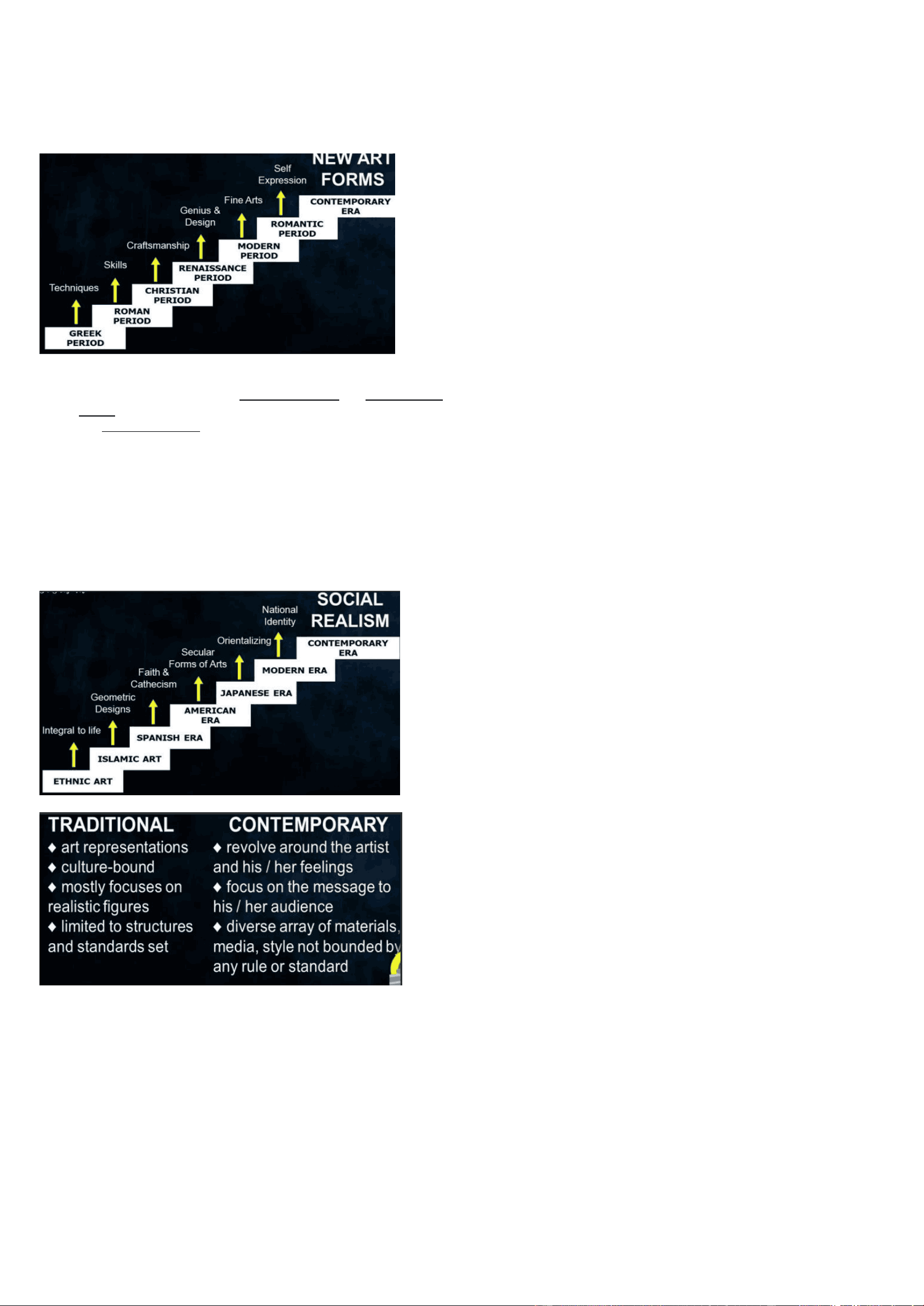
CONTEMPORARY ART
- The art that springs out of the present-day events and passions of the
society
- The newest form of art, amusing people from the late 1960s or early
around 1970s up to this very minute
- This art functions in a global society that is culturally diverse and
technology-oriented
- Is essential to you not only because it belongs to your time but it also
serves a form of expression of the people’s present feelings and longings
- Contemporary works of art are the means through which the artists of
today communicate their sentiments
ARTS IN THE PHILIPPINES
ARTS OR SINING
- The different manners of expressing human skills and imagination in the
creation of aesthetic conditions, objects and presentations
- Involves the use of all the physical senses in order to appreciate it
3 MAJOR TRADITIONS THAT LED TO THE DEVELOPMENT OF PHILIPPINE ARTS
ETHNIC TRADITION
- In this era, art forms were primarily influenced by the area where our
ancestors prosper (e.g. pottery, weaving and metalwork)
- Arts reflected the pagan beliefs and practices, everyday activity such as
fishing and farming, and specific decorative art pattern to the community
Angono Petroglyphs
- Is situated in Binangonan, Rizal
- Was discovered by the National Artist, Carlos “Botong” Francisco, in 1965
- There are 127 human and animal figures engraved on the rock wall and
dated back to circa late Neolithic
Banga or Pot Dance
- A performance of Kalinga of the Mountain Province of the Philippines
- This dance shows the elegant grace of Igorot tribe and the skill and
strength of women
Manunggul Jar
- Is found in Manunggul Cave, Lipuun Point, Palawan in the early 1960s
- A burial jar which signifies the belief of early Filipino in life after death
SPANISH COLONIAL TRADITION
- Spaniards tend to replace indigenous arts with western arts
- For the period of Spanish rule, art forms were primarily influenced by
religion and secularization
- In this time, Spaniards used arts to propagate the Catholic faith
Langit, Lupa, at Impyerno by Josef Luciano Dans
- This painting will be found in St. James the Apostle Church in Paete,
Laguna
- Dated 1850 and depicts the heaven, crucifixion of Christ; earth, Adan and
Eve; and hell, sinners with different transgressions
St. Paul Metropolitan Cathedral
- Located in Burgos, Vigan City, Ilocos Sur
- The original structure was built in 1574 and replaced as a church in 1641
- The cathedral follows a Baroque architectural design
AMERICAN COLONIAL AND CONTEMPORARY ARTS TRADITIONS
- During American rule, development of Philippine art forms was mainly
influenced by education and governance
- It is in this time wherein urbanization, consume rism, changes in the
political system, and rise of new technology influence the development of
art
The Making of the Philippine Flag
- This painting was made by Fernando Amorsolo, Grand Old Man of
Philippine Art” and born in Manila
- Shows a reminder of the traditions and customs of the Filipino
Bayanihan by Carlos “Botong” Francisco
- Carlos “Botong” Francisco was born in Angono, Rizal
- This painting by him was dated in 1962
- This mural painting shows the Filipino’s bayanihan tradition
- This also shoes the distinctive style of Francisco’s painting that showcased
his mastery in arts
Cinco Marias (Tres Marias Series) by Federico Aguilar Alcuaz
- Federico Aguilar Alcuaz was born in Santa Cruz, Manila
- Depicts the variety of domestic activities (Guillermo, 2007)
MODERN ART
- Refers to the practice of art from 1860s to 1960s
- The main theme of art works in this time is national identity
CONTEMPORARY ART
- Refers to the practice of art form 1970s to the present
- Mirror contemporary culture and society
ELEMENTS OF ART
SPACE
- In visual arts, it pertains to emptiness
- Positive space refers to a part which is enclosed in a shape
- Negative space refers to the opposite part which the shape is enclosing
LINE
- A series of connected points
2 Characteristics:
Form curved, dotted, or broken lines
Direction vertical, horizontal, or diagonal lines
pf3
pf4
pf5

Partial preview of the text

Download Contemporary Philippine Arts of the Regions Reviewer and more Study notes Art in PDF only on Docsity!

LESSON 1

ART

  • An expression or application of human creative skill and imagination
  • A form of creative activity such as painting, music, literature, and dance

CONTEMPORARY ART

  • The art that springs out of the present-day events and passions of the society
  • The newest form of art, amusing people from the late 1960s or early around 1970s up to this very minute
  • This art functions in a global society that is culturally diverse and technology-oriented
  • Is essential to you not only because it belongs to your time but it also serves a form of expression of the people’s present feelings and longings
  • Contemporary works of art are the means through which the artists of today communicate their sentiments

ARTS IN THE PHILIPPINES

ARTS OR SINING

  • The different manners of expressing human skills and imagination in the creation of aesthetic conditions, objects and presentations
  • Involves the use of all the physical senses in order to appreciate it

3 MAJOR TRADITIONS THAT LED TO THE DEVELOPMENT OF PHILIPPINE ARTS ETHNIC TRADITION

  • In this era, art forms were primarily influenced by the area where our ancestors prosper (e.g. pottery, weaving and metalwork)
  • Arts reflected the pagan beliefs and practices, everyday activity such as fishing and farming, and specific decorative art pattern to the community

Angono Petroglyphs

  • Is situated in Binangonan, Rizal
  • Was discovered by the National Artist, Carlos “Botong” Francisco, in 1965
    • There are 127 human and animal figures engraved on the rock wall and dated back to circa late Neolithic

Banga or Pot Dance

  • A performance of Kalinga of the Mountain Province of the Philippines
  • This dance shows the elegant grace of Igorot tribe and the skill and strength of women

Manunggul Jar

  • Is found in Manunggul Cave, Lipuun Point, Palawan in the early 1960s
  • A burial jar which signifies the belief of early Filipino in life after death

SPANISH COLONIAL TRADITION

  • Spaniards tend to replace indigenous arts with western arts
  • For the period of Spanish rule, art forms were primarily influenced by religion and secularization
  • In this time, Spaniards used arts to propagate the Catholic faith

Langit, Lupa, at Impyerno by Josef Luciano Dans

  • This painting will be found in St. James the Apostle Church in Paete, Laguna
  • Dated 1850 and depicts the heaven, crucifixion of Christ; earth, Adan and Eve; and hell, sinners with different transgressions

St. Paul Metropolitan Cathedral

  • Located in Burgos, Vigan City, Ilocos Sur
  • The original structure was built in 1574 and replaced as a church in 1641
  • The cathedral follows a Baroque architectural design

AMERICAN COLONIAL AND CONTEMPORARY ARTS TRADITIONS

  • During American rule, development of Philippine art forms was mainly influenced by education and governance
  • It is in this time wherein urbanization, consumerism, changes in the political system, and rise of new technology influence the development of art

The Making of the Philippine Flag

  • This painting was made by Fernando Amorsolo, “Grand Old Man of Philippine Art” and born in Manila
  • Shows a reminder of the traditions and customs of the Filipino

Bayanihan by Carlos “Botong” Francisco

  • Carlos “Botong” Francisco was born in Angono, Rizal
  • This painting by him was dated in 1962
  • This mural painting shows the Filipino’s bayanihan tradition
  • This also shoes the distinctive style of Francisco’s painting that showcased his mastery in arts

Cinco Marias (Tres Marias Series) by Federico Aguilar Alcuaz

  • Federico Aguilar Alcuaz was born in Santa Cruz, Manila
  • Depicts the variety of domestic activities (Guillermo, 2007)

MODERN ART

  • Refers to the practice of art from 1860s to 1960s
  • The main theme of art works in this time is national identity

CONTEMPORARY ART

  • Refers to the practice of art form 1970s to the present
  • Mirror contemporary culture and society

ELEMENTS OF ART

SPACE

  • In visual arts, it pertains to emptiness
  • Positive space refers to a part which is enclosed in a shape
  • Negative space refers to the opposite part which the shape is enclosing

LINE

  • A series of connected points 2 Characteristics: Form – curved, dotted, or broken lines Direction – vertical, horizontal, or diagonal lines

SHAPE & FORM

  • An area that is enclosed by a line or lines
  • Are two dimensional figures with height and width Different kinds of Shapes: Geometric Shapes – triangle, squares, rectangle Organic Shapes – shapes found in nature, e.g. shape of a leaf or cloud Abstract Shapes – asymmetrical and free flowing shapes

COLOR

  • In visual arts, it is associated with natural phenomenon in our environment
  • The element of art that is produced when light, striking an object, is reflected back to the eye
  • These may pertain to lightness, darkness, coolness, or warmth

VALUE

  • In visual arts, it is considered a property of a color which pertains to its lightness or darkness

TEXTURE

  • In visual arts, it is the element that appeals to our sense of feel on things, rough, smooth, bumpy, or slippery
  • It pertains to the surface of an art piece

PRINCIPLES OF ART

PROPORTION

  • Refers to the relationship of the size of elements in a body of art
  • Ex. When drawing a human standing beside a house, it is important to ensure that the size of the human is proportional to the size of the house

HARMONY

  • In visual arts, it is the unity of the artwork, specifically about the arrangement of the related elements

VARIETY

  • May be referred to as diversity
  • This means adding multiple , different elements to break the monotony of an artwork and make it more interesting

MOVEMENT

  • In arts, it is the illusion of motion in a painting, sculpture design, or in a piece of art

RHYTHM

  • Refers to the repetition of certain elements to produce a pattern
  • In visual arts, repeated design elements may create a certain flow and may lead the viewer’s eyes

BALANCE

  • Refers to the even and equal distribution of elements

EMPHASIS

  • A principle which may refer to the greater impact given on a certain element

LESSON 2

CONTEMPORARY

  • “happening, existing, living, or coming into being during the same period of time” (Merriam-Webster) - Refers to the art of any form and genre that produced in our contemporary time, simply put as “art created today” - Should not be confused with Modern Art which ranges from the end of the 19 th^ Century until the 1970’s or 1980’s or the late 20th^ Century - Will put Contemporary Art from the late 20th^ Century to the present - Modern Art differs from Contemporary Art historically and contextually

CONTEMPORARY ART

  • Influenced by the economic, social, political and environmental context where the artist is immersed in
  • Can be said that it is the artist’s expression of his perception and comprehension of these contexts
  • Contemporary Philippine Art is not confined to the usual genres of the four main art forms, namely, visual, literary, applied and performing arts
  • Genres are categories of artistic creation and are characterized by similarities in form, style, or subject matter. Many other genres came up which include pure art forms as well as mixed art forms

EXAMPLES OF CONTEMPORARY ART FORMS

Visual Arts

  • Pop Art
  • Word Art
  • Conceptual Art [Mel Ramsden (Art & Language Group) Secret Painting, 1967 – 1968]
  • Installation Art
  • Photorealism
  • Contemporary Realism
  • Graffiti Art

Performance Arts

  • Music: blues, electronic, experimental, funk, hip-hop, jazz, metal, pop, rock, roots
  • Theater Art: stage, film, street play
  • Dance: flash mob, street dances comprising hip-hop, funk, house and rave

Applied Arts

  • Video Art
  • Photography
  • Computer Art
  • Film and Broadcasting Art
  • Architecture, Design and Allied Art

Literary Arts

  • Illustrated Novel
  • Digi-Fiction
  • Graphic Novels
  • Manga
  • Doodle Fiction
  • Text-Talk Novels
  • Chick Literature
  • Flash Fiction
  • Hyper Poetry
  • Blog

CONTEMPORARY ART IN THE PHILIPPINES

  • Contemporary Philippine Artists hail from the different regions of the country. They use a wide variety of art media in their creations, some of the media are materials that are readily available in the locality where the artist resides
  • Are multifaceted and are expressive renditions of the artist’s perception of what were observed and experienced
  • Expressions are influenced by social, historical, geographical, ideational, personal and technical factors
  • These factors are imbibed by the artist and are combined to get immersed in the heart, to get molded in the mind and to be propelled in the hands to create an expressive reality

ELEMENTS OF CONTEMPORARY ART

APPROPRIATION

  • Relates to the modifications made by the artist

HYBRIDITY

  • Refers in the use of different art mediums that are put together
  • Filipino music has a rich and unique musical tradition long before westeners set foot on our native land
  • Was present in every stage of our ancestors’ lives, from birth to death, in blissful or tragic times
  • Luzon – Pastores
  • Visayas – Pinalangga
  • MIindanao – Buyayang

Theater

  • A collaborative form of fine art that uses live performers to present the experience of a real or imagined event before a live audience in a specific place
  • Performers may communicate this experience to the audience through combinations of gesture, speech, song, music, or dance

Dance

  • The movement of the body in a rhythmic way, usually to music and within a given space, for the purpose of expressing an idea or emotion, releasing energy, or simply taking delight in the movement itself
  • Examples: Banga, Kuratsa, Singkil

LESSON 4

NATIONAL ARTISTS IN THE PHILIPPINES

National Artist

  • A Filipino who has made a significant contribution to the development of Philippine arts in the fields of Music, Dance, Theater, Visual Arts, Literature, Film and Architecture
  • A Filipino individual who should have been awarded the highest national recognition for the arts namely, National Artist Award, also known as the Gawad Pambansang Alagad ng Sining

THE ORDER OF NATIONAL ARTIST

  • The highest national recognition given to Filipino individuals who have made significant contributions to the development of Philippine arts
  • Administered by the National Commission for Culture and the Arts (NCCA) and Cultural Center of the Philippines (CCP) and conferred by the President of the Philippines upon recommendation by both institutions
  • Established under the Proclamation No. 1001 dated April 27, 1972
  • First award was given to Fernando Amorsolo on May 15, 1973 under the Proclamation No. 1144, CCP Board of Trustees was named as the National Artist Awards Committee

Measured in terms of:  Vision  Unusual Insight  Creativity and Imagination  Technical Proficiency of the highest order in expressing Filipino culture and traditions, history, way of life, and aspirations

Presidential Decree No. 28

  • Issued on June 7, 1973
  • Reiterated the mandate of CCP to administer the National Awards as well as the privileges and honors to National Artist

The Order of National Artists aims to recognize:

  1. The Filipino artist who have made significant contributions to the cultural heritage of the country
  2. The Filipino artistic accomplishment at its highest level and to promote creative expression as significant to the development of a national cultural identity
  3. The Filipino artists who have dedicated their lives to their works to forge new paths and directions for future generations of Filipino artists

7 CATEGORIES UNDER WHICH NATIONAL ARTISTS CAN BE RECOGNIZED:

  1. Literature
  2. Film and Broadcasting/Broadcast Arts
  3. Architecture, Design and Allied Arts
    1. Music
    2. Dance
    3. Theater
    4. Visual Arts

Literature

  • Poetry
  • Fiction
  • Essay
  • Playwriting
  • Journalism
  • Literary Criticism

Architecture, Design & Allied

  • Architecture Design
  • Interior Design
  • Industrial Arts Design
  • Landscape Architecture
  • Fashion Design

Film & Broadcasting

  • Direction
  • Writing
  • Production Design
  • Cinematography
  • Editing
  • Camera Work
  • Performance

Music

  • Singing
  • Composition
  • Direction
  • Performance

Dance

  • Choreography
  • Direction
  • Performance

Theater

  • Direction
  • Performance
  • Production Design

Visual Arts

  • Painting
  • Sculpture
  • Printmaking
  • Photography
  • Installation Art
  • Mixed Media Works
  • Illustration
  • Graphic Arts
  • Performance Arts
  • Imaging

QUALIFICATIONS FOR THE NATIONAL ARTIST AWARD:

1. Living artists who are Filipino citizens at the time of nomination, as well as those who died after the establishment of the award in 1972 but were Filipino citizens at the time of their death 2. The content and form of their work have procured in building a Filipino sense of nationhood 3. An artist who have developed a mode of creative expression or style and living a legend on succeeding generations of artists 4. An artist who manifest excellence in the practice of their art form 5. The artwork made has attained an international and national recognition

INSIGNIA OF THE ORDER OF THE NATIONAL ARTISTS

  • Formed from a Grand Collar featuring circular links depicting the arts and an eight-pointed sunburst suspended from a sampaguita wreath in green and white enamel
  • The center of the badge is divided into three equal portions, in red, white and blue representing the Philippine Flag with three stylized letter K’s that stands for the CCP’s motto “Katotohanan, Kabutihan at Kagandahan”

NATIONAL ARTISTS IN THE PHILIPPINES

ARCHITECTURE

Juan Napkil

  • The University of the Philippines-Diliman Administration Building

Pablo Antonio

  • Far Eastern University-Manila

Leandro V. Locsin

  • Philippine International Convention Center, Manila (PICC)

Jose Maria Zaragoza

  • Meralco Building in Ortigas

DANCE

  • Francisca Reyes Aquino
  • Leonor Orosa-Goquingco
  • Lucrecia Reyes Urtula
  • Ramon Obusan

FILM

  • Gerardo de Leon
  • Lino Brocka
  • Ishmael Bernal
  • Eddie S. Romero
  • Manuel Conde

LITERATURE

  • Amado V. Hernndez
  • Jose Garcia Villa
  • Nick Joaquin
  • Carlos P. Romulo
  • Francisco Arcellana
  • N.V. M Gonzales
  • Carlos Quirino
  • Edith L. Tiempo
  • F. Sionil Jose
  • Virgilio S. Almario
  • Bienvenido Lumbera
  • Cirilo F. Bautista

MUSIC

  • Antonio J. Mollina
  • Jovita Fuentes
  • Antonio R. Buenaventura
  • Lucrecia R. Kasilag
  • Lucio D. San Pedro
  • Felipe Padilla de Leon
  • Jose Maceda
  • Levi Celerio
  • Ernani Joson Cuenco
  • Andrea O. Veneracion
  • Francisco Feliciano
  • Ramon Santos

THEATER

  • Honorata “Atang” de la Rama
  • Wilfrido Ma. Guerero
  • Rolando S. Tinio
  • Daisy Avellana
  • Severino Montano

VISUAL ARTS

  • Fernando C. Amorsolo
  • Carlos “Botong” V. Francisco
  • Guillermo E. Tolentino
  • Victorio C. Edades
  • Napoleon V. Abueva
  • Vicente Manansala
  • Cesar Legaspi
  • Hernando R. Ocampo
  • Arturo R. Luz
  • J. Elizalde Navarro
  • Ang Kiukok
  • Jose T. Joya
  • Abdulmari Asia Imao
  • BenCab
  • Federico Aguilar Alcuaz
  • Francisco Coching

VISUAL ARTIST Fernando C. Amorsolo

  • Planting Rice
  • Fruit Gatherer
  • Under the Mango tree
  • He is already dead when he was given the award

Carlos “Botong” V. Francisco

  • Bayanihan
  • Planting of the First Cross
  • Filipino Struggles Through the Years
  • First Mass at Limasawa
  • Known for its romantic paintings of bucolic landscapes and idealized portraits of well-known individuals from the Commonwealth Period and the Second World War
  • He is already dead when he was given the award

Guillermo E. Tolentino

  • Oblation

Victorio C. Edades

  • The Sketch

Napoleon V. Abueva

  • Sandugo
  • Awarded in 1976
  • Had contributed to the University’s Visual Arts Heritage

Vicente S. Manansala

  • Tiangge (Market Scene)
  • Cubist paintings such as Bayanihan, Luksong Tinik, Stations of the Cross
  • He is already dead when he was given the award

Cesar Legaspi

  • Sea of Gold
  • Morning Dance
  • Tree Planting
  • Man and Woman
  • He received the award alive but is now dead

Hernando R. Ocampo

  • Genesis
  • Man and Carabao
  • Ina ng Balon
  • He is already dead when he was given the award

Arturo R. Luz

  • Bagong Taon
  • Candle Vendors
  • Cities of the Past
  • Is still alive and was given the award alive

J. Elizalde Navarro

  • Caliraya Landscape

Ang Kiukok

  • Fishermen
  • Angry Figure
  • Fighting Figures