Download Exam 1 Review Notes - Resources Geology | GEOS 1024 and more Study notes Geology in PDF only on Docsity!
GEOS EXAM
LECTURE POWERPOINT
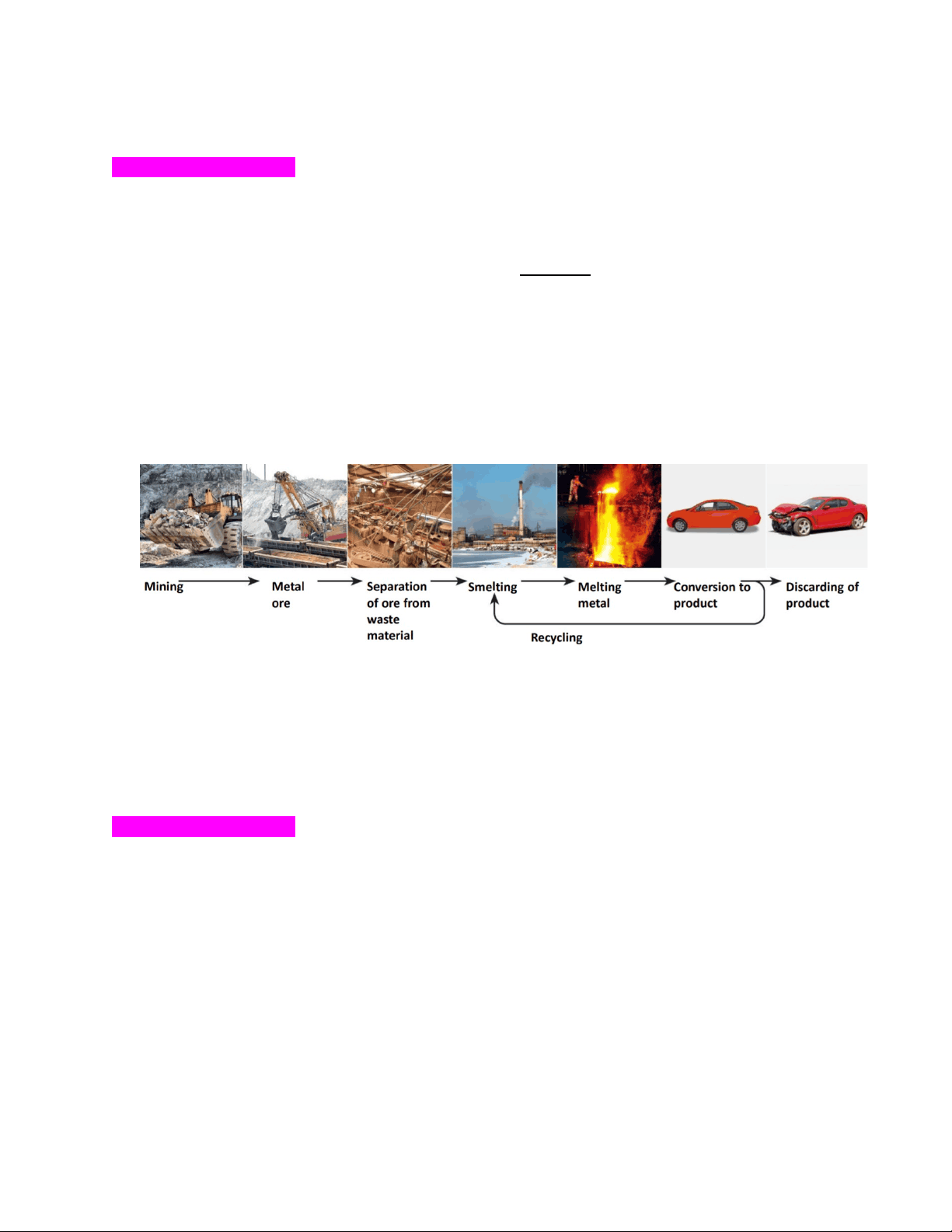
Geosphere (Earth, ground, soil) Elements: periodic table o Silicon (Si), Oxygen (O) Minerals: naturally occurring inorganic substance, crystalline minerals, constituent of rocks o Quartz (SiO2), fools gold Rocks: combination of minerals o Quartz (SiO2), Potassium Feldspar (KALSi3O8), Sodium Feldspar (NaAlSi3O8) Extraction, processing, use and disposal of consumables o Elements from minerals and rocks o Use life-cycle examples = car, phone Environmental impacts? o Cradle to grave The earth supplies space, food, and energy… limited resources o Our population is growing rapidly though Population video o Our population is expected to grow to 10 billion by the end of the century, yet the size of the earth remains the same Currently almost 7.7 billion people, 324 million in the U.S. LECTURE POWERPOINT # World population, iClicker Word Cloud o Crowded, people, big, growing, large, dangerous The 4 spheres – Our Resource Base o Internal – fIssion (I for internal) o External – fUsion (u for you)
Resource extraction and use and environmental impacts Exploration construction operation closure o Water, air, land, biota, people/culture Hans Rosling Video #1 in-class quiz
Science Background Check, iClicker o What is the pH value of natural rainwater? acidic (5.4) o What is the pH value of Ocean water? basic (8.2) o The dominant source of renewable energy presently used in the U.S. is? biomass (solid and liquid fuels from organic materials, i.e. ethanol and wood) Burning wood, ethanol (corn based) in cars + diesel, garbage, crops Part of the biosphere NASA: Keeping Up with Carbon video o Ocean floor is the largest reservoir of carbon on the planet o Upwelling: most of the ocean’s nutrients are in cold water, currents bring nutrients and carbon up to the surface so that carbon can then be released as a gas back into the atmosphere… carbon cycle o Climate: oceans are a great regulator of the Earth’s climate o Greenhouse gasses trap heat… carbon dioxide is a greenhouse gas Burning fossil fuels and cutting down forests have increased atmospheric carbon dioxide o Warm water can hold less carbon than cold water… ocean will become less effective at moving carbon throughout the atmosphere Absorbing more carbon makes the ocean more acidic Harmful to organisms that live inside the ocean Carbon o Organic (associated with life), the Biosphere Photosynthesis Fossil fuels What we are made of o Inorganic Carbon dioxide (CO2) An anion in rocks and minerals, Carbonate (CaCO3) Diamonds, Hokie Stone LECTURE POWERPOINT # Population and resources
o Island example, maximum population? Sandals, bikes, cars, airplanes Standard of living, growth o Developed, emerging, developing o Gross domestic product Water (H2O) o Acidity, neutral, and alkalinity (capability of water to neutralize acid, buffering capacity) H+ and OH-, pH values (rainwater and oceans) Renewable energy in the U.S. o Biomass, material derived from the biosphere… waste? Carbon o Carbon cycle, photosynthesis “Replacement” Fertility Rate (RFR): the number of children a couple must have to replace themselves o Developed countries RFR necessary to sustain their population is 2. o Developing countries RFR necessary to sustain their population is 2. Developed countries (Industrialized) o 20% World’s population… 85% World’s wealth uses 88% world’s resources Is this sustainable? Nope! What is the maximum population that the earth can hold? What standard of living (SOL) do you envision? o Current U.S. SOL, with all the Freedoms and limitations, that Americans have < 2 billion Everyone at the same affluence level as above, but with no limitations on pollution, land use, no environmental restrictions, etc. 0.5 billion Everyone at the same affluence level as above, but with many limitations, including massive recycling, gasoline rationing, enforced local food production, enforced use of renewable energy, etc. (tending more towards sustainability) 4 billion o Only U.S. and Europe at current level of affluence. Everyone else at prosperity level of India 7 billion o Everyone in the world at Mexico’s/India’s current prosperity level 20 billion
LECTURE POWERPOINT
Renewable energy (human lifetime, 100 years) o Ethanol from corn Growth, processing, use, waste disposal Advantages and disadvantages Environmental and economic impacts Net energy Please describe the earth in one word… big, small, home, dying, limited, water, life, complex Net energy = energy put into process – energy produced Net energy ration = energy produced/energy put into a process o The higher the number, the more energy that is gained (>1) Petroleum resources today… improved and more efficient extraction technologies, hydraulic fracturing Oil and the World War iClicker questions o Are Germany and Japan petroleum rich countries? No o Did Germany produce much of its liquid fuel for the war from coal? o Germany’s first air defeat in the war by the Brits was mainly caused by what? The superior 100 octane fuel used in the British planes
China (left) vs. India (right) Which country is predicted to have the largest population in the World by 2050? India LECTURE POWERPOINT # Ethanol from corn (cob, starch) o Net energy gain is questionable Ration generally less than 1 Cradle to grave, life cycle The prize, WW2, and Oil o Germany, Japan, Russia, U.S. Petroleum resource, technology Thomas Malthus – population and resource growth Population pyramids o Developing to developed shapes Example countries China, India “We are like tenant farmers chopping down the fence around our house for fuel when we should be using Nature’s inexhaustible sources of energy – sun, wind, and tide…”
What are the elements of potassium (K), nitrogen (N), and phosphorous (P) primarily used for? Agriculture (fertilizer) Lithosphere and the earth’s crust (skin) o Abundant elements: greater than 0.1 wt% S A I O Silicon (Si) 28% Aluminum (Al) 8% Iron (Fe) 6% Most abundant anion (negatively charged ion) in the Earth’s crust o Oxygen (O) 46%, 460,000 ppm o Scare elements: less than 0.1wt% G S U C C Gold (Au) Silver (Ag) Uranium (U) Copper (Cu) Another constituent of interest in the Earth’s crust o Carbon (C) less than 0.02 weight %, 200 ppm Which of these elements are considered abundant in the earth’s crust? Nonrenewable resources: those that are not replenished on the time scale of a human lifetime (100 years) o Generally fixed quantity that formed over long periods of time Renewable resources: those that are replenished on the time scale of less than a human lifetime (100 years) o Days – solar, wind o Years – food crops, biofuels o Decades – trees (in theory… for this class wood is considered renewable) How would you classify? o Uranium used to generate nuclear power? Nonrenewable, energy resource o Uranium used to make super-hard steel for armor piercing shells? Nonrenewable, metal resource o Petroleum used to make plastic for credit cards? Nonrenewable, nonmetallic resource o Wood to build a house? Renewable, nonmetallic resource o Wind to heat a house? Renewable, energy resource o Is water a renewable or nonrenewable resource? It can be both o Is water an energy, metallic, or nonmetallic resource? The earth’s crust is made up of tectonic plates and they are moving o Impact distribution of elements/resources o Linear structures associated with volcanoes and earthquakes o Convection cells: tendency of hotter and less dense material to rise, and colder denser material to sink under the influence of gravity… results in transfer of heat o Subduction: where one plate moves under another and is forced to sink due to gravity o Pulling apart Major tectonic plates o Energy dissipation Energy from the sun drives the water cycle, temperature at the surface, distribution of some resources, etc.
PRACTICE QUESTIONS
- Within the next 10 years in the U.S., renewable energy sources will produce more energy than non-renewable sources False
- Since the 1950s in the U.S. renewable energy has received 40% of the total federal research funds that have been allocated to energy research False
- Middle Eastern oil became a critical resource for the Americans in the Atlantic in WW2 False
- The coal mining industry has a lower rate of injuries and illnesses per 100 employees than the agriculture or construction industries True
- ____ is the element that is mainly responsible for the Sun’s energy flux Hydrogen
- What is the current rate of natural population increase (births-deaths) in the world? 1.3%
- What is the definition of a resource? natural concentrations that have potential for economic extraction
- Between the 1960s and 2004 the rate of the U.S.’s population has ___ decreased
- The human population is presently increasing by 1 billion people every ___ years 15
- U.S. petroleum production is… decreasing
- Surface coal mining when compared to the underground coal mining, is safer and is cheaper… but it does NOT cause less environmental impacts
- U.S. energy consumption is ___% non-renewable and ___% renewable 90%, 10%
- One of the main reasons that the Germans invaded Russia was, to gain control of their large oil fields
- What is the prize? Petroleum
- The majority of the identified World Oil reserves (liquid petroleum) are located in OPEC countries
- Examples of developed countries include England and Japan
- Which of the following does not describe a sustainable society? utilizes nonrenewable resources for maximum benefit of the current generation
- ___ is the element we use in the 2nd^ greatest amount Iron