Download Optics and Physics Problems: Refraction, Mirrors, Lenses, and Electromagnetism and more Exams Engineering Physics in PDF only on Docsity!
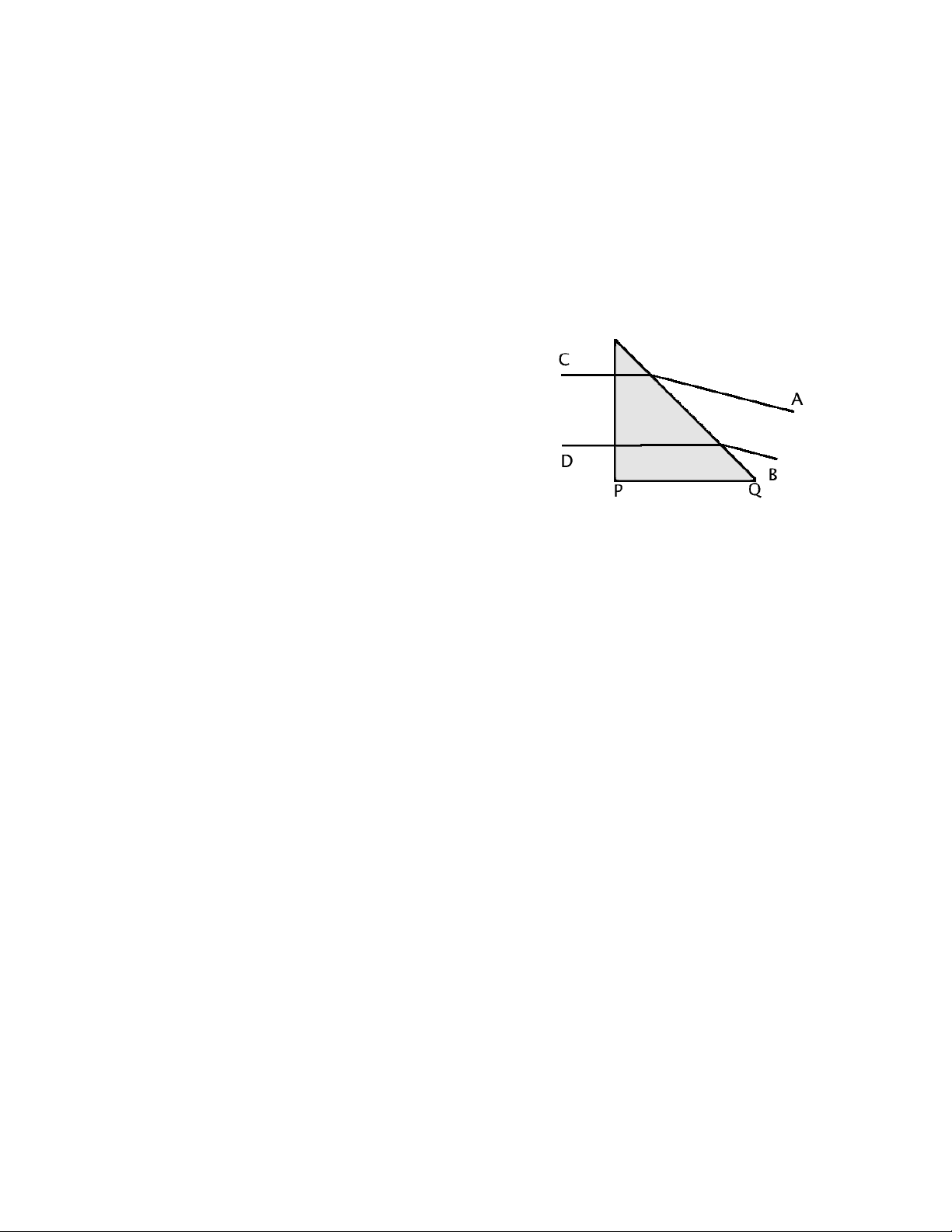
Attempt all questions, in any order. YOU MUST GIVE YOUR REASONING. 2 hours. The questions do not carry equal weight (see board) ---sketch to solutions ---Xiaochuan graded Qns 1 2 & 6, & I defer to his comments (1) <2>!Consider the diagram below (in which the prism angles are π/2, π/4 & π/4) If for the rays indicated the refractive index of the material of the prism is n (& taking air as 1), through what angle are the rays bent? what is AB/CD (the ratio of the distances between the rays)? ---ans = see Xʼs solution (2) <2>!(i) A ray of light from point P strikes a plane mirror at point Q, and returns through point R. As we know, reflection occurs at equal angles. Prove (by any method) that this follows from a requirement that the distance PQR is a minimum. ---see Fermat handout at course site mikebloxham.com/7C, or use Calculus (ii)<4>! A lens has one face convex, the other flat. Its focal length is F. The lens is glued (the flat side) to a mirror. An object is placed on the axis of the lens, a distance p away from the mirror, such that a real image is formed at a distance q from the mirror, and on the same side as the object p. What is the minimum possible value of p+q? (Hint: use Newtonʼs alternative to 1/o+1/v=1/f). ---one possible method is to assert (and justify by drawing a ray trace) that an image of the lens forms, so that the problem is equivalent to the simplest instance of a a convex lens ... BUT (be careful) with a focal length that you will now have to calculate to be f=F/
2. Then, very easily, newtonʼs form ( o=f+x;i=f+y) xy=fsquared gives a minimum p +q=4f=2F.
(3) <4>!The radius of curvature of the human cornea is about 8mm (the cornea is a bump at the front of the eye - this is not the radius of the eyeball, which weʼll take to be, for a largish eye, 1.25cm), and the refractive index of the fluid that fills the eye approximately 1.34. Draw and label the angles on a ray diagram, and from the relation between them determine how far behind the retina light from infinity would be focussed, if the eyeʻs lens were not there.
---half the answer is the diagram, showing the small angles I label α, β, γ & θ .. except
in this instance, the object is at infinity, so alpha is 0. The calculations gives focussing at a point that is only 6-7mm behind the retina. you might be curious to work out the diopter of the eye lens (in or out of its aqueous humour). ---see separate solution, that has comments on your alternative methods (4) <4>!I am old, and my eye has almost ceased to accommodate (change in strength). Also, I am far (long) sighted, and without glasses, everything is blurred. I save money on glasses by buying several, of 1-diopter power, and wear as many as I need at a time. To read, I wear three, and find I can read adequately, so long as I hold the book somewhere between a foot and a foot and a half from my eye. I am thinking of getting a GPS unit for my car, but (using one or more glasses) will I be able to see both it and the road? For this very crude calculation, letʼs estimate the GPS unit to be about 2 feet away, and ignore the gaps between eye and glasses. ---see separate solutions, and my tips (advice) about answers ---several ways to do this, but the quickest might be to show that from what I say about reading a book, my eye can only accommodate by about 1 diopter. This calculation, though crude, should, as Shakespeare would say, give me pause (before I buy the GPS unit, I really must go out there and try my glasses out). (5) <4>!Charge is flowing radially & uniformly (isotropically: the same in all directions) from the origin, from source Q, at a steady rate, with
dQ
dt
= C [I should have given you
the sign of C] What is the magnitude and direction of the displacement current
(Maxwellʼs correction to Ampère) at a point r a distance r from the origin?
(Xiaochuan rightly points out I really mean displacement current density here) ---the whole point of the displacement current is to cancel out the actual current where the divergence of that current is nil. So the answer is: if the current is outward, radially
inward, with a magnitude C / 4 π r^2 It is crucial that you give the direction to be
opposite to that of the current (in this example), as that is what shows you understand what Maxwellʼs correction is all about. I did discuss this example in lecture, a long time ago.