Download Final Exam Fall 2007 - Chemical Oceanography | OCEAN 400 and more Exams Geology in PDF only on Docsity!
Ocean 400 Your Name_______________
Chemical Oceanography
Winter 2007
Final Exam Read all questions carefully before you begin to answer. Use the back of the pages if necessary. Points are assigned to each question in ( bold). Always explain your answers and show all your work. Partial credit will be given for partial answers.
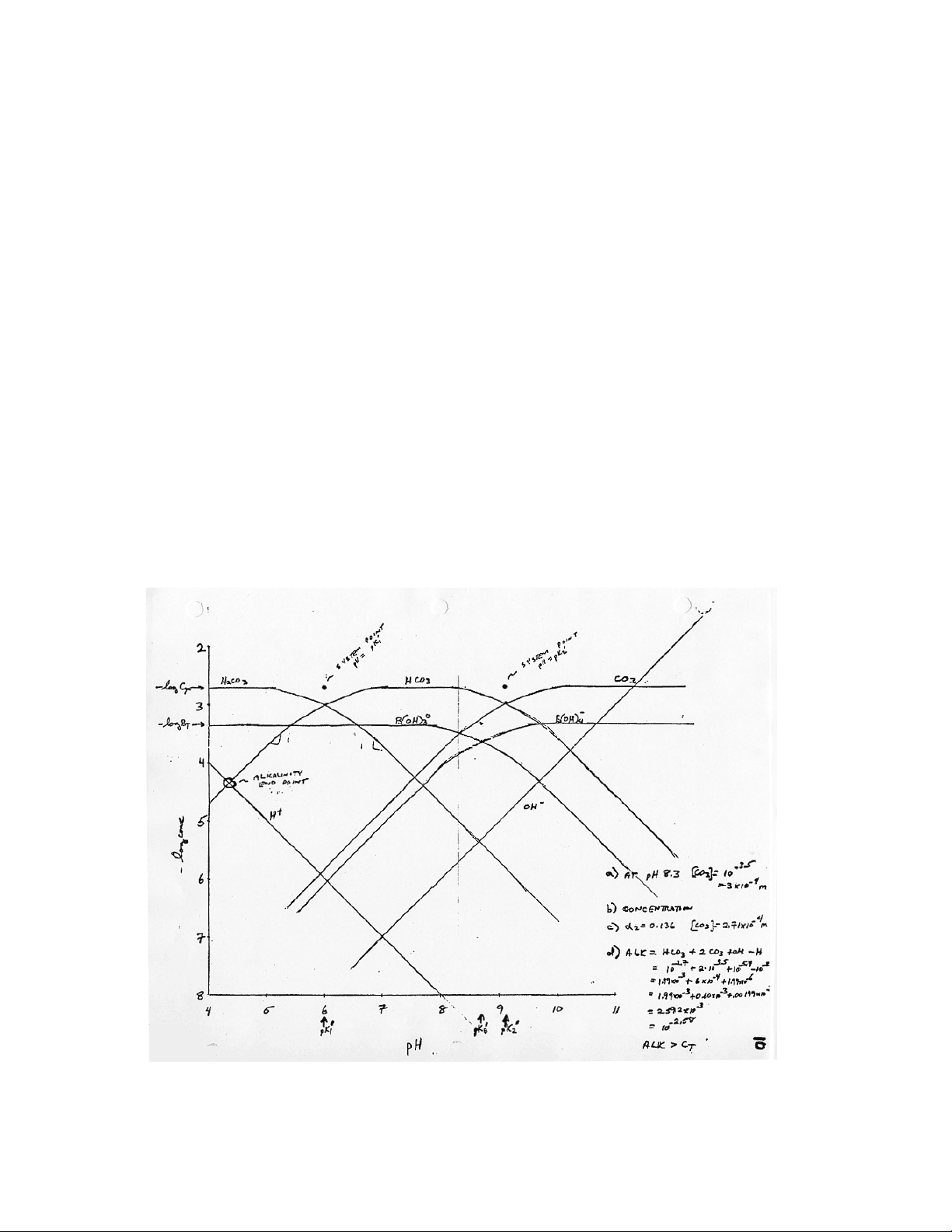
1. Ocean carbonate system Acidity derived from the carbonic acid system is the most important control on the pH seawater and links many key processes.
a) Use the graph of the carbonate system shown below. At what pH are [H 2 CO 3 ] and [CO 3 2-^ ] equal? ( 5 pts )
pH ~ 7. b) Use the graph. What is the concentration of [CO 3 2-] at pH = 8.0? ( 5 pts )
-log C = 3.8 Æ [CO 3 2-] = 10 -3.
Use the solubility and first and second acidity constants written below.
CO 2 (g) + H 2 O = H 2 CO 3 ° log K’ (^) H = -1. H 2 CO 3 ° = H+^ + HCO 3 -^ log K’ 1 = -6. HCO 3 -^ = H+^ + CO 3 2-^ log K’ 2 = -9.
CaCO 3 (s)(aragonite) = Ca2+^ + CO 3 2-^ log K’ (^) s = -6.13 (at 25°C)
c) Calculate by hand. What is the concentration of [CO 3 2-] at pH = 8.0? ( 10 pts )
CO3 3 2-^ = α 2 Ct = 10-3.
d) Pteropods are a swimming snail important in high latitude ecosystems. They make their shells out of a form of CaCO 3 (s) called aragonite. The solubility reaction and solubility product at 25°C is given above. The concentration of total [Ca 2+] = 10. x 10-3^ M. At what concentration of CO 3 2-^ will aragonite be undersataurated? ( 10 pts )
K = (Ca)(CO3) [CO 3 2-]<7.0610-5*^ M aragonite is undersaturated
e) Calculate by hand. At approximately what pH value will the CO 3 2-^ reach this value? ( 10 pts )
CO 3 2-^ = α 2 CT = K 1 K 2 /(H 2 + K 1 H + K 1 K 2 )CT 7.0610-5*^ (H 2 + 10-6^ H + 10-15^ ) = 10-15^10 -2.
[ H] = 2.110 -8*^ (quadratic formula) pH = 7.
f) If increases in atmospheric CO 2 continues, and pH decreases further, what would be one likely effect on pteropod abundance. How might that be reflected in the carbon to phosphorus ratio measured in sediment traps? The ratio measured in the present ocean is about C:P = 131:1. ( 5 pts )
As pH decreases, aragonite becomes undersaturated and pteropods would be less abundant and fewer CaCO 3 shells would be found in sediment traps, decreasing the C:P ratio.
5. Match Processes (identify A-) (8 points)
regenerated production __ B _ A) after most oxygen is consumed, this process is used by bacteria to oxidize organic material
new production D B) some diatoms may use chitin, a large organic molecule composed of C and N, to grow under low N- conditions. This type of production is an example of _____.
preformed nitrate __ G ___ C) this value can be used to estimate new production rates, if the age of a water mass is known.
apparent oxygen utilization __ C ___ D) a bloom of N 2 -fixing Trichodesmium is an example of this type of production.
Denitrification ___ A __ E) multiplying this process by the f- ratio yields new production
export production ___ F_ _ F) this type of production would be close to new production at steady state
primary production __ E ___ G) if AOU = 0, then the concentration of this should be equal to the concentration of nitrate at depth
regenerated nitrate __ H ___ H) an increase in concentration of this at depth usually leads to an increase in AOU.
- Jenkins (1982) calculated an integrated oxygen consumption of 5.7 mol O 2 m-2^ y-1^ in
the water column of the North Atlantic below the euphotic zone (100m to ∞).
a) Explain how he derived this value. What information did he use and how did he do the calculation? ( 10 pts )
b) Convert this O 2 consumption to a carbon flux and explain how you did it and what parameters you used. ( 5 pts )
The superposition of the vertical biological flux (POC export) on the horizontal circulation of the ocean controls the distribution of many trace metals (e.g. Cd, Cu, Zn). Give three main characteristics of the distributions of elements controlled in this way. ( 10 pts )
Suess (1980)
The main equation from Suess (1980) was that 0.0238 0.
prod flux
C C Z
=
Z equals depth in meters. According to this equation the ratio of flux prod
C
C
should be a
constant at a fixed depth of 100m throughout the ocean at a value of 0.39.
If the ratio flux prod
C
C
stands for the export ratio, is this consistent with what you know about
the magnitude and distribution of export production in the surface ocean? ( 10 pts )
10 ) Impact of increasing CO2 and global warming on ocean cycles. The main source of nitrogen to the ocean is by nitrogen fixation. The main sink is some combination of denitrification and anammox. Write a short analysis of how the ocean nitrogen cycle might change in response to global change. No longer than the front of this page. ( 30 pts )
- Metal Speciation Ligands have been observed to control the concentration of dissolved trace metals at many ocean sites. Boye and colleagues measured an increase of dissolved iron concentrations closer to the coast in the north Atlantic corresponding with increased ligand concentrations (see figure from Boye et. al, Marine Chemistry 2003).
Several ligands do not specifically bind a particular metal and can bind to multiple metals, i.e. iron and zinc. Boye et. al observed that the concentration of Zn-bound ligands were less than Fe-ligands, despite equal concentrations of dissolved Zn 2+^ and Fe 3+ of 1.0 nM (10-9^ M). Cathodic stripping voltammetry measurements yielded the following stability constants for Fe and Zn:
Fe 3+^ + L2-^ = FeL+^ log KFeL = 20 Zn2+^ + L2-^ = ZnL log KZnL = 19
a) Express [FeL] and [ZnL] in terms of [Fe 3+^ ], [Zn2+], [L], and K(Fe/Zn)L. ( 10 pts )
FeL = (Fe 3+)(L)K (^) FeL ZnL = (Zn2+^ )(L)K (^) ZnL
b) Why might complexed zinc ([ZnL]) be less abundant than complexed iron? Assuming thermodynamic equilibrium, what is the ratio of complexed zinc to complexed iron? Assume the same ligand binds both iron and zinc. ( 10 pts )
The binding stability for Zn is less than that for iron (log K values). ZnL/FeL = (Zn 2+^ )(L)K (^) ZnL / (Fe3+^ )(L)K (^) FeL = 1:
- Radioactive Decay
See attached Figure of the U-Th decay schemes.
a) Some parent / daughter isotope pairs in these series are sometimes said to be at secular equilibrium. What are the criteria for secular equilibrium and what does this mean if two isotopes are in secular equilibrium? Give one example from the isotopes in the U-Th decay chains. ( 10 pts )
b) The concept of secular equilibrium for isotopes from the U-Th series serves as a starting point for calculating useful geochemical rates. Give and explain an example that could be used to study gas exchange. ( 5 pts )
c) 210 Po is a very toxic isotope (about 106 times more toxic than cyanide). The main hazard is its intense alpha radiation which if ingested does serious damage to internal tissues. Imagine that you are an undercover spy and you want to poison some critic of your government by slipping some 210 Po into their margarita. The maximum safe body burden of 210 Po is ~1000 Bq = 16.7 dpm. To make sure your deadly poison works you want to increase the body burden by >10 times to >167 dpm.
Hint: 1 Becquerel (Bq) = 1 dps = 0.016 dpm
i) Your chemical lab knows how to separate 210 Po from 210 Pb. You just have to get them the material. You have 200 dpm of pure 210 Pb. How long do you have to let the 210 Pb decay so that you have 200 dpm of 210 Po? ( 10 pts ) (I don’t think we’ve covered the equations or approach for this type of application- we might consider leaving it out)
ii) Your lab chemists do their job well and now you have a sugar cube containing 200 dpm of 210 Po. You get ready to meet your victim in a bar in Fremont but suddenly he is out of the country (gone to Britain) for 138 days. Finally you meet and while his back is turned you slip the sugar cube into his drink. Will your poison work?? ( 10 pts )
17 ) Sarmiento and Gruber (2002) a) Why doesn’t atmospheric CO 2 increases as fast as it is produced? b) Why is the seasonal cycle of CO 2 controlled by exchange with land rather then exchange with the ocean? c) Does the increase in anthropogenic CO 2 result in an increase in new production?
- Anammox is one of the new and exciting areas of biogeochemical oceanography.
The half reactions for the reduction of NO 3 to N 2 and reduction of N 2 to NH 4 +^ are given below.
a) Write a balanced reaction of NO 3 plus NH 4 +^ to produce N 2 and give the equilibrium constant. ( 10 pts )
1/5 NO 3 -^ + 6/5 H+^ + e -^ = 1/10 N 2 (g) + 3/5 H2 O log K = +21. 1/6 N 2 (g) + 4/3 H+^ + e -^ = NH 4 +^ log K = +4.
b) Will anammox proceed if NO 3 -^ = 10-6^ , NH 4 +^ = 10-6^ and PN2 = 0.8 atm? ( 10 pts )