
Problem Set 1 Questions - Chemical Oceanography | OCEAN 400, Assignments of Geology

Material Type: Assignment; Class: CHEMICAL OCEAN; Subject: Oceanography; University: University of Washington - Seattle; Term: Winter 2009;

Typology: Assignments

Pre 2010

Uploaded on 03/18/2009

koofers-user-2nu
koofers-user-2nu 🇺🇸

10 documents

1 / 3

Toggle sidebar

This page cannot be seen from the preview

Don't miss anything!

bg1
Ocean 400 Problem Set #1
Winter 2009
Due: 9:30 a.m., Tuesday, Jan. 13
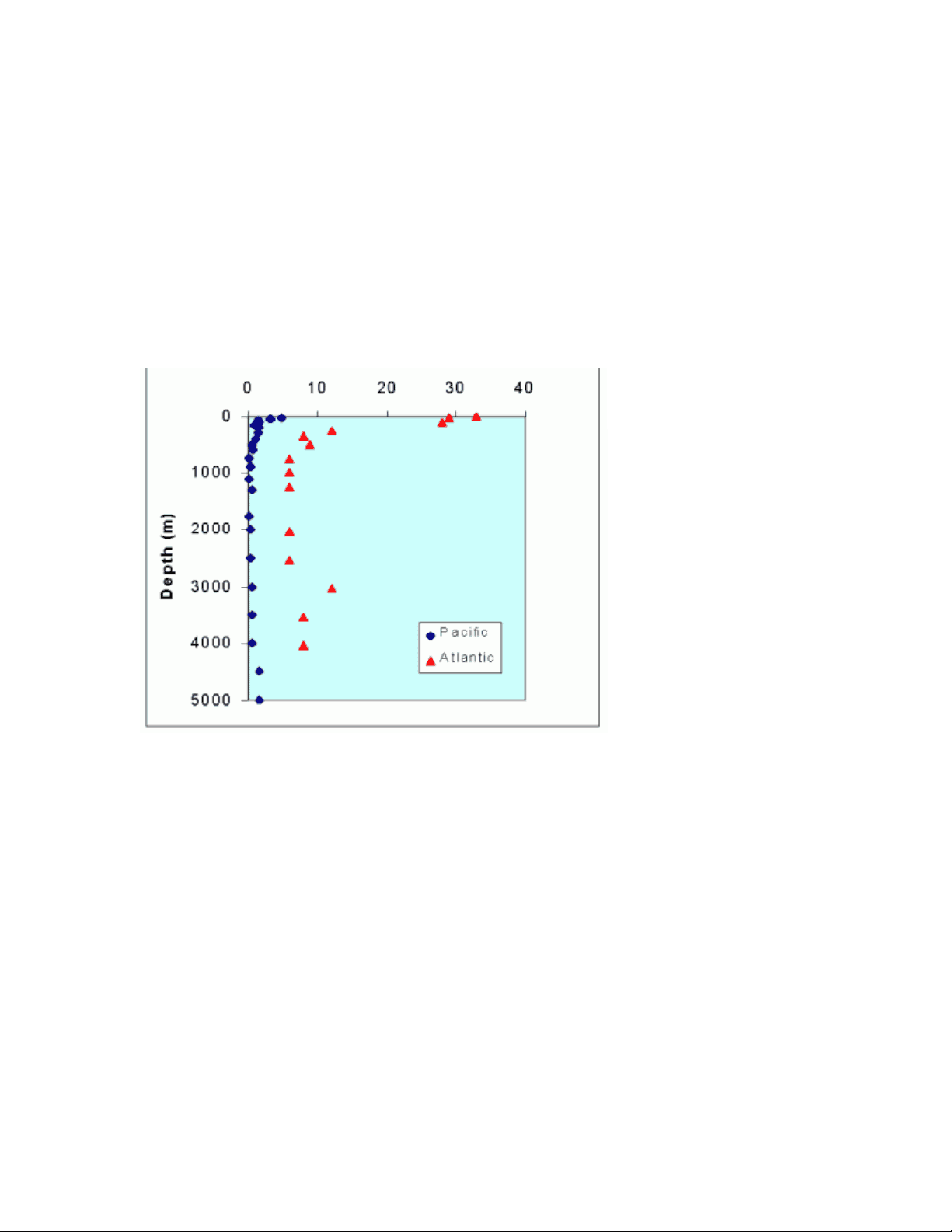
1. Two representative profiles of the infamous oceanographic element My (Mysterium)
in the Atlantic and Pacific are shown below. What factors control the distribution of My
in seawater? What might explain the difference between ocean basins? What are two
plausible sources of My?
2. Some elements in seawater are considered to be conservative.
a) Propose a definition that would apply to conservative elements in seawater.
b) Which of the major elements in seawater are considered conservative?
c) Uranium (U) is a trace element that has been proposed to be conservative in seawater.
How would you design a study to show that this is true?
pf3

Partial preview of the text

Download Problem Set 1 Questions - Chemical Oceanography | OCEAN 400 and more Assignments Geology in PDF only on Docsity!

Ocean 400 Problem Set

Winter 2009

Due: 9:30 a.m., Tuesday, Jan. 13

  1. Two representative profiles of the infamous oceanographic element My (Mysterium) in the Atlantic and Pacific are shown below. What factors control the distribution of My in seawater? What might explain the difference between ocean basins? What are two plausible sources of My?
  2. Some elements in seawater are considered to be conservative. a) Propose a definition that would apply to conservative elements in seawater. b) Which of the major elements in seawater are considered conservative? c) Uranium (U) is a trace element that has been proposed to be conservative in seawater. How would you design a study to show that this is true?
  1. The Table below gives the world average composition of river water. Do your calculations with these values using the molar concentrations. a) Correct the concentrations of Na, Mg, SO4, K and Ca for seasalt aerosols using Cl as a tracer? What assumptions do you need to make?

Propose an approach to calculate how much CO 2 (atm) is consumed by weathering of b) carbonate rocks (CaCO 3 ) c) silicate rocks hint: Assume all Si comes from silicate rocks. Calculate the HCO 3 -^ that weathering produces. Then calculate the HCO 3 -^ that comes from weathering of carbonate rocks. As a check, if all the Ca2+^ comes from weathering CaCO 3 then Ca should equal 0.5 x HCO 3 - from carbonate weathering. You will find that it doesn’t. The reason is that some carbonate rocks are MgCO 3 or CaMg(CO 3 ) 2.

d) From your model, what is the total amount of CO 2 consumed by weathering (in PgC y -1^ )? Use a total world river flow of 3.7 x 10^16 L y-^.

e) How does your rate compare with that of Sarmiento and Gruber (2002) as shown in their Figure 1.

f) How does the weathering ratio of CaCO 3 /silicate rocks compare with the outcrop abundance of carbonate sedimentary rocks to silicate rocks. See the attached table from Meybeck (1987, American Journal of Science, 287, 401-428). If the weathering ratio differs from the outcrop ratio, suggest why.