Download Problem Set 2 Questions - Chemical Oceanography | OCEAN 400 and more Assignments Geology in PDF only on Docsity!
Ocean 400- Chemical Oceanography Problem Set #2 KEYWinter 2009 Due: 9:30 a.m., Wednesday, Jan. 21 Graded out of 35 points
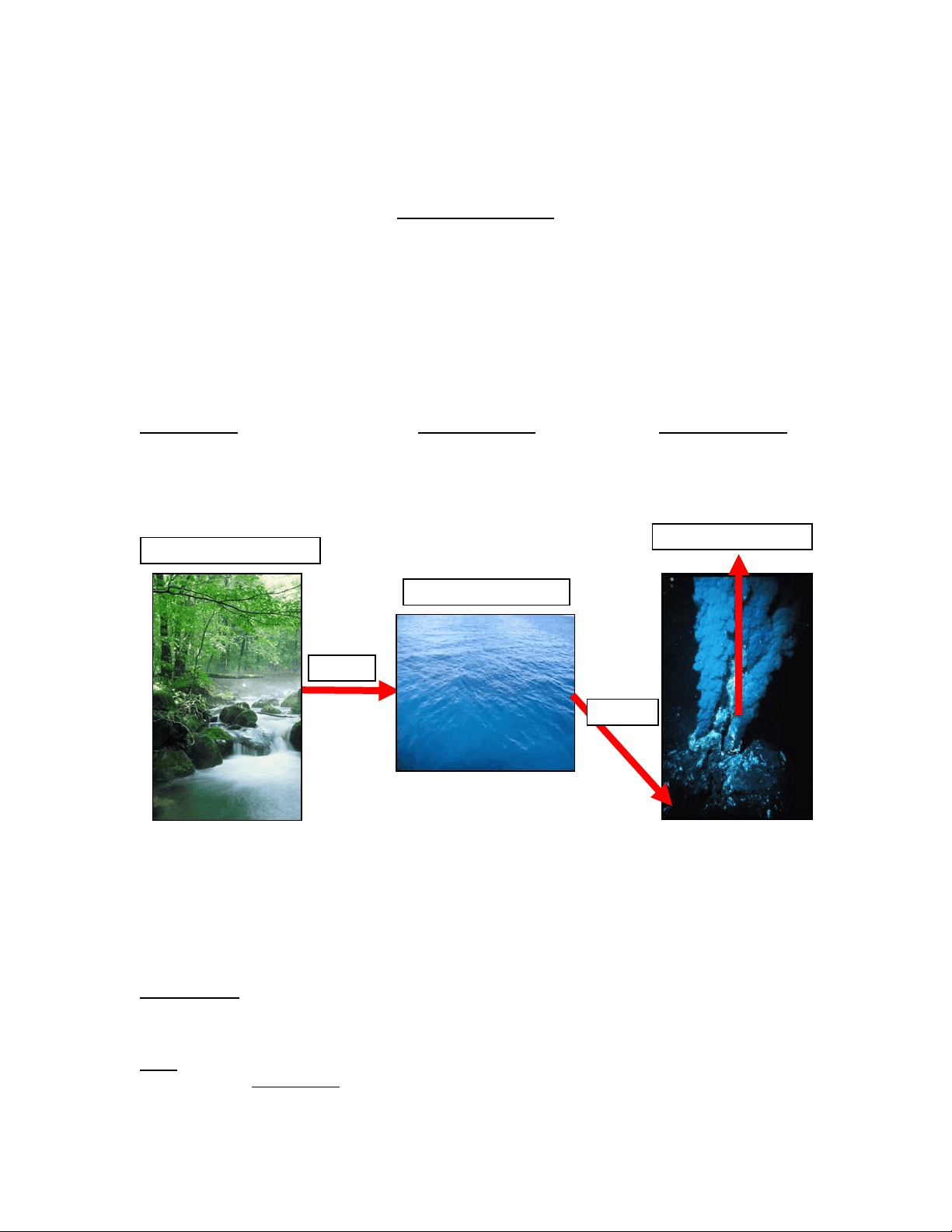
1. Box Model Problem: What controls the Mg +2^ composition of seawater? (20pts total) You might think it is fundamental, but there is some debate about what controls the magnesiumconcentration in seawaters. The main input is rivers (see Power Point Lecture Notes 2 and 4). The main removal is by hydrothermal processes - the concentration of Mgsolutions is zero (you can see the table in the major ions lecture for more details). Here we’ll see how this +2^ in 350°C end member hydrothermal balance works. a) Draw a schematic diagram for this box model calculation. (2pts) Source: Rivers Inventory: Ocean Sink: H.V. Systems [Mg +2^ ]R * 3.5 x 10 16 kg water yr -1^ [Mg +2^ ]O * 1.38 x 10 21 kg water [Mg+2^ ]O * 1 x 10 14 kg water yr - = mmol Mg +2^ / yr = mmol Mg +2^ = mmol Mg +2^ / yr
b) Calculate the residence time of water in the ocean, twice: once relative to river input, and again relative to hydrothermal circulation. (4pts) Mass of ocean = 1.38 x 10River discharge = 3.5 x 10 21 16 kgkg yr - Hydrothermal circulation ~ 1 x 10^14 kg yr - Residence time : assume steady state where sources = sinks. τ = inventory / sink rate OR τ = inventory / source rate River τ R =^ 1.38 x 10 3.5 x 10 16 21 kg yr^ kg^ -1= 3.94 x 10^4 yr =^ 39.4 thousand years
[Mg+2^ ] (^) R = 0.128 mmol/kg [Mg+2^ ] (^) O = 52.8 mmol/kg
[Mg+2^ ] (^) HV = 0 mmol/kg
[Mg+2^ ] (^) O
[Mg+2^ ] (^) R
Hydrothermal Vent Systems τHV = 1.38 x 10 1 x 10 14 kg yr 21 kg -1 = 1.38 x 10 7 yr = 13.8 million years
c) Calculate the residence time of Mg+2^ in seawater relative to these two processes, individually. (10pts) Ocean Inventory of Mg +2: [Mg +2^ ]O * Mass Ocean = total amount of Mg+2^ in ocean (52.8 mmol Mg +2/kg) * (1.38 x 10 21 kg) = 7.28 x 10 22 mmol Mg+ River Source Flux of Mg +2: [Mg(0.128 mmol Mg +2^ ]R * River Flow Rate = amount of Mg +2/kg) * (3.5 x 10 16 kg yr -1) = +2^ coming out of rivers / yr 4.48 x 10 15 mmol Mg +2 (^) /yr
Hydrothermal Vent System Removal Flux of Mg+2 : [Mg +2^ ] (^) O * Hydrothermal System Flow Rate = amount of Mg +2^ removed by H.V. systems / yr Recall that the water going into a vent has the [Mg +2^ ] concentration of seawater and that the water exiting the hydrothermal system has a [Mgmagnesium from the seawater. +2] concentration of zero. Therefore the vent is removing all of the
(52.8 mmol Mg +2/kg) * (1.38 x 10 21 kg) = 5.28 x 10 15 mmol Mg+2^ /yr
Note: the hydrothermal vent end member has a concentration of [My] = 20 mmol My / kg. Now how would you As an example, let’s consider another species such as My. Let’s say that the water coming out of determine the hydrothermal vent removal rate of My? Removal Rate: the H.V. end member. First we need to find the difference between the concentration of My in the ocean and in This value is the amount of My that has been removed from the seawater by the hydrothermal vent system.vent to get the removal rate of My. We then multiply this “missing” concentration by the rate of flow through the
(H.V. flow rate) * ([My]O – [My]HV ) = mmol My / yr When considering Mg the [Mg +2]HV = 0 so we only use [Mg+2^ ]O in our calculation.
Residence times of Mg+ River τR = (^) 4.48 x 107.28 x 10 15 22 mmol Mgmmol Mg +2 +2 (^) /yr^ = 1.62 x 10 7 yr = 16.2 million years
Hydrothermal Vent System τHV = 7.28 x 10 22 mmol Mg +2^ = 1.37 x 10 7 yr = 13.7 million years 5.28 x 10 15 mmol Mg +2^ /yr These contrasting residence times indicate that the ocean is not in steady state with respect to magnesiumbecause the rate of magnesium input to the ocean via rivers is slower than the rate of magnesium removal by hydrothermal vent systems.
(^210) Po into their margarita. The maximum safe body burden of 210 Po is ~1000 Bq = 16.7 dpm. To make sure your deadly poison works you want to increase the body burden by >10 times to >167 dpm. Hint: 1 Becquerel (Bq) = 1 dps = 0.016 dpm i) Your chemical lab knows how to separatehave 200 dpm of pure 210 Pb. How long do you have to let the 210 Po from 210 Pb. You just have to get them the material. You 210 Pb decay so that you have almost (95%) 200 dpm of 210 Po? Start with the following equation (from the class notes) that describes a system with a radioactive parentand radioactive daughter nuclide. ( D = daughter and P = parent)
A (^) D = [λD / ( λD - λP)] * A (^) Po * (exp(-λP*t) – exp(-λD *t)) The above equation can be converted to the following equation which describes a system with a radioactive parent and radioactive daughter nuclide under secular equilibrium. can be simplified in this manner (consider half lives, decay constants, and relevant time scales) then Rationalize why the equation above use (^210) Pb activity. the following equation to determine how long it will take to get a (10pts) 210 Po activity that is 95% of the
A (^) D ~ A (^) P - A (^) P exp(-λDt) Hint: To solve this problem see chapter 6 of the text book and read the section on secular equilibrium. First lets look at the decay series of interest. (^210) Pb Æ 210 Bi Æ 210 Po
Half Lives: (^210) Pb = 22.3 yr (^210) Bi = 5.01 d (^210) Po = 138 d = 0.378 yr
The half life of Bi (~5days) is very short relative to the other two nuclides in the decay series so we can neglect it in our calculations. Start with the following equation: A (^) D = [λD / ( λD - λP)] * A (^) Po * (exp(-λPt) – exp(-λD t)) Relevant Equations τ λ1/2 = ln(2) /^ = ln(2) / τ1/2^ λ A (^) P = A (^) Po * exp(-λPt) Decay Constants: λ λD = ln(2) / (0.378 yr) = 1.83 yr - P = ln(2) / (22.3 yr) = 0.031 yr^ - We can simplify the equation above by noting that λD >> λP and so ( λD - λP) ~ λD. A (^) D ~ A (^) Po * (exp(-λPt) – exp(-λD *t)) A (^) D ~ A (^) P – (A (^) Po * exp(-λD *t))
Now if we consider our time scale of interest we can see that the parent half life (22.3 years) is much longer than the time scale of our desired poisoning operation. Therefore only a tiny fraction of the parent nuclidewill have decayed by the time we have enough of the daughter nuclide for our poison.
Thus: A (^) P ~ A (^) Po And the equation can be simplified to A (^) D ~ A (^) P - (A (^) P * exp(-λD *t)) A (^) D ~ A (^) P (1 - exp(-λD *t)) Where A (^) P represents the parent decay activity, which is the source of the daughter nuclide, and (AP * exp(- λsink for the daughter nuclide. The difference between the source and the sink terms determine the activityD *t)) represents the activity of the parent times the exponential decay of the daughter nuclide, which is the of the daughter. We want the activity of the daughter to be at 95% of the activity of the parent. A (^) D / A (^) P = 0.95 = 1 - exp(-λD *t) (0.95 – 1) / -1 = exp(-λD *t) ln(1-0.95) = -λD *t t = ln(0.05)/ -λD t = ln(0.05) / 1.83yr - t = 1.637 yr = 597.5 days ii) Your lab chemists do their job well and now you have a sugar cube containing 200 dpm ofget ready to meet your victim in a bar in Fremont but suddenly he is out of the country (gone to Britain) for 210 Po. You 138 days. Finally you meet and while his back is turned you slip the sugar cube into his drink. poison work? (2pts) Will your
138 days is the half life of the daughter nuclide so after 138 days only half of the poison will remain in the sugar cube (100dpm). This is well above the safe 16.7dpm limit so theoretically the poison will still work.