
Gravitational Forces and Orbits: Central Forces and Excel Simulation, Study notes of Physics

The radial force between two objects, the potential energies associated with different force laws, and kepler's laws of planetary motion. The text also includes an excel simulation to visualize orbits in central forces. Students will learn about the importance of conservation of angular momentum and energy in gravitational systems.

Typology: Study notes

Pre 2010

Uploaded on 09/02/2009

koofers-user-qm1
koofers-user-qm1 🇺🇸

10 documents

1 / 7

Toggle sidebar

This page cannot be seen from the preview

Don't miss anything!

bg1
Physics 247 October 2001 1
Central Forces
This is an Excel Problem dealing with two-dimensional motion. A lot of the physics
discussed below is ahead of where we are in the lecture, but don't let that bother you. If
you are unfamiliar with parts of it, think of this as a gentle preview. The case explored is
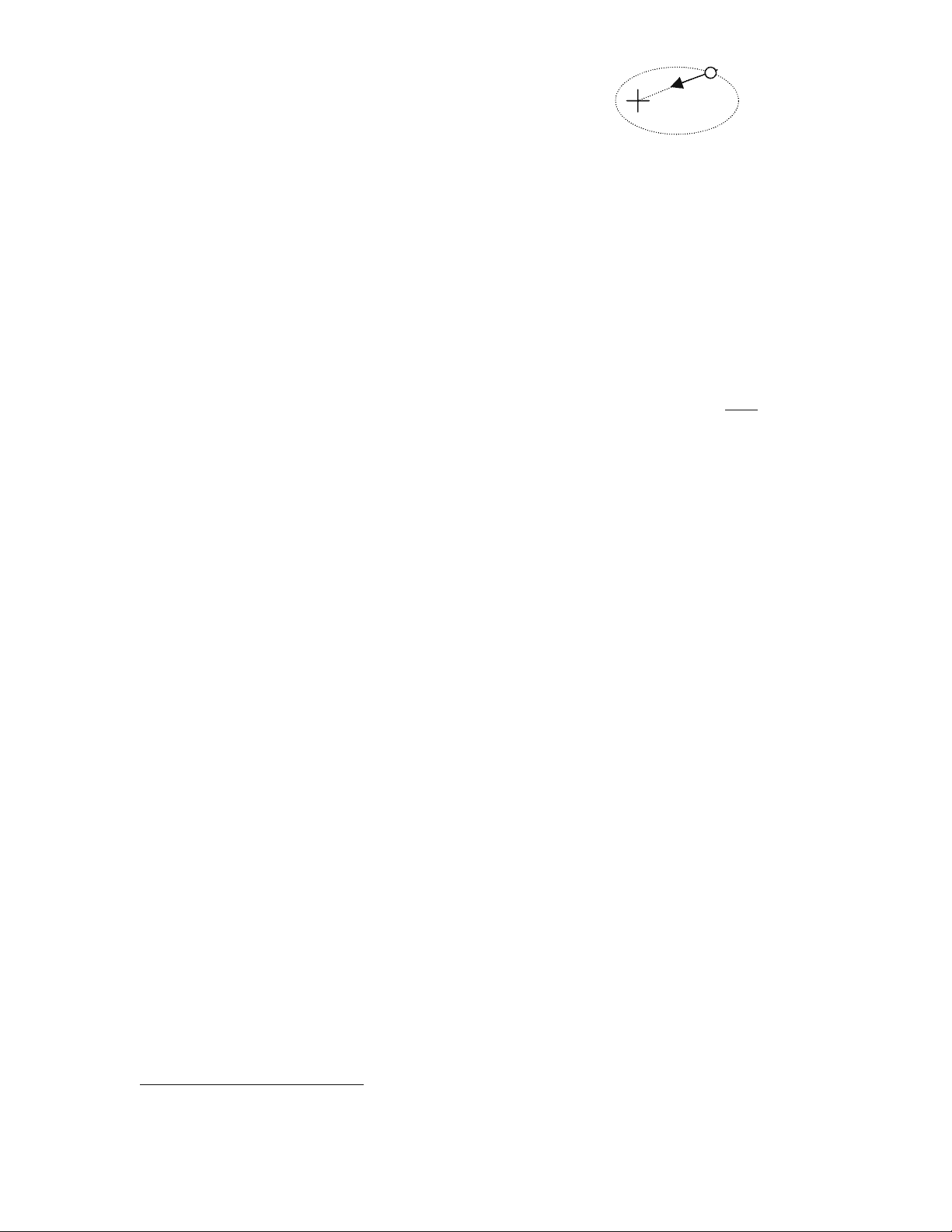
orbital motion about a point that attracts the orbiting object directly toward it. This is
called a “Central Force” problem because the force points directly toward the origin.
An example of such a force is gravity. The radial force between two objects of masses M
and m, separated by a distance r (much greater than their sizes)1 is F = - GMm/r2. The
minus sign indicates that the force is attractive. In the case that M>>m, the large mass
can be thought of as holding still at the origin and the small mass orbiting around it.2
Another example is the orbit of a star in our Galaxy. Except rather close to or very far
from the Galactic center, the distribution of mass in the Galaxy supplies a force that is
approximately proportional to 1/r rather than 1/r2 like the force of a point mass.
A third example is mathematically interesting though I can’t think of an actual physical
situation, maybe an atom in a solid. In it, the force toward the origin is proportional to r,
so in one dimension it is just a harmonic oscillator. It is still called the harmonic
oscillator, but oscillation in each direction is sinusoidal with the same frequency but (in
general) different amplitudes.
A fourth example is the force between quarks, which I am told is attractive and pretty
much independent of the separation, meaning that it is constant.
In all these cases, energy is conserved. The respective potential energies for F = -A/rp are
U = -A/r for p=2 (point mass), U = A*ln(r/ro) for p=1 (Milky Way Galaxy, where ro is the
arbitrary radius at which the potential is zero), U = (1/2) A*r2 for p=-1 (harmonic
oscillator), and U = A*r for p=0 (quarks). In each case, if I got them right, F = -dU/dr.
In addition, for central forces there is no torque supplied by the force (it has zero lever
arm about the origin). As a consequence, angular momentum is also conserved. The
angular momentum of the orbiting mass m about the origin is L = m(x*vy – y*vx)
counterclockwise.
Kepler noticed several things about the orbits of the planets: the orbit of each is in a
plane, is elliptical in shape with the Sun at one focus, has a period “T” and semimajor
axis “a” that are related by T2 proportional to a3, and that the orbits sweep out “equal
areas in equal times.”
Given the origin, the location of m at one time, and its velocity, the orbital plane is fixed,
the plane perpendicular to both r and v that contains the original location. The “equal
areas in equal time” turned out to be the same as angular momentum conservation. The
1 If an object is spherically symmetric, its gravity behaves this way anyway, even when the pulled object is
close (but outside) but “r” is the distance from the center of the object.
2 Otherwise both orbit around their common center of mass.
pf3
pf4
pf5

Partial preview of the text

Download Gravitational Forces and Orbits: Central Forces and Excel Simulation and more Study notes Physics in PDF only on Docsity!

Central Forces

This is an Excel Problem dealing with two-dimensional motion. A lot of the physics

discussed below is ahead of where we are in the lecture, but don't let that bother you. If

you are unfamiliar with parts of it, think of this as a gentle preview. The case explored is

orbital motion about a point that attracts the orbiting object directly toward it. This is

called a “Central Force” problem because the force points directly toward the origin.

An example of such a force is gravity. The radial force between two objects of masses M

and m, separated by a distance r (much greater than their sizes)

is F = - GMm/r

. The

minus sign indicates that the force is attractive. In the case that M>>m, the large mass

can be thought of as holding still at the origin and the small mass orbiting around it.

Another example is the orbit of a star in our Galaxy. Except rather close to or very far

from the Galactic center, the distribution of mass in the Galaxy supplies a force that is

approximately proportional to 1/r rather than 1/r

like the force of a point mass.

A third example is mathematically interesting though I can’t think of an actual physical

situation, maybe an atom in a solid. In it, the force toward the origin is proportional to r,

so in one dimension it is just a harmonic oscillator. It is still called the harmonic

oscillator, but oscillation in each direction is sinusoidal with the same frequency but (in

general) different amplitudes.

A fourth example is the force between quarks, which I am told is attractive and pretty

much independent of the separation, meaning that it is constant.

In all these cases, energy is conserved. The respective potential energies for F = -A/r

p

are

U = -A/r for p=2 (point mass), U = A*ln(r/r o) for p=1 (Milky Way Galaxy, where ro is the

arbitrary radius at which the potential is zero), U = (1/2) A*r

for p=-1 (harmonic

oscillator), and U = A*r for p=0 (quarks). In each case, if I got them right, F = -dU/dr.

In addition, for central forces there is no torque supplied by the force (it has zero lever

arm about the origin). As a consequence, angular momentum is also conserved. The

angular momentum of the orbiting mass m about the origin is L = m(xvy – yvx)

counterclockwise.

Kepler noticed several things about the orbits of the planets: the orbit of each is in a

plane, is elliptical in shape with the Sun at one focus, has a period “T” and semimajor

axis “a” that are related by T

proportional to a

, and that the orbits sweep out “equal

areas in equal times.”

Given the origin, the location of m at one time, and its velocity, the orbital plane is fixed,

the plane perpendicular to both r and v that contains the original location. The “equal

areas in equal time” turned out to be the same as angular momentum conservation. The

If an object is spherically symmetric, its gravity behaves this way anyway, even when the pulled object is

close (but outside) but “r” is the distance from the center of the object.

Otherwise both orbit around their common center of mass.

constancy of the orbital plane meant that the attractive force toward the Sun had to lie in

that plane, and the constancy of angular momentum meant that the force had to point

toward the origin.

Consider now, following in the mindsteps of Isaac Newton, circular orbits with F = -

A/r

p

, which must equal -mv

/r, for the planet to go in a circle of radius r. We can learn

two things from this by comparing with Kepler’s observations. The period of the orbit T

= 2πr/v = 2πrsqrt(mr

p-

/A). Thus,

T

r

p+

(m/A).

In order for the different planets to have the square of T proportional to the cube of r (the

semimajor axis of a circle is its radius), p=2 is required. The force must be proportional

to 1/r

. In addition, (m/A) must be constant. Thus, “A” must be proportional to m, the

mass of the planet. We find that the gravitational force must be proportional to the mass

it is acting on, and inversely proportional to the square of its distance from the other

mass. By symmetry, the force must also be proportional to the other mass, that of the

Sun in this case, and so we get Fgrav = - GMm/r

, where G is the fundamental

gravitational constant, something that has to be measured.

What about the ellipses. That part is much tougher to prove, dealing with the details of

the orbit. What surprised me, though, was that only two possible force laws always have

“closed” orbits after one revolution. Those are the 1/r

force and the r force, gravity and

the harmonic oscillator. For any other force law, when the orbiting object gets back to its

maximum radius, it isn’t at the same place. The following pictures show what can

happen in galactic gravity, in general and for a special velocity at the maximum radius.

Orbits in Central Forces

Orbits in Central Forces

The formulae for this setup are displayed next, along with some commentary.

A B C D E F G H

Orbit in Central Force a(radial) = -1/r^p p = 2 Dictionary of xZero = 1 p values yZero = 0 "1" = Galaxy gravity vxZero = 0 "2" = Point Gravity vyZero = 0.75 "-1" = Harmonic Osc.

factor = 0.0007 bold cells are named Dt = =factor2PI()SQ* 1/r

time vx(a bit earlier) vy(a bit earlier) x y r ax=-x/r^(p+1) ay=-y/r^(p+1) 0 =vxZero-G11Dt/2 =vyZero-H11Dt/2 =xZero =yZero =SQRT(D11D11+E11E11) =-D11/(F11^(p+1)) =-E11/(F11^(p+1)) =A11+Dt =B11+G11Dt =C11+H11Dt =D11+B12Dt =E11+C12Dt =SQRT(D12D12+E12E12) =-D12/(F12^(p+1)) =-E12/(F12^(p+1)) =A12+Dt =B12+G12Dt =C12+H12Dt =D12+B13Dt =E12+C13Dt =SQRT(D13D13+E13E13) =-D13/(F13^(p+1)) =-E13/(F13^(p+1)) =A13+Dt =B13+G13Dt =C13+H13Dt =D13+B14Dt =E13+C14Dt =SQRT(D14D14+E14E14) =-D14/(F14^(p+1)) =-E14/(F14^(p+1)) =A14+Dt =B14+G14Dt =C14+H14Dt =D14+B15Dt =E14+C15Dt =SQRT(D15D15+E15E15) =-D15/(F15^(p+1)) =-E15/(F15^(p+1)) =A15+Dt =B15+G15Dt =C15+H15Dt =D15+B16Dt =E15+C16Dt =SQRT(D16D16+E16E16) =-D16/(F16^(p+1)) =-E16/(F16^(p+1)) =A16+Dt =B16+G16Dt =C16+H16Dt =D16+B17Dt =E16+C17Dt =SQRT(D17D17+E17E17) =-D17/(F17^(p+1)) =-E17/(F17^(p+1)) =A17+Dt =B17+G17Dt =C17+H17Dt =D17+B18Dt =E17+C18Dt =SQRT(D18D18+E18E18) =-D18/(F18^(p+1)) =-E18/(F18^(p+1)) =A18+Dt =B18+G18Dt =C18+H18Dt =D18+B19Dt =E18+C19Dt =SQRT(D19D19+E19E19) =-D19/(F19^(p+1)) =-E19/(F19^(p+1)) =A19+Dt =B19+G19Dt =C19+H19Dt =D19+B20Dt =E19+C20Dt =SQRT(D20D20+E20E20) =-D20/(F20^(p+1)) =-E20/(F20^(p+1)) =A20+Dt =B20+G20Dt =C20+H20Dt =D20+B21Dt =E20+C21Dt =SQRT(D21D21+E21E21) =-D21/(F21^(p+1)) =-E21/(F21^(p+1)) =A21+Dt =B21+G21Dt =C21+H21Dt =D21+B22Dt =E21+C22Dt =SQRT(D22D22+E22E22) =-D22/(F22^(p+1)) =-E22/(F22^(p+1)) =A22+Dt =B22+G22Dt =C22+H22Dt =D22+B23Dt =E22+C23Dt =SQRT(D23D23+E23E23) =-D23/(F23^(p+1)) =-E23/(F23^(p+1)) =A23+Dt =B23+G23Dt =C23+H23Dt =D23+B24Dt =E23+C24Dt =SQRT(D24D24+E24E24) =-D24/(F24^(p+1)) =-E24/(F24^(p+1)) =A24+Dt =B24+G24Dt =C24+H24Dt =D24+B25Dt =E24+C25Dt =SQRT(D25D25+E25E25) =-D25/(F25^(p+1)) =-E25/(F25^(p+1)) =A25+Dt =B25+G25Dt =C25+H25Dt =D25+B26Dt =E25+C26Dt =SQRT(D26D26+E26E26) =-D26/(F26^(p+1)) =-E26/(F26^(p+1)) =A26+Dt =B26+G26Dt =C26+H26Dt =D26+B27Dt =E26+C27Dt =SQRT(D27D27+E27E27) =-D27/(F27^(p+1)) =-E27/(F27^(p+1)) =A27+Dt =B27+G27Dt =C27+H27Dt =D27+B28Dt =E27+C28Dt =SQRT(D28D28+E28E28) =-D28/(F28^(p+1)) =-E28/(F28^(p+1)) =A28+Dt =B28+G28Dt =C28+H28Dt =D28+B29Dt =E28+C29Dt =SQRT(D29D29+E29E29) =-D29/(F29^(p+1)) =-E29/(F29^(p+1)) =A29+Dt =B29+G29Dt =C29+H29Dt =D29+B30Dt =E29+C30Dt =SQRT(D30D30+E30E30) =-D30/(F30^(p+1)) =-E30/(F30^(p+1)) =A30+Dt =B30+G30Dt =C30+H30Dt =D30+B31Dt =E30+C31Dt =SQRT(D31D31+E31E31) =-D31/(F31^(p+1)) =-E31/(F31^(p+1)) =A31+Dt =B31+G31Dt =C31+H31Dt =D31+B32Dt =E31+C32Dt =SQRT(D32D32+E32E32) =-D32/(F32^(p+1)) =-E32/(F32^(p+1)) =A32+Dt =B32+G32Dt =C32+H32Dt =D32+B33Dt =E32+C33Dt =SQRT(D33D33+E33E33) =-D33/(F33^(p+1)) =-E33/(F33^(p+1)) =A33+Dt =B33+G33Dt =C33+H33Dt =D33+B34Dt =E33+C34Dt =SQRT(D34D34+E34E34) =-D34/(F34^(p+1)) =-E34/(F34^(p+1)) =A34+Dt =B34+G34Dt =C34+H34Dt =D34+B35Dt =E34+C35Dt =SQRT(D35D35+E35E35) =-D35/(F35^(p+1)) =-E35/(F35^(p+1)) =A35+Dt =B35+G35Dt =C35+H35Dt =D35+B36Dt =E35+C36Dt =SQRT(D36D36+E36E36) =-D36/(F36^(p+1)) =-E36/(F36^(p+1)) =A36+Dt =B36+G36Dt =C36+H36Dt =D36+B37Dt =E36+C37Dt =SQRT(D37D37+E37E37) =-D37/(F37^(p+1)) =-E37/(F37^(p+1)) =A37+Dt =B37+G37Dt =C37+H37Dt =D37+B38Dt =E37+C38Dt =SQRT(D38D38+E38E38) =-D38/(F38^(p+1)) =-E38/(F38^(p+1)) =A38+Dt =B38+G38Dt =C38+H38Dt =D38+B39Dt =E38+C39Dt =SQRT(D39D39+E39E39) =-D39/(F39^(p+1)) =-E39/(F39^(p+1)) =A39+Dt =B39+G39Dt =C39+H39Dt =D39+B40Dt =E39+C40Dt =SQRT(D40D40+E40E40) =-D40/(F40^(p+1)) =-E40/(F40^(p+1)) =A40+Dt =B40+G40Dt =C40+H40Dt =D40+B41Dt =E40+C41Dt =SQRT(D41D41+E41E41) =-D41/(F41^(p+1)) =-E41/(F41^(p+1))

Note : Dt = factor2PI()*SQRT((xZero^2+yZero^2)/(vxZero^2+vyZero^2))

Iteration On to avoid circular reference problem: Tools menu, Preferences, Calculation, poke Iteration

The timestep as defined above is “factor” times 2π times the ratio of initial radius to

initial velocity. If the object is in a circular orbit, “factor” is the fraction of an orbit

calculated in one timestep. My spreadsheet does 3000 timesteps, so with factor = 0.0007,

it should do a little more than 2 circular orbits. A plot of y versus x shows the orbit, but a

plot of y versus time gives you a better idea of how many orbits you have calculated, and

a way to see the period easily. For vyZero = 1, it looks like:

y versus time (for counting cycles)

time

This is probably not

important this week, but it

will likely be next week! See

note at end. Must activate

"iteration" to avoid circular

reference problem when "a"

depends on "v"!

while for vyZero = 0.75 the result is

y versus time (for counting cycles)

time

The skew in the shape occurs because in alternate half cycles the orbiter is far out going

slowly and then near in going fast (conserving angular momentum).

Trick: If instead you plot x versus t, with vxZero = 0, for 1/r

force, the maximum and

minimum values of x will be at the far point and near point, and the distance between

them will be twice the semimajor axis. You will be able to read both the period and

semimajor axis off your diagram and by adjusting for various values of vyZero, find

Kepler’s Law. (I didn’t think of this until just now—I used a much more complicated

approach. Here are my results relating semimajor axis and period:

Period Versus Semimajor Axis

y = 6.286x 1.

1

10

0.1 1 10 Axis

The formula in the corner is a “trendline” added by Excel (available from the Chart

menu). 1.495 was its idea of the slope, darn close to 1.5 wouldn’t you say?

1) The most important graph to make is y vs. x, the orbit. When you do it for point

gravity and the harmonic oscillator, the orbits should be ellipses. You will want to lock

in the vertical and horizontal scales of your graph so it maintains the same proportions as

you change the orbits, and adjust the figure so that a circular orbit is a circle. (You can

get Excel to draw circles and ellipses if you activate the drawing menu. You can use the

circle (use shift key while drawing) to verify your axis ratio, and try overlaying an ellipse

on your orbit to see that an ellipse will fit any of them for these two cases.)

2) Some of you noticed last week that Excel complained about "circular references"

when the first "v" depended on the first "a" and vice versa. When we get around to doing

the golf (or soccer) ball, you will need to solve this problem in order to use the initial half

step back in time to improve the accuracy. Excel has a very nice feature to do this, called

iteration. When two cells (or many) depend on one another, Excel will hunt for a self-

consistent answer if you have the iteration feature turned on. On my Mac, it is found in

the tools menu, choose "preferences," then "calculation,", then poke the box labeled

"iteration." (Sometimes the iteration procedure runs away and does not converge on the

desired solution, but I've never had this happen in this situation.) You can tell when the

procedure has succeeded because the first two velocities are symmetric about vZero.

If you run into trouble, you can fix it up without the iteration if you use "vZero" for the

"v" in the formula for the acceleration in the very first timestep (only), rather than the

value of the v in that row.