Download Roller Coaster Physics: Energy and Momentum Analysis and more Study Guides, Projects, Research Engineering in PDF only on Docsity!
Project 3 Energy and
Momentum
A&L Engineering: Roller Coaster Design Report
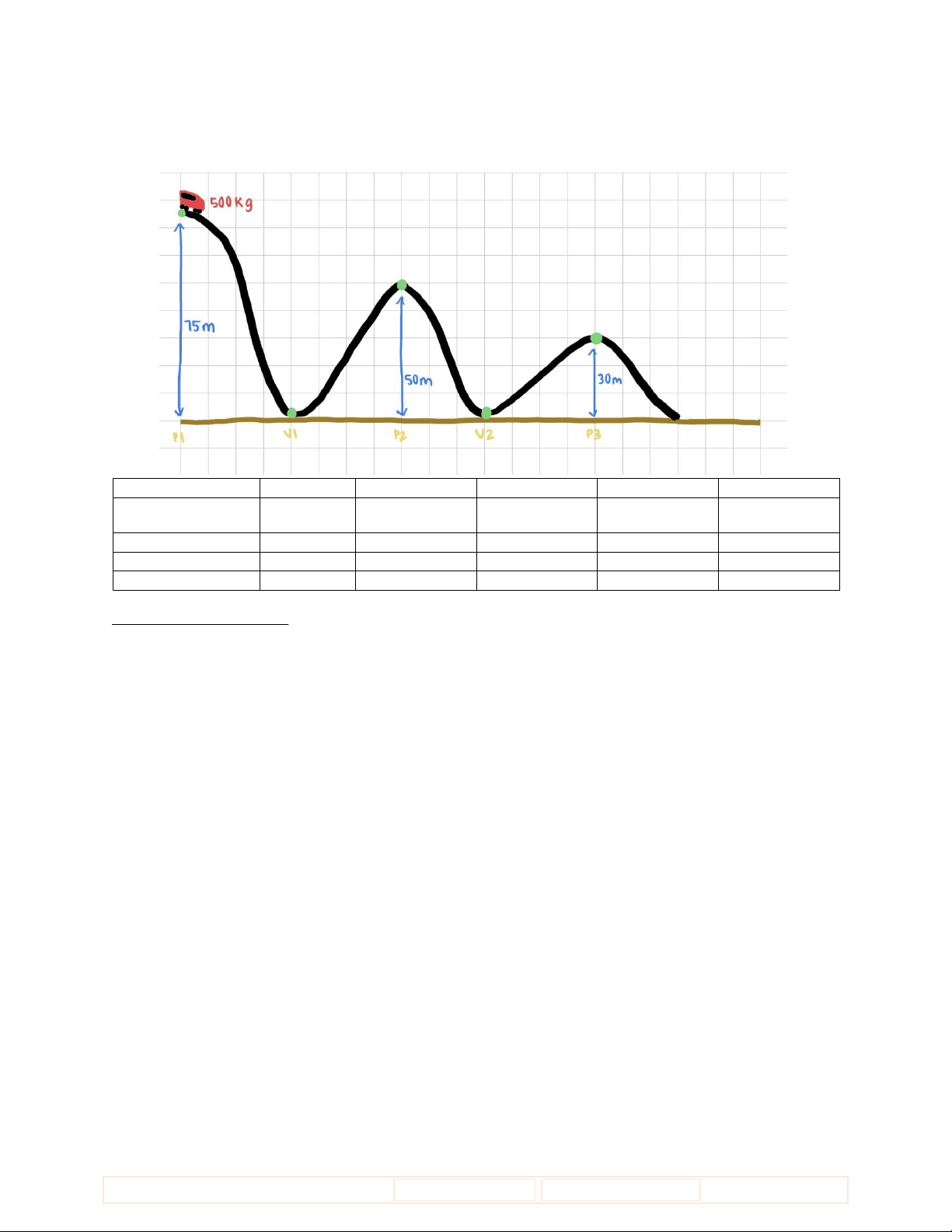
Height P1: 75m V1: 0m P2: 50m V2: 0m P3: 30m Potential Energy
367,500 J 0 J 245,000 J 0 J 147,000 J
Kinetic Energy 0 J 367,500 J 122,500 J 367,500 J 220,500 J Velocity 0 m/s 38.34 m/s 22.14 m/s 38.34 m/s 29.70 m/s Momentum 0 kg m/s 19,170 kg m/s 11,070 kg m/s 19,170 kg m/s 14,850 kg m/s Calculating the Data The total energy remains constant. There is no friction or air resistance. At the launch point, the cart is at rest and all energy is potential energy. So, at this point, potential energy is equal to total energy. We would use the same equation to find the potential energy at each additional valley and peak. PE = mgh PE = 500 kg * 9.8 m/s^2 * 75 m PE = 367,500 J Kinetic energy can be solved by remembering that Total Energy = Potential Energy + Kinetic Energy (TE = PE + KE). Solve for KE by rearranging the equation to KE = TE – PE. Velocity is unknown, but we can solve for it by using the equation MgH = mgh + ½mv^2 where TE = MgH and PE = mgh. The initial velocity is 0 but use the same steps to calculate the additional velocities. At the launch point: 367,500 J = 367,500 J + ½(500 kg)(v^2 ) 367,500 = 367,500 + 250v^2 Subtract 367,500 from both sides. 0 = 250v^2 Divide 250 from both sides. v^2 = 0 Square root both sides. v = 0 m/s Momentum is calculated by multiplying velocity by mass.
Project 3 Energy and
Momentum
Energy Transfers As mentioned before, the total energy is constant. This is a property of the law of conservation of energy. During the roller coaster ride in the cart along the track, energy transforms from potential to kinetic. At the launch point, we start with potential energy. As the cart travels down into the valleys, energy transforms into kinetic. As the cart travels towards the peaks, kinetic energy decreases and potential energy increases. Inelastically Colliding with Another Cart The cart moving along the track (A) collides into another cart sitting still on the flat surface at the end of the track (B). The two carts will stick together and continue down the track together. Momentum is conserved across an inelastic collision, so it will remain the same before and after the collision. Mathematically, the momentum would look like this: Before Collision: Mass * Initial Velocity + Mass * 0 After Collision: 2 * Mass * Final Velocity We can set the momentum before the collision equal to the momentum after the collision to solve for the final velocity. Mvi + M(0) = 2Mvf 500(38.34) + 500(0) = 2(500)(vf) 19,170 = 1,000vf vf = 19.17 m/s The momentum before and after the collision is 19,170 kg m/s. We can solve for kinetic energy using the formula KE = ½mv^2. KE Before Collision: ½(500)(38.34)^2 = 367,488.90 J KE After Collision: ½(500)(19.17)^2 = 91,872.23 J As moving cart A inelastically collides with resting cart B, the kinetic energy drastically decreases because some of it is converted into thermal energy at impact and the two carts are now stuck together.