Download Roller Coaster Physics - Student Exploration Sheet and more Study notes Physics in PDF only on Docsity!
Name: ______________________________________ Date: ________________________
Student Exploration: Roller Coaster Physics
Vocabulary: friction, gravitational potential energy, kinetic energy, momentum, speed
Prior Knowledge Questions (Do these BEFORE using the Gizmo.)
An object’s momentum reflects how easy it is to stop. Objects with greater momentum are harder to stop and can also inflict more damage when they collide with other objects.
- Which do you think has more momentum, a moving car or a moving train? ____________
- The speed of an object is how fast it is moving. Which has more momentum, a car with a
speed of 20 km/h (kilometers per hour) or a car moving at 100 km/h? __________________
- What are the two factors that affect an object’s momentum? _________________________
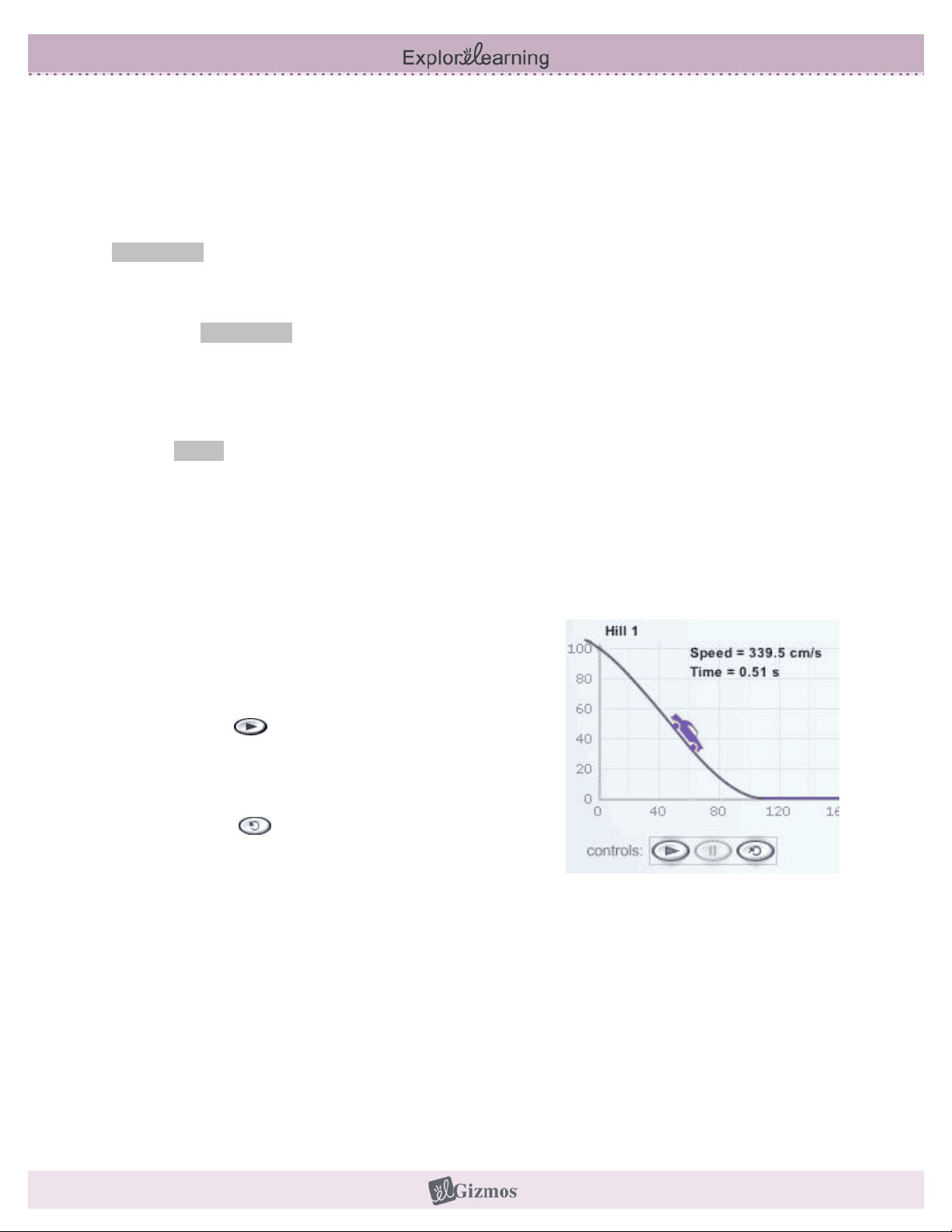
Gizmo Warm-up The Roller Coaster Physics Gizmo™ shows a toy car on a track that leads to an egg. You can change the track or the car. For the first experiment, use the default settings ( Hill 1 = 70 cm, Hill 2 = 0 cm, Hill 3 = 0 cm, 35-g car).
- Press Play ( ) to roll the 35-gram toy car down
the track. Does the car break the egg? _________
- Click Reset ( ). Raise Hill 1 to 100 cm, and click
Play again. Does the car break the egg? _________
- Click Reset. Lower Hill 1 back to 70 cm and select the 50-gram toy car. Click Play. Does
the 50-gram car break the egg? _________
- What factors determine whether the car will break the egg? __________________________
Activity A:
Momentum
Get the Gizmo ready: Click Reset.
Question: What determines whether the egg will break?
- Form hypothesis: Which factor(s) determine whether the car breaks the egg? (Circle one.)
A. The mass of the car only. B. The speed of the car only. C. The mass and speed of the car.
- Collect data: Use the Gizmo to find five situations in which the car breaks the egg, and five in which the car does not break the egg. In each situation, record the mass of the car and the speed of the car when it hits the egg. Include units. Leave the last column blank for now.
Egg breaks Mass Speed
Egg does not break Mass Speed
- Calculate: Momentum ( p ) is calculated by multiplying mass ( m ) by speed ( v ): p = m • v. Label the third column in each table Momentum , and calculate the momentum in each situation. Because mass is measured in grams and speed is measured in centimeters per second, the units of momentum here are grams centimeters per second, or g•cm/s.
- Analyze: Carefully analyze and compare the data in each table.
A. Does the car’s mass alone determine whether the egg breaks? _________________
B. Does the car’s speed alone determine whether the egg breaks? ________________
C. Does the car’s momentum determine whether the egg breaks? _________________
Explain: ____________________________________________________________
- Draw conclusions: What is the minimum momentum required to break the egg? __________
Use the Gizmo to test and refine your answer.
Activity C:
Energy on a roller coaster
Get the Gizmo ready:
Click Reset. Set Hill 1 to 100 cm, and Hill 2 and 3 to 0 cm. Select the 50-g car.
Question: How is energy expressed in a moving roller coaster?
- Observe: Turn on Show graph and select E vs t to see a graph of energy ( E ) versus time. Click Play and observe the graph as the car goes down the track.
Does the total energy of the car change as it goes down the hill? _____________________
- Experiment: The gravitational potential energy ( U ) of a car describes its energy of position. Click Reset. Set Hill 3 to 99 cm. Select the U vs t graph, and click Play.
A. What happens to potential energy as the car goes down the hill? _______________
B. What happens to potential energy as the car goes up the hill? __________________
- Experiment: The kinetic energy ( K ) of a car describes its energy of motion. Click Reset. Select the K vs t (kinetic energy vs. time) graph, and click Play.
A. What happens to kinetic energy as the car goes down the hill? _________________
B. What happens to kinetic energy as the car goes up the hill? ___________________
- Compare: Click Reset. Set Hill 1 to 80 cm, Hill 2 to 60 cm, and Hill 3 to 79 cm. Be sure the 50-g toy car is selected, and press Play. Sketch the U vs t , K vs t , and E vs t graphs below.
- Draw conclusions: Based on the graphs, how are potential energy, kinetic energy, and total energy related to one another?