
Econ 713 Week #5 Discussion: Sequential and Perfect Equilibria, Exams of Microeconomics

The concepts of sequential equilibrium and perfect equilibrium in game theory. Definitions, theorems, and exercises. The authors explore the relationship between sequential equilibrium and subgame perfection, and the existence of perfect equilibria in perturbed games. The document also includes exercises for students to practice finding equilibria in various games.

Typology: Exams

Pre 2010

Uploaded on 09/02/2009

koofers-user-wvc
koofers-user-wvc 🇺🇸

10 documents

1 / 2

Toggle sidebar

This page cannot be seen from the preview

Don't miss anything!

bg1
Econ 713. Discussion. Week #5. 02-23-06
Danqing Hu & Michael Rapp
1 Sequential Equilibrium
De…nition 1 (Sequential Equilibrium) A strategy-beliefs pair ( ; )is a sequential eqiulibrium if
1. is sequentially rational given :
2. is consistent given :
9a sequence of strategy-beliefs pairs k; ksuch that
(a) each kis completely mixed
(b) each kis Bayesian given k, and k; k! (; ):
Theorem 1 Sequential equilibria exist and are subgame perfect.
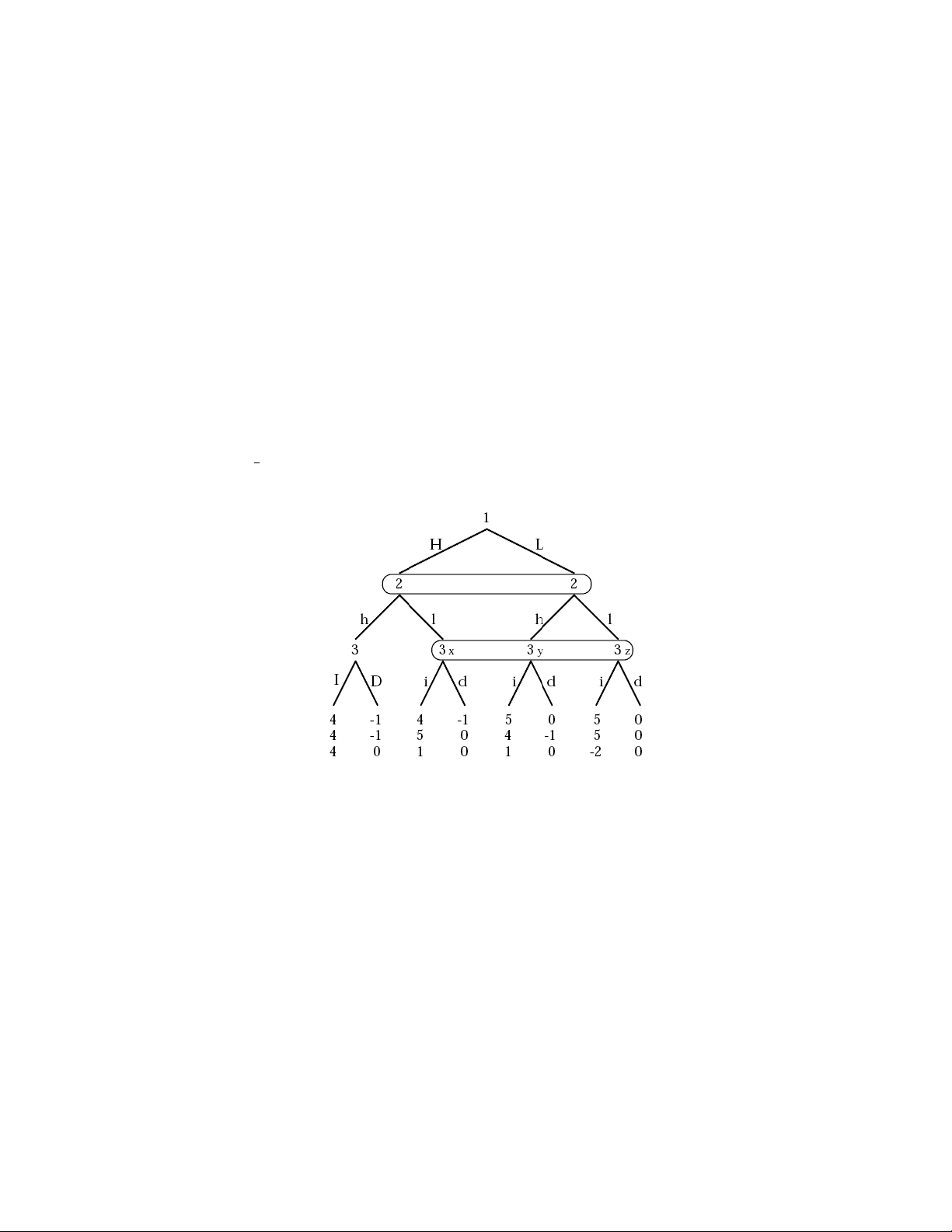
Exercise 1 Last week, we looked for the set of PBE in the game depicted below:We found (L; l; (I; d)) and
H; h; (I ; d) ; (z)1
3. Indicate whether those equilibria are sequential or not.
Entrepreneurs’game
2 Perfect Equilibrium
De…nition 2 (Perturbed Game) For any game Gand 2RjSij
++ , the perturb ed game Gis the game G
with the restriction that each strategy simust be played with probability at least si.
De…nition 3 (Perfect Equilibrium) Pro…le is a perfect equilibrium of Gif there exists a sequence of
k!
0and a sequence of pro…les ksuch that
1. Each kis a Nash equilibrium of Gk;
2. k!
De…nition 4 ("perfect pro…le) For "2R;pro…le is "perfect if it is completely mixed and if si=2
Bi(i))i(si)"
Proposition 2 is a perfect equilibrium if and only if it is the limit of a sequence of "perfect pro…les
with "!0.
1
pf2

Partial preview of the text

Download Econ 713 Week #5 Discussion: Sequential and Perfect Equilibria and more Exams Microeconomics in PDF only on Docsity!

Econ 713. Discussion. Week #5. 02-23-

Danqing Hu & Michael Rapp

1 Sequential Equilibrium

DeÖnition 1 (Sequential Equilibrium) A strategy-beliefs pair (; ) is a sequential eqiulibrium if

  1.  is sequentially rational given :
  2.  is consistent given  : 9 a sequence of strategy-beliefs pairs

k; k

such that

(a) each k^ is completely mixed (b) each k^ is Bayesian given k, and

k; k

Theorem 1 Sequential equilibria exist and are subgame perfect.

Exercise 1 Last week, we looked for the set of PBE in the game depicted below: We found (L; l; (I; d)) and H; h; (I; d) ;  (z)  (^13)

. Indicate whether those equilibria are sequential or not.

Entrepreneursígame

2 Perfect Equilibrium

DeÖnition 2 (Perturbed Game) For any game G and  2 R ++jSi j, the perturbed game G is the game G with the restriction that each strategy si must be played with probability at least si.

DeÖnition 3 (Perfect Equilibrium) ProÖle ^ is a perfect equilibrium of G if there exists a sequence of k^!  0 and a sequence of proÖles k^ such that

  1. Each k^ is a Nash equilibrium of Gk ;
  2. k^! 

DeÖnition 4 ("perfect proÖle) For " 2 R; proÖle  is "perfect if it is completely mixed and if si 2 = Bi (i) ) i (si)  "

Proposition 2 ^ is a perfect equilibrium if and only if it is the limit of a sequence of "perfect proÖles with "! 0.

3 Proper Equilibrium

DeÖnition 5 ("proper proÖles) For " 2 R; proÖle  is "proper if it is completely mixed and if ui (si; i) < ui (s^0 i; i) implies that i (si)  "i (s^0 i).

DeÖnition 6 (Proper equilibrium) ^ is a proper equilibrium if it is the limit of a sequence of "proper proÖles with "! 0.

Remark 3 Proper equilibria are perfect.

4 Exercises

Exercise 2 (From F&T Fig 8.11. page 353) Consider the game depicted below.

  1. Find the subgame perfect equilibria of the game.
  2. Represent the reduced normal form of the game
  3. Find the perfect equilibria of the game.
  4. Find the proper equilibria of the game.

L R

U D

T B

L R

U D

T B

Exercise 1

Exercise 3 (Question 1. Midterm 2004) Let G be a two player normal form game, and let G^0 be another normal form game obtained from G by removing a strictly dominated strategy.

  1. Must G and G^0 have the same perfect equilibria? Prove that they must, or provide an example showing that they need not.
  2. Suppose in addition that G is zero-sum. Must G and G^0 have the same value? Prove that they must, or construct an example showing that they need not.