


Studia grazie alle numerose risorse presenti su Docsity
Guadagna punti aiutando altri studenti oppure acquistali con un piano Premium
Prepara i tuoi esami
Studia grazie alle numerose risorse presenti su Docsity
Prepara i tuoi esami con i documenti condivisi da studenti come te su Docsity
Trova i documenti specifici per gli esami della tua università
Preparati con lezioni e prove svolte basate sui programmi universitari!
Rispondi a reali domande d’esame e scopri la tua preparazione
Riassumi i tuoi documenti, fagli domande, convertili in quiz e mappe concettuali
Studia con prove svolte, tesine e consigli utili
Togliti ogni dubbio leggendo le risposte alle domande fatte da altri studenti come te
Esplora i documenti più scaricati per gli argomenti di studio più popolari
Ottieni i punti per scaricare
Guadagna punti aiutando altri studenti oppure acquistali con un piano Premium
RICERCA IN LINGUA INGLESE DETTAGLIATA CON RELATIVE IMMAGINI SUGLI INDIANI D'AMERICA.
Tipologia: Guide, Progetti e Ricerche
1 / 9
Questa pagina non è visibile nell’anteprima
Non perderti parti importanti!


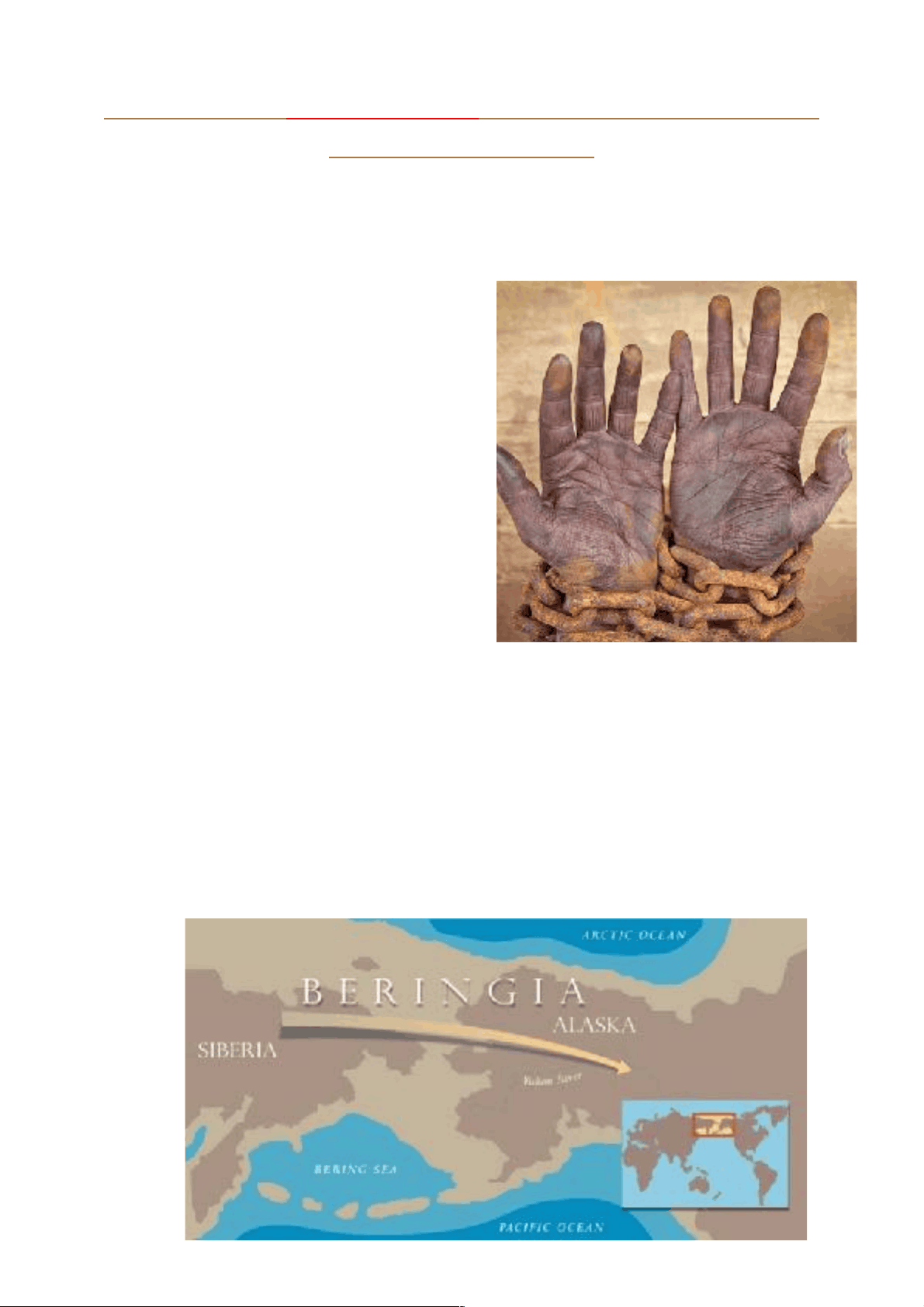
"I would like to remember a Memory, a Memory that I would define ‘covered-up’: I am talking about the extermination of the Native populations of America, the Indians of the Center and South America, the Redskins of the North America and an impressive number of native Africans forced to slavery." "Oh yes, I would like to talk about it because we don't really remember about it and it is rarely spoken of, also because the Western civilization is to blame: France, Portugal and England, first and foremost, but also the Catholic religion and the Pope that, through a series of "Seals" dictat- ed, in that time, the history of the world.” After all the United States, in this historical phase of progressive murkiness of their image to international level and of their increasing socio-economic problems, have little interest to make further bad publicity showing one of the bloodiest premise upon which their actual power has been built. Many centuries ago, in another geologic era, the American continent and the Asian one were not separated from the sea, as it is now between Alaska and Siberia. They were linked instead by a strip of land called Beringia (see below). Today Beringia doesn't exist anymore, it is a submerged land and the line of sea that separates America and Asia is now called Bering Strait. Across that land, the ancestors of the Indians departed from Mongolia 20 thousands years ago and reached America giving rise to the population of the so-called redskins.
To call this population Indians is not correct and the mistake was made by Christopher Columbus: when, in 1492, he reached the coast of the American continent, Columbus was convinced to have reached India, the true destination of his trip. Accordingly, he called the population of that place Indians. When it was clear that, instead of India, he had discovered a new continent, America, by then the mistake was made. The correct name of the population that lived there before the arrival of Columbus and the European conquerors is Native Americans. "Redskin" refers to the color of their complexion and it is as wrong as the term “Indian.” The Indians of America had already understood everything about the slavery to which the “Whites” wanted to submit the world: that is one reason more why they were killed off, because they didn't want to submit to the life imposed by the "pale faces", devoted only to working, without having the time to “dream" and to find wisdom. On the contrary, the Indians showed immediately repudiation and contempt toward the Western dogma of the "working for the whole life": if I don't work I don't eat, if I don't work I don't have the right to living my life, if I don't work I am a parasite for the society. It should be known that the Indians worked only for what it was necessary to survive, and it’s safe to say that they only worked a few hours through the day, the rest of the time was devoted to ac- quiring wisdom, to singing songs, to dancing, to loving, to solitary rides in the grass- land, to the exploration of nature, in short to what we call "leisure time" and of
ern illnesses, for which the Whites were vaccinated, and with the slaughter of bisons, in order to remove their principal source of sustenance, starving the Indians so that they would surrender. The English and the French did everything that was in their power to take possession of the Indians’ territory and, after years of struggles, massacres and bloody wars they suc- ceeded, forcing the Native Americans to live in territories thought on purpose for them and called "Indian reserves”.
The Indian reserves were areas destined to welcome the Indian tribes that the advance of the Whites slowly sent away from the territories of origin. They were the territories that didn't interest the Whites, both because they didn't possess mines to exploit or because they were too arid or cold to allow the Europeans the agriculture or the breeding. The Na- tives, fair and brave, fought for a long time against the white invaders. The reserves became a form of “Lagers” where smallpox-infected covers were given and women were sterilized "to expedite the reso- lution of the Indian matter." Among the most important battles that have marked the history of these people we re- member two of them: