Download Rabbits of New York and more Exercises Natural Resources in PDF only on Docsity!
New York’s Wildlife Resources
An Extension Publication of the Department of Natural Resources, New York State College of Agriculture and Life Science, a Statutory College of the State University at Cornell University, Ithaca, New York
Description
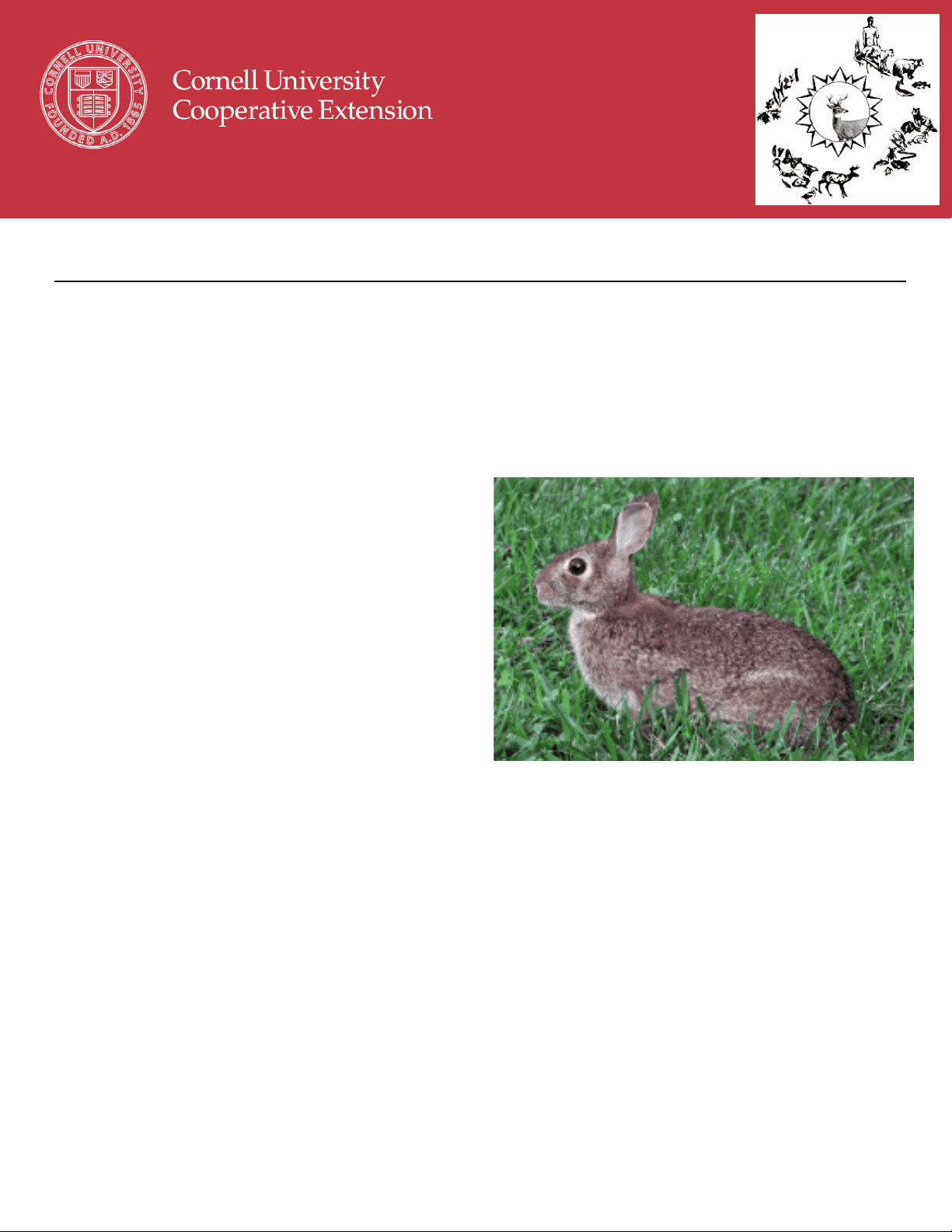
Cottontail rabbits are among the most common of our state’s mammals. Two species of cottontails exist in New York: the eastern cottontail, which was widely in- troduced in the early- to mid-1900s across many north- eastern states, and the New England cottontail, which is native to New York State. The eastern cottontail is common and thrives in fields, farms, and along forest edges, while the New England cottontail does best in dense thicket habitats. As a result of habitat loss and fragmentation, New England cottontails are declining in number, and have been replaced by eastern cottontails in many habitat patches. The characteristic for which the cottontail was named is its short, brown and white, powder puff tail. Only the tail’s undersurface is white, but it is carried such that the brown upper surface usually is not vis- ible. Frequently, all one sees of the rabbit is this spot of white “cotton” as the animal bounds away on an erratic course toward cover. Cottontails have white undersides, but the rest of the pelage (coat) is made up of multiple-colored hairs having brown, black, and tan bars. This gives the cottontail a brown, faintly speckled appearance. Unlike the snowshoe hare—the only rabbit through- out much of the Adirondack park—cottontails remain brown throughout the winter. The snowshoe hare molts in December, its brown fur replaced with a snowy white pelage until mid-April. Dense, long hairs cover the bottom of the hind feet, creating the “snow- shoes” which allow them to travel readily through deep snow.
Rabbits of New York
Eastern cottontail ( Sylvilagus floridanus ), New England cottontail ( Silvilagus transitionalis ), Snowshoe hare ( Lepus americanus ). Written by Kristi L. Sullivan and Megan Hilbert. 2014.*
The cottontail is slight of build compared to the snowshoe hare. Females tend to be a bit larger than the males. The average sizes and weights of the three rabbit and hare species of New York are presented in Table 1. Note that the New England cottontail averages just slightly smaller than the eastern cottontail; howev- er, there is too much overlap between the two to use only size as a distinguishing characteristic. A useful, though not foolproof, field identification feature is the absence or presence of markings on the forehead or between the ears of the rabbits. While the eastern cottontail usually has an oblong white blaze on the forehead (particularly the young), the New England cottontail never has the white blaze, but instead has a faint black patch between the ears; occasionally, some eastern cottontails also have black patches. Positive identification of species can only be made by post-mor- tem examination of their skull dimensions.
Eastern Cottontail
Even though hares and rabbits have large, elongat- ed incisor teeth that are adapted for gnawing, these animals are not classified as rodents. They are instead classified as lagomorphs because of a second pair of smaller incisors located just behind the upper, larger pair. Cottontail rabbits differ from hares in that their young are born naked, blind, and helpless, whereas hares are born fully furred, able to see, and capable of running in just a few hours. Wildlife with such charac- teristics are termed altricial and precocial, respectively.
Distribution and Abundance
Rabbits do not distribute themselves evenly across the landscape, instead concentrating in favorable habitats. They generally spend their entire lives in an area of 0.8-2.8 hectares (2-7 acres). Only occasionally will they move a mile or so from their location, usually driven by lack of food or cover as the seasons change. In suburban areas, cottontail rabbits are numerous and mobile enough to fill the habitats created when other individuals are removed. Although habitat quality can impact distribution, population densities can reach one rabbit per ha (2.5 acres) in optimal habitat. The cottontail is generally abundant throughout New York State, with the exception of the central Adirondack Mountains. The lack of adequate brush or field habitat combined with long, cold winters, makes that area more suitable for the winter-hardy snowshoe
hare.The New England cottontail primarily inhabits the Hudson Valley and possibly the eastern foothills of the Adirondack Mountains. Both species can occur on the same site, but the New England cottontail generally prefers wooded or shrubby areas rather than the more open field habitat of the eastern cottontail. The New England cottontail has disappeared from many histor- ical locations including Warren County, the Catskills, and Long Island. It was last documented in Rensselaer County in the 1960s. Recent surveys suggest that it continues to decline throughout its range due to forest maturation, habitat loss, habitat fragmentation, and competition with eastern cottontails. In New York, it is now limited to a few fragmented populations in Co- lumbia, Dutchess, Putnam and Westchester counties. If current trends continue, the species will likely become extirpated in the state. The New England cottontail has decreased by more than 75% across its entire north- eastern range, and it is a candidate for Federal threat- ened or endangered status.
Life History
–Reproduction
In areas with adequate habitat, the success of rabbits and hares is due in large part to their high reproductive capacity. Typically, mating commences with the first warm days in late February and continues into September. Both the male and female exhibit wild, leaping courtship antics before breeding takes place. Males are promiscuous and do not assist in the care and protection of the young. Gestation lasts 28 days on average and the female frequently mates again the same day after she gives birth. Litter sizes typically range from 3 to 8 offspring, and females produce 3 to 4 litters each breeding sea- son. The altricial young are born hairless and with their eyes closed. The newborn are about 3 to 5cm long and weigh a mere 28 g (1 oz). Young cottontails need pa- rental care and nursing for approximately 20 days after birth. Sexual maturity can occur at three months under ideal habitat conditions. In such cases, females-of-the- year can contribute (via their reproductive efforts) up
Table 1. PHYSICAL DIMENSIONS OF WILD RABBITS IN NEW YORK STATEa
Common name Length from nose to tail Cm (in)
Tail length Cm (in)
Hind foot length Cm (in)
Weight Kg (lbs) Eastern Cottontail 38.0-46.1 (14.8-18.0) 3.0-7.0 (1.2-2.7) 7.7-10.6 (3.0-4.1) 0.8-1.4 (1.8-3.0)
New England Cottontail 36.3-48.3 (14.2-18.8) 3.1-4.9 (1.2-1.9) 9.0-10.2 (3.5-4.0) 0.8-1.3 (1.6-3.0)
Snowshoe Hare 47.0-52.0 (18.3-20.3) 3.6-5.0 (1.4-2.0) 13.5-14.7 (5.3-5.7) 1.4-2.0 (3.1-4.4)
New England Cottontail
–Food and Cover
Rabbits are herbivores—that is, the majority of their diet consists of vegetation. If given a choice, cotton- tails will eat succulent growth such as leaves, stems, shoots, and flowers, rather than dried plants, bark, or twigs. During summer months, goldenrod, timothy, chickweed, clover, alfalfa, sorrel, soybeans, wheat, rye, fallen fruit, and garden crops like lettuce, peas, beans, etc., are sought and eaten by rabbits. With the approach of winter and the disappearance of green, leafy vegetation, cottontails are forced to switch their feeding to the bark and twigs of species such as sumac, white and black oak, dogwood, sassafras, maple, rose, willow, apple, raspberry, and poison ivy. They will also, if necessary, eat moth pupae and carrion. Snowshoe hairs feed on twigs, buds, and bark of woody vege- tation during the winter. In the summer, they prefer herbaceous plants like clovers, grasses, sedges, and ferns, as well as berries, and the twigs and foliage of woody deciduous plants. Rabbits frequently engage in coprophagy—the ingestion of their own feces. This practice allows them to recycle their wastes and utilize nutrients missed in tough, fibrous bark, as well as to obtain vitamins formed by their digestive microorgan- isms. The best times to observe rabbits are the early morning hours and about an hour before and after sun- set. It is during these times that rabbits feed most ac- tively. Snowshoe hares in particular forage most active- ly at dawn. Cottontail rabbits can be seen moving along the fringes of clearings, just a few hops from dense cover. Because the cottontail is most active at dusk and dawn, it is called a “crepuscular” animal. By taking a
quiet stroll along a country lane that has mowed shoul- ders or a walk through a golf course or cemetery during summer, you frequently will be rewarded by sighting a few rabbits. One seldom sees cottontails in the open during the winter months. They seem to realize their increased vulnerability due to the sharp contrast of their brown bodies against the snow. Instead, a person with a sharp eye can pick out a stationary rabbit snugged down in its “form,” which is usually located in brush or beside a hole in the ground. A “form” is a hollow in the vege- tation or snow that offers a little protection from the wind plus the advantage of overhead cover. On sunny winter days, rabbits often can be seen basking in the sun just a few meters from the woodchuck burrows they use as shelters from predators and freezing weather.
–Sign
One does not have to see rabbits to know they are around. Evidence of their feeding on shrubs or seed- lings are cleanly nipped twigs at heights of up to 60 cm (24 in) off the ground or snow. Twigs cut any higher, or with a somewhat jagged appearance, were probably browsed by deer. Tooth marks on trunks of trees or along lower branches at ground or snow level can be identified as rabbit gnawing if they are about 2.0 mm wide, whereas marks about 1.0 mm wide are made by mice. Other evidence of the presence of rabbits is their droppings. Rabbits deposit about 250 to 500 green or brown fecal pellets per day that are about one-half the size of marbles. Rabbits leave very distinctive tracks in snow or soft soil. When hopping, the long hind feet actually come down in front of the smaller front feet so that the tendency for a novice is to follow the tracks backward. The indisputable clue is the location of the claws in the prints. Rabbits are not very vocal. Except for the few mews and soft grunts made at the nest site, the only other vocalization that rabbits give is a plaintive scream when they are injured or extremely frightened. The noise is similar to the sound that can be made by blowing the on exposed edge of a blade of grass squeezed between the sides of each of your thumbs.
Habitat and Management
Rabbits are one of the easiest mammals to manage. When given adequate amounts of quality food and cov- er, rabbit populations flourish. In areas without these requirements, rabbit densities generally are low. As Eastern Cottontail
previously stated, a wide variety of foods are suitable for cottontails, so during the summer, food is usually not a critical concern; however, they need undisturbed cover for nesting sites at this time. As with most wild animals, food and shelter are often the limiting factors of cottontail populations through the winter. Ideally, food and cover should exist on the same site. With just a little effort, existing habitat can be greatly improved. Old field vegetation should not be allowed to grow out of reach of rabbits. Large sumacs, a preferred food, can be lopped over or knocked down. Trees such as gray birch or quaking aspen and crook- ed or forked evergreens make excellent “living brush piles” when they are partially cut through and toppled over. Best results are obtained when several trees are used in a group. Brush left over from logging or firewood cutting makes superb cover when piled at least 1.5 meters ( ft) high and 3 meters (10 ft) in diameter. These shelters are most beneficial and last longer if they are placed near areas of grasses or shrubs and are built on top of old stone fences, dilapidated farm machinery, stumps, or log pieces so that the brush is off the ground where it will not decay as quickly and where there will be spaces underneath the pile. Snowshoe hares require dense stands of young conifers for escape cover during the day, and stands of larger conifers that provide travel corridors between resting and feeding areas. They also need to be close to areas that provide abundant woody browse for food, and prefer deciduous species such as raspberries, ma- ples, birches, aspen, alder, and willow.
Ecological Role
As herbivores, rabbits are primary consumers. Thus, in the natural system the rabbit plays an indispens- able role by converting vegetation into meat protein. Because of the cottontail’s wide distribution and abundance, many predators are dependent upon the availability of rabbits as a food source. In areas with low densities, or during years of poor rabbit survival, predator populations are likely to decrease. In such in- stances, remaining predators must make greater use of other prey species, such as ruffed grouse, woodchuck, voles or mice.
Economic and Social Values
The widespread distribution and abundance of the cottontail has contributed toward making it a favorite of some people and a foe of others. To city or sub- urban dwellers, cottontails are often one of the few wild mammals observable around the yard. For many,
having a rabbit occasionally hop through the lot is a valuable experience. The cottontail rabbit is also an exciting and popu- lar small game animal for novice and veteran hunters alike. For many, few experiences afield can be matched by an afternoon of rabbit hunting with beagles and a couple of close hunting friends. However, the cottontail can also be a major pest to gardeners, homeowners, orchardists, and nurserymen. Rabbits can wreak havoc on leafy garden vegetables such as peas, beans, and lettuce. The bark and twigs of fruit trees and some ornamental shrubs are partic- ularly inviting to rabbits through the winter months. Rabbit damage rarely reaches economic significance in commercial fields or plantations, but there can be exceptions.
Control Methods
Tree nurseries and orchards routinely represent substantial financial investments and wildlife damage can be a serious problem. Control methods must be effective, economical, and, preferably, long lasting. Habitat management frequently meets all these re- quirements. Since rabbits rarely damage orchards out- side of winter, the elimination of dense cover adjacent to and in orchards or nurseries effectively keeps rabbits away. Steps can be taken to manipulate the rabbit’s
habitat by removing brush piles, weed patches, stone piles, and other debris where they live and hide. After breeding season is over, the potential over-wintering rabbit population can be substantially reduced through hunting. If habitat and/or population management is not feasible, exclusion may be the best means of control, especially for gardeners. To be effective, the fence
Snowshoe Hare