


At the beginning of a roller coaster ride, the coaster
car is pulled to the top of the first hill, and released
afterwards. The car accelerates downwards, and the
velocity of the car increases from 0 to maximum
while rolling down on the track due to gravity.
The roller coaster does not get higher than the first hill
if it is not powered by any other source. The highest
position of the car would have the maximum potential
energy.
At the top of the first hill, potential energy is maximum,
and the total mechanical energy would be the same as
potential energy. When there is friction, the total
mechanical energy will be decreased, and the
maximum height reached by the roller coaster would
be less than the height of the first hill. But if there
wasn't any friction, the total mechanical energy would
be conserved. Therefore, the maximum height that the
roller coaster car would go would be the same as the
Name
:
Student Exploration: Roller Coaster Physics
Directions: Follow the instructions to go through the simulation. Respond to the questions and
prompts in the orange boxes.
Vocabulary: friction, gravitational potential energy, kinetic energy, momentum
Prior Knowledge Questions (Do these BEFORE using the Gizmo.)
Sally gets onto the roller coaster car, a bit nervous already. Her heart beats
faster as the car slowly goes up the first long, steep hill.
1. What happens at the beginning of every roller coaster ride?
2. Does the roller coaster ever get higher than the first hill? Explain.
Gizmo Warm-up
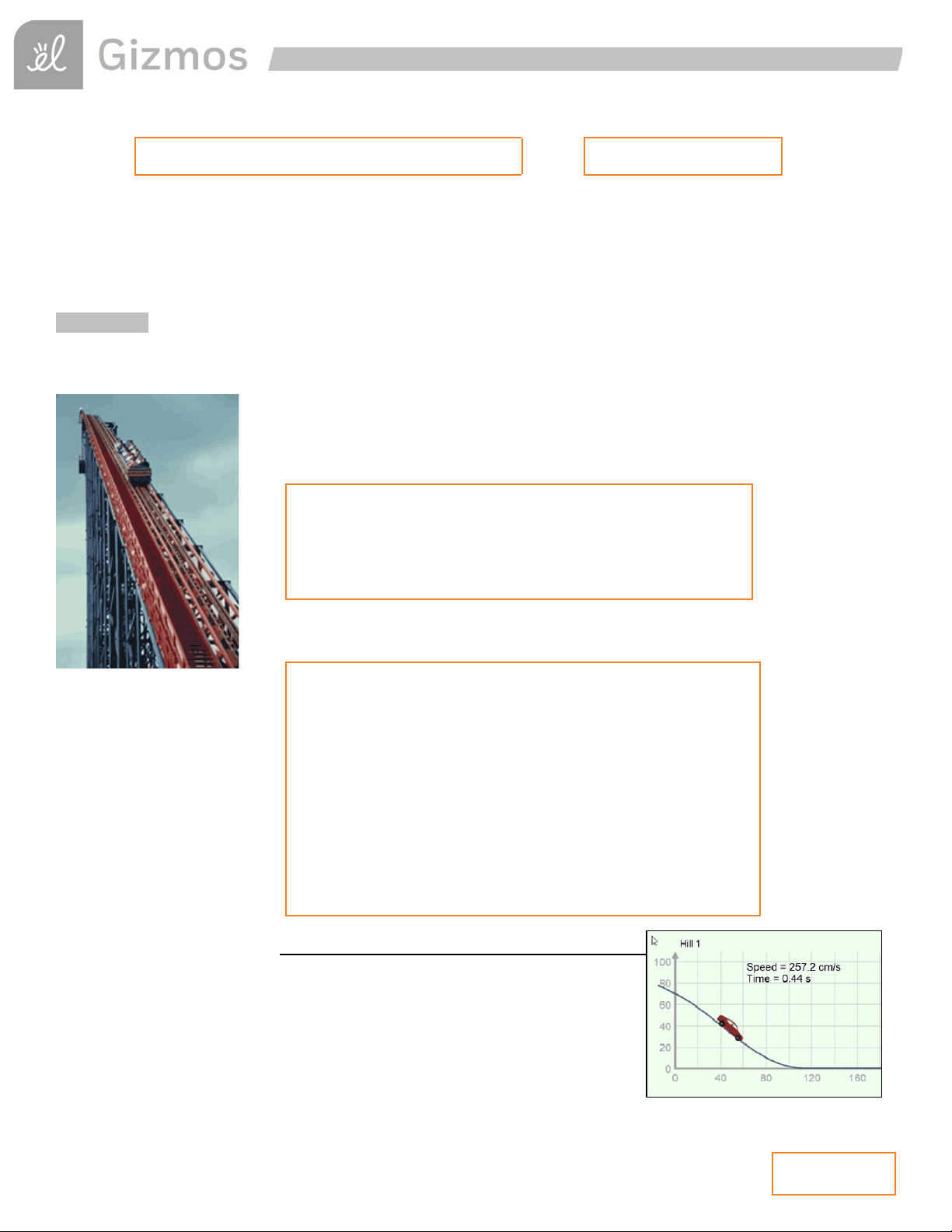
The Roller Coaster Physics Gizmo models a roller coaster with a toy
car on a track that leads to an egg. You can change the track or
the car. For the first experiment, use the default settings (Hill 1 =
70 cm,
Hill 2 = 0 cm, Hill 3 = 0 cm, 35-g car).
No, just
Date:


