
Socio religious reforms, Cheat Sheet of History

This docs is Must for knowledge

Typology: Cheat Sheet

2024/2025

Available from 05/23/2026

tusshar.03
tusshar.03 🇮🇳

2 documents

1 / 5

Toggle sidebar

This page cannot be seen from the preview

Don't miss anything!

bg1
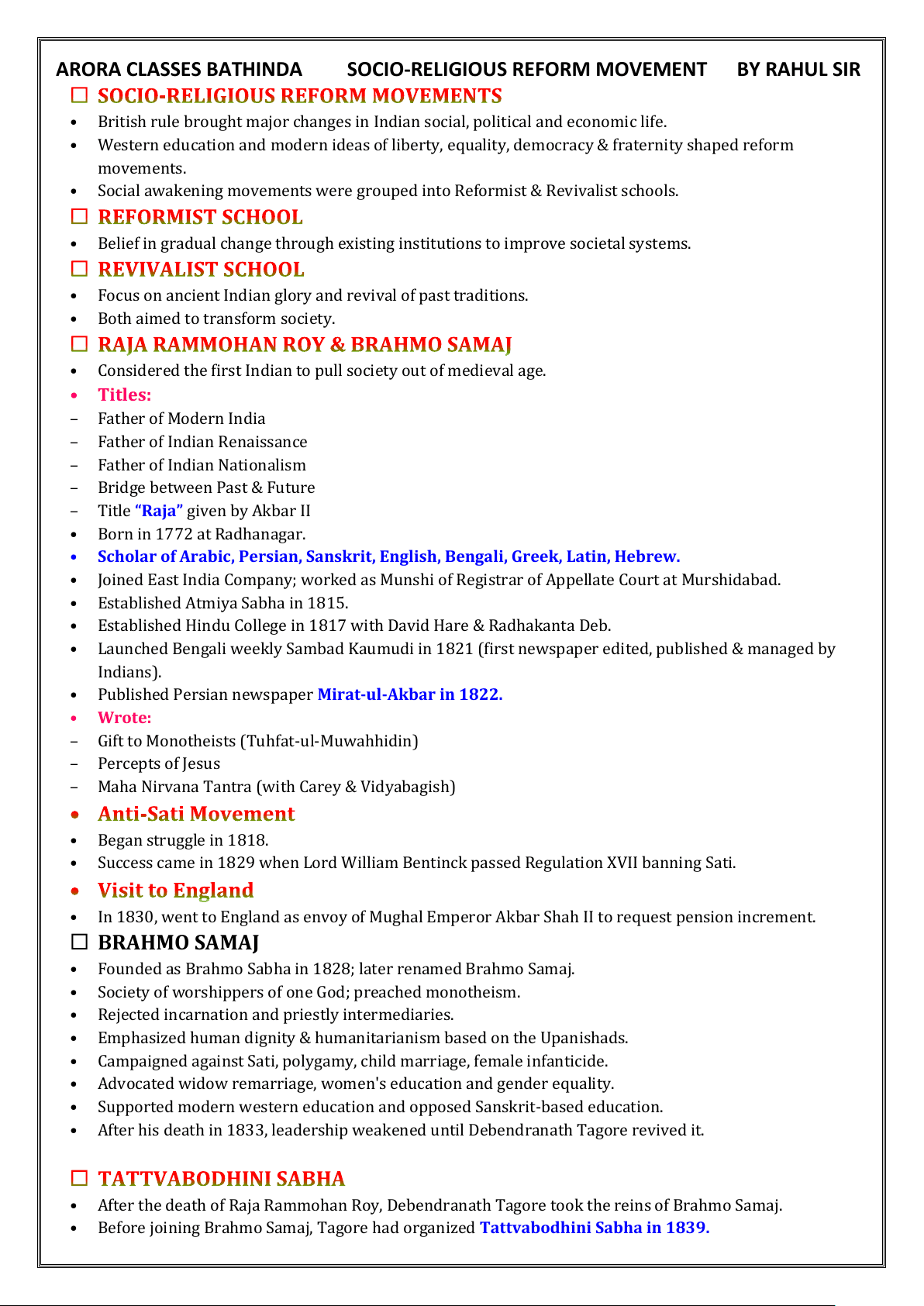
ARORA CLASSES BATHINDA SOCIO-RELIGIOUS REFORM MOVEMENT BY RAHUL SIR
British rule brought major changes in Indian social, political and economic life.
Western education and modern ideas of liberty, equality, democracy & fraternity shaped reform
movements.
Social awakening movements were grouped into Reformist & Revivalist schools.
Belief in gradual change through existing institutions to improve societal systems.
Focus on ancient Indian glory and revival of past traditions.
Both aimed to transform society.
Considered the first Indian to pull society out of medieval age.
Titles:
Father of Modern India
Father of Indian Renaissance
Father of Indian Nationalism
Bridge between Past & Future
Title Raja” given by Akbar II
Born in 1772 at Radhanagar.
Scholar of Arabic, Persian, Sanskrit, English, Bengali, Greek, Latin, Hebrew.
Joined East India Company; worked as Munshi of Registrar of Appellate Court at Murshidabad.
Established Atmiya Sabha in 1815.
Established Hindu College in 1817 with David Hare & Radhakanta Deb.
Launched Bengali weekly Sambad Kaumudi in 1821 (first newspaper edited, published & managed by
Indians).
Published Persian newspaper Mirat-ul-Akbar in 1822.
Wrote:
Gift to Monotheists (Tuhfat-ul-Muwahhidin)
Percepts of Jesus
Maha Nirvana Tantra (with Carey & Vidyabagish)
Began struggle in 1818.
Success came in 1829 when Lord William Bentinck passed Regulation XVII banning Sati.
In 1830, went to England as envoy of Mughal Emperor Akbar Shah II to request pension increment.
BRAHMO SAMAJ
Founded as Brahmo Sabha in 1828; later renamed Brahmo Samaj.
Society of worshippers of one God; preached monotheism.
Rejected incarnation and priestly intermediaries.
Emphasized human dignity & humanitarianism based on the Upanishads.
Campaigned against Sati, polygamy, child marriage, female infanticide.
Advocated widow remarriage, women's education and gender equality.
Supported modern western education and opposed Sanskrit-based education.
After his death in 1833, leadership weakened until Debendranath Tagore revived it.
After the death of Raja Rammohan Roy, Debendranath Tagore took the reins of Brahmo Samaj.
Before joining Brahmo Samaj, Tagore had organized Tattvabodhini Sabha in 1839.
pf3
pf4
pf5

Partial preview of the text

Download Socio religious reforms and more Cheat Sheet History in PDF only on Docsity!

ARORA CLASSES BATHINDA SOCIO-RELIGIOUS REFORM MOVEMENT BY RAHUL SIR

  • British rule brought major changes in Indian social, political and economic life.
  • Western education and modern ideas of liberty, equality, democracy & fraternity shaped reform movements.
  • Social awakening movements were grouped into Reformist & Revivalist schools.
  • Belief in gradual change through existing institutions to improve societal systems.
  • Focus on ancient Indian glory and revival of past traditions.
  • Both aimed to transform society.
  • Considered the first Indian to pull society out of medieval age.

• Titles:

  • Father of Modern India
  • Father of Indian Renaissance
  • Father of Indian Nationalism
  • Bridge between Past & Future
  • Title “Raja” given by Akbar II
  • Born in 1772 at Radhanagar.
  • Scholar of Arabic, Persian, Sanskrit, English, Bengali, Greek, Latin, Hebrew.
  • Joined East India Company; worked as Munshi of Registrar of Appellate Court at Murshidabad.
  • Established Atmiya Sabha in 1815.
  • Established Hindu College in 1817 with David Hare & Radhakanta Deb.
  • Launched Bengali weekly Sambad Kaumudi in 1821 (first newspaper edited, published & managed by Indians).
  • Published Persian newspaper Mirat-ul-Akbar in 1822.
  • Wrote:
  • Gift to Monotheists (Tuhfat-ul-Muwahhidin)
  • Percepts of Jesus
  • Maha Nirvana Tantra (with Carey & Vidyabagish)
  • Began struggle in 1818.
  • Success came in 1829 when Lord William Bentinck passed Regulation XVII banning Sati.
  • In 1830, went to England as envoy of Mughal Emperor Akbar Shah II to request pension increment.

 BRAHMO SAMAJ

  • Founded as Brahmo Sabha in 1828; later renamed Brahmo Samaj.
  • Society of worshippers of one God; preached monotheism.
  • Rejected incarnation and priestly intermediaries.
  • Emphasized human dignity & humanitarianism based on the Upanishads.
  • Campaigned against Sati, polygamy, child marriage, female infanticide.
  • Advocated widow remarriage, women's education and gender equality.
  • Supported modern western education and opposed Sanskrit-based education.
  • After his death in 1833, leadership weakened until Debendranath Tagore revived it.
  • After the death of Raja Rammohan Roy, Debendranath Tagore took the reins of Brahmo Samaj.
  • Before joining Brahmo Samaj, Tagore had organized Tattvabodhini Sabha in 1839.
  • In 1840, Tattvabodhini School was founded, where Akshay Kumar Datta was appointed as a teacher.
  • To propagate its social welfare programmes, Tattvabodhini Sabha published a monthly journal called Tattvabodhini Patrika.
  • Debendranath and his 20 associates formally joined Brahmo Samaj on 21 Dec 1843.
  • He compiled a religious text “Brahmo Dharma” containing spiritual & moral texts from Hindu scriptures.
  • Brahmo Samaj experienced another phase of energy when Keshab Chandra Sen joined in 1857.
  • He founded a small society known as Sangat Sabha to discuss spiritual & social issues.
  • Debendranath made him Acharya of Brahmo Samaj in 1858.
  • In 1861, Keshab launched the journal Indian Mirror.
  • He tried to make Brahmo Samaj an all-India movement.  Ved Samaj established in Madras  Prarthana Samaj established in Maharashtra
  • Keshab’s teachings were too radical; he introduced elements from other religions.
  • Debendranath disagreed and dismissed him in 1865.
  • This caused the split in 1866.
  • Keshab and followers founded Brahmo Samaj of India (Nav Vidhana).
  • Debendranath’s group became Adi Brahmo Samaj.
  • Slogan of Adi Brahmo Samaj: “Brahmoism is Hinduism.”
  • Slogan of Brahmo Samaj of India: “Brahmoism is Catholic & Universal.”
  • Keshab founded Indian Reform Association for western education, women’s emancipation & social work.
  • In 1878, when he married his 13-year-old daughter to the minor king of Cooch Behar, another split occurred.
  • Disgusted followers formed Sadharan Brahmo Samaj, led by Ananda Mohan Bose.
  • Many Brahmo centres were opened afterward.
  • In Punjab, Dayal Singh Trust established Dayal Singh College (1910) to promote Brahmo ideas.
  • Founded by Dr. Atmaram Pandurang in 1867 during Keshab Chandra Sen’s visit to Maharashtra.
  • Related group: Paramahansa Mandali (1849) founded by Dadoba Pandurang & Durgaram.
  • Other members: R.G. Bhandarkar & N.G. Chandavarkar.
  • In 1870, M.G. Ranade joined, giving the Samaj an all-India character.
  • Samaj focused more on social reforms than religious issues.
  • It relied on education & persuasion, not confrontation.
    1. Disapproval of caste system
    2. Women’s education
    3. Widow remarriage
    4. Raising the age of marriage for males & females
  • Founding member of Indian National Congress
  • Helped establish Poona Sarvajanik Sabha
  • Published the Anglo-Marathi newspaper “Indu Prakash”
  • Works: Rise of Maratha Power; Essays on Indian Economics
  • Founded Indian Social Conference
  • Dhondu Keshav Karve & Vishnu Shastri worked with Ranade for reforms.
  • Ranade & Karve launched widow remarriage movement and started Widow’s Home Association.
  • Dhondu Keshav Karve founded India’s first women’s university: SNDT Women’s University (Mumbai).
  • Founded by K. Shridharalu Naidu in 1864 during Keshab Sen’s visit to Madras.
  • Renamed as Brahmo Samaj of Southern India in 1871.
  • Original Name: Narendranath Datta.
  • National Youth Day: 12 January.
  • In 1893, on request of Maharaja Ajit Singh of Khetri, he took the name Vivekananda.
  • Famous for his speech at the World Parliament of Religions (Chicago, 1893).
  • Books: Raja Yoga, Karma Yoga, Jnana Yoga, Bhakti Yoga.
  • Subhash Chandra Bose called him the “Maker of Modern India.”
  • Slogan: “Go Back to Gita.”
  • Quote: “It is an insult to teach religion to a starving man.” A group of westerners led by Madame Blavatsky & Olcott , who were inspired by Indian thoughts & Culture, Founded Theosophical Society in New York in 1875. The founders arrived in India and shifted their headquarters to Adyar, Tamil Nadu. Mrs. Annie Besant joined the Society in 1888. The Society considered Ancient Hinduism as the most profoundly spiritual religion in the world. It aimed to work for universal Brotherhood of Humanity without distinction of Race, Caste, Colour.

In an atmosphere surcharged with proud assertions of the white man’s racial superiority, renowned theosophists proclaimed India’s cultural supremacy. Thus, it gave much-needed self-respect to Indians fighting British colonial rule.

He was bestowed the title of Vidyasagar in 1839 for his mastery over Sanskrit and philosophy. At age 21, he joined Fort William College as the head of the Sanskrit department. Michael Madhusudan gave him the title Dayasagar, ‘Ocean of generosity.’ He served as Principal of Sanskrit College from 1851 to 1858 and strongly believed that everyone, irrespective of caste or gender, had the right to education. He established 20 model schools and 35 schools for girls throughout Bengal. He also introduced Sunday as a weekly holiday and summer vacation in May and June. He is credited with reconstructing the Bengali alphabet. His book Borno Porichoy is still used as the introductory text to learn Bengali alphabet. His works on social reforms include Bahubivah, Balyabivah, Bidhobabivah. It was due to his struggle that the Government of India passed the Widow Remarriage Act in 1856.

In western India, he struggled for the upliftment of lower castes. He belonged to the Mali caste of gardeners. He was influenced by Thomas Paine’s book The Rights of Man and believed that enlightenment of women and lower castes was the only solution to combat social evils. To liberate depressed classes and make them conscious of their rights through education, he founded the Satya Shodhak Samaj in 1873 (Truth Seekers Society). To carry forward his anti-Brahmin activities in an organized manner, he wrote critical works: Ghulamgiri, Sarvajanik Satyadharma Pustak, Life of Shivaji, Tritiya Ratna, Ishara. He was the first to use the term “Dalit” (Broken/Scattered). He was bestowed with the title Mahatma by UK Vandekar. He and his wife Savitribai Phule opened the first school for girls in Pune. Savitribai wrote the famous poem ****Go, Get Education. Savitribai is considered the first female teacher of India and is regarded as the mother of Indian feminism. She set up Balhatya Pratibandhak Griha to prevent female infanticide.

The Parsi social reformer Behramji Malabari founded Seva Sadan along with Dayaram Gidumal. Malabari campaigned against child marriage and enforced widowhood. His efforts led to the Age of Consent Act (1891). He edited the Indian Spectator.