


Study with the several resources on Docsity
Earn points by helping other students or get them with a premium plan
Prepare for your exams
Study with the several resources on Docsity
Earn points to download
Earn points by helping other students or get them with a premium plan
Second exam Material Type: Notes; Professor: Botkin; Class: Western Civilization I; Subject: Humanities & Western Civ; University: University of Kansas; Term: Fall 2010;
Typology: Study notes
1 / 7
This page cannot be seen from the preview
Don't miss anything!


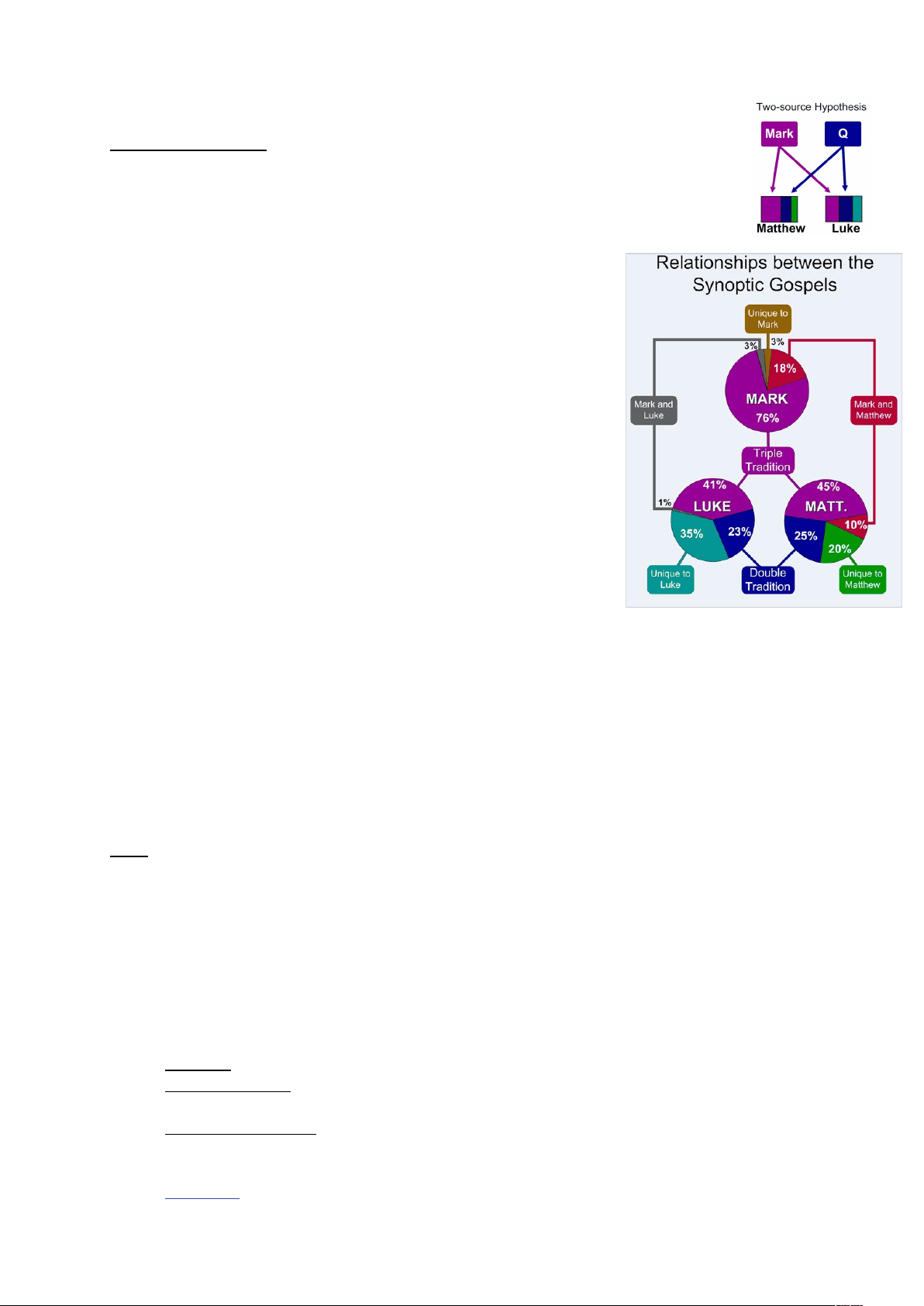
The Gospel of Mark: Parables -talking in parables to teach lessons, they tell an underlying moral or story Q-source - a hypothetical textual source for the gospel of Matthew and gospel of Luke. Q is defined as the “common” material found in Matthew and Luke but not in Mark. This ancient text supposedly contained the quotations of Jesus. Synoptic Gospels- Gospels of Mark, Matthew, Luke; All three stories share the same stories, same sequences, and sometimes the same wording. Because of this there must be some literary independence accounted for. Council of Nicaea/Nicene Creed- The council of Nicaea was the first effort to attain consensus in the church through an assembly representing all of Christendom. They settled the issue of the relationship with Jesus and God the father, and they constructed the first part of the Nicene Creed. The Nicene Creed is to act as a yardstick of correct belief. It was drawn up at times of conflict about doctrine. 325 it explicitly affirms the divinity of Jesus, applying to him the term “God”. The version speaks of the Holy Spirit as worshipped and glorified with the father and the son. Gnosticism- a prominent heretical movement of the 2nd^ century Christian church, partly of pre-Christian origin. Gnostic doctrine taught that the world was created and ruled by a lesser divinity, the demiurge, and that Christ was an emissary of the remote supreme divine being, esoteric knowledge of whom enabled the redemption of the human spirit -Allegorical interpretation of scripture- Eschatology- the study of, or teachings about, the “end times” and/or the future world beyond the end of normal time The doctrine of the Trinity- The father, the son, and the Holy Spirit. “One God, three persons” -Gentiles- target audience Paul: Agape - “Love feasts”, each participant brings food, eaten in the common room, held on Sundays, last supper, shared wine and bread with the faithful, Saul of Tarsus- Paul’s Jewish name when he lived in Cilicia. Changed his name when he was a Roman citizen. Herod- King of Jews in New Testament, heard that there was a new ruler, the birth of Jesus, said that he wanted to meet him so he sent people to fetch him, Maji had a dream that it was a trick and that Herod was going to kill baby Jesus, Joseph’s family moved to Egypt, Herod got pissed and killed every son that was under the age of 2. Epistles- Romans: explained that salvation is offered through the gospel of Jesus Christ. First Corinthians: written to correct the views of the Corinthian church, urging uniformity of belief, and clarifying Christian doctrine. Second Corinthians: he states the importance of forgiving others, and God’s new agreement that comes from the Spirit of the living God (2 Cor. 3:3), and the importance of being a person of Christ and giving generously to God’s people in Jerusalem, and ends with his own experience of how God changed his life
His advice to the people of Corinth- uniformity of belief and expounding Christian doctrine His views on marriage- Paul states that it is better for Christians to remain unmarried, but that it is better to marry than sin. Women in general- they must remain silent (1 Cor. 11:2-16, 14:34-35), and the role of prophecy and speaking tongues in churches Augustine: Manichean dualism and its effects on Augustine’s thought- Manichaeism taught an elaborate cosmology describing the struggle between a good, spiritual world of light, and an evil, material world of darkness. He is concerned with the effect of Manichaeism on his own relationship with God. Manichaeism offered Augustine a way to accommodate his conflicts: he could pursue his career, and retain his partner, while purging his sins through his service to the pure Elect (4.1.1); and he could blame those sins on his lower, alien nature, which like the material world had been made by the power of evil, but which his true self would eventually shed (5.10.18). Manichaeism also responded to his need for the name of Christ, and his initial distaste for the Christian scriptures (3.4.8-6.10). He could regard the Bible as a crude and contaminated attempt at the truth , whereas the Manichaean scriptures offered both the name of Christ and what seemed to be a profound understanding of the universe and of human life (3.6.10). *Neoplatonic ideas in his philosophy- a balance between soul and body. Platonists were the best of philosophers, since they concentrated not merely on the causes of things and the method of acquiring knowledge, but also on the cause of the organized universe as such. *His image of God as it develops throughout his conversion process The problem of evil: How is it possible to explain the profusion and variety of natural and moral evil in a God-created world? (C, 138) -The atheistic Argument:
2) Argument of Efficient Causes: Some things are caused, anything caused is caused by another, and there can’t be an infinite series of causes. So there must be a first cause. This is God. 3) Necessary Being: Every contingent being at some time fails to exist. So if everything were contingent, then at some time there would have been nothing— and so there would be nothing now—which is clearly false. So not everything is contingent. So there is a necessary being. This is God 4) Greatest Being: some things are greater than other. Whatever is great to any degree gets its greatness from that which is the greatest. So there is a greatest being, which is the source of all greatness. This is God 5) Intelligent Designer: many things in the world that lack intelligence act for an end. Whatever acts for an end must be directed by an intelligent being. So the world must have an intelligent designer. This is God. Cosmological argument- is an argument for the new existence of a First Cause to the universe, and by extension is often used as an argument for the existence of an “unconditioned” or “supreme” being, usually then identified as God. Aquinas’ conception of First Cause was the idea that the Universe must have been caused by something that was itself uncaused, which he asserted was God. The Great Chain of Being- a conception of the metaphysical order of the universe in which all beings from the most basic up to the very highest and most perfect being are hierarchically linked to form on interconnected whole. Plants->animals->humans->angels->god **His four types of law
Feudalism- military hierarchy in which a ruler/lord offers mounted fighters a unit of land to control in exchange for a military service. Swearing on the bible or relics of saint’s seals the deal. Pilgrimage- a journey to a place associated with someone or something well known or respected. Thomas Beckett- was appointed archbishop of Canterbury by his friend, King Henry II of England. His allegiance shifted from Henry to the Church. Henry: “Who will rid me of his meddlesome priest?” Becket is murdered by four of Henry’s Knight in 1170 while at the church alter. Score 1 for the church-Becket was canonized and Henry was humiliated. The pilgrims were going to the shrine of him during the Canterbury tales. The Pardoner’s Tale- three guys try to find death because he killed their friend. They come across an old man and asked him where to find death. The old man said that he was trying to find death, but he would not take him. He then says they can find death at the foot of a tree. They go there and find a bag of gold. They decide to steal the bag, but not in the middle of the day. They draw straws for getting food and wine and the youngest brother gets the smallest straw. He goes to town and then two other brothers decided to kill him when he gets back. The youngest brother decides to poison the wine. He comes back they kill him, and then they drink the wine and die a slow death. All three have found death. Wife of Bath’s Tale- a knight in king Arthur’s court rapes a woman. The queen gives him the punishment of finding what women really want, in a one year time period. He asks every woman and they all say something different. The day he comes back to the queen he asks an old hag what women want, she says that she’ll tell him if he promises to giver her whatever she wants whenever she wants. He agrees and she says that women want sovereignty over their husbands. The queen accepts this answer. The old hag declares that she wants to marry the knight, he refuses and then gives in and they get married. In their marriage bed, he declares that he is unhappy because she is ugly. She gives him the choice of her being faithful and ugly or beautiful and unfaithful. He gives the choice to her and she is pleased with that choice so she becomes fair and faithful. They live happily ever after. The end. The Black Death- three different strains of the disease killed 30-50% of the European population between 1348-1353. People questioned the Church, who was supposed to protect them. No one knew the cause, how it was transmitted, but knew to blame the Jews (poisoned the wells), and cats. A cult of death became popular in art. Hundred Years War- England vs. France; Joan of arc heard voices from God and wanted to fight in the war. This inspired France to win. Machiavelli: Qualities of the Renaissance person: A Renaissance man was a man of many Talents: poetry, philosophy, literature, geometry, art, technology, etc. **Distinction between new and existing states and how to acquire them: Significance of owning and understanding the use of arms- V irtú (vs. vir and virtue from first half of the semester)- defined as being successful at one’s chosen activity. Virtue is the ability to harness the fickle fortuna; the ability to seize the opportunities; to minimize the rises; preparedness for actions; occasional rashes and bravery —we can sum it up as possessing the ability and qualities to succeed in the chosen activity. Machiavelli is concerned with practical outcomes. Nature and role of Fortuna- circumstances and opportunities-should inform the decisions of the ruler, a good ruler should be able to take advantage even of the most perilous circumstances. Fortuna is a combination of fate and luck. Be prepared for the worst, hope for the best. *The Medici Family -most powerful family in Florence during the 1400s. Wealth based on textiles and banking.
the center of the universe, demonstrated that the observed motions of celestial objects can be explained without putting Earth at rest in the center of the universe. Galileo’s discoveries (on the moon, the sun, other planets and stars)- The moon- Galileo saw that the light was spread unevenly on the moon and came to the conclusion that there were craters and lunar mountains on it. The Sun- the earth circles around the sun. He was also the first person to observe sunspots. The Stars- he discovered the satellites around Jupiter. Because of the telescope, he could see stars unseen by the naked eye. He argued that the stars that were dimmer in light were farther away from earth than the bright ones. Conflict between Galileo’s theories and the Christian Scripture- The church was about to condemn Copernicus’ work when Galileo talked to the pope. Pope Urban VIII and him were good friends and he admired his work. Urban wanted to be included in his next work and his say on heliocentrism. Galileo put him under a pseudonym, Simplicio. The audiences did not agree with Simplicio’s ideas. Urban did not take this likely and condemned heliocentrism fro “false and contrary to Scripture”. Galileo was called to defend is writings, but was sentenced to house arrest on terms of heresy. His writings were banned and he was not allowed to publish any more of his writings. *His method on trying to reconsolidate the latter two (his message in the Letter to the Grand Duchess )- General Themes: The Good Life o Seneca, Aristotle, Plato, Socrates Faith vs. Scientific Method o Augustine, Aristotle, Plato, Galileo, Aquinas, The Citizen and the ideal State/Government o Augustine, Plato, Luther (?) Nature and the Supernatural o Pico, Aquinas, Fate and Free Will o Relationship between Humans and Gods Mark, Paul, Qur’an, Aquinas, Augustine