Scarica Lingua inglese 1 testi e più Dispense in PDF di Lingua Inglese solo su Docsity!
TEXT 1:
•Text – descriptive, informative
•Physical placement (layout)
•Physical properties of the text (size, font etc)
Image (product, representation, colours etc.)
•Cohesion and coherence
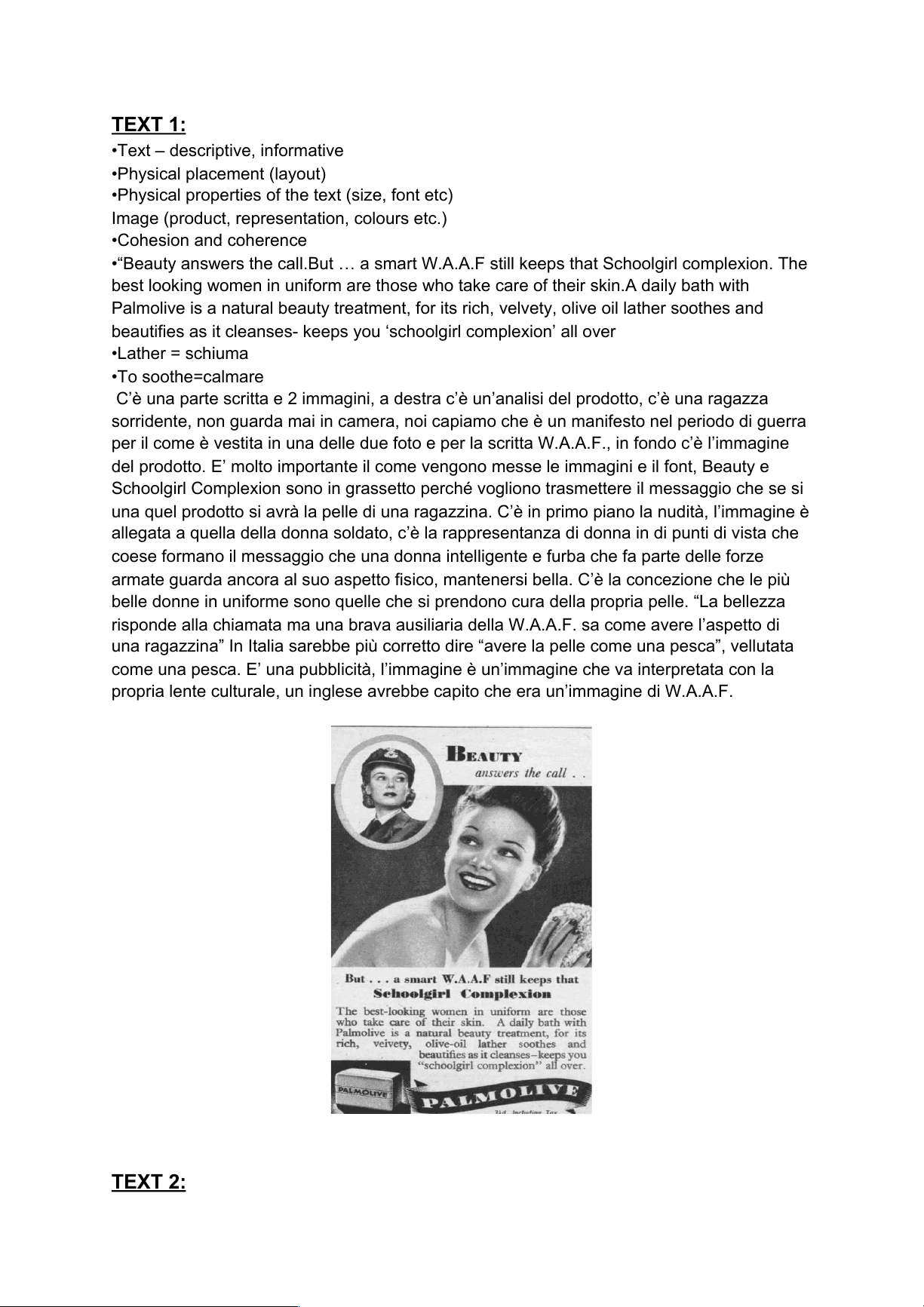
•“Beauty answers the call.But … a smart W.A.A.F still keeps that Schoolgirl complexion. The
best looking women in uniform are those who take care of their skin.A daily bath with
Palmolive is a natural beauty treatment, for its rich, velvety, olive oil lather soothes and
beautifies as it cleanses- keeps you ‘schoolgirl complexion’ all over
•Lather = schiuma
•To soothe=calmare
C’è una parte scritta e 2 immagini, a destra c’è un’analisi del prodotto, c’è una ragazza
sorridente, non guarda mai in camera, noi capiamo che è un manifesto nel periodo di guerra
per il come è vestita in una delle due foto e per la scritta W.A.A.F., in fondo c’è l’immagine
del prodotto. E’ molto importante il come vengono messe le immagini e il font, Beauty e
Schoolgirl Complexion sono in grassetto perché vogliono trasmettere il messaggio che se si
una quel prodotto si avrà la pelle di una ragazzina. C’è in primo piano la nudità, l’immagine è
allegata a quella della donna soldato, c’è la rappresentanza di donna in di punti di vista che
coese formano il messaggio che una donna intelligente e furba che fa parte delle forze
armate guarda ancora al suo aspetto fisico, mantenersi bella. C’è la concezione che le più
belle donne in uniforme sono quelle che si prendono cura della propria pelle. “La bellezza
risponde alla chiamata ma una brava ausiliaria della W.A.A.F. sa come avere l’aspetto di
una ragazzina” In Italia sarebbe più corretto dire “avere la pelle come una pesca”, vellutata
come una pesca. E’ una pubblicità, l’immagine è un’immagine che va interpretata con la
propria lente culturale, un inglese avrebbe capito che era un’immagine di W.A.A.F.
TEXT 2:
Hudson Corporation, based in New Jersey, USA, makes top-of-the – range luggage and
travel accessories. It is a well-known brand name in the USA. Its suitcases and bags are
associated with high quality, traditional design and craftsmanship. Hudson emphasises in its
advertising that its products are ‘made in America’. Recently, the company’s market share in
the USA has decreased. One reason for this has been the increased competition from Asian
companies selling similar products at much lower prices.
- Range of products – ampia gamma di prodotti
- Range of prices – gamma dei prezzi
- Market share – quota del mercato
A few years ago, the management decided to boost sales by entering the European market,
focusing initially on Switzerland, Germany, France and Italy. They set up a branch office and
warehouse facility in Zurich, which would be the base for their European expansion
•To boost sales = incrementare le vendite
•To give a boost to the economy = dare una spinta all’economia
•Boost = lancio pubblicitario
•Booster = promotore
•Branch office = filiale, succursale
•Warehouse = magazzino (bonded warehouse = deposito doganale)
•Data warehouse = database per gestire i dati di un’azienda
TEXT 3: (conversation 1)
Sabra: Hello. Can I speak to Anna, please?
Jan: Who’s speaking?
Sabra: It’s Sabra.
Jan: Hello Sabra. I’m afraid she’s not here.
Sabra: When will she be back?
Jan: About eight o’clock. Can I take (al contrario dell’italiano, che è posso lasciare, è posso
prendere) a message?
Sabra: Please. Can you tell her I can’t come on Friday. Thanks. Bye
Jan: Bye
(E’ una conversazione informale)
(conversation 2)
Caller: Hello. Can I talk to Mrs Sharp, please?
Jan: Speaking.
Caller: Hello. I’m calling about your cooker delivery. They will call tomorrow between seven
and one. Jan: Hold on a moment. I’ll get a pen. So that’s tomorrow, Tuesday, between seven
and one?
Caller: Yes. That’s right.
Jan: That’s fine. Thanks for calling.
(E’ una conversazione di business, il registro infatti è diverso)
TEXT 4:
the project was done before. Positive verb (discover - > action verb); re-evaluating (revaluate
another time). The choice of the verbs is important because it gives a positive addition to the
reader.
There is coherence and cohesion because there is an introduction, then different
paragraphs. Each section refers to a specific topic. The conclusion is about how much you
pay to go there.
There is some digression when the narrator explains the negative and positive aspect, with
the response of Piano design, the comparison to past architecture and also the reference to
how much you pay to go to other skyscrapers across the world
In many cases there is a positive idea with lots of adjectives that emphasize the building
(the tallest, vertical city, symbol of the change, positive addition to the London skyline,
central, special). The only negative idea is about the cost but it’s very short.
There is Intertextuality and cultural bound words like St Thomas Street, London Bridge,
English Heritage, World trade centre. We understand better the text if we know something
about the place.
Repetition , so in this way the word remains in readers’ mind - > spiral, forms, projects, mirror
glass. This creates a kind of sound, rhyme and lets us understand better the text. There is
also the alliteration that is the repetition of the S for example skyline, skyscraper, Shard.
Some idioms like London feel (sapore di Londra antica) and the idea of noise
( onomatopoeia ) like with the rumble of trains
( Traduzione 1 Paragrafo : “Cammina lungo St Thomas Street vicino alla stazione del London Bridge (underground) e scoprirai perché alcune persone credono che questa parte della Londra centrale sia così speciale. A pochi secondi dal Tamigi e alcuni minuti a piedi dalla City, questa strada ci dà una sensazione di vecchia Londra. C’è un pub tradizionale, il rumore dei treni, bar di famiglia che vende tutto il giorno dei cibi fritti d’asporto e la palestra di box dietro l’angolo. Poi guardi in alto e nuova Londra riempie completamente lo skyline. 2 Paragrafo: The Shard, l’edificio più alto nell’Europa occidentale, è una torre di vetro che fa specchio a forma di cono descritto dal suo costruttore come una città verticale e ora simbolo del cambiamento che sta avvenendo nell’area attorno il London Bridge. The Shard (significa coccio, frammento, aveva accezione negative), anche chiamato The Shard of Glass, frammento del London Bridge e ancora prima London Bridge towe, è un grattacielo a Londra di 87 piani 3 Paragrafo (structure): The Shard è una struttura di 1.016 piedi e 1.3 square feet di spazio interno che conterrà un hotel a 5 stelle, ristoranti, 10 appartamenti di lusso e uffici. Renzo Piano, l’architetto italiano che ha curato il progetto, ha disegnato lo Shard come una scultura a spirale che sembra emergere dal fiume Tamigi 4 Paragrafo: Il progetto di Piano ha scatenato delle critiche da English Heritage (che cura i beni artistici) che affermò che quest’edificio sarebbe stato un frammento di vetro nel cuore della Londra storica, dando all’edificio il suo nome, The Shard. Piano considerò questa forma a spirale slanciata
della torre come un’aggiunta positiva allo skyline di Londra, perché ricordavano le guglie delle chiese che possiamo ritrovare nelle stampe storiche della città, e credette che la sua presenza sarebbe stata molto più delicata (si sarebbe notata meno) di quanto gli oppositori del progetto sostenevano. Propose un uso sofisticato del glazing(lavorazione del vetro - > termine tecnico) con facciate fatte da pannelli di vetro angolari particolari intese per riflettere la luce del sole e il cielo sopra, cosicché la forma dell’edificio sarebbe potuta cambiare a seconda del tempo e delle stagioni. L’edificio è caratterizzato da 11.000 pannelli di vetro con una superficie di area in totale di 56.000 metri quadri 5 Paragrafo: A seguito della distruzione del World Trade Center negli attacchi terroristici dell’ settembre 2001, gli architetti e gli ingegneri strutturali in tutto il mondo iniziarono a rivalutare il design di strutture così alte. E così fece Londra. 6 Paragrafo: La costruzione iniziò a maggio del 2008 ed è stata completata nel suo esterno a luglio 2012, giusto in tempo per le Olimpiadi a Londra. La galleria tramite la quale è possibile vedere al di fuori e il ponte di osservazione dello Shard che si trova al 72esimo piano fu aperto al pubblico nel febbraio 2013. 7 Paragrafo: Quando la giornata è limpida, si pensa che i visitatori dello Shard possano vedere la Francia. Ma nonostante queste viste panoramiche offerte scalando l’edificio più alto in Europa, costa meno rispetto agli altri grattacieli del mondo (posto molto costoso). Infatti, alcuni visitatori alla torre di acciaio e vetro si sono sentiti dispiaciuti (risentiti) dal costo di ammissione pesante (costoso). Gli adulti devono pagare 29.95 sterline per accedere; troppo per quanto guadagna una persona media per una vista su Londra.)
VOCABULARY:
MINIMAL TEXTS = significa poche parole, alcuni casi
- keep of the grass (significa che bisogna camminare al di fuori del prato, ha un
significato più grande deducibile da poche parole lo stesso vale per tutti gli altri
minimale texts)
- keep the left
- keep out
- danger
- exit
They are complete in terms of communicative meaning
Text= a stretch of language complete in itself
Grand – imponente grandioso: a grand palace, in grand style, the grand staircase of a
building, the Grand Canyon, a grand idea, grand final (finalissima)
TRANSCRIPTION OF THE FINANCIAL TIMES VIDEO:
The Shard, London’s newest skyscraper and tallest building in western Europe, has opened
its doors to the public.
Construction may still be finished below, but 244 meters above the hustle and bustle a
serene 360 degree viewing gallery offers visitors a view of the city previously only possible
from aircraft.
The V&A’s collection of Japanese art and design is one of the largest in Britain. It includes
ceramics, lacquer, arms and armour, woodwork, metalwork, textiles and dress, prints,
paintings and sculpture. An active programme of acquiring modern and
contemporary studio crafts has resulted in the V&A having one of the most prestigious
holdings of this material outside Japan.
Lacquer = lacca giapponese
Arms and armour = armi e armature
Craft = arte manuale
Holdings = dotazione (to hold = tenere, contenere)
The V&A’s collection of ukiyo-e is one of the largest and finest in the world, with over 25,
prints, paintings, drawings and books. Ukiyo-e means ‘Pictures of the Floating World’.
Images of everyday Japan, mass-produced for popular consumption in the Edo period
(1615-1868), they represent one of the highpoints of Japanese cultural achievement.
Popular themes include famous beauties and well-known actors, renowned landscapes,
heroic tales and folk stories.
Drawings = disegni (to draw); drawing room = salotto
Renowned = rinomato
The art of ukiyo-e is most frequently associated with colour woodblock prints, popular in
Japan from their development in 1765 until the closing decades of the Meiji period (1868-
1912). The earliest prints were simple black and white prints taken from a single block.
Sometimes these prints were coloured by hand, but this process was expensive
Woodblock = a piece of wood on which a pattern is cut which is used
for printing (xilografia)
Woodcarving = intaglio
Wood engraving = incisione su legno
Woodcut = a picture printed from a pattern which has been cut in the
surface of a block of wood
In the 1740s, additional woodblocks were used to print the colours pink and green, but it
wasn’t until 1765 that the technique of using multiple colour woodblocks was perfected. The
glorious full colour prints that resulted were known as nishiki-e or ‘brocade pictures’.
Brocade = broccato
Prints could be produced quite cheaply and in large numbers. While only the wealthy could
afford paintings by the artists of the day, ukiyo-e prints were enjoyed by a much wider
audience. The subjects depicted in these prints reflect the interests and aspirations
of the people who bought them.
‘Pictures of the Floating World’, the literal translation of ukiyo-e, refers to the licensed brothel
and theatre districts of Japan’s major cities during the Edo period. Inhabited by prostitutes
and Kabuki actors, these were the playgrounds of the newly wealthy merchant class.
Despite their low status in the strict social hierarchy of the time, actors and courtesans (high-
class prostitutes) became the style icons of their day. Their fashions spread to the general
populace via inexpensive woodblock prints.
Playground = terreno di gioco; campo da gioco; area di svago
Newly = avv. Di recente; da poco
A newly discovered species
Populace = plebe
It is an informative and descriptive text about this museum that is in London, The Victoria
and Albert Museum. It is vivid because we get the idea of it and just by reading the text, I
can visualize the different objects. This because it is full of adjectives and there is a very
detailed description. In my opinion the possible readers of this text could be tourists that find
it on Google or in a magazine, or students like me that study it for an exam.
The text can be divided into 6 paragraphs:
The first paragraph explains that is the world’s largest museum of decorative arts and
design, housing a permanent collection of over 4.5 million objects. It was founded and
named after Queen Victoria and Prince Albert. It is split into 4 collections departments
The second paragraph tells us that is the one of the largest collections of Japanese art and
design in Britain. It includes ceramics, arms, woodwork, metalwork, textiles and dress, prints,
paintings, and sculpture. It can be regarded as one of the most prestigious holdings of this
material outside Japan.
The third paragraph says that is the V&A’s collection of ukiyo-e is one of the finest in the
world with 25.000 prints, books and paintings. Data is important because it makes us
visualize the objects. Ukiyo-e are images of everyday life in Japan of the Edo period.
Popular themes include well-known actors, landscapes or heroic tales.
The fourth paragraph says how ukiyo are made with woodblock prints. The earliest prints
were in black and white. Sometimes these prints were coloured by hand, but this process
was expensive. Then additional woodblocks were used to print the colours pink and green.
Finally, the technique of using multiple colour woodblocks was perfected and the full colour
prints that resulted were known as ‘brocade pictures’.
The fifth says that prints were cheaper and could be produced in large numbers than the
paintings. The subjects represented the interests of the people who bought them.
The last tells us that the representation was mainly about the kabuki actors and the
prostitutes
Words are simple like painting, prints, artist, collection while others are a bit technical like
ukiyo-e, brocade pictures, woodblock that is a piece of wood on which a pattern is cut which
is used for printing, lacquer, icons, subjects, populace. Like I said at the beginning, it is a
detailed description with lots of adjectives like: largest, permanent, prestigious, modern,
contemporary, glorious, wealthy, renowned. There are different types of nouns: collective
stampe ukiyo-e potevano essere acquistate da un’audience molto più ampio. I soggetti dipinti in queste stampe riflettono gli interessi e le aspirazioni delle persone che li compravano
- I dipinti del mondo fluttuante, la traduzione letterale di ukiyo-e, si riferiscono ai bordelli e ai distretti del teatro delle maggiori città giapponesi durante il periodo Edo. Abitati da prostitute e attori Kabuki erano l’area di gioco della recente (si era formata da poco) benestante classe di mercanti. Nonostante il loro stato basso nella stretta gerarchia sociale del tempo, attori e cortigiane (prostitute di alta classe) divennero le icone di stile del loro tempo. Le loro mode si propagavano alla plebe attraverso queste stampe che non costavano troppo e che erano fatte di questi blocchi di legno)
TEXT 6:
The Guardian, Friday Jan 24, 2020 'To Meghan Markle' is now a verb – here's how to use it You too can preserve your own mental wellbeing by bailing from an environment that doesn’t value you – Sussex-style! You could understand why Meghan Markle, who opted out of royalty this month after a year of being hounded and vilified by a racist, rightwing press could be referred to in some circles as the patron saint of good mental health. To bail = ottenere la libertà provvisoria Opt out clause = clausola di ritiro (chiamarsi fuori) To hound = cacciare (con segugi) That’s probably why the term “to Meghan Markle” was created this week: “Meghan Markle, a verb, past tense - Meghan Markled: to value yourself and your mental health enough to up and leave a room/situation/ environment in which your authentic self is not welcomed or wanted.” Why shouldn’t a word be made for a person who not only realizes when love is not returned, but when to get the hell out? If you aspire to Meghan Markle it in 2020, here’s how. Meghan Markling when going out To “Meghan Markle it” is an ode to self-respect, a sermon to owning one’s own boundaries, especially when it involves alcohol. Do say: “Man, when I go out tonight, I am so going to Meghan Markle it,” before going home early, getting eight hours sleep and not texting your ex. Don’t say: “I don’t care about Meghan Markling it, I am going to dance on a table before texting my ex with some Beyoncé lyrics.” Meghan Markling in relationships On the matter of exes: the next time you get sent a text saying “U up?” at 3am from a deadbeat who has ignored you for weeks, you need to Meghan Markle it.
Obviously most people can’t just move to Canada to become an uber-influencer. But you could consider whether said love interest really respects you, and if not, how to leave them behind. Do say: “I totally Meghan Markled my ex last night and never returned his texts.” Don’t say: “I’m not going to Meghan Markle this time: they didn’t get back to my last 30 calls, but I think they have been really busy, to be fair?” Meghan Markling it at work This one is slightly counterintuitive, because part of Harry and Meghan’s problem with royalty was that they didn’t have to work. But for the rest of us, Meghan Markling it at work looks like understanding what an asset you are, and leaving a company when that is not appreciated. Do say: “I’m considering Meghan Markling: they haven’t given me a raise in two years, and I’d have better options working as an Instagram influencer than staying in this loveless work marriage.” Don’t say: “I’ll Meghan Markle it when I finally have time to update my LinkedIn, which is never.” So basically to Meghan Markle means someone who wants to escape from their life.
TEXT 7:
The opening is a sentence generally used in a court and this gives the readers the idea that they’ll have to judge someone or something. In this text there are many difficult words, which are legal words. In the text there is the number of suspects, the number of people coming to England from other countries, claiming asylum, so the text is about migrants. The suspects refused to answer the police questions, they curbed their right to silence. Michael Howard, we can guess he’s a politician, wanted to prevent people that entered the country without the right to ask for political asylum. “Both these reforms” (at the beginning of the second paragraph) were enacted after libertarians’ protests because they wanted these reforms to be more restrictive.
are described as “gentle, trusting children of nature”, so there are two positive adjectives next to “children of nature” that have a negative connotation, it means someone savage. There is the idea that they're not civilized because they're not settled, so left alone, they would have destroyed themselves and disappeared. The writer wants to convince the reader, they use the word inevitable to justify what happened. This article is not neutral, therefore it’s written for very conservative English people who think there’s still a strong connection with Australia. Down Under: reference to Australia and New Zealand’s position on the maps from the perspective of England to tear out their hearts = strapparsi il cuore Aussies = Australians Poms = prisoners of mother England → Britains (ironical term) Abos = aboriginals ancient Brits = abitanti della Britannia (periodo prima dei Romani) to tame = addomesticare bloody-minded = very stubborn or someone who’s very individualist
TEXT 9:
Kamala Harris accepted her place in history on Saturday night with a speech honoring the women who she said “paved the way for this moment tonight”, when the daughter of Jamaican and Indian immigrants would stand before the nation as the vice-president-elect of the United States. With her ascension to the nation’s second highest office, Harris, 56, will become the first woman and the first woman of color to be elected vice-president, a reality that shaped her speech and brought tears to the eyes of many women and girls watching from the hoods of their cars that had gathered in the parking lot of a convention center in Wilmington, Delaware. Wearing an all-white pantsuit, in an apparent tribute to the suffragists who fought for a woman’s right to vote, Harris smiled, exultant, as she waved from the podium waiting for the blare of car horns and cheers to subside. Joe Biden, the president-elect, would speak next. But this was a moment all her own. She began her remarks with a tribute to the legacy of the late congressman and civil rights activist John Lewis. “Protecting our democracy takes struggle,” Harris said, speaking from a stage outside the Chase Center on the Riverfront in Wilmington. “It takes sacrifice. But there is joy in it. And there is progress. Because we, the people, have the power to build a better future.” With Harris poised to become the highest-ranking woman in the history of American government, this milestone marks the extraordinary arc of a political career that has broken racial and gender barriers at nearly every turn. As a prosecutor, she rose to become the first Black female attorney general of California. When she was elected to the Senate in 2016, she became only the second Black woman in history to serve in the chamber. In her remarks, Harris paid tribute to the women across the country – and throughout history – who made this moment possible.
“I reflect on their struggle, their determination and the strength of their vision, to see what can be, unburdened by what has been,” she said. “I stand on their shoulders.” She specifically honored the contributions of Black women to the struggle for suffrage, equality and civil rights – leaders who are “too often overlooked, but so often prove that they are the backbone of our democracy”. the blare of car horns = rumore dei clacson to subside = abbassarsi poised = pronta at nearly every turn = ad ogni passo (della sua carriera politica) prosecutor = pubblico ministero attorney general = procuratore generale unburdened = liberata (da un peso) “I stand on their shoulders” = she symbolizes every woman backbone = (in questo cas9 è una metafora) la colonna portante della democrazia overlooked = sottostimato
TEXT 10:
The text is about pollution and what people should do in order to reduce it. The writer’s purpose is convincing and persuading people to use bikes instead of cars to live in a less polluted city. The writer included a fact in the text, which is at the beginning of the paragraph, from “Last year…” to “...own car to work”.
TEXT 13:
The paragraph talks about smartphones and the Internet. It is mostly comparing and we can see it because of the use of some words or expressions, such as likewise , or they both allow…
TEXT 14:
It is an informative text. fake news = when you create a news about something or someone which is fake to have a critical eye to lookout for = essere in allerta telltale signs = indizi rivelatori fact-checking charity Full Fact = associazione a scopo benefico che controlla ciò che sono i reali fatti e ciò che è fake doctored photo = foto ritoccate hoaxers = qualcuno che fa degli scherzi
Fake News Glossary: Top Keywords To Know ALGORITHM: a set of rules that are programmed to solve a problem. On social media, algorithms analyse your online habits to sort content in a user’s feed by how important they think the story is to you. BIAS: if a news piece has bias, it may only support a certain argument and not show fairness to different sides of the story. This can make the viewer think one point of view is more important than the other. CONTEXT: the circumstances or background surrounding an event or story. The context is important as it can help you fully understand the many possible reasons as to why something happened. CLICKBAIT: eye-catching but misleading headlines, trying to get people to click on websites to make views or money. These could have lots of exclamation marks, dramatic photographs, or phrases like “Best Ever!”
DISINFORMATION: a type of fake news that deliberately attempts to mislead using material that the deceiver knows is untrue. Disinformation is designed to be widely shared, often to persuade people to think a certain way, vote a certain way or to make money from advertising each time someone clicks on a story. ECHOCHAMBER: a space where all the ideas and opinions reflect our own. We might not even realise we’re in one, which can be harmful as our view of the world might seem balanced but is actually one-sided. FILTER BUBBLE : how algorithms fill your social media feed with posts they think will interest you. This can create an echo chamber which reinforces what you already think,rather than giving new information. FAKE NEWS: a popular and informal term, which many politicians and activists have used as an insult to their opponents or a way to dismiss stories that they don't like – no matter whether they're factual or not. HOAX: a trick meant to deceive; like a practical joke but far more serious. Someone could publish that they have found a cure for coronavirus made out of dandelions, which could turn out to be a totally false hoax. IMPARTIAL: to have a fair point of view that doesn’t favour one argument over another. No-one likes it when journalists seem to have a favourite politician or party; reporting the facts should always be unbiased. MISINFORMATION: a type of fake news that describes bad information; false, misleading or out of context, regardless of the motivation behind it. This is different to disinformation, which is intended to mislead. OPINION : how you feel and what you think about things. When looking at the news, it's important to understand if you are reading or seeing someone's opinion or a journalist reporting on the facts. PARODY/SATIRE: comical ways of looking at serious information, often through imitation, exaggeration or irony. Sometimes people can share these jokes as if they are real, which can generate fake news. RELIABILITY : how trustworthy something is. When asking about the reliability of a news story, you might ask if it was written by a journalist from an organisation that you have heard of before. SOURCE: the beginning or starting place; for a news story, it’s the journalist who first wrote the piece. It's important to check the source of a story so you can decide if it is true and based on facts or just their opinion. TRUST: a belief in the truth of a person or thing. It’s important to establish trust between people and the places you get your information from so you can feel confident it is correct when forming your opinion. UNBIASED: information that doesn’t take an opinionated stance and presents both sides of an argument. VERIFICATION: checking something authentic and where it has come from. If an account shows that it is verified (like displaying bluetick), then it is real - but this doesn't mean everything they say will be true.