




1
ASTR1030, Accelerated Solar System
Astronomy
Midterm 2 Study Sheet
I. PHYSICS
1. Energy and Power
•Energy is defined as the ability to do work.
•Power is the rate of energy use, e. g. the amount of energy
used in a period of time.
2. Units
• 1 calorie is the amount of energy it takes to raise one gram
of water by 1oC.
• 1 joule (~1/4 of a calorie) is the standard MKS unit
favored by science.
• 1 Watt is a joule/s.
3. Types of Energy:
•Kinetic Energy is the energy from motion.
•Potential Energy is stored energy that can be converted
(gravitational, chemical, electrical).
•Radiative Energy is energy carried by light.
•Thermal Energy is a type kinetic energy called heat.
4. Heat Versus Temperature:
•Temperature is the measure of the average kinetic energy
of a particle within a object.
• Thermal Energy, or heat, is the total kinetic energy in an
object.
5. Mass is Energy:
• Matter contains a tremendous amount of energy.
• This matter to energy conversion can explain the energy
output of the sun and other stars.
• Converting matter to energy on Earth in a controlled fash-
ion, however, is very difficult.
6. Basic Physics: States of Matter
•Solid: At low enough temperature (below 0 oC for water),
individual molecules have very little kinetic energy. They
can thus bond tightly to their neighbors to form a solid.
•Liquid: As the kinetic energy of the molecules increases
(they move faster), they can break the bonds to the nearest
neighbor, yet still remain tightly packed (incompressible).
•Gas: At even higher temperatures (above 100 oC for
water), the molecules no longer stay together (evapora-
tion). All bonding between molecules is gone.
•Plasma: At extremely high temperatures (greater than
~5000 oC), the molecules dissociate and ionize. The mate-
rial is now freely moving electrons and ions.
II. KEPLER’S LAWS
(See Midterm 1 Study Sheet)
III. NEWTON’S LAWS: MOTION & GRAVITY
(See Midterm 1 Study Sheet)
IV. NEWTON’S FORM OF KEPLER’S 3RD LAW
(See Midterm 1 Study Sheet)
V. LIGHT
1. Light is a wave and particle.
•Wave:
Po we r En er gy
Ti me
-------------------=
E mc2
=
fλ× c=
•Photons:
2. Types of light:
•Radio Waves are the same as light - the lowest frequency
(longest wavelength) part of the spectrum. We (humans)
cannot sense radio waves.
•Infrared Radiation has frequencies less than that of visible
light (longer wavelengths). We cannot see infrared radia-
tion, but we can feel intense infrared radiation as heat.
•Visible Light is a small portion of the spectrum from 700
nm (red) to 400 nm (violet). Remember, 1 nm = 1x10⁻⁹ m.
We (humans) see light.
•Ultraviolet Radiation has frequencies greater than that of
visible light (shorter wavelengths). We cannot sense ultra-
violet radiation, but after exposure, we can feel it’s effects
(sunburn).
•X rays have frequencies greater than that of ultraviolet
(shorter wavelengths). We cannot sense X rays. Many
materials are transparent to X rays (i. e., they look like
glass or water to someone with X-ray vision), so X rays
are very useful to “look” inside or through an object.
•Gamma Rays have frequencies greater than that of X rays.
Individual gamma ray photons have a lot of energy and
can damage a cell if they strike it - making them danger-
ous to humans.
3. Interaction with Matter. There are 4 basic ways
in which light can interact with matter:
•Emission: Every substance has a distinct emission pattern
or finger print.
Important Point: We can tell what a star is made of by ana-
lyzing the emission spectrum.
•Absorption: Every substance has a distinct absorption pat-
tern or finger print. Important Point: We can tell what a
gas is made of by analyzing the absorption spectrum.
• Transmission
• Reflection
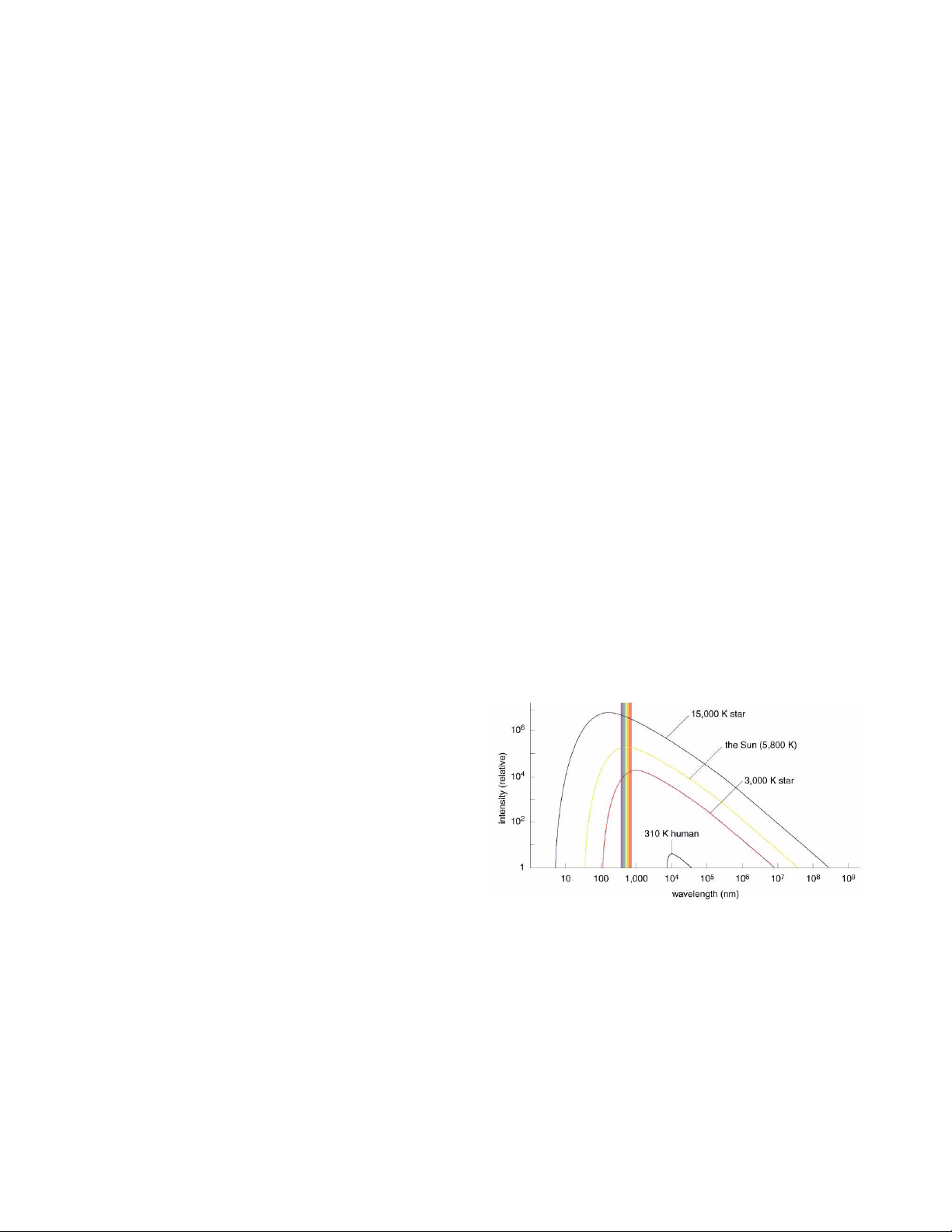
4. Wien’s law
• The peak in the spectrum is proportional to the tempera-
ture.
Important Point: One can determine a star’s surface temper-
ature by measuring the wavelength of the peak emission.
5. Stefan-Boltzmann Law
• The total amount of energy is proportional to the tempera-
ture to the forth power times the size of the object.
• The surface area of a star is:
Ehc
λ
------ h 6.626 10 34–
×J s–= =
λpe ak
2.9 106
×
T
----------------------- Kn m
o
( )=
P
A
--- σT4σ5.7 10 8–
×W
m2K4
--------------
= =
A4πR2
=

