Baixe Synthesis of Highly Functionalized Poly (alkyl cyanoacrylate) e outras Notas de estudo em PDF para Engenharia Elétrica, somente na Docsity!
Synthesis of Highly Functionalized Poly(alkyl cyanoacrylate)
Nanoparticles by Means of Click Chemistry
Julien Nicolas,*,†^ Fethi Bensaid,†^ Didier Desmae¨le,‡^ Mathurin Grogna,§
Christophe Detrembleur,
§
Karine Andrieux,
†
and Patrick Couvreur
†
Laboratoire de Physico-Chimie, Pharmacotechnie et Biopharmacie, Uni V. Paris-Sud, UMR CNRS 8612,
Faculte´ de Pharmacie, 5 rue Jean-Baptiste Cle´ment, 92296 Chaˆtenay-Malabry, France, Laboratoire
Biocis, Uni V. Paris-Sud, UMR CNRS 8076, Faculte´ de Pharmacie, 5 rue Jean-Baptiste Cle´ment,
92296 Chaˆtenay-Malabry, France, and Center for Education and Research on Macromolecules
(CERM), Uni V ersity of Liege, Sart-Tilman, B6, 4000 Liege, Belgium
Recei V ed June 13, 2008; Re V ised Manuscript Recei V ed September 9, 2008
ABSTRACT: A general methodology was proposed to prepare highly functionalized poly(alkyl cyanoacrylate) nanoparticles by means of Huisgen 1,3-dipolar cyclo-addition, the so-called click chemistry. To achieve this goal, different protocols were investigated to obtain azidopoly(ethylene glycol) cyanoacetate of variable molar mass, followed by a Knoevenagel condensation-Michael addition reaction with hexadecyl cyanoacetate to produce a poly[(hexadecyl cyanoacrylate)- co -azidopoly(ethylene glycol) cyanoacrylate] (P(HDCA- co -N 3 PEGCA)) co- polymer, displaying azide functionalities at the extremity of the PEG chains. As a proof of concept, model alkynes were quantitatively coupled either to the P(HDCA- co -N 3 PEGCA) copolymers in homogeneous medium followed by self-assembly in aqueous solution or directly at the surface of the preformed P(HDCA- co -N 3 PEGCA) nanoparticles in aqueous dispersed medium, both yielding highly functionalized nanoparticles. This versatile approach, using alkyl cyanoacrylate derivatives, opened the door to ligand-functionalized and biodegradable nanoparticles with “stealth” properties for biomedical applications.
Introduction
Nanoparticles developed from poly(alkyl cyanoacrylate)
(PACA) biodegradable polymers have opened new and exciting
perspectives in the field of drug delivery due to their nearly
ideal characteristics as drug carriers in connection with biomedi-
cal applications. Introduced more than 25 years ago in the field
of pharmacology,^1 PACA drug carriers have, indeed, demon-
strated significant advantages for the treatment of numerous
pathologies such as cancer^2 and severe infections (viral,
bacteriologic, parasite)^3 as well as several metabolic and
autoimmune diseases, 4 which has been well-reviewed in the
recent literature.^5 -^7 Clinical trials have even shown that these
nanodevices are safe and biocompatible when loaded with the
anticancer drug doxorubicin.^8
Throughout the last two decades, PACA nanoparticles with
different features have been developed:^9 nanospheres (matrix-
type nanoparticles),1,10-^15 nanocapsules (vesicular-type nano-
particles) either oil- or water-containing,^16 -^25 as well as
nanoparticles with controlled-surface properties;14,22,26-^39 the
later being considered as the second generation of drug delivery
devices. Regarding this recent class of advanced PACA nano-
particles, the major breakthrough is undoubtedly the grafting
of poly(ethylene glycol) (PEG), termed “PEGylation”. PEG is
a hydrophilic and flexible polymer intensively employed in the
pharmaceutical area, especially for drug delivery purposes such
as polymer-protein/peptide bioconjugates^40 -^45 or long-circulat-
ing nanoparticles.28,46-^48 Indeed, PEG gives rise to several
potential beneficial effects including increased bioavailability
and plasma half-lives, biocompatibility/decreased immunoge-
nicity, reduced proteolysis and enhanced solubility and stability,
thus being considered as a key material in this field.^40 Consider-
ing nanoparticle technology, non-“PEGylated” nanoparticles are
quickly eliminated from the bloodstream due to the adsorption
of blood proteins (opsonins) onto their surface, which triggers
the recognition by the macrophages of the mononuclear ph-
agocyte system (MPS). As a consequence, these nanoparticles
accumulate in the organs of the MPS such as the liver and the
spleen, restricting the therapeutic activity of the entrapped
compounds to hepatic diseases. In contrast, when covered by
PEG chains, the obtained nanoparticles are able to efficiently
escape this recognition system, resulting in long-circulating
colloidal devices, also called “stealth” nanoparticles.46,
Alkyl cyanoacrylates monomers are also well-known for their
very high reactivity and the excellent adhesive properties of
the resulting polymers. However, this unique feature tends to
make the synthesis of well-defined and/or functionalizable
poly(alkyl cyanoacrylate) architectures extremely difficult or
even impossible. A significant step was accomplished to
circumvent this important drawback via the synthesis of random
poly[(hexadecyl cyanoacrylate)- co -methoxypoly(ethylene gly-
col) cyanoacrylate] (P(HDCA- co -MePEGCA)) comblike co-
polymers with amphiphilic properties.^28 This original approach
derived from tandem Knoevenagel condensation-Michael ad-
dition reaction to build the polymeric backbone, where the
corresponding cyanoacetates were reacted with formaldehyde
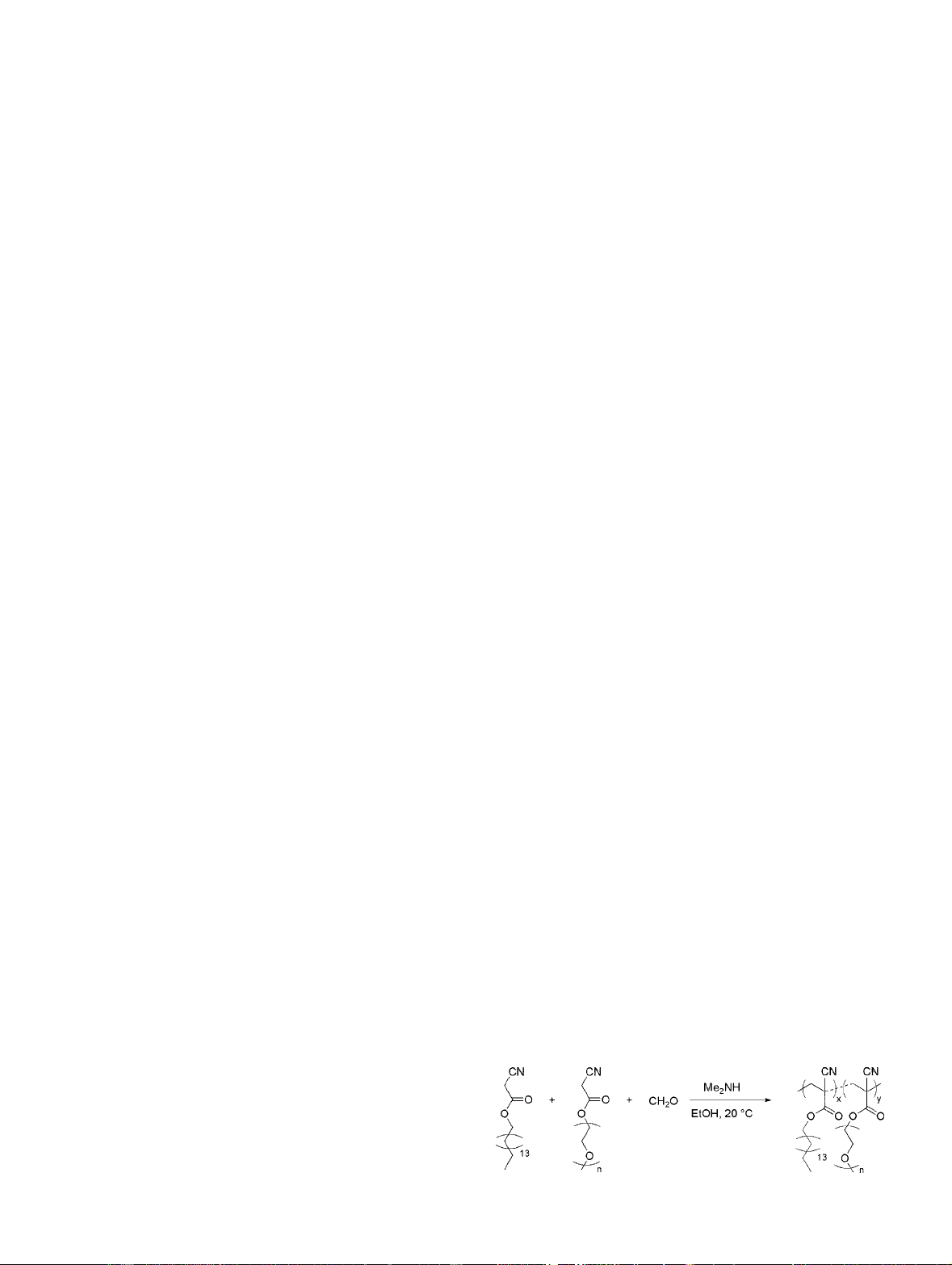
in the presence of dimethylamine as the catalyst (Scheme 1).
- Corresponding author: Telephone: +33 1 46 83 58 53. Fax: +33 1 46 61 93 34. E-mail: [email protected]. † (^) Laboratoire de Physico-Chimie, Pharmacotechnie et Biopharmacie, Univ. Paris-Sud, UMR CNRS 8612. ‡ (^) Laboratoire Biocis, Univ. Paris-Sud, UMR CNRS 8076. § (^) Center for Education and Research on Macromolecules (CERM), University of Lie`ge.
Scheme 1. Synthesis of Random Poly[(hexadecyl cyanoacrylate)- co -methoxypoly(ethylene glycol) cyanoacrylate] (P(HDCA- co -MePEGCA)) Copolymer via Knoevenagel Condensation - Michael Addition Reaction
8418 Macromolecules 2008 , 41 , 8418- 8428
10.1021/ma8013349 CCC: $40.75 2008 American Chemical Society Published on Web 10/24/
However, even though these “PEGylated” nanoparticles have
demonstrated a noticeable brain-targeting effect;^6 they suffer
from a crucial lack of specificity toward cells and/or tissues
and can not be efficiently addressed. Thus, for the forthcoming
years, the most exciting challenge in drug delivery, whatever
the nature of the drug carriers (i.e., liposome, nanoparticles, etc.),
will be undoubtedly the synthesis of efficient ligand-function-
alized colloidal devices to achieve specific cells targeting based
on a molecular recognition process. To the best of our
knowledge concerning PACA technology, only one example
of the so-called third generation PACA nanoparticles has been
reported and involves poly[(hexadecyl cyanoacrylate)- co -
aminopoly(ethylene glycol) cyanoacrylate] (P(HDCA- co -
H 2 NPEGCA)) nanospheres displaying folic acid groups,49,50^ to
target the folate receptor which is overexpressed at the surface
of many tumor cells. However, this approach is restricted to
amine-reactive compounds and led to only ∼15% folate content
at the surface of the nanospheres.49,
In order to extend this concept of functionalizable poly(alkyl
cyanoacrylate) “PEGylated” nanoparticles, we have chosen to
take advantage of Huisgen 1,3-dipolar cyclo-addition (termed
click chemistry)51,52^ between alkyne and azide derivatives due
to its high efficiency and its mild experimental conditions.^53 -^56
Indeed, click chemistry has recently received intense interest
as a well-established synthetic route to obtain tailor-made
complex materials and has been exploited in many areas such
as dendrimers,^57 -^59 bioconjugates,^60 -^62 therapeutics^63 -^65 and
functionalized polymers.^66 -^68
Herein, we propose a general methodology to obtain highly
functionalized PACA biodegradable nanoparticles from a novel
poly[(hexadecyl cyanoacrylate)- co -azidopoly(ethylene glycol)
cyanoacrylate] (P(HDCA- co -N 3 PEGCA)) copolymer, as a click-
able polymeric scaffold (Figure 1). This versatile approach
allowed either: (i) the early coupling reaction to proceed in
homogeneous medium with clickable P(HDCA- co -N 3 PEGCA)
copolymers followed by the formation of functionalized nano-
particles by self-assembly in aqueous solution (Figure 1a) or
(ii) an effective coupling reaction directly at the surface of
clickable P(HDCA- co -N 3 PEGCA) nanoparticles (Figure 1b).
Depending on the characteristics of the desired alkyne moiety
(nature, solubility, size, etc.), one of the pathways would be
more appropriate than the other one; for instance, if large
molecules such as peptide sequences or proteins are required,
the click reaction at the surface of the azido-functionalized
PACA nanoparticles would be more suitable than early on the
copolymer in homogeneous medium, which would undoubtedly
alter the following nanoprecipitation process (due to modified
hydrophilic-lipophilic balance (HLB)).
In the literature, click chemistry has been employed with
nanoparticles based on well-defined poly(acrylic acid)- b -
polystyrene (PAA- b -PS) block copolymers.69,70^ O’Reilly et al.
used nitroxide-mediated polymerization (NMP) or reversible
addition-fragmentation transfer (RAFT) to prepare shell cross-
linked PAA- b -PS nanoparticles bearing azide functionalities at
their surface, on which an alkyne-fluorescein dye has been
successfully clicked.^69 More recently, Opsteen et al. synthesized
an azido-terminated PAA- b -PS copolymer by atom-transfer
radical polymerization (ATRP) to form water-containing nano-
capsules covered by azide groups, followed by click reaction
with a wide variety of alkyne-ligands based on dansyl dye,
biotin, or enhanced green fluorescent protein (EGFP).^70 Even
though these two studies clearly demonstrated the feasibility
of the click reaction at the surface of these model nanoparticles,
a similar approach employing well-established biodegradable
polymers such as PACA is highly desirable regarding biomedi-
cal applications, where biocompatible and/or biodegradable,
ligand-functionalized, colloidal drug carriers are in great
demand.
Experimental Section
Materials. Poly(ethylene glycol) monobenzyl ether (BnPEG 70 , M n,NMR ) 3160 g · mol-^1 , DP n,NMR ) 70, M n,SEC ) 2700 g · mol-^1 , M w / M n ) 1.06) was purchased from Polymer Source and used as received. Ethylene oxide (EO, >99%) was purchased from Chemo- gas. Poly(ethylene glycol) monomethyl ether (PEG 43 , M n,NMR ) 1910 g · mol-^1 , DP n,NMR ) 43, M n,SEC ) 1970 g · mol-^1 , M w / M n ) 1.04, Fluka), cyanoacetic acid (99%, Fluka), N , N ′-dicyclohexyl- carbodiimide (DCC, >99%, Fluka), methanesulfonyl chloride (MsCl, 99.7%, Aldrich), sodium azide (NaN 3 , 99.5%, Aldrich), 4-dimethylaminopyridine (DMAP, 99%, Aldrich), formaldehyde (37% in water, Aldrich), pyrrolidine (99%, Aldrich), anhydrous magnesium sulfate (MgSO4, >99%, Aldrich), sodium ascorbate
Figure 1. General approach to prepare functionalized poly(alkyl cyanoacrylate) nanoparticles: click reaction on the poly[(hexadecyl cyanoacrylate)- co -methoxypoly(ethylene glycol) cyanoacrylate] (P(HDCA- co -N 3 PEGCA)) copolymer followed by self-assembly in aqueous solution (a) or click reaction at the surface of preformed P(HDCA- co -N 3 PEGCA) nanoparticles (b).
Macromolecules, Vol. 41, No. 22, 2008 Poly(alkyl cyanoacrylate) Nanoparticles 8419
of DCC (11 mg, 0.053 mmol) and DMAP (15 mg, 0.10 mmol) in DCM (1 mL). The reaction medium was stirred during 24 h at ambient temperature under argon atmosphere. The solid was filtered off and the solvent was removed under reduced pressure. The solid was then purified by recrystallization from isopropanol, filtered and dried under vacuum overnight to give a slightly yellow powder: 86 mg (94%). 1 H NMR (400 MHz, CDCl 3 ) δ ) 3.38 (t, 2H, J ) 4.5 Hz, C H 2 N 3 ), 3.54 (s, 2H, CNC H 2 ), 3.35-3.92 (m, 280H, OC H 2 C H 2 O), 3.73 (t, 2H, J ) 4.5 Hz, COOCH 2 C H 2 ), 4.35 (t, 2H, J ) 4.5 Hz, COOC H 2 CH 2 ). 13 C NMR (CDCl 3 ) δ ) 24.7 (CN C H 2 ), 50.8 ( C H 2 N 3 ), 65.7 (COO C H 2 CH 2 ), 68.5 (COOCH 2 C H 2 ), 70. (O C H 2 C H 2 O), 113.1 (CH 2 C N), 163.3 ( C OOCH 2 ). IR (neat): υ (cm-^1 ) ) 2255 (CtN), 2098 (N 3 ), 1738 (CdO). M n,SEC ) 2750 g · mol-^1 , M w / M n ) 1.07. Synthesis of N 3 PEG 47 CA Following Path B. Synthesis of Benzylpoly(ethylene glycol) Methanesulfonyl (BnPEG 47 Ms, 8 ). In a 50 mL round-bottom flask, a solution of BnPEG 47 (502 mg, 0. mmol), DMAP (15 mg, 0.12 mmol) and TEA (180 μL, 1.28 mmol) in DCM (8 mL) was cooled to 0 °C. MsCl (80 μL, 1.02 mmol) was then introduced dropwise by a syringe over ca. 15 min. The mixture was then stirred under argon atmosphere at 0 °C during 2 h and overnight at ambient temperature. The mixture was then washed three times with 1 M aqueous HCl solution and once with brine. The organic phase was dried over MgSO 4 , filtered and concentrated under reduced pressure. The solid was dissolved in a minimal amount of DCM and precipitated by dropwise addition in a large volume of cold Et 2 O. The product was collected by filtration as a fine, white powder: 500 mg (96%). 1 H NMR (CDCl 3 ) δ ) 3.08 (s, 3H, CH 2 SO 3 C H 3 ), 3.35-3.92 (m, 188H, OC H 2 C H 2 O), 4. (t, 2H, J ) 4.4 Hz, C H 2 SO 3 CH 3 ), 4.56 (s, 2H, C 6 H 5 OC H 2 ), 7. (m, 5H, C 6 H 5 OCH 2 ). M n,SEC ) 1960 g · mol-^1 , M w / M n ) 1.07.
Synthesis of Benzylpoly(ethylene glycol) Azide (BnPEG 47 N 3 , 9 ). In a 100 mL round-bottom flask equipped with a condenser and an argon inlet was introduced a solution of 8 (2.32 g, 1. mmol) in DMF (20 mL). NaN 3 (0.36 g, 5.43 mmol) was then added and the mixture was stirred during 24 h a 50 °C. DMF was removed under vacuum and a minimum of acetone was added which allowed the excess NaN 3 to be filtered off. Acetone was then removed under reduced pressure. The solid was then dissolved in DCM and the mixture was washed three times with water. The organic phase was dried over MgSO 4 , filtered, concentrated under reduced pressure and dried under vacuum to give a slightly yellow powder: 2.04 g (91%). 1 H NMR (CDCl 3 ) δ ) 3.39 (t, 2H, J ) 4.5 Hz, C H 2 N 3 ), 3.42-3.93 (m, 188H, OC H 2 C H 2 O), 4.56 (s, 2H, C 6 H 5 OC H 2 ), 7. (m, 5H, C 6 H 5 OCH 2 ). IR (neat): υ (cm-^1 ) ) 2102 (N 3 ). M n,SEC ) 1950 g · mol-^1 , M w / M n ) 1.06. Synthesis of Azidopoly(ethylene glycol) (N 3 PEG 47 , 10 ). In a 100 mL round-bottom flask, 9 (2.04 g, 0.93 mmol) was dissolved in concentrated aqueous HCl solution and stirred under argon during 48 h at ambient temperature. The mixture was then diluted with 250 mL of water and the pH adjusted at ∼2 with 1 M NaOH aqueous solution. The resulting aqueous layer was extracted with four portions of DCM and the organic layer was collected, dried over MgSO 4 , filtered and concentrated under reduced pressure. The solid was dissolved in a minimal amount of DCM and precipitated by dropwise addition in a large volume of cold Et 2 O. The product was collected by filtration as a fine, white powder: 1.65 g (84%). (^1) H NMR (CDCl 3 ) δ ) 3.40 (t, 2H, J ) 4.5 Hz, C H 2 N 3 ), 3.42-3.
(m, 188H, OC H 2 C H 2 O). IR (neat): υ (cm-^1 ) ) 2104 (N 3 ). M n,SEC ) 1900 g · mol-^1 , M w / M n ) 1.07. Synthesis of Azidopoly(ethylene glycol) Cyanoacetate (N 3 PEG 47 CA, 7a ). In a 50 mL round-bottom flask containing 10 (1.60 g, 0.76 mmol), cyanoacetic acid (0.14 g, 1.61 mmol) and DCM (7 g) was introduced dropwise by a syringe over ca. 15 min a solution of DCC (330 mg, 1.60 mmol) and DMAP (60 mg, 0. mmol) in DCM (1 g). The reaction medium was stirred during 24 h at ambient temperature under argon atmosphere. The solid was filtered off and the solvent was removed under reduced pressure. The solid was then purified by recrystallization from isopropanol, filtered and dried under vacuum overnight to give a slightly yellow powder: 1.58 g (96%). 1 H NMR (400 MHz, CDCl 3 ) δ ) 3.38 (t,
2H, J ) 4.5 Hz, C H 2 N 3 ), 3.54 (s, 2H, CNC H 2 ), 3.55-3.70 (m, 188H, OC H 2 C H 2 O), 3.73 (t, 2H, J ) 4.5 Hz, COOCH 2 C H 2 ), 4. (t, 2H, J ) 4.5 Hz, COOC H 2 CH 2 ). 13 C NMR (CDCl 3 ) δ ) 24. (CN C H 2 ), 50.7 ( C H 2 N 3 ), 65.8 (COO C H 2 CH 2 ), 68.5 (COOCH 2 C H 2 ), 70.6 (O C H 2 C H 2 O), 113.2 ( C NCH 2 ), 163.3 ( C OOCH 2 ). IR (neat): υ (cm-^1 ) ) 2261 (CtN), 2102 (N 3 ), 1739 (CdO). M n,SEC ) 1920 g · mol-^1 , M w / M n ) 1.08. The synthesis of N 3 PEG 70 CA ( 7b ) was also achieved from BnPEG 70 following Path B with similar intermediate yields (overall yield 68%) and identical 1 H, 13 C NMR and IR results. M n,SEC ) 2690 g · mol-^1 , M w / M n ) 1.07. Synthesis of Methoxypoly(ethylene glycol) Cyanoacetate (MePEG 43 CA). MePEG 43 CA was synthesized as follows. In a 100 mL round-bottom flask containing poly(ethylene glycol) mono- methyl ether (11.0 g, DP n ) 45, 5.5 mmol), cyanoacetic acid (0. g, 11.0 mmol) and DCM (30 mL) was introduced dropwise by a syringe over ca. 20 min, a solution of DCC (2.27 g, 11.0 mmol) and DMAP (60 mg, 0.41 mmol) in DCM (10 mL). The reaction medium was stirred during 24 h at room temperature under argon atmosphere. The solid was filtered off and the solvent was removed under reduced pressure. The solid was then purified by recrystal- lization from isopropanol, filtered and dried under vacuum overnight to give a fine, white powder: 10.7 g (94%). 1 H NMR (CDCl 3 ) δ ) 3.34 (s, 3H, OC H 3 ), 3.53 (s, 2H, CNC H 2 ), 3.25-3.92 (m, 172H, OC H 2 C H 2 O), 4.32 (t, 2H, J ) 4.5 Hz, COOC H 2 CH 2 ). IR (neat): υ (cm-^1 ) ) 1745 (CdO), 2251 (CtN). M n,SEC ) 1890 g · mol-^1 , M w/ M n ) 1.04. Synthesis of Poly[(hexadecyl cyanoacrylate)- co -azidopoly(eth- ylene glycol) cyanoacrylate] (P(HDCA- co -N 3 PEG 47 CA)) Copoly- mer. The P(HDCA- co -N 3 PEG 47 CA) copolymer was prepared as follows. In a 50 mL round-bottom flask containing 7a ( n ) 47, 1.0 g, 0.48 mmol), HDCA (0.6 g, 1.9 mmol), EtOH (5 mL) and DCM (10 mL), under magnetic stirring, were sequentially intro- duced dropwise by a syringe, over ca. 20 min, formalin (1 mL, 13.3 mmol) and pyrrolidine (50 μL, 0.61 mmol). The mixture was allowed to stir during 24 h at room temperature and was then concentrated under reduced pressure. The residue was taken into DCM and washed three times with water, one time with 1 M aqueous HCl solution and once with brine. The resulting organic layer was dried over MgSO 4 , filtered and concentrated under reduced pressure and dried under vacuum to give a slightly yellow powder: 1.55 g. The same procedure was used with compound 7b ( n ) 70) to achieve the P(HDCA- co -N 3 PEG 70 CA) copolymer. Copolymers were analyzed by 1 H NMR (Figure 3) and IR spectroscopy (see text). From a calibration based on PMMA standards, SEC gave: for the P(HDCA- co -N 3 PEG 47 CA) copolymer, M n,SEC ) 2000 g · mol-^1 and M w / M n ) 1.82; for the P(HDCA- co - N 3 PEG 70 CA) copolymer, M n,SEC ) 2800 g · mol-^1 and M w / M n ) 2.0. Click Reaction between 4-Pentyn-1-ol and Poly[(hexadecyl cyanoacrylate)- co -azidopoly(ethylene glycol) cyanoacrylate] (P(HDCA- co -N 3 PEG 70 CA)) Copolymer in Organic Medium. A typical click reaction in organic medium using P(HDCA- co - N 3 PEG 70 CA) copolymer obtained from compound 7b ( n ) 70) was as follows. A solution of P(HDCA- co -N 3 PEG 70 CA) copolymer ( mg, 4.96 μmol) and 4-pentyn-1-ol (4.3 mg, 50 μmol) in DMF ( mL) was placed in a 5 mL round-bottom flask sealed with a rubber septum and degassed by argon bubbling during 30 min. Then, CuBr (1.5 mg, 10 μmol) was added to the reaction medium and argon bubbling was continued for further 10 min. PMDETA (3.6 mg, 4.3 μL, 20 μmol) was then introduced by a syringe and the reaction medium turned dark purple. The resulting solution was allowed to stir during 6 h at room temperature under argon atmosphere. At the end of the reaction, the rubber septum was removed and the solution was diluted with 1 mL of DMF under stirring, leading to oxidation of Cu(I) catalyst into Cu(II). Then, the catalyst was removed by passing the organic solution through a basic alumina column, and the solvent was evaporated under vacuum. The same protocol was followed with the P(HDCA- co -N 3 PEG 47 CA) copoly- mer obtained from compound 7a ( n ) 47). The resulting copoly- mers were analyzed by 1 H NMR (Figure 5) and IR spectroscopy
Macromolecules, Vol. 41, No. 22, 2008 Poly(alkyl cyanoacrylate) Nanoparticles 8421
(see text). From a calibration based on PMMA standards, SEC gave: for the P(HDCA- co -N 3 PEG 47 CA) copolymer, M n,SEC ) 2110 g · mol-^1 and M w / M n ) 1.95; for the P(HDCA- co -N 3 PEG 70 CA) copolymer, M n,SEC ) 2860 g · mol-^1 and M w / M n ) 2.1. Synthesis of Pent-4-ynoic-methoxypoly(ethylene glycol) Ester (Alkyne - PEG 43 ). In a 50 mL round-bottom flask containing poly(ethylene glycol) monomethyl ether (5.0 g, 2.5 mmol), 4-pen- tynoic acid (0.5 g, 5.0 mmol) and DCM (30 mL) was introduced dropwise by a syringe over ca. 20 min, a solution of DCC (1.03 g, 4.99 mmol) and DMAP (50 mg, 0.41 mmol) in DCM (10 mL).
The reaction medium was stirred during 24 h at ambient temperature under argon atmosphere. The solid was filtered off and the solvent was removed under reduced pressure. The solid was then purified by recrystallization from isopropanol, filtered and dried under vacuum overnight to give a fine, white powder: 4.8 g (92%). 1 H NMR (CDCl 3 ) δ ) 1.98 (s, 1H, C≡C H ), 2.45-2.65 (m, 4H, OOCC H 2 C H 2 ), 3.37 (s, 3H, OC H 3 ), 3.32-3.92 (m, 172H, OC H 2 C H 2 O), 4.26 (t, 2H, J ) 4.5 Hz, COOC H 2 CH 2 ). 13 C NMR (CDCl 3 ) δ ) 14.3 (CH 2 C H 2 C≡CH), 33.2 ( C H 2 CH 2 C≡CH), 59. (O C H 3 ), 63.8 ( C H 2 OOCCH 2 ), 69.0 ( C H 2 CH 2 OOC), 69.1 (Ct C H),
Scheme 2. Synthetic Pathways to Prepare Azidopoly(ethylene glycol) Cyanoacetate (N 3 PEGCA, 7) from Benzyl - PEG (BnPEG, 1, n ) 47 or 70): DMAP ) 4-Dimethylaminopyridine; TEA ) Triethylamine; DCC ) N , N -Dicyclohexylcarbodiimide
Figure 2. 400 MHz 1 H (a) and 75 MHz 13 C (b) NMR spectra in CDCl 3 of the azidopoly(ethylene glycol) cyanoacetate (N 3 PEG 47 CA, 7a ) synthesized following Path A (see Scheme 2).
8422 Nicolas et al. Macromolecules, Vol. 41, No. 22, 2008
previous results concerning P(HDCA- co -MePEGCA) copoly-
mers.^28 The formation of the polymeric backbone was identified
by the broad signal at 2.3-2.8 ppm, endorsed by the broad peak
at 4.2-4.4 ppm assigned to the methylene in the R-position of
the ester function involved in the macromolecular structure.
Considering the average copolymer compositions, integration
of peaks b and f gave a HDCA:N 3 PEG n CA molar ratio of 4.2:
( n ) 47) and 4.1:1 ( n ) 70), very close of the initial
stoichiometry. Even if overlaid with one of the PEG satellite,
the peak c at 3.4 ppm was assigned to the methylene in
R-position of the azide function, the signal of which was also
detected by IR spectroscopy at 2103 cm-^1.
It has been previously shown^73 by near-infrared measurements
that Knoevenagel condensation-Michael addition reaction
between HDCA and PEGCA derivatives does not lead to well-
defined P(HDCA- co -PEGCA) random copolymers, but to a
complex mixture of various oligomers exhibiting different
amphiphilic properties, probably due to a difference of steric
hindrance between the starting cyanoacetates. The size exclusion
chromatograms of the above-mentioned copolymers totally
confirmed those early observations (Figure 4). Indeed, whereas
a significant tailing toward lower molar masses was noticed on
the chromatogram of the P(HDCA- co -N 3 PEG 47 CA) copolymer,
a detectable amount of PHDCA homopolymer (which elutes
earlier than HDCA) was visible when the P(HDCA- co -
N 3 PEG 70 CA) copolymer was analyzed. This low molecular
weight polymer might arise either from Knoevenagel-Michael
addition homocondensation reaction between HDCA moieties
and/or from a rapid depolymerisation of the (co)polymer
accompanied by simultaneous repolymerization of the resulting
monomer to yield lower molecular weight species, as often
observed with poly(alkyl cyanoacrylate).^74
Nevertheless, even though these intrinsic features of alkyl
cyanoacrylate chemistry might be considered as a drawback
regarding polymer synthesis, note that during nanoparticles
formation by self-assembly in aqueous medium, PHDCA
homopolymer is entrapped into the core of the nanoparticles
stabilized by P(HDCA- co -PEGCA) copolymers to eventually
lead to well-defined colloidal objects. Besides, to the best of
our knowledge, this is the only method available to yield
biodegradable PACA nanoparticles covered by PEG chains in
mild conditions (as opposed to direct emulsion polymerization
of alkyl cyanoacrylates in strong aqueous acidic media). For
the sake of simplicity, the term copolymer will be employed in
the text to refer to the oligomers mixture resulting from
Knoevenagel condensation-Michael addition reaction.
2. Click Reaction in Homogeneous Medium. The clicking
ability of the P(HDCA- co -N 3 PEG n CA) copolymer was first
investigated in homogeneous medium (DMF) using CuBr:
PMDETA as the catalyst and 4-pentyn-1-ol as a small model
molecule. Under mild experimental conditions, both P(HDCA-
co -N 3 PEG n CA) copolymers ( n ) 47 and 70) were efficiently
clicked with 4-pentyn-1-ol in a quantitative fashion. Indeed, IR
spectroscopy of the final clicked copolymers showed a total
disappearance of the azide signal at 2103 cm-^1. Besides, 1 H
Figure 4. Size exclusion chromatography analysis of poly[(hexadecyl cyanoacrylate)- co -azidopoly(ethylene glycol) cyanoacrylate] (P(HDCA- co -N 3 PEGCA)) copolymers obtained by Knoevenagel condensation- Michael addition reaction between hexadecyl cyanoacetate (HDCA) and azidopoly(ethylene glycol) cyanoacetate (N 3 PEG n CA; n ) 47 or 70).
Figure 5. 300 MHz 1 H NMR spectrum in CDCl 3 of the poly[(hexadecyl cyanoacrylate)- co -azidopoly(ethylene glycol) cyanoacrylate] (P(HDCA- co -N 3 PEG 70 CA)) copolymer before (a) and after (b) click reaction with 4-pentyn-1-ol in N , N -dimethylformamide.
8424 Nicolas et al. Macromolecules, Vol. 41, No. 22, 2008
NMR spectroscopy showed all expected peaks accounting for
the formation of the triazole ring (Figure 5). For instance, peak
g and peak h were respectively assigned to the triazole ring
proton and to the R-methylene. Integration data using peak h
and peak b gave a coupling efficiency of 93% ( n ) 47) and
95% ( n ) 70), which demonstrated that azide moieties have
been almost quantitavely clicked, whatever the PEG chain length
(also suggesting that azide groups were not altered by the
copolymerization process, thus remaining available for further
coupling reactions). Furthermore, SEC did not show any traces
of cross-linked materials resulting from a possible coupling
reaction between nitrile groups of the copolymer and the azide
end groups^75 (which is not surprising since experimental
conditions to achieve such a reaction are very harsh compared
to the classical click conditions employed here).
Stable nanoparticles from the starting P(HDCA- co -N 3 PEG 47 -
CA) and from the clicked copolymer were then prepared by
the nanoprecipitation technique and analyzed by DLS (Table
1). From these measurements, azide-functionalized nanoparticles
exhibited an average diameter very close to nearly identical
P(HDCA- co -MePEG 43 CA) nanoparticles (entries 1 and 2, Table
1). Besides, it was satisfying to see that upon clicking, particle
size distribution remained narrow with no significant difference
Table 1. Colloidal Characteristics of Poly[(hexadecyl cyanoacrylate)- co -methoxypoly(ethylene glycol) cyanoacrylate] (P(HDCA- co -MePEGCA)) and Poly[(hexadecyl cyanoacrylate)- co -azidopoly(ethylene glycol) cyanoacrylate] (P(HDCA- co -N 3 PEG n CA)) Nanoparticles before and after Click Reactions RPEG n CA
entry R n click reaction alkyne (solvent)
av particle diameter ( D z ) (nm)
particle size distribution 1 OMe 43 99 a^ 0. 2 N 3 47 105 a^ 0. 3 N 3 47 4-pentyn-1-ol ( N , N -dimethylformamide) 106 a^ 0. 4 N 3 47 alkyne-dansyl ( N , N -dimethylformamide) 95 a^ 0. 5 N 3 70 82 a^ 0. 6 N 3 70 alkyne-PEG (H 2 O/acetone) 95 b^ 0. a (^) Measurement performed after nanoprecipitation without any further purification. b (^) Measurement performed after dialysis.
Figure 6. Size exclusion chromatography analysis with a fluorescence detector (λex. ) 340 nm; λem. ) 520 nm) of alkyne-dansyl (a), poly[(hexadecyl cyanoacrylate)- co -azidopoly(ethylene glycol) cy- anoacrylate] (P(HDCA- co -N 3 PEG 47 CA)) copolymer before (b) and after click reaction with alkyne-dansyl in N , N -dimethylformamide followed by dialysis (c).
Figure 7. 300 MHz 1 H NMR spectrum in CDCl 3 of the poly[(hexadecyl cyanoacrylate)- co -azidopoly(ethylene glycol) cyanoacrylate] (P(HDCA- co -N 3 PEG 70 CA)) nanoparticles before (a), after the click reaction with alkyne-PEG 43 in aqueous dispersed medium (b), and after dialysis (c).
Macromolecules, Vol. 41, No. 22, 2008 Poly(alkyl cyanoacrylate) Nanoparticles 8425
Conclusion
For the first time, a general methodology was proposed to
prepare highly functionalizable PACA-PEG copolymers and
associated nanoparticles. This approach relied on the synthesis
of a novel P(HDCA- co -N 3 PEGCA) copolymer by Knoevenagel
condensation-Michael addition reaction, able to efficiently react
with alkyne derivatives via Huisgen 1,3-dipolar cyclo-addition,
the so-called click chemistry. As a proof of concept, model
molecules have been quantitatively coupled either to the
P(HDCA- co -N 3 PEGCA) copolymers in homogeneous medium
followed by nanoprecipitation or directly at the surface of the
P(HDCA- co -N 3 PEGCA) nanoparticles in aqueous dispersed
medium, acting here as a clickable colloidal scaffold. In all
cases, stable clicked nanoparticles were obtained and easily
recovered. These results are believed to be of high interest
regarding the field of drug delivery as long as they open the
door to ligand-functionalized, biodegradable and “stealth”
colloidal drug carriers using alkyl cyanoacrylate monomers.
Acknowledgment. Dr. Christine Vauthier is warmly thanked
for valuable discussions. The French Ministry of Research and the CNRS are acknowledged for financial support.
References and Notes
(1) Couvreur, P.; Kante, B.; Roland, M.; Guiot, P.; Bauduin, P.; Speiser, P. J. Pharm. Pharmacol. 1979 , 31 , 331–332. (2) Chiannilkulchai, N.; Driouich, Z.; Benoit, J. P.; Parodi, A. L.; Couvreur, P. Sel. Cancer Ther. 1989 , 5 , 1–11. (3) Balland, O.; Pinto-Alphandary, H.; Pecquet, S.; remont, A.; Couvreur, P. J. Antimicrob. Chemother. 1994 , 33 , 509–522. (4) de Kozak, Y.; Andrieux, K.; Villarroya, H.; Klein, C.; Thillaye- Goldenberg, B.; Naud, M.-C.; Garcia, E.; Couvreur, P Eur. J. Immunol. 2004 , 34 , 3702–3712. (5) Vauthier, C.; Dubernet, C.; Fattal, E.; Pinto-Alphandary, H.; Couvreur, P. Ad V_. Drug Deli_ V ery Re V_._ 2003 , 55 , 519–548. (6) Garcia-Garcia, E.; Andrieux, K.; Gil, S.; Couvreur, P Int. J. Pharm. 2005 , 298 , 274–292. (7) Couvreur, P.; Vauthier, C. Pharm. Res. 2006 , 23 , 1417–1450. (8) Kattan, J.; Droz, J. P.; Couvreur, P.; Marino, J. P.; Boutan-Laroze, A.; Rougier, P.; Brault, P.; Vranckx, H.; Grognet, J. M.; Morge, X. In V est. New Drugs 1992 , 10 , 191–199. (9) Nicolas, J.; Couvreur, P. Wiley Interdiscip. Re V_. Nanomed. Nanobio- technol._ 2009 , in press. (10) El-Egakey, M. A.; Bentele, V.; Kreuter, J. Int. J. Pharm. 1983 , 13 , 349–352. (11) Douglas, S. J.; Illum, L.; Davis, S. S.; Kreuter, J. J. Colloid Interface Sci. 1984 , 101 , 149–158. (12) Douglas, S. J.; Illum, L.; Davis, S. S. J. Colloid Interface Sci. 1985 , 103 , 154–163. (13) Seijo, B.; Fattal, E.; Roblottreupel, L.; Couvreur, P Int. J. Pharm. 1990 , 62 , 1–7. (14) Yang, S. C.; Ge, H. X.; Hu, Y.; Jiang, X. Q.; Yang, C. Z. Colloid Polym. Sci. 2000 , 278 , 285–292. (15) Limouzin, C.; Caviggia, A.; Ganachaud, F.; Hemery, P. Macromol- ecules 2003 , 36 , 667–674. (16) Fallouh, N. A.; Roblottreupel, L.; Fessi, H.; Devissaguet, J. P.; Puisieux, F Int. J. Pharm. 1986 , 28 , 125–132. (17) Gallardo, M.; Couarraze, G.; Denizot, B.; Treupel, L.; Couvreur, P.; Puisieux, F Int. J. Pharm. 1993 , 100 , 55–64. (18) Puglisi, G.; Fresta, M.; Giammona, G.; Ventura, C. A. Int. J. Pharm. 1995 , 125 , 283–287. (19) Vranckx, H.; Demoustier, M.; Deleers, M Eur. J. Pharm. Biopharm. 1996 , 42 , 345–347. (20) Lambert, G.; Fattal, E.; Pinto-Alphandary, H.; Gulik, A.; Couvreur, P. Pharm. Res. 2000 , 17 , 707–714. (21) Wohlgemuth, M.; Mayer, C. J. Colloid Interface Sci. 2003 , 260 , 324–
(22) Brigger, I.; Armand-Lefevre, L.; Chaminade, P.; Besnard, M.; Rigaldie, Y.; Largeteau, A.; remont, A.; Grislain, L.; Demazeau, G.; Couvreur, P. Pharm. Res. 2003 , 20 , 674–683. (23) Krauel, K.; Davies, N. M.; Hook, S.; Rades, T. J. Controlled Release 2005 , 106 , 76–87. (24) Altinbas, N.; Fehmer, C.; Terheiden, A.; Shukla, A.; Rehage, H.; Mayer, C. J. Microencapsulation 2006 , 23 , 567–581. (25) Hillaireau, H.; Le Doan, T.; Chacun, H.; Janin, J.; Couvreur, P. Int. J. Pharm. 2007 , 331 , 148–152.
(26) Douglas, S. J.; Davis, S. S.; Illum, L. Int. J. Pharm. 1986 , 34 , 145–
(27) Peracchia, M. T.; Vauthier, C.; Puisieux, F.; Couvreur, P. J. Biomed. Mater. Res. 1997 , 34 , 317–326. (28) Peracchia, M. T.; Desmae¨le, D.; Couvreur, P.; d’Angelo, J. Macro- molecules 1997 , 30 , 846–851. (29) Peracchia, M. T.; Harnisch, S.; Pinto-Alphandary, H.; Gulik, A.; Dedieu, J. C.; Desmaële, D.; d’Angelo, J.; Muller, R. H.; Couvreur, P. Biomaterials 1999 , 20 , 1269–1275. (30) Li, Y. P.; Pei, Y. Y.; Zhou, Z. H.; Zhang, X. Y.; Gu, Z. H.; Ding, J.; Zhou, J. J.; Gao, X. J. J. Controlled Release 2001 , 71 , 287–296. (31) Chauvierre, C.; Labarre, D.; Couvreur, P.; Vauthier, C. Macromolecules 2003 , 36 , 6018–6027. (32) Chauvierre, C.; Labarre, D.; Couvreur, P.; Vauthier, C. Pharm. Res. 2003 , 20 , 1786–1793. (33) Chauvierre, C.; Marden, M. C.; Vauthier, C.; Labarre, D.; Couvreur, P.; Leclerc, L. Biomaterials 2004 , 25 , 3081–3086. (34) Labarre, D.; Vauthier, C.; Chauvierre, U.; Petri, B.; Muller, R.; Chehimi, M. M. Biomaterials 2005 , 26 , 5075–5084. (35) Bertholon-Rajot, I.; Labarre, D.; Vauthier, C. Polymer 2005 , 46 , 1407–
(36) Bertholon, I.; Vauthier, C.; Labarre, D. Pharm. Res. 2006 , 23 , 1313–
(37) Bertholon, I.; Lesieur, S.; Labarre, D.; Besnard, M.; Vauthier, C. Macromolecules 2006 , 39 , 3559–3567. (38) Bravo-Osuna, I.; Ponchel, G.; Vauthier, C. Eur. J. Pharm. Sci. 2007 , 30 , 143–154. (39) Chauvierre, C.; Leclerc, L.; Labarre, D.; Appel, M.; Marden, M. C.; Couvreur, P.; Vauthier, C. Int. J. Pharm. 2007 , 338 , 327–332. (40) Veronese, F. M. Biomaterials 2001 , 22 , 405–417. (41) Veronese, F. M.; Harris, J. M. Ad V_. Drug Deli_ V ery Re V_._ 2002 , 54 , 453–456. (42) Roberts, M. J.; Bentley, M. D.; Harris, J. M. Ad V_. Drug Deli_ V ery Re V_._ 2002 , 54 , 459–476. (43) Duncan, R. Nat. Re V_. Drug Disco_ V ery 2003 , 2 , 347–360. (44) Harris, J. M.; Chess, R. B. Nat. Re V_. Drug Disco_ V ery 2003 , 2 , 214–
(45) Nicolas, J.; Mantovani, G.; Haddleton, D. M. Macromol. Rapid Commun. 2007 , 28 , 1083–1111. (46) Stolnik, S.; Illum, L.; Davis, S. S. Ad V_. Drug Deli_ V ery Re V_._ 1995 , 16 , 195–214. (47) Bazile, D.; Prud’homme, C.; Bassoullet, M.-T.; Marland, M.; Spen- lehauer, G.; Veillard, M. J. Pharm. Sci. 1995 , 84 , 493–498. (48) Storm, G.; Belliot, S. O.; Daemen, T.; Lasic, D. D. Ad V_. Drug Deli_ V ery Re V_._ 1995 , 17 , 31–48. (49) Stella, B.; Arpicco, S.; Peracchia, M. T.; Desmae¨le, D.; Hoebeke, J.; Renoir, M.; d’Angelo, J.; Cattel, L.; Couvreur, P. J. Pharm. Sci. 2000 , 89 , 1452–1464. (50) Stella, B.; Marsaud, V.; Arpicco, S.; Geraud, G.; Cattel, L.; Couvreur, P.; Renoir, J.-M. J. Drug Targeting 2007 , 15 , 146–153. (51) Rostovtsev, V. V.; Green, L. G.; Fokin, V. V.; Sharpless, K. B. Angew. Chem., Int. Ed. 2002 , 41 , 2596–2599. (52) Tornoe, C. W.; Christensen, C.; Meldal, M. J. Org. Chem. 2002 , 67 , 3057–3064. (53) Kolb, H. C.; Finn, M. G.; Sharpless, K. B. Angew. Chem., Int. Ed. 2001 , 40 , 2004–2021. (54) Kolb, H. C.; Sharpless, K. B. Drug Disco V_. Today_ 2003 , 8 , 1128–
(55) Binder, W. H.; Sachsenhofer, R. Macromol. Rapid Commun. 2007 , 28 , 15–54. (56) Lutz, J.-F. Angew. Chem., Int. Ed. 2007 , 46 , 1018–1025. (57) Wu, P.; Feldman, A. K.; Nugent, A. K.; Hawker, C. J.; Scheel, A.; Voit, B.; Pyun, J.; Frechet, J. M. J.; Sharpless, K. B.; Fokin, V. V. Angew. Chem., Int. Ed. 2004 , 43 , 3928–3932. (58) Malkoch, M.; Schleicher, K.; Drockenmuller, E.; Hawker, C. J.; Russell, T. P.; Wu, P.; Fokin, V. V. Macromolecules 2005 , 38 , 3663–
(59) Mynar, J. L.; Choi, T.-L.; Yoshida, M.; Kim, V.; Hawker, C. J.; Frechet, J. M. J. Chem. Commun. 2005 , 5169–5171. (60) Wang, Q.; Chan, T. R.; Hilgraf, R.; Fokin, V. V.; Sharpless, K. B.; Finn, M. G. J. Am. Chem. Soc. 2003 , 125 , 3192–3193. (61) Parrish, B.; Breitenkamp, R. B.; Emrick, T. J. Am. Chem. Soc. 2005 , 127 , 7404–7410. (62) Hatzakis, N. S.; Engelkamp, H.; Velonia, K.; Hofkens, J.; Christianen, P. C. M.; Svendsen, A.; Patkar, S. A.; Vind, J.; Maan, J. C.; Rowan, A. E.; Nolte, R. J. M. Chem. Commun. 2006 , 2012–2014. (63) Lee, L. V.; Mitchell, M. L.; Huang, S.-J.; Fokin, V. V.; Sharpless, K. B.; Wong, C.-H. J. Am. Chem. Soc. 2003 , 125 , 9588–9589. (64) Manetsch, R.; Krasinski, A.; Radic, Z.; Raushel, J.; Taylor, P.; Sharpless, K. B.; Kolb, H. C. J. Am. Chem. Soc. 2004 , 126 , 12809–
Macromolecules, Vol. 41, No. 22, 2008 Poly(alkyl cyanoacrylate) Nanoparticles 8427
(65) Krasinski, A.; Radic, Z.; Manetsch, R.; Raushel, J.; Taylor, P.; Sharpless, K. B.; Kolb, H. C. J. Am. Chem. Soc. 2005 , 127 , 6686–
(66) Helms, B.; Mynar, J. L.; Hawker, C. J.; Frechet, J. M. J. J. Am. Chem. Soc. 2004 , 126 , 15020–15021. (67) Opsteen, J. A.; van Hest, J. C. M. Chem. Commun. 2005 , 57–59. (68) Ladmiral, V.; Mantovani, G.; Clarkson, G. J.; Cauet, S.; Irwin, J. L.; Haddleton, D. M. J. Am. Chem. Soc. 2006 , 128 , 4823–4830. (69) O’Reilly, R. K.; Joralemon, M. J.; Hawker, C. J.; Wooley, K. L. J. Polym. Sci., Part A: Polym. Chem. 2006 , 44 , 5203–5217. (70) Opsteen, J. A.; Brinkhuis, R. P.; Teeuwen, R. L. M.; Loewik, D. W. P. M.; van Hest, J. C. M. Chem. Commun. 2007 , 3136–3138.
(71) Keller, R. N.; Wycoff, H. D. Inorg. Synth. 1946 , 1–4. (72) Bentley, M. D.; Harris, J. M.; Kozlowski, A. US 2005176896. (73) Brigger, I.; Chaminade, P.; Desmae¨le, D.; Peracchia, M. T.; D’Angelo, J.; Gurny, R.; Renoir, M.; Couvreur, P. Pharm. Res. 2000 , 17 , 1124–
(74) Ryan, B.; McCann, G. Macromol. Rapid Commun. 1996 , 17 , 217–
(75) Tsarevsky, N. V.; Bernaerts, K. V.; Dufour, B.; Du Prez, F. E.; Matyjaszewski, K. Macromolecules 2004 , 37 , 9308–9313.
MA
8428 Nicolas et al. Macromolecules, Vol. 41, No. 22, 2008