Docsity
Docsity

Prepare-se para as provas

Estude fácil! Tem muito documento disponível na Docsity


Ganhe pontos para baixar

Ganhe pontos ajudando outros esrudantes ou compre um plano Premium


Guias e Dicas
Guias e Dicas


Global Optimization by Basin-Hopping and the Lowest Energy Structures of Lennard-Jones, Notas de estudo de Engenharia Elétrica

Global Optimization by Basin-Hopping and the Lowest Energy Structures of Lennard-Jones

Tipologia: Notas de estudo

Antes de 2010

Compartilhado em 11/01/2010

igor-donini-9
igor-donini-9 🇧🇷

4.5

(4)

419 documentos

1 / 6

Toggle sidebar

Esta página não é visível na pré-visualização

Não perca as partes importantes!

bg1
Global Optimization by Basin-Hopping and the Lowest Energy Structures of Lennard-Jones
Clusters Containing up to 110 Atoms
David J. Wales*
UniVersity Chemical Laboratories, Lensfield Road, Cambridge CB2 1EW, U.K.
Jonathan P. K. Doye
FOM Institute for Atomic and Molecular Physics, Kruislaan 407, 1098 SJ Amsterdam, The Netherlands
ReceiVed: March 19, 1997; In Final Form: April 29, 1997X
We describe a global optimization technique using “basin-hopping” in which the potential energy surface is
transformed into a collection of interpenetrating staircases. This method has been designed to exploit the
features that recent work suggests must be present in an energy landscape for efficient relaxation to the
global minimum. The transformation associates any point in configuration space with the local minimum
obtained by a geometry optimization started from that point, effectively removing transition state regions
from the problem. However, unlike other methods based upon hypersurface deformation, this transformation
does not change the global minimum. The lowest known structures are located for all Lennard-Jones clusters
up to 110 atoms, including a number that have never been found before in unbiased searches.
I. Introduction
Global optimization is a subject of intense current interest.1
Improved global optimization methods could be of great
economic importance, since improved solutions to traveling
salesman-type problems, the routing of circuitry in a chip, the
active structure of a biomolecule, etc., equate to reduced costs
or improved performance. In chemical physics the interest in
efficient global optimization methods stems from the common
problem of finding the lowest energy configuration of a (macro)-
molecular system. For example, it seems likely that the native
structure of a protein is structurally related to the global
minimum of its potential energy surface (PES). If this global
minimum could be found reliably from the primary amino acid
sequence, this knowledge would provide new insight into the
nature of protein folding and save biochemists many hours in
the laboratory. Unfortunately, this goal is far from being
realized. Instead the development of global optimization
methods has usually concentrated on much simpler systems.
Lennard-Jones (LJ) clusters represent one such test system.
Here the potential is
where and 21/6σare the pair equilibrium well depth and
separation, respectively. We will employ reduced units, i.e.,
)σ)1 throughout. Much of the initial interest in LJ clusters
was motivated by a desire to calculate nucleation rates for noble
gases. However, as a result of the wealth of data generated,
the LJ potential has been used not only for studying global
optimization but also the effects of finite size on phase
transitions such as melting. Through the combined efforts of
many workers, likely candidates for the global minima of LJN
clusters have been found up to N)147.2-16 This represents a
significant achievement since extrapolation of Tsai and Jordan’s
comprehensive enumeration of minima for small LJ clusters17
suggests that the PES of the 147-atom cluster possesses of the
order of 1060 minima.18
Previous studies have revealed that the Mackay icosahedron19
provides the dominant structural motif for LJ clusters in the
size range of 10-150 atoms. Complete icosahedra are possible
at N)13, 55, 147, ... At most intermediate sizes the global
minimum consists of a Mackay icosahedron at the core covered
by a low-energy overlayer. As a consequence of the phase
behavior of LJ clusters, finding these global minima is relatively
easy. Studies have shown that in the region of the solid-liquid
transition the cluster is observed to change back and forth
between a liquid-like form and icosahedral structures.20 As a
result of this “dynamic coexistence,” a method as crude as
molecular dynamics within the melting region coupled with
systematic minimization of configurations generated by the
trajectory is often sufficient to locate the global minimum.21
However, there are a number of sizes at which the global
minimum is not based on an icosahedral structure. These
clusters are illustrated in Figure 1. For LJ38 the lowest energy
structure is a face-centered-cubic (fcc) truncated octahedron,13,14
and for N)75, 76, 77, 102, 103, and 104, geometries based
on Marks’ decahedra22 are lowest in energy.14,15 For these cases,
finding the lowest minimum is much harder because the global
minimum of free energy only becomes associated with the global
potential energy minimum at temperatures well below melting
where the dynamics of structural relaxation are very slow. For
LJ38, the microcanonical temperature for the transition from face-
centered cubic to icosahedral structures has been estimated to
be about 0.12k-1, where kis the Boltzmann constant, and for
XAbstract published in AdVance ACS Abstracts, June 15, 1997.
E)4
i<j
[
(
σ
rij
)
12 -
(
σ
rij
)
6
]
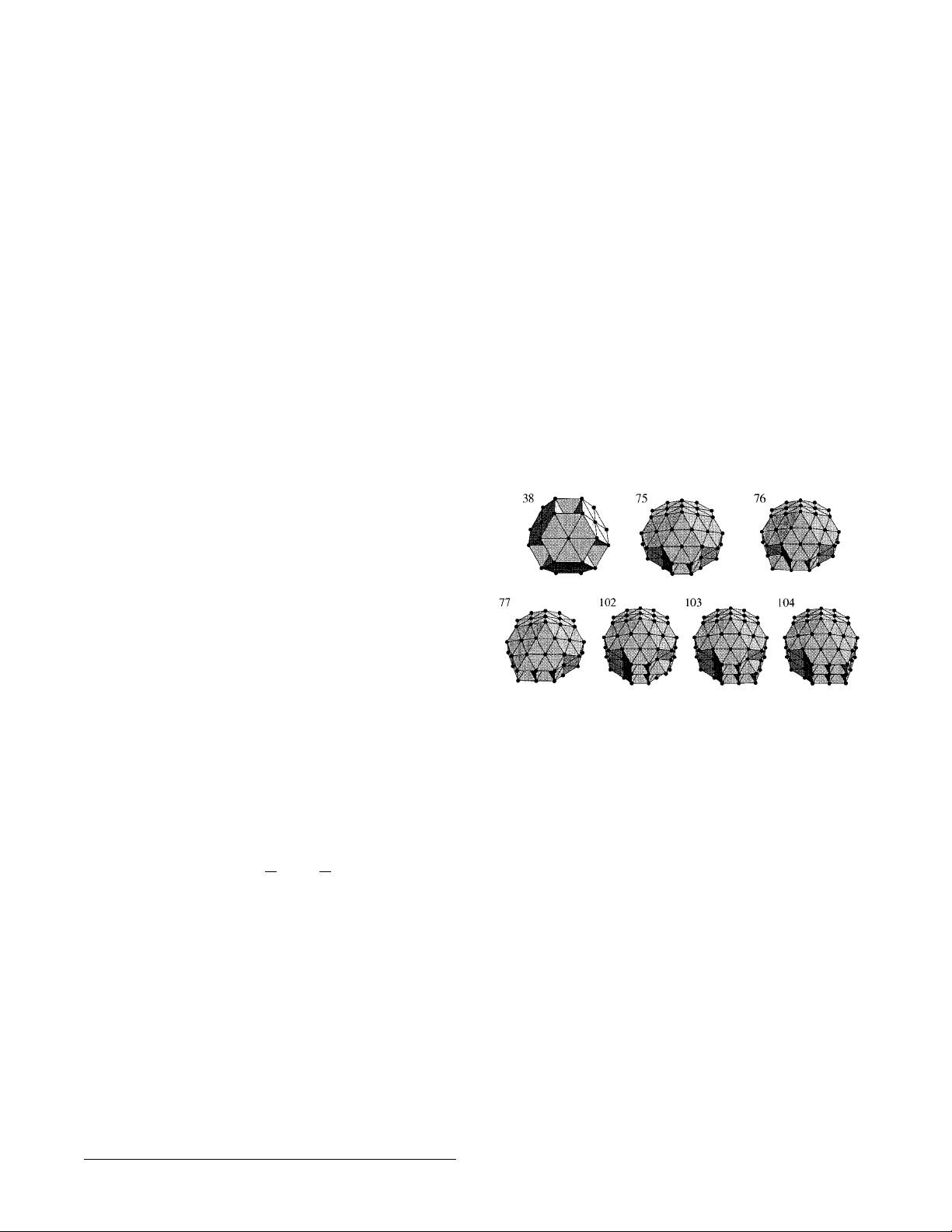
Figure 1. Nonicosahedral Lennard-Jones global minima.
5111J. Phys. Chem. A 1997, 101, 5111-5116
S1089-5639(97)00984-5 CCC: $14.00 © 1997 American Chemical Society
pf3
pf4
pf5

Pré-visualização parcial do texto

Baixe Global Optimization by Basin-Hopping and the Lowest Energy Structures of Lennard-Jones e outras Notas de estudo em PDF para Engenharia Elétrica, somente na Docsity!

Global Optimization by Basin-Hopping and the Lowest Energy Structures of Lennard-Jones

Clusters Containing up to 110 Atoms

David J. Wales*

Uni V ersity Chemical Laboratories, Lensfield Road, Cambridge CB2 1EW, U.K.

Jonathan P. K. Doye

FOM Institute for Atomic and Molecular Physics, Kruislaan 407, 1098 SJ Amsterdam, The Netherlands

Recei V ed: March 19, 1997; In Final Form: April 29, 1997 X

We describe a global optimization technique using “basin-hopping” in which the potential energy surface is

transformed into a collection of interpenetrating staircases. This method has been designed to exploit the

features that recent work suggests must be present in an energy landscape for efficient relaxation to the

global minimum. The transformation associates any point in configuration space with the local minimum

obtained by a geometry optimization started from that point, effectively removing transition state regions

from the problem. However, unlike other methods based upon hypersurface deformation, this transformation

does not change the global minimum. The lowest known structures are located for all Lennard-Jones clusters

up to 110 atoms, including a number that have never been found before in unbiased searches.

I. Introduction

Global optimization is a subject of intense current interest.^1

Improved global optimization methods could be of great

economic importance, since improved solutions to traveling

salesman-type problems, the routing of circuitry in a chip, the

active structure of a biomolecule, etc., equate to reduced costs

or improved performance. In chemical physics the interest in

efficient global optimization methods stems from the common

problem of finding the lowest energy configuration of a (macro)-

molecular system. For example, it seems likely that the native

structure of a protein is structurally related to the global

minimum of its potential energy surface (PES). If this global

minimum could be found reliably from the primary amino acid

sequence, this knowledge would provide new insight into the

nature of protein folding and save biochemists many hours in

the laboratory. Unfortunately, this goal is far from being

realized. Instead the development of global optimization

methods has usually concentrated on much simpler systems.

Lennard-Jones (LJ) clusters represent one such test system.

Here the potential is

where  and 21/6σ are the pair equilibrium well depth and

separation, respectively. We will employ reduced units, i.e., 

) σ ) 1 throughout. Much of the initial interest in LJ clusters

was motivated by a desire to calculate nucleation rates for noble

gases. However, as a result of the wealth of data generated,

the LJ potential has been used not only for studying global

optimization but also the effects of finite size on phase

transitions such as melting. Through the combined efforts of

many workers, likely candidates for the global minima of LJ N

clusters have been found up to N ) 147.^2 -^16 This represents a

significant achievement since extrapolation of Tsai and Jordan’s

comprehensive enumeration of minima for small LJ clusters^17

suggests that the PES of the 147-atom cluster possesses of the

order of 10^60 minima. 18

Previous studies have revealed that the Mackay icosahedron^19

provides the dominant structural motif for LJ clusters in the

size range of 10-150 atoms. Complete icosahedra are possible

at N ) 13, 55, 147, ... At most intermediate sizes the global

minimum consists of a Mackay icosahedron at the core covered

by a low-energy overlayer. As a consequence of the phase

behavior of LJ clusters, finding these global minima is relatively

easy. Studies have shown that in the region of the solid-liquid

transition the cluster is observed to change back and forth

between a liquid-like form and icosahedral structures.^20 As a

result of this “dynamic coexistence,” a method as crude as

molecular dynamics within the melting region coupled with

systematic minimization of configurations generated by the

trajectory is often sufficient to locate the global minimum.^21

However, there are a number of sizes at which the global

minimum is not based on an icosahedral structure. These

clusters are illustrated in Figure 1. For LJ 38 the lowest energy

structure is a face-centered-cubic (fcc) truncated octahedron,13,

and for N ) 75, 76, 77, 102, 103, and 104, geometries based

on Marks’ decahedra^22 are lowest in energy.14,15^ For these cases,

finding the lowest minimum is much harder because the global

minimum of free energy only becomes associated with the global

potential energy minimum at temperatures well below melting

where the dynamics of structural relaxation are very slow. For

LJ 38 , the microcanonical temperature for the transition from face-

centered cubic to icosahedral structures has been estimated to

X Abstract published in Ad V ance ACS Abstracts, June 15, 1997. be about 0.12 k -^1 , where k is the Boltzmann constant, and for

E ) 4 ∑

i < j [(

rij )

12

r ij )

6

]

Figure 1. Nonicosahedral Lennard-Jones global minima.

J. Phys. Chem. A 1997, 101, 5111 - 5116 5111

S1089-5639(97)00984-5 CCC: $14.00 © 1997 American Chemical Society

LJ75 the estimate for the decahedral to icosahedral transition is

about 0.09 k -^1. 23 (For comparison, melting typically occurs

at about T ) 0.2-0.3 k -^1 .)

The topography of the PES can also play a key role in

determining the ease of global optimization.^24 A detailed study

of the LJ 38 PES has shown that there is a large energy barrier

between the fcc and icosahedral structures, 25 which correspond

to well-separated regions of the PES. Furthermore, fcc and

decahedral structures have less polytetrahedral character than

icosahedral structures, and hence they have less in common with

the liquid-like state, which is characterized by disordered

polytetrahedral packing.26,27^ Since the vast majority of con-

figuration space is dominated by “liquid-like” configurations,

it is therefore harder to find global minima based upon fcc and

decahedral packing using unbiased searches.

These considerations explain why global optimization meth-

ods have only recently begun to find the truncated octahe-

dron13,16,28,29^ and why, until now, the Marks’ decahedron has

never been found by an unbiased global optimization method.

The greater difficulty of finding the LJ 75 global minimum

compared to LJ 38 can probably be explained by the slightly

smaller transition temperature, the sharper transition, 23 and the

much larger number of minima on the LJ 75 PES.

Before we consider the effectiveness of different global

optimization methods for Lennard-Jones clusters, it is interesting

to note that the use of physical principles to construct good

candidate structures for the global minima^2 - 5,8,14,15^ or to reduce

the configuration space that needs to be searched^10 -^12 led to

the initial discovery of 93% of the LJ global minima in this

size range. It seems that physical insight into a specific problem

will often be able to beat unbiased global optimization, a view

expressed by Ngo et al.^30 in their discussion of computational

complexity.

One difficulty in evaluating the relative performances of

different global optimization methods is that, too often, the

methods have only been applied to small clusters, or to larger

clusters with global minima that are especially stable, such as

LJ 55. It is also difficult to draw any firm conclusions about

how efficient different methods may be when the number of

searches employed varies widely. However, it seems reasonable

to suggest two hurdles that any putative global optimization

approach should aspire to. The first is the location of the

truncated octahedron for LJ 38 , and any method which fails this

test is unlikely to be useful. The second hurdle is the location

of the Marks’ decahedron for LJ 75 ; this problem poses a much

more severe test for an unbiased search and one which does

not appear to have been passed until the present work.

The most successful global optimization results for LJ clusters

reported to date are for genetic algorithms.16,28,31,32^ These

methods mimic some aspects of biological evolution: a popula-

tion of clusters evolves to low energy by mutation and mating

of structures, along with selection of those with low potential

energy. To be successful, new configurations produced by

“genetic manipulation” are mapped onto minima by a local

optimization algorithm such as the conjugate gradient method.

The study by Deaven et al. is particularly impressive, since these

workers matched or beat all the lowest energy minima that they

knew of up to N ) 100, including the truncated octahedron

(although they probably missed the global minima at N ) 69

and 75-78). Niesse and Mayne were also able to locate the

LJ 38 truncated octahedron, and report that this structure took

about 25 times longer to find than the icosahedral global minima

of the neighboring sizes.

Another class of global optimization techniques, sometimes

called hypersurface deformation methods, attempts to simplify

the problem by applying a transformation to the PES which

smoothes it and reduces the number of local minima. 33,34^ The

global minimum of the deformed PES is then mapped back to

the original surface in the hope that this will lead back to the

global minimum of the original PES. The distinctions between

the various methods of this type lie in the type of transformations

that are used, which include applying the diffusion equation, 35

increasing the range of the potential13,36^ and shifting the position

of the potential minimum toward the origin.^37 The performance

of hypersurface deformation methods has been variable: Pillardy

and Piela^13 managed to find the 38-atom truncated octahedron,

but other workers report difficulties^35 for the trivial cases of

LJ 8 and LJ 9 where there are only 8 and 21 minima on the PES,

respectively.

Although intuitively appealing, the problem with hypersurface

deformation is that there is no guarantee that the global

minimum on the deformed PES will map onto the global

minimum of the original surface. This difficulty is clearly

illustrated when we consider Stillinger and Stillinger’s sugges-

tion of increasing the range of the potential: 36 it has been shown

that the global minimum may in fact depend rather sensitively

on the range of the potential, with the appearance of numerous

“range-induced” transitions.14,

Other methods include those based on “annealing”. Such

approaches take advantage of the simplification in the free

energy landscape that occurs at high temperatures and attempt

to follow the free energy global minimum as the temperature

is decreased. At 0 K, the free energy global minimum and the

global minimum of the PES must coincide. Standard simulated

annealing^39 was used by Wille to find a few new minima at

small sizes 9 but does not appear to have been systematically

applied to LJ clusters. More sophisticated variants of this

technique include gaussian density annealing and analogues,^40 -^43

but again some appear to fail at small sizes.42,

The difficulty with the annealing approach methods is that,

if the free energy global minimum changes at low temperatures

where dynamical relaxation is slow, the algorithms will become

stuck in the structure corresponding to the high temperature free

energy global minimum. Such methods are therefore likely to

experience difficulties in finding the global minima for LJ 38

and LJ 75. In the language employed in recent protein-folding

literature, 44 annealing will fail when T f < T g, where T f is the

“folding” temperature below which the global potential energy

and free energy minima coincide, and T g is the “glass”

temperature at which the system effectively becomes trapped

in a local minimum.

Another method which attempts to reduce the effects of

barriers on the PES makes use of quantum tunneling. The

diffusion Monte Carlo approach is used to find the ground state

wave function, which should become localized at the global

minimum as p is decreased to zero.^45 A more rigorous approach

has been applied by Maranas and Floudas, who found upper

and lower bounds for the energy of the global minimum.

However, the computational expense of this method, which

scales as 2 N^ with the number of atoms, means that it has only

been used for small systems. 46,47^ Most of the above studies,

along with the recently described “pivot method” 48 -^50 and

“taboo search”,51,52^ have yet to prove their usefulness by passing

the first hurdle for LJ 38 suggested above. However, this does

not necessarily mean that these approaches should be discounted,

since some authors have only applied their algorithms to smaller

clusters and may not have run enough searches to achieve

convergence.

In the present work we present the results of a “basin-

hopping” global optimization technique for Lennard-Jones

5112 J. Phys. Chem. A, Vol. 101, No. 28, 1997 Wales and Doye

minimizations were performed using the Polak-Ribiere variant

of the conjugate gradient algorithm.^54 Hence the energy at any

point in configuration space is assigned to that of the local

minimum obtained by the given geometry optimization tech-

nique, and the PES is mapped onto a set of interpenetrating

staircases with plateaus corresponding to the set of configura-

tions which lead to a given minimum after optimization. A

schematic view of the staircase topography that results from

this transformation is given in Figure 2. These plateaus, or

basins of attraction, have been visualized in previous work as

a means to compare the efficiency of different transition state

searching techniques. 55,

The energy landscape for the function E ˜ ( X ) was explored

using a canonical Monte Carlo simulation at a constant reduced

temperature of 0.8. At each step, all coordinates were displaced

by a random number in the range [-1,1] times the step size,

which was adjusted to give an acceptance ratio of 0.5. The

nature of the transformed surface allowed relatively large step

sizes of between 0.36-0.40. For each cluster in the range

considered, seven separate runs were conducted. Five of these

each consisted of 5000 Monte Carlo steps starting from different

randomly generated configurations of atoms confined to a sphere

of radius 5.5 reduced units. The subsequent geometry optimiza-

tions employed a container of radius one plus the value required

to contain the same volume per atom as the fcc primitive cell.

The container should have little effect on any of our results

and is only required to prevent dissociation during the conjugate

gradient optimizations.

The convergence criterion employed for the conjugate gradi-

ent optimizations used in the Monte Carlo moves need not be

very tight. In the present work we required the root-mean-

square (RMS) gradient to fall below 0.01 in reduced units and

the energy to change by less than 0.1  between consecutive

steps in the conjugate gradient search. Initially it appeared that

a tolerance of 0.1 for the RMS gradient was satisfactory, but

this was subsequently found to cause problems for clusters

containing more than about 60 atoms. The lowest energy

structures obtained during the canonical simulation were saved

and reoptimized with tolerances of 10-^4 and 10-^9 for the RMS

force and the energy difference, respectively. The final energies

are accurate to about six decimal places.

Several other techniques were employed in these calculations,

namely seeding, freezing and angular moves. Here we used

the pair energy per atom, E ( i ), defined as

so that the total energy is

If the highest pair energy rose above a fraction R of the lowest

pair energy then an angular move was employed for the atom

in question with all other atoms fixed. R was adjusted to give

an acceptance ratio for angular moves of 0.5 and generally

converged to between 0.40 and 0.44. Each angular displacement

consisted of choosing random θ and φ spherical polar coordi-

nates for the atom in question, taking the origin at the center of

mass and replacing the radius with the maximum value in the

cluster.

The two remaining runs for each size consisted of only 200

Monte Carlo steps starting from the global minima obtained

for the clusters containing one more and one less atom. When

starting from LJ N - 1 the N - 1 atoms were frozen for the first

100 steps, during which only angular moves were attempted

for the remaining atom, starting from a random position outside

the core. When starting from LJ N + 1 the atom with the highest

pair energy E ( i ) was removed and 200 unrestricted Monte Carlo

moves were attempted from the resulting geometry.

The above basin-hopping algorithm shares a common phi-

losophy with our previous approach in which steps were taken

directly between minima using eigenvector-following to calcu-

late pathways.^25 The latter method is similar to that described

recently by Barkema and Mousseau 57 in their search for well-

relaxed configurations in glasses. Although the computational

expense of transition state searches probably makes this method

uncompetitive for global optimization, our study illustrated the

possible advantage of working in a space in which only the

minima are present. The basin-hopping algorithm differs in that

it is applied in configuration space to a transformed surface,

rather than in a discrete space of minima, and steps are taken

stochastically. The genetic algorithms described by Deaven et

al.^16 and Niesse and Mayne^28 used conjugate gradient minimiza-

tion to refine the local minima which comprise the population

of structures that are evolved in their procedure. Hence these

authors are in effect studying the same transformed surface as

described above, but explore it in a rather different manner.

We suspect that the success of their methods is at least partly

due to the implicit use of the transformed surface E ˜.

The present approach is basically the same as the “Monte

Carlo-minimization” algorithm of Li and Scheraga,^58 who

applied it to search the conformational space of the pentapeptide

[Met^5 ]enkephalin. A similar method has recently been used

by Baysal and Meirovitch^59 to search the conformational space

of cyclic polypeptides.

III. Results

The basin-hopping algorithm has successfully located all the

lowest known minima up to LJ110, including all the nonicosa-

hedral structures illustrated in Figure 1 (sizes 38, 75, 76, 77,

102, 103, and 104) and three new geometries based upon

icosahedra illustrated in Figure 3 (sizes 69, 78, and 107). We

believe that this is the first time any of the six decahedral global

minima have been located by an unbiased algorithm. The total

number of searches was fixed in our calculations to provide a

simple reference criterion. In fact, most of the global minima

were found in more than one of the separate Monte Carlo runs.

The global minima for the smallest clusters were located within

a few steps in each of the seven runs. To give a better idea of

how the algorithm performed we will provide some more details

for the sizes with nonicosahedral or newly discovered icosa-

hedral global minima.

Figure 2. A schematic diagram illustrating the effects of our energy transformation for a one-dimensional example. The solid line is the energy of the original surface and the dashed line is the transformed energy E ˜.

E ( i ) ) 4 ∑

j * i [(

r ij )

12

r ij )

6

]

E )

i

E ( i )

5114 J. Phys. Chem. A, Vol. 101, No. 28, 1997 Wales and Doye

For LJ 38 the truncated octahedron was found in four out of

five of the longer unseeded runs; the first success occurred

within a thousand Monte Carlo steps on average. Not surpris-

ingly, the global minimum was not located in the shorter runs

starting from the structurally unrelated global minima for N )

37 and 39.

For LJ 75 the global minimum was found in just one of the

longer Monte Carlo runs, and again in the short run from the

global minimum for LJ76. However, the latter minimum was

only found in the short runs seeded from the LJ 75 and LJ 77

decahedra. Similarly, the LJ 77 global minimum was only found

in the short run seeded from the LJ 76 decahedron. The

decahedral global minimum for LJ 75 was found in four out of

100 Monte Carlo runs of 5000 steps each, a frequency which

fits in quite well with our results for LJ 75, LJ 76 , and LJ 77. A

successful run requires an initial geometry which falls within

the decahedral catchment area; all the other runs produce the

lowest icosahedral minimum after which the decahedron is not

found. It would obviously be possible to locate global minima

based upon decahedra more efficiently by biasing the starting

configuration, but our intention was to analyze the performance

of an unbiased algorithm in the present work.

The pattern for LJ 75 - LJ 77 is repeated for LJ 102 - LJ 103. For

LJ 102 the decahedral global minimum was located in one of the

longer Monte Carlo runs and in the short run seeded from the

global minimum of LJ 103. The decahedral minima for LJ 103

and LJ 104 were only found in short runs seeded from larger or

smaller decahedra. The decahedral global minimum for LJ 102

was found in three out of 100 Monte Carlo runs of 5000 steps

each.

The three new icosahedral global minima all have an atom

missing from a vertex of the underlying Mackay icosahedron

(Figure 3). This is a possibility that Northby did not consider

in his restricted search of the icosahedral configuration space.

The new LJ 69 global minimum was found in three of the five

longer Monte Carlo runs and in the short run seeded from LJ 70.

The new global minimum for LJ 78 was only found in the short

run seeded from LJ 79. The new minimum for LJ 107 was found

in one of the longer Monte Carlo runs and in the short run

seeded from LJ 108.

We also performed a few preliminary runs for LJ 192 and LJ 201 ,

sizes at which a complete Marks decahedron and a complete

truncated octahedron occcur, respectively. For LJ 192 the Marks

decahedron has energy - 1175.697 144. This structure was not

found in 50 MC runs of 10 000 steps each; instead the lowest

minimum located had an energy of - 1174.919 801. For LJ 201

the truncated octahedron has energy - 1232.731 497. However,

we located a structure of energy - 1236.124 253, which is based

upon icosahedral packing. This minimum was found in three

out of 50 MC runs of 10 000 steps each. For these larger

systems greater efficiency could probably be achieved by

varying the temperature and other parameters of the MC search.

IV. Conclusions

We have presented the results of a “basin-hopping” or “Monte

Carlo-minimization”^58 approach to global optimization for

atomic clusters bound by the Lennard-Jones potential containing

up to 110 atoms. All the lowest known minima were located

successfully, including the seven structures based upon fcc or

decahedral packing and three new global minima based upon

icosahedra. Of the latter ten structures, only the smallest has

been located before by an unbiased algorithm, to the best of

our knowledge.

The method is based upon a hypersurface deformation in

which the potential energy surface (PES) is converted into the

set of basins of attraction of all the local minima. This process

removes all the transition state regions but does not affect the

energies of the minima. On the original PES, most trajectories

that approach the boundary between two basins of attraction

are reflected back due to the high potential energy; only if the

trajectory is along a transition state valley does passage between

basins become likely. In contrast, on the transformed PES it is

feasible for the system to hop between basins at any point along

the basin boundary which dramatically reduces the time scale

for interbasin motion. We speculate that the success of a

previous genetic algorithm applied to the same clusters may be

at least partly due to the fact that the same surface is implicitly

considered in that approach.^16

The efficiency of the present approach could doubtless be

improved by combining it with various other techniques. The

most obvious shortcut would be to start not from initial random

configurations but from seeds with either decahedral, icosahe-

dral, or fcc morphologies. We have already checked that such

biasing is indeed effective, but our aim in the present paper

was to gauge the performance of the unbiased algorithm. The

temperature at which our Monte Carlo runs were conducted was

also not optimized systematically.

Finally, as we noted in the introduction, global optimization

for Lennard-Jones clusters at most sizes is a relatively easy task.

A more stringent and general test is provided by Morse clusters

which exhibit different structural behaviour as a function of the

range of the potential. 14,38^ At short range the task is particularly

difficult because the PES is very ruggedsthe number of

minima^27 and the barrier heights^60 increase as the range is

decreased.

Acknowledgment. We are grateful to the Royal Society

(D.J.W.) and the Engineering and Physical Sciences Research

Council (J.P.K.D.) for financial support.

References and Notes

(1) The magnitude of this interest can be gauged by, for example, the fact that there have been over 2600 citations of the classic simulated annealing paper by Kirkpatrick et al ., cited in ref 39. (2) Hoare, M. R.; Pal, P. Ad V_. Phys._ 1971 , 20 , 161. (3) Hoare, M. R.; Pal, P. Nature (Physical Sciences) 1971 , 230 , 5. (4) Hoare, M. R.; Pal, P. Nature (Physical Sciences) 1972 , 236 , 35. (5) Hoare, M. R.; Pal, P. Ad V_. Phys._ 1975 , 24 , 645. (6) Hoare, M. R. Ad V_. Chem. Phys._ 1979 , 40 , 49. (7) Freeman, D. L.; Doll, J. D. J. Chem. Phys. 1985 , 82 , 462. (8) Farges, J.; de Feraudy, M. F.; Raoult, B.; Torchet, G. Surf. Sci. 1985 , 156 , 370. (9) Wille, L. T. Chem. Phys. Lett. 1987 , 133 , 405. (10) Northby, J. A. J. Chem. Phys. 1987 , 87 , 6166.

Figure 3. Lennard-Jones global minima that have not previously been reported.

TABLE 2: Lowest Energy Icosahedral Minima at Sizes with

Nonicosahedral Global Minima

N point group energy/ ref

38 C (^) 5v - 173.252 378 16 75 C 1 - 396.282 249 14 76 C 1 - 402.384 580 12 77 C 1 - 408.518 265 12 102 C (^) s - 569.277 721 10 103 C 1 - 575.658 879 10 104 C (^) s - 582.038 429 10

Lowest Energy Structures of Lennard-Jones Clusters J. Phys. Chem. A, Vol. 101, No. 28, 1997 5115